
We use cookies on our website to give you an improved browser experience. View our Privacy Policy for more information. Please make your selection to opt in or out of ALL cookies here: Accept or Decline
Puff Ink For Screen Printing can turn a flat cotton tee into a raised, tactile design. The effect looks simple on a product page. On press, it depends on ink formulation, mesh choice, deposit thickness, and careful curing. A small change in any of these can leave the print soft, uneven, or under-expanded.
For this guide, fictional screen-printing specialist Dana Mercer offers an illustrative shop-floor reminder: “A clean puff starts with a controlled deposit, not a hotter dryer.” That is a practical principle, not a verified quotation from a real industry expert. Test prints remain essential. Check the ink’s technical data sheet, then run a sample on the actual garment. Watch how the surface rises after curing. Feel the print once it cools. Does it stay flexible? Does the texture look consistent across the design?
The 10 suppliers featured in this overview can help printers compare product options, support, and application guidance. Look beyond price. Ask about recommended mesh counts, curing conditions, available colors, and compatibility with your fabric. Supplier advice matters, but it should be confirmed through testing on your own press. One detail is easy to miss: a dramatic puff on a sample may not behave the same way on a production run. That deserves a second look.
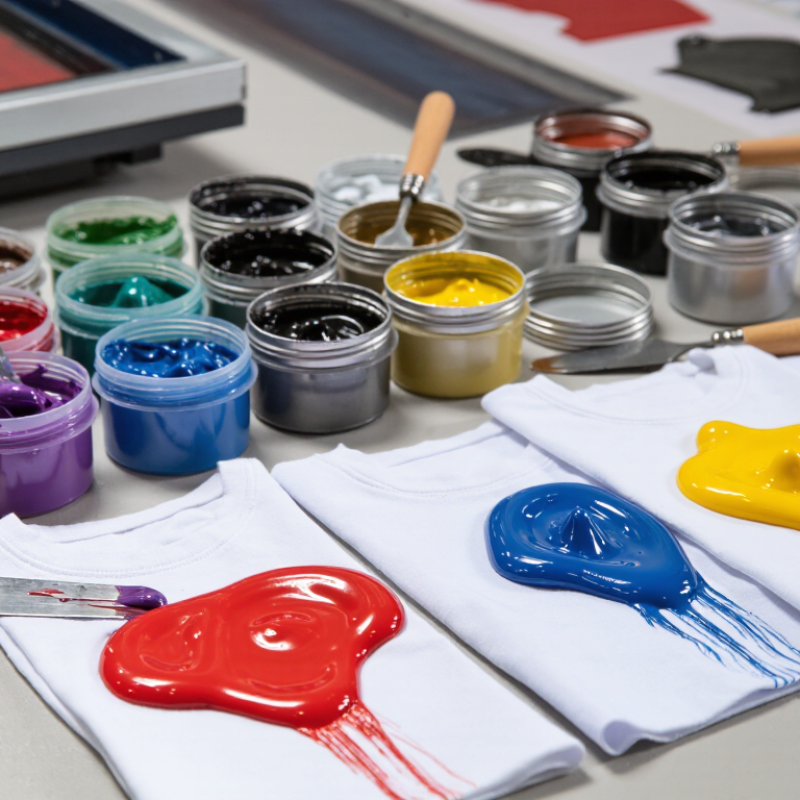
Puff ink rises when heat activates a blowing agent inside the ink film. Tiny gas bubbles form, lifting the printed layer into a soft, raised surface. The effect depends on ink deposit, drying, fabric, and curing temperature—not heat alone. A thick screen deposit may look dramatic, but excessive heat can flatten the foam or leave a brittle, uneven print. On press, check the center and edges of the design; they may expand differently.
Substrate choice matters. Textile Exchange’s 2023 Materials Market Report says polyester made up 57% of global fiber production in 2022, so printers often encounter synthetic blends that respond differently from cotton during curing. Test the actual garment, not just a fabric swatch. Use a temperature probe to verify the ink film’s cure conditions, then wash-test the print and inspect its height and hand feel. Small trials help. Puff is not perfectly predictable; humidity, mesh, and squeegee pressure can shift the result. Keep notes on each setup, and accept that one test may still miss the final garment’s behavior.
An 86–110 mesh screen is a practical starting point for many puff inks. Its relatively open weave can pass the heavier ink deposit needed to build texture. A 110 mesh may give finer detail, while 86 mesh can lay down more ink. The right choice depends on the ink’s particle size, artwork, and desired rise. Check the product’s technical sheet before setting up; “puff ink” is not one uniform formula.
Deposit matters as much as mesh. Use a stencil thickness suited to the product, then make a small test print on the actual fabric. A steady squeegee pass helps avoid uneven patches. Too little ink may produce a weak rise. Too much can blur edges or cure unevenly. Watch the printed surface after curing, not just while it is wet. Measure the cure temperature at the ink film, and follow the supplier’s stated time and temperature range.
Ask suppliers for mesh recommendations, stencil guidance, and curing instructions specific to the ink you plan to use. Request a sample if possible. Print a few swatches, noting the mesh, pass count, and fabric. Small changes can alter the hand and height. I have found that a clean-looking test is not always the most durable one, so wash testing is worth the extra time. Even then, results may vary with fabric and shop conditions.
| Puff Ink Type or Application | Suitable Substrate | Starting Mesh Range | Deposit Approach | Key Selection Check | Practical Note |
|---|---|---|---|---|---|
| Standard plastisol puff | Cotton and compatible cotton-rich garments | 86–110 threads per inch | Use a controlled, even deposit; test one print stroke before production. | Confirm the ink’s expansion behavior and cure requirements in its technical data sheet. | A common starting point for raised lettering and simple graphics. |
| High-expansion plastisol puff | Cotton garments where a more pronounced raised effect is desired | 86–110 threads per inch | Begin with a moderate deposit and adjust only after a cured test print. | Check expansion consistency, surface texture, and compatibility with the garment. | A larger deposit does not automatically produce a cleaner or more durable result. |
| Low-expansion plastisol puff | Cotton and cotton-rich apparel with fine raised details | 86–110 threads per inch | Favor a neat, controlled deposit for smaller shapes and lettering. | Verify that the finished height and edge definition meet the artwork requirements. | Useful when a subtle relief is preferred over a tall, highly textured print. |
| Opaque puff for dark garments | Dark cotton or cotton-rich garments | 86–110 threads per inch | Test coverage and puff development on the actual garment color. | Check opacity, dye migration risk, and the ink maker’s recommended cure process. | A test print helps reveal whether an underbase or garment-specific adjustment is needed. |
| Color-matched puff print | Light or dark cotton garments | 86–110 threads per inch | Keep the deposit consistent across the printed area to reduce visible variation. | Assess the cured color, surface appearance, and expansion after printing. | Puffing can change how a color appears; judge color from a cured sample. |
| Puff accent over a flat print | Cotton apparel with both raised and non-raised graphic elements | 86–110 threads per inch for the puff screen | Apply puff only to designated artwork areas; keep neighboring flat details separate. | Check registration and the sequence recommended for the ink system. | A separate screen helps control where the raised effect appears. |
| Large solid-area puff graphic | Cotton or compatible cotton-rich garments | 86–110 threads per inch | Use an even deposit and inspect the cured print for uniform expansion. | Evaluate hand feel, edge quality, and flexibility on the intended garment. | Large areas can behave differently from small details; test the full artwork size. |
| Fine-detail puff graphic | Cotton garments with bold lettering or simplified shapes | 86–110 threads per inch | Keep artwork shapes open and avoid relying on very narrow gaps or strokes. | Review a cured sample for detail fill-in and legibility. | Raised ink can soften small details, so artwork and deposit should be evaluated together. |
| Puff print on a cotton-polyester blend | Blended garments, subject to ink-system compatibility | 86–110 threads per inch | Start with a controlled deposit and test on the exact fabric blend. | Confirm suitability for the fiber blend, dye migration precautions, and cure instructions. | Blend composition and garment dye can affect results; do not assume all blends behave alike. |
| Water-based puff system | Fabric types specifically approved by the ink supplier | 86–110 threads per inch as an initial trial range | Follow the system’s guidance for deposit, screen setup, and drying. | Confirm substrate compatibility, drying behavior, and the complete cure method. | Water-based formulations vary; use the product-specific technical data sheet rather than plastisol settings. |
A puff print can look fully raised while its ink film remains under-cured. Do not assume every supplier’s ink cures at the same temperature or dwell time. Request the technical data sheet and confirm whether its temperature refers to the ink film, dryer setting, or another measurement point. These are not interchangeable. Use a calibrated probe to check the printed surface, then record belt speed and the measured temperature for each test run. Small changes matter.
Ask each supplier for a stated cure window, test method, and guidance for your fabric and ink deposit. Treat a suggested setting as a starting point, not a guarantee. AATCC TM135, a standard method for measuring fabric dimensional change after laundering, includes evaluation after repeated wash cycles. Use it as one durability check, alongside stretch and adhesion tests. Wash samples only after they have cooled and conditioned consistently. Compare puff height and cracking under the same conditions. I have seen a print pass a quick touch test, then lose definition after washing. That result is easy to miss. Keep a sample from every supplier and document the actual curing conditions, even when the production schedule feels rushed.
Puff ink suppliers differ in how their formulas expand under heat. Some produce a soft, rounded surface; others create a firmer, taller texture. Ask for a cured sample, not just a wet swatch. Check the printed surface under angled light, then rub it gently after cooling. Small differences can matter on a large run.
Substrate range needs a practical test. Cotton, cotton blends, and some polyester fabrics may respond differently to the same ink. A supplier should explain recommended mesh, deposit, flash conditions, and curing guidance for each fabric type. If those details are vague, request a small production-style trial. Keep the print area consistent. That part is easy to overlook.
Support is more than answering emails. Useful guidance includes troubleshooting uneven expansion, pinholes, or a rough hand feel, with clear adjustments to test. Ask whether technical staff can review your fabric, equipment, and target finish. No supplier can guarantee identical results across every press and garment. Still, responsive support and documented instructions make problems easier to diagnose, even when the first test misses the mark.
A supplier’s sample can look convincing under bright showroom lights. Request test prints on the fabric you actually plan to use, such as cotton jersey or a polyester blend. Keep the screen, deposit, and curing settings consistent across samples. Record the puff height, edge definition, and any pinholes after printing. Small details matter.
Wash testing reveals problems a fresh print can hide. Wash several samples using the care conditions your customers are likely to follow, then inspect them after repeated cycles. Look for cracking, flattening, color loss, or ink lifting at the edges. Let the fabric cool fully before judging the raised texture; handling it warm can give a misleading impression. A single wash is not enough.
Ask suppliers for current safety data sheets and relevant compliance documents for the specific ink formulation. Check that document names, dates, and product details match the sample being evaluated. If information is unclear, request written clarification rather than relying on a verbal assurance. Keep the records with your test notes. This takes extra time, and it can feel overly cautious, but supplier paperwork and print performance should support each other. A neat sample alone proves little.
A practical supplier assessment framework based on test prints, wash testing, and compliance documentation.
Recommended evaluation weights, not results from a supplier survey: test-print quality carries 40%, wash-test performance 35%, and compliance documentation 25%. Compare suppliers using the same fabric, print setup, curing conditions, and wash-test method; verify applicable documents for your market and intended use.
We use cookies on our website to give you an improved browser experience. View our Privacy Policy for more information. Please make your selection to opt in or out of ALL cookies here: Accept or Decline
Do you consent to the use of ALL cookies?
901 2nd Court West
Birmingham, AL 35204
Sales: 866.481.4036
Logistics/Ops: 866.481.4036
2101 Dralle Road
University Park, IL 60466
Sales: 708.813.9070
Logistics/Ops: 708.235.4200
400 E. 13th Street
Little Rock, AR 72114
Sales: 866.760.5344
Logistics/Ops: 866.760.5344
225 Collins Road
Elkhart, IN 46515
Sales: 574.295.0214
Logistics/Ops: 574.607.4611
601 Berryman Pike
Tipton, IN 46072
Sales: 800.897.7591
Logistics/Ops: 800.897.7591
3900 Uvalda Street
Denver, CO 80239
Sales: 303.706.8000
Ops/Logistics: 303.576.8398
510 3rd Street E
Milan, IL 61264
Sales: 800.322.1052
Logistics/Ops: 800.322.1052
1660 E. Aurora
Des Moines, IA 50313
Sales: 800.671.1660
Logistics: 800.671.1660
86554 Gene Lasserre Blvd.
Yulee, FL 32097
Sales: 904.253.3060
Logistics/Ops: 904.225.3000
694 S.E. County Road 245
Lake City, FL 32025
Sales: 800.727.6706
Logistics/Ops: 386.752.7412
210 Neptune Road
Auburndale, FL 33823
Sales: 863.967.1131
Logistics/Ops: 863.777.9814
4601 McCoy Drive
Pensacola, FL 32503
Sales: 850.308.7030
Logistics/Ops: 850.434.5502
815 South 56th Street
Tampa, FL 33619
Sales: 813.302.1940
Logistics/Ops: 813.621.1352
200 Hosea Road
Lawrenceville, GA 30046
Sales: 770.953.7575
Logistics/Ops: 770.513.6000
Branch Product Guide
Branch Line Card
Moulding Offering
Cedar Offering
Column Offering
8173 Hwy. 165 North
Monroe, LA 71211
Sales: 800.256.4165
Logistics/Ops: 800.256.4165
508 Warren Avenue
Portland, ME 04103
Sales: 207.888.2331
Logistics/Ops: 207.797.6565
4300 Georgia Pacific Blvd.
Frederick, MD 21704
Sales: 301.798.7474
Logistics/Ops: 301.874.8000
419 Maple Street
Bellingham, MA 02019
Sales: 508.449.0535
Logistics/Ops: 508.966.5500
825 Buchanan Ave SW
Grand Rapids, MI 49507
Sales: 877.800.1180
Logistics/Ops: 616.278.0909
995 Pacific St. NW
Aitkin, MN 56431
Sales: 800.432.3727
Logistics/Ops: 218.212.7770
1102 Port Terminal Drive
Duluth, MN 55802
Sales: 800.951.9899
Logistics/Ops: 800.851.9899
9110 83rd Ave. North
Brooklyn Park, MN 55445
Sales: 763.425.0204
Logistics/Ops: 763.425.0204
910 E. Railroad Street
Long Beach, MS 39560
Sales: 866.535.4135
Logistics/Ops: 228.205.2400
1727 Warren Street
North Kansas City, MO 64116
Sales: 800.621.2611
Logistics/Ops: 800.621.2611
2123 North Golden
Springfield, MO 65803
Sales: 800.375.7891
Logistics/Ops: 800.375.7891
13860 Corp. Woods Trail
Bridgeton, MO 63044
Sales: 314.209.0800
Logistics/Ops: 314.209.0800
1109 South 19th Street
Omaha, NE 68108
Sales: 800.489.6637
Logistics/Ops: 800.489.6637
1 Luger Road
Denville, NJ 07834
Sales: 973-339-3539
Logistics/Ops: 973.625.1461
3720 Jeffrey Blvd.
Blasdell, NY 14219
Sales: 716.235.5989
Logistics/Ops: 716.825.6557
319 Yaphank Ave.
Yaphank, NY 11980
Sales: 631.358.5714
Logistics/Ops: 631.924.7401
3300 Parkside Drive
Charlotte, NC 28208
Sales: 800.839.2588
Logistics/Ops: 704.394.3172
1712 East D Street
Butner, NC 27509
Sales: 984.389.8200
Logistics/Ops: 919.575.3700
128 Foothills Drive
Statesville, NC 28687
Sales: 800.222.1414
Logistics/Ops: 704.394.3172
550 Munroe Falls Rd.
Tallmadge, OH 44278
Sales: 330.357.4506
Logistics/Ops: 330.794.1141
10347 Toebben Dr.
Independence, KY 41051
Sales: 859.298.3926
Logistics/Ops: 859.746.2250
450 N. MacArthur
Oklahoma City, OK 73127
Sales: 800.375.6025
Logistics/Ops: 800.375.6025
1680 North Aspen
Broken Arrow, OK 74012
Sales: 918.272.2212
Logistics/Ops: 918.272.2212
522 Bridge Street
Hunker, PA 15639
Sales: 878.217.2001
Logistics/Ops: 724.925.7285
4290 Atlanta Street
Charleston, SC 29418
Sales: 843.371.1420
Logistics/Ops: 843.554.8192
1040 S. Industrial Dr.
Erwin, TN 37650
Sales: 423.641.1005
Logistics/Ops: 423.742.5911
4287 Pilot Drive
Memphis, TN 38118
Sales: 901.365.2101
Logistics/Ops: 901.365.2101
700 Myatt Drive
Madison, TN 37115
Sales: 615.327.9547
Logistics/Ops: 629.777.4949
4747 Mark IV Parkway
Fort Worth, TX 76106
Sales: 866.323.5117
Logistics/Ops: 817.625.9091
6990 Market Avenue
El Paso, TX 79915
Sales: 915.778.6356
Logistics/Ops: 915.265.7200
2502 Wilson Road
Harlingen, TX 78552
Sales: 800.580.6711
Logistics/Ops: 800.580.6711
10,000 North Loop East
Houston, TX 77029
Sales: 713.921.1977
Logistics/Ops: 713.675.3544
702 East 44th St.
Lubbock, TX 79404
Sales: 866.454.6010
Logistics/Ops: 866.454.6010
535 N. WW White Road
San Antonio, TX 78219
Sales: 800.284.0488
Logistics/Ops: 210.333.8112
142 Pine Haven Shores Rd.
Shelburne, VT 05482
Sales: 802.800.2540
Logistics/Ops: 802.985.2512
4700 Bethlehem Road,
Richmond, VA 23230
Sales: 804.201.2400
Logistics/Ops: 804.342.1161
4516 N Barker Road
Spokane Valley, WA 99027
Phone: 509.892.9420
Toll free: 800.728.6157
8365 N. 76th Street
Milwaukee, WI 53223
Sales: 800.356.9245
Logistics/Ops: 800.356.9245
312 S. Chester Street
Sparta, WI 54656
Sales: 800.362.5864
Logistics/Ops: 800.362.5864
899 Grossman Drive
Schofield, WI 54476
Sales: 800.472.0017
Logistics/Ops: 800.472.0017
