
We use cookies on our website to give you an improved browser experience. View our Privacy Policy for more information. Please make your selection to opt in or out of ALL cookies here: Accept or Decline
Choosing the right machine in 2026 requires more than comparing speed, price, and catalog photos. Global buyers need equipment that matches fin geometry, alloy behavior, production volume, and local service conditions. An Aluminum Fin Press Machine can shape delicate fins accurately, but its value depends on repeatability, tooling quality, and operator control. Small errors can cause uneven spacing, cracked edges, or rejected heat exchanger assemblies. Those details matter on the factory floor.
This introduction will examine major Aluminum Fin Press Machine types available to international manufacturers. It will consider mechanical, hydraulic, servo-driven, and customized configurations. Each type offers different benefits for speed, force control, energy use, maintenance, and expansion. Buyers should also review stroke length, die compatibility, feeding accuracy, safety systems, and spare-part availability. A machine may appear efficient during a demonstration. Real performance can change with thicker aluminum sheets, frequent die changes, or inexperienced operators.
Practical experience often reveals limitations that specifications hide. Service response times can matter as much as rated capacity. Supplier testing records, installation support, and training deserve careful attention. Certification requirements may also differ between markets, so technical documents should be verified before purchase. Not every recommendation fits every factory. Some conclusions remain conditional because production data is often incomplete. That uncertainty should be stated clearly, not disguised with impressive numbers. The following guide offers a balanced framework for comparing machine types, reducing avoidable costs, and selecting dependable equipment for long-term aluminum fin production.
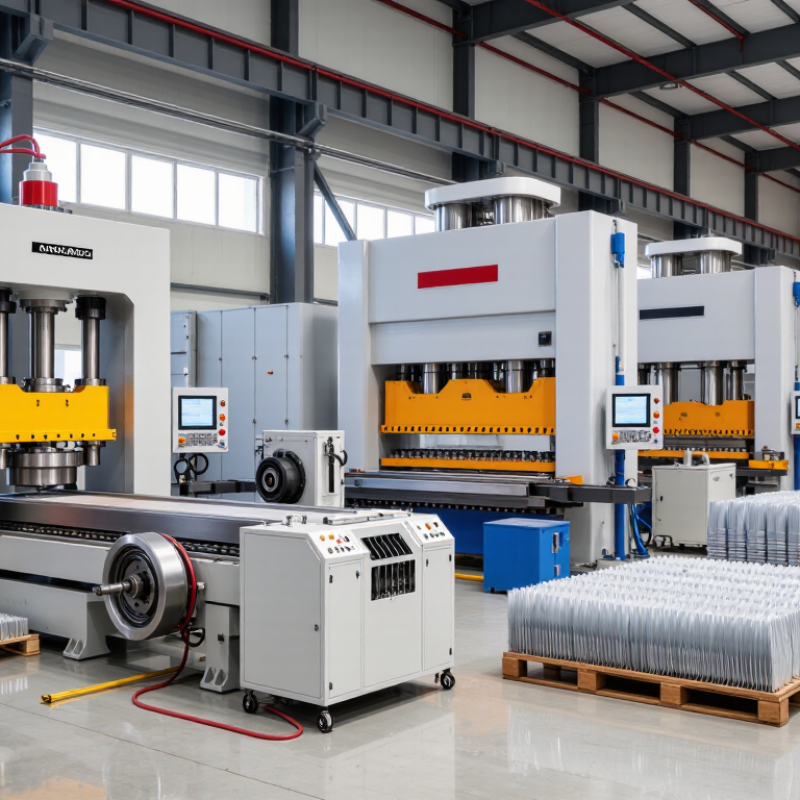
An aluminum fin press machine forms thin aluminum sheets into repeated fins for heat exchangers, radiators, and cooling coils. It uses a shaped punch and die to create louvers, collars, or corrugated profiles. The machine does not simply cut metal. It controls feeding, pressing, forming, and strip movement as one coordinated process.
A typical line includes a decoiler, straightener, servo feeder, press unit, and collection system. The decoiler releases the aluminum coil at a controlled speed. Rollers remove coil memory and flatten the strip. The feeder then advances a precise length before each stroke.
Inside the press, forming tools shape the fin geometry. Small errors matter. A slight pitch change can reduce airflow or complicate assembly.
Common 2026 configurations include high-speed stamping presses, multi-station fin presses, and flexible servo-driven models. High-speed machines suit stable, large-volume production. Multi-station systems perform several forming steps within one cycle. Servo models offer better control for varied fin heights and materials.
In practice, the first setup is rarely perfect. Operators may adjust feed length, tool clearance, and lubrication after inspecting several samples. Burrs, uneven collars, and wrinkled edges often reveal poor alignment rather than defective aluminum.
Experienced technicians check fin pitch with gauges and inspect the strip under consistent lighting. Machine speed helps, but repeatable accuracy matters more.
Aluminum fin press machines are mainly classified by how the strip changes shape. In factory evaluations, I usually separate them into stamping, progressive forming, and roll forming systems. Each method leaves different marks on production speed, fin geometry, and tooling cost.
Stamping presses use a punch and die to cut, pierce, or shape aluminum sheet. They suit flat fins, simple louvers, and moderate production volumes. Progressive presses perform several operations in one tool. The strip advances through stations, while cutting, drawing, and louvering happen in sequence. This method supports complex fins and high output. Roll forming uses paired rollers to create continuous waves or corrugations. It offers stable feeding and less interrupted production, but it may struggle with deep, irregular shapes. Some suppliers use hybrid lines, combining rolling and pressing. Classification can become less clear there.
Tips: Check the forming method against alloy temper, strip thickness, fin pitch, and target speed. Ask for sample parts, measured burr height, and repeatability data. A machine that looks fast may waste material during setup. I have seen buyers focus on strokes per minute and overlook die changes, feeding accuracy, and maintenance access. That mistake is understandable, but expensive. Run a realistic trial before approving the final configuration.
Choosing the right aluminum fin press machine depends on fin geometry, material thickness, and production volume. Different designs need different forming control.
For flat plate fins, a single-station mechanical press can suit small batches and frequent design changes. It offers simpler tooling and easier access for adjustments. Short runs matter.
Louvered and wavy fins usually require a high-speed press with accurate coil feeding. These machines maintain consistent pitch across long production cycles. A progressive die press is suitable for large quantities because it combines piercing, forming, and cutting in one sequence. However, complex dies cost more and require skilled maintenance.
For serrated, offset, or perforated fins, multi-station systems provide better control over each forming step. Servo feeding can improve positioning accuracy, especially when fin spacing is narrow. Production teams should check strip width, tensile strength, burr limits, and die-change time before purchase. A machine that handles thick aluminum may not perform well with thin foil.
From factory trials, unstable feeding often causes more waste than slow pressing speed. The first sample run may reveal springback, uneven louvers, or damaged edges. That result is useful, not embarrassing. Buyers should request measured samples under real material conditions, rather than trusting brochure capacity alone. Small manufacturers may prefer flexible presses, while high-volume plants need uptime, automation, and repeatable tolerances.#+#+#+#+
Indicative production-speed ranges help match machine types with fin designs and production scales. Mechanical and servo presses generally suit high-volume stamping, while pneumatic and hydraulic systems are better for flexible, lower-volume or heavier forming applications. Actual output depends on fin height, material thickness, pitch, tooling, stroke length and automation.
Global buyers should compare aluminum fin press machines by process results, not headline tonnage. The International Aluminium Institute reported about 70 million tonnes of primary aluminum production in 2023, showing the scale of pressure on efficient forming equipment. Check rated force, stroke length, ram speed, feed accuracy, and coil-width range. A practical machine should maintain stable pitch at high speed, even when thin aluminum strips flex or vary slightly. Speed is not everything.
Servo feeding can reduce pitch errors and support quick product changes. Ask for measured repeatability, not only brochure claims. A reasonable evaluation includes sample trials, dimensional inspection, noise readings, and energy consumption per finished meter. The U.S. Department of Energy’s industrial efficiency guidance emphasizes measuring equipment performance under actual operating conditions. That detail matters. Also compare die-change time, lubrication control, access for cleaning, and spare-part availability. Safety systems should align with ISO 12100 and applicable electrical safety requirements. Remote monitoring is useful, but poor sensors create misleading data. I would request at least three months of production records before trusting digital dashboards. A buyer should also inspect guarding, emergency stops, overload protection, and maintenance access. The best machine is rarely the fastest one; it is the one that keeps fin geometry consistent during long, ordinary shifts.
| Machine Type | Working Principle | Typical Production Speed | Typical Aluminum Strip Thickness | Typical Strip Width Range | Stroke / Feed Control | Dimensional Repeatability | Energy and Drive Characteristics | Best-Suited Fin Products | Key Advantages | Limitations to Compare |
|---|---|---|---|---|---|---|---|---|---|---|
| High-Speed Mechanical Fin Press | Motor-driven crankshaft or eccentric mechanism converts rotary motion into a fixed reciprocating slide motion. | Approximately 300–800 strokes/min | About 0.08–0.30 mm | 100–600 mm | Fixed or adjustable stroke; mechanical roll feeder or servo feeder is commonly used. | Generally suitable for stable, high-volume production when tooling, feeder alignment, and material quality are well controlled. | High installed power and efficient operation at full production speed; flywheel and clutch-brake condition are important. | Flat fins, louvered fins, wavy fins, and high-volume HVAC or automotive heat-exchanger fins. | High output Proven structure Lower cost per part | Less flexible for frequent changes in stroke profile; shock, noise, vibration, and clutch-brake maintenance must be assessed. |
| Servo-Driven Fin Press | A programmable servo motor directly controls slide position, speed, dwell, and motion profile. | Approximately 150–600 strokes/min | About 0.08–0.40 mm | 100–800 mm | Fully programmable stroke and feed synchronization; electronic cam profiles are available on advanced systems. | High repeatability, especially during short production runs, variable-pitch forming, and controlled forming zones. | Regenerative braking and variable-speed operation can reduce energy use during idle or low-load periods. | Variable-pitch fins, delicate louvered fins, multi-specification production, and applications requiring controlled forming. | Flexible motion control Lower setup waste Reduced mechanical shock | Higher initial investment; drive system, encoder, software, and servo motor support should be verified for local serviceability. |
| Hydraulic Fin Press | Hydraulic cylinders generate slide force through a pump, valve system, and controlled hydraulic circuit. | Approximately 20–100 strokes/min | About 0.15–1.00 mm | 200–1,200 mm | Adjustable stroke, pressure, speed, and dwell time; programmable control is commonly available. | Good force control and overload protection; final fin accuracy depends strongly on hydraulic stability and tooling condition. | Higher idle energy consumption is possible; hydraulic oil temperature, leakage prevention, and filtration are key considerations. | Thicker aluminum parts, low-to-medium volume production, large fin blanks, and forming operations requiring high force. | High forming force Adjustable pressure Overload protection | Lower production speed, possible oil leakage, more heat generation, and higher maintenance requirements than a basic mechanical press. |
| Progressive-Die Fin Press Line | A continuous strip passes through multiple die stations for piercing, louvering, forming, cutting, and other sequential operations. | Approximately 200–700 strokes/min | About 0.08–0.35 mm | 100–500 mm | Servo roll feed with automatic pitch control; die stations determine the complete forming sequence. | High part-to-part consistency when strip tension, die clearance, feed pitch, and press rigidity are properly controlled. | Efficient for continuous production; material utilization depends on strip layout and scrap management. | High-volume louvered, slit, pierced, and formed fins produced from coil stock. | Integrated operations High automation Consistent output | Die design and maintenance are complex; a tooling change may require significant time and skilled technicians. |
| Multi-Row or Multi-Lane Fin Press | Two or more fin lanes are formed simultaneously using shared or individually adjustable tooling and feeding systems. | Approximately 200–600 strokes/min | About 0.08–0.30 mm | 300–1,200 mm total working width | Multi-lane servo feed or synchronized mechanical feed; lane spacing and pitch should be adjustable. | Good productivity with consistent lane-to-lane quality when the press frame and feeder are sufficiently rigid. | Higher throughput per press footprint; power demand increases with the number of active lanes and forming load. | High-volume heat-exchanger cores requiring repeated fin widths, multiple lanes, or parallel production. | High area productivity Reduced floor space Parallel production | More complicated setup and alignment; one tooling problem can affect several lanes at the same time. |
| Cut-to-Length and Fin Forming Press Line | Coil material is uncoiled, straightened, cut or indexed, and formed into individual fin plates or segmented fin components. | Approximately 30–200 cycles/min | About 0.15–0.80 mm | 200–1,500 mm | Servo indexing with programmable blank length, feed pitch, and forming sequence. | Suitable for accurate blank length and repeatable formed geometry when straightening and cutting systems are correctly calibrated. | Energy consumption varies by cutting, forming, and material-handling equipment; line integration affects total efficiency. | Plate fins, segmented fins, thicker fins, and products that cannot be made efficiently by continuous high-speed stamping. | Flexible blank sizes Suitable for thicker stock Integrated handling | Usually slower than continuous strip stamping; line length, material handling, and changeover requirements can be greater. |
For global buyers, selecting an aluminum fin press machine means comparing more than stroke, speed, and tonnage. Progressive, high-speed, and servo-assisted presses suit different fin geometries and production volumes. A supplier should explain why one type fits your material thickness, coil width, and tolerance targets. Ask for sample parts, measured flatness, burr photos, and a recorded cycle test. Ask for evidence.
Supplier evaluation should begin with traceable engineering records, not polished brochures. Review machine drawings, component specifications, inspection procedures, and technician training records. An on-site audit can reveal poor guarding, improvised wiring, weak lubrication practices, or limited spare-part control. Request factory acceptance testing with your actual aluminum alloy and tooling. The results should include repeatability data, noise readings, emergency-stop checks, and an operator training log. Compliance documents must match the delivered machine, including risk assessments, electrical diagrams, manuals, and destination-market declarations. Documents can be copied.
Total operating cost often hides inside tooling changes, coil scrap, electricity, compressed air, maintenance, and unplanned downtime. Compare five-year costs using realistic shift hours and local utility rates. Include die refurbishment, software updates, technician travel, and disposal of worn components. A faster press may waste more metal if feeding is unstable. That trade-off matters. I would request references from buyers running similar fin profiles, though reference checks can be incomplete. One missed question remains: who owns process knowledge when production problems appear? Put response times, training scope, warranty limits, and spare-part availability into the contract.
We use cookies on our website to give you an improved browser experience. View our Privacy Policy for more information. Please make your selection to opt in or out of ALL cookies here: Accept or Decline
Do you consent to the use of ALL cookies?
901 2nd Court West
Birmingham, AL 35204
Sales: 866.481.4036
Logistics/Ops: 866.481.4036
2101 Dralle Road
University Park, IL 60466
Sales: 708.813.9070
Logistics/Ops: 708.235.4200
400 E. 13th Street
Little Rock, AR 72114
Sales: 866.760.5344
Logistics/Ops: 866.760.5344
225 Collins Road
Elkhart, IN 46515
Sales: 574.295.0214
Logistics/Ops: 574.607.4611
601 Berryman Pike
Tipton, IN 46072
Sales: 800.897.7591
Logistics/Ops: 800.897.7591
3900 Uvalda Street
Denver, CO 80239
Sales: 303.706.8000
Ops/Logistics: 303.576.8398
510 3rd Street E
Milan, IL 61264
Sales: 800.322.1052
Logistics/Ops: 800.322.1052
1660 E. Aurora
Des Moines, IA 50313
Sales: 800.671.1660
Logistics: 800.671.1660
86554 Gene Lasserre Blvd.
Yulee, FL 32097
Sales: 904.253.3060
Logistics/Ops: 904.225.3000
694 S.E. County Road 245
Lake City, FL 32025
Sales: 800.727.6706
Logistics/Ops: 386.752.7412
210 Neptune Road
Auburndale, FL 33823
Sales: 863.967.1131
Logistics/Ops: 863.777.9814
4601 McCoy Drive
Pensacola, FL 32503
Sales: 850.308.7030
Logistics/Ops: 850.434.5502
815 South 56th Street
Tampa, FL 33619
Sales: 813.302.1940
Logistics/Ops: 813.621.1352
200 Hosea Road
Lawrenceville, GA 30046
Sales: 770.953.7575
Logistics/Ops: 770.513.6000
Branch Product Guide
Branch Line Card
Moulding Offering
Cedar Offering
Column Offering
8173 Hwy. 165 North
Monroe, LA 71211
Sales: 800.256.4165
Logistics/Ops: 800.256.4165
508 Warren Avenue
Portland, ME 04103
Sales: 207.888.2331
Logistics/Ops: 207.797.6565
4300 Georgia Pacific Blvd.
Frederick, MD 21704
Sales: 301.798.7474
Logistics/Ops: 301.874.8000
419 Maple Street
Bellingham, MA 02019
Sales: 508.449.0535
Logistics/Ops: 508.966.5500
825 Buchanan Ave SW
Grand Rapids, MI 49507
Sales: 877.800.1180
Logistics/Ops: 616.278.0909
995 Pacific St. NW
Aitkin, MN 56431
Sales: 800.432.3727
Logistics/Ops: 218.212.7770
1102 Port Terminal Drive
Duluth, MN 55802
Sales: 800.951.9899
Logistics/Ops: 800.851.9899
9110 83rd Ave. North
Brooklyn Park, MN 55445
Sales: 763.425.0204
Logistics/Ops: 763.425.0204
910 E. Railroad Street
Long Beach, MS 39560
Sales: 866.535.4135
Logistics/Ops: 228.205.2400
1727 Warren Street
North Kansas City, MO 64116
Sales: 800.621.2611
Logistics/Ops: 800.621.2611
2123 North Golden
Springfield, MO 65803
Sales: 800.375.7891
Logistics/Ops: 800.375.7891
13860 Corp. Woods Trail
Bridgeton, MO 63044
Sales: 314.209.0800
Logistics/Ops: 314.209.0800
1109 South 19th Street
Omaha, NE 68108
Sales: 800.489.6637
Logistics/Ops: 800.489.6637
1 Luger Road
Denville, NJ 07834
Sales: 973-339-3539
Logistics/Ops: 973.625.1461
3720 Jeffrey Blvd.
Blasdell, NY 14219
Sales: 716.235.5989
Logistics/Ops: 716.825.6557
319 Yaphank Ave.
Yaphank, NY 11980
Sales: 631.358.5714
Logistics/Ops: 631.924.7401
3300 Parkside Drive
Charlotte, NC 28208
Sales: 800.839.2588
Logistics/Ops: 704.394.3172
1712 East D Street
Butner, NC 27509
Sales: 984.389.8200
Logistics/Ops: 919.575.3700
128 Foothills Drive
Statesville, NC 28687
Sales: 800.222.1414
Logistics/Ops: 704.394.3172
550 Munroe Falls Rd.
Tallmadge, OH 44278
Sales: 330.357.4506
Logistics/Ops: 330.794.1141
10347 Toebben Dr.
Independence, KY 41051
Sales: 859.298.3926
Logistics/Ops: 859.746.2250
450 N. MacArthur
Oklahoma City, OK 73127
Sales: 800.375.6025
Logistics/Ops: 800.375.6025
1680 North Aspen
Broken Arrow, OK 74012
Sales: 918.272.2212
Logistics/Ops: 918.272.2212
522 Bridge Street
Hunker, PA 15639
Sales: 878.217.2001
Logistics/Ops: 724.925.7285
4290 Atlanta Street
Charleston, SC 29418
Sales: 843.371.1420
Logistics/Ops: 843.554.8192
1040 S. Industrial Dr.
Erwin, TN 37650
Sales: 423.641.1005
Logistics/Ops: 423.742.5911
4287 Pilot Drive
Memphis, TN 38118
Sales: 901.365.2101
Logistics/Ops: 901.365.2101
700 Myatt Drive
Madison, TN 37115
Sales: 615.327.9547
Logistics/Ops: 629.777.4949
4747 Mark IV Parkway
Fort Worth, TX 76106
Sales: 866.323.5117
Logistics/Ops: 817.625.9091
6990 Market Avenue
El Paso, TX 79915
Sales: 915.778.6356
Logistics/Ops: 915.265.7200
2502 Wilson Road
Harlingen, TX 78552
Sales: 800.580.6711
Logistics/Ops: 800.580.6711
10,000 North Loop East
Houston, TX 77029
Sales: 713.921.1977
Logistics/Ops: 713.675.3544
702 East 44th St.
Lubbock, TX 79404
Sales: 866.454.6010
Logistics/Ops: 866.454.6010
535 N. WW White Road
San Antonio, TX 78219
Sales: 800.284.0488
Logistics/Ops: 210.333.8112
142 Pine Haven Shores Rd.
Shelburne, VT 05482
Sales: 802.800.2540
Logistics/Ops: 802.985.2512
4700 Bethlehem Road,
Richmond, VA 23230
Sales: 804.201.2400
Logistics/Ops: 804.342.1161
4516 N Barker Road
Spokane Valley, WA 99027
Phone: 509.892.9420
Toll free: 800.728.6157
8365 N. 76th Street
Milwaukee, WI 53223
Sales: 800.356.9245
Logistics/Ops: 800.356.9245
312 S. Chester Street
Sparta, WI 54656
Sales: 800.362.5864
Logistics/Ops: 800.362.5864
899 Grossman Drive
Schofield, WI 54476
Sales: 800.472.0017
Logistics/Ops: 800.472.0017
