We use cookies on our website to give you an improved browser experience. View our Privacy Policy for more information. Please make your selection to opt in or out of ALL cookies here: Accept or Decline
Choosing the 2026 Best French Doors Patio Doors requires more than comparing glass panels, handles, and showroom photographs. Global buyers now examine insulation, drainage, security, durability, and installation support together. A beautiful door can still perform poorly when its threshold leaks during monsoon rain.
The International Energy Agency reports that buildings consume about 30% of global final energy. The U.S. Department of Energy also notes that windows can represent 25–30% of residential heating and cooling energy use. These figures make glazing and frame performance important purchasing evidence, not decorative details. Low-emissivity glass, thermally broken frames, certified air-sealing, and correctly sized weatherstripping deserve close attention. However, product labels differ between markets. That creates confusion.
Dr. Wolfgang Feist, founder of the Passive House Institute, describes the goal clearly: “A Passive House is a building, for which thermal comfort can be maintained exclusively by post-heating or post-cooling.” His principle applies to patio doors, although doors alone cannot create an efficient home. Buyers should compare whole-unit U-values, solar heat-gain coefficients, water resistance, and tested operating cycles. The 2024 International Energy Agency buildings analysis and current ENERGY STAR guidance provide useful context, but neither replaces local climate testing.
This guide evaluates leading models for apartments, villas, renovations, and coastal homes. It considers real installation conditions, including uneven masonry, salty air, narrow balconies, and limited service access. Some rankings remain debatable. That is intentional. A door that performs brilliantly in Toronto may disappoint in Singapore. The best choice depends on climate, wall construction, budget, maintenance skill, and installer quality.
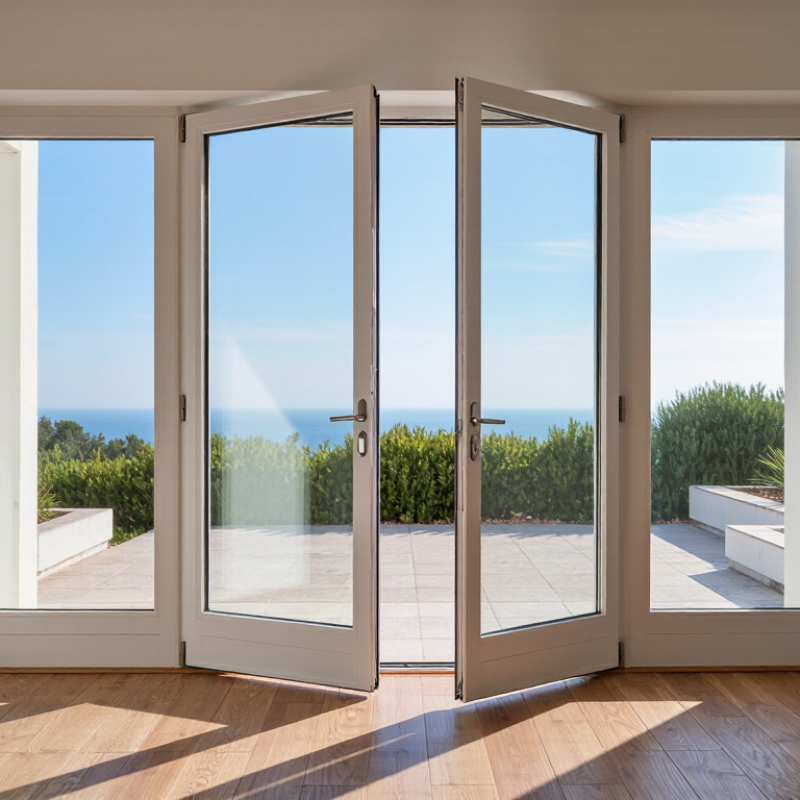
French patio doors use two hinged panels, usually with large glass areas and a meeting point in the center. Both panels can open, creating a wide passage for gardens, balconies, or entertaining spaces. Unlike sliding doors, they need clear floor space for the swing. Unlike folding doors, they do not stack beside the opening.
Their traditional appearance suits brick homes, coastal houses, and modern renovations. Yet appearance is only part of the decision. The frame, glass, hinges, drainage, and weather seals affect daily performance. In colder regions, insulated glass and thermally efficient frames can reduce heat loss. In hot climates, low-emissivity glass may help control solar heat. A poorly installed threshold can still allow drafts or water entry, even with quality materials. This detail is easy to underestimate.
Tips: Measure the opening after checking the wall structure, not before. Confirm the handing, swing direction, and furniture clearance. For busy households, choose durable hinges and a strong multi-point locking system. Check local building requirements for safety glass, ventilation, and emergency access. Ask for tested air, water, and wind performance where possible. Do not rely on appearance alone. French doors can feel elegant but may be inconvenient in a narrow room. A simple floor plan often exposes this problem early.
For global buyers, French patio doors should match climate, space, and daily movement. Traditional double doors open from the center. They create a wide, welcoming passage. In tight rooms, outward swings may block walkways. Inward swings can reduce exterior clearance, but they need furniture space. Sliding French-style doors save room, although their opening is usually narrower. Folding configurations offer a broad opening, yet their hardware needs careful alignment.
Material changes performance. Fiberglass resists moisture and keeps maintenance low. Aluminum offers slim frames and strong panels. Wood gives warmth and suits classic homes, but it needs regular sealing in wet or sunny regions. Glass affects comfort as much as appearance. Low-emissivity insulated glass can reduce heat transfer. Laminated glass adds impact resistance and softer noise. Clear glass brings daylight. Obscure or textured glass improves privacy near streets. Frame depth, drainage, weather seals, and threshold design deserve equal attention.
Tips: Ask for tested air, water, and wind performance, not attractive photos alone. Check handle height and screen compatibility before ordering. Confirm rough opening sizes with a qualified installer. Regional temperature swings can expose weak seals quickly. I would not choose the largest glass area automatically. More glass may mean more heat gain, glare, and cleaning. No configuration is perfect; reviewing morning sun, rain direction, and furniture placement often reveals the better choice.
2026 Best French Doors Patio Doors for Global Buyers
In site inspections, I compare French patio doors under real weather conditions, not only showroom samples. Energy efficiency begins with the whole assembly. Check the U-value, solar heat gain rating, insulated frames, and low-emissivity glazing. A low U-value alone can mislead. Poor seals may still create cold drafts beside the frame. Ask for tested air leakage and water resistance data. Local climate matters, especially in coastal, humid, or freezing regions.
Security needs more than a decorative handle. Look for a strong multipoint locking system, reinforced strike plates, and laminated glass. The inactive door should lock firmly at the top and bottom. Confirm that emergency operation remains practical for residents. Durability depends on drainage channels, corrosion-resistant hardware, stable hinges, and a frame suited to repeated opening. Inspect the threshold after installation. Small gaps often become expensive problems.
Accessibility deserves equal attention. A low or flush threshold helps wheelchair users, children, and anyone carrying groceries. Check opening force, clear passage width, handle height, and smooth operation. Sliding resistance can increase when frames settle or floors shift. I have seen attractive doors fail this test after one wet season. That experience changed my preference for documented cycle testing and replaceable seals. Buyers should also verify local building requirements, glass safety rules, and installation support before comparing prices. Performance claims are useful, but independent test reports deserve greater trust.
French patio doors can suit many properties, but climate should guide the selection. In cold regions, choose insulated frames and double or triple glazing. Low-emissivity glass helps retain indoor heat near large openings. A tight weather seal also limits drafts during winter storms. Still, more glass does not automatically mean better comfort.
Hot climates need solar-control glass and carefully planned exterior shading. West-facing doors may receive harsh afternoon sunlight. A deep roof overhang can reduce heat without blocking every view. In humid areas, corrosion-resistant hardware and moisture-stable frames deserve close attention. Coastal properties need extra protection from salt air. Small details matter.
Traditional homes often benefit from divided glass panels, balanced proportions, and inward-opening doors. Modern properties may look cleaner with wider panels and narrow sightlines. For compact rooms, outward-opening doors can preserve furniture space, where local conditions allow. A low threshold improves access, but it must still manage rainwater effectively. That trade-off is easy to underestimate.
A practical installation check includes the wall opening, drainage path, sill height, and floor levels. Even an expensive door can perform poorly over an uneven threshold. One detail I would reconsider is choosing style before studying daylight and prevailing wind. The most attractive arrangement may create glare, heat gain, or difficult ventilation. French doors work best when their appearance follows the building’s real climate and daily use.
| Recommended Choice | Best Climate | Suitable Property Design | Typical Frame Material | Recommended Glazing | Weather and Energy Features | Typical Performance Range | Main Advantages | Important Considerations |
|---|---|---|---|---|---|---|---|---|
| Thermally Broken Insulated French Door | Cold Mixed Sub-freezing winters and large seasonal temperature changes | Modern houses, renovated farmhouses, energy-efficient extensions | Insulated aluminum with a thermal break | Low-emissivity double glazing; triple glazing where winter temperatures are severe | Multiple seals, insulated core, warm-edge spacer, and low-conductivity threshold | Double glazing: approximately U-1.2–1.8 W/m²K Triple glazing: approximately U-0.7–1.1 W/m²K | Strong structural stability, slim sightlines, and improved heat retention compared with non-insulated metal frames | Thermal-break quality and threshold design are critical; metal surfaces can still feel colder than timber or composite frames |
| Triple-Glazed Timber French Door | Very Cold Highland Long heating seasons and cold nights | Traditional homes, alpine properties, heritage-inspired residences | Engineered softwood or hardwood with factory-applied protective coating | Triple low-emissivity glazing filled with argon or another inert gas | Deep insulated frame, compression seals, insulated sill, and low solar heat loss | Whole-door U-value commonly around 0.8–1.3 W/m²K, depending on construction | Low thermal conductivity, natural appearance, and good acoustic potential | Requires periodic coating inspection; drainage, moisture protection, and correct installation are essential |
| Fiberglass or Composite French Door | Mixed Humid Variable temperatures and regular rainfall | Family homes, coastal-style residences, low-maintenance renovations | Fiberglass-reinforced polymer or insulated composite frame | Low-emissivity double glazing with safety glass where required | Low moisture absorption, insulated panels, durable gaskets, and corrosion-resistant hardware | Typical whole-door U-value: approximately 1.2–1.8 W/m²K | Stable in changing humidity, resistant to rot, and generally easier to maintain than exposed timber | Check the finish warranty, sill drainage, replacement-part availability, and resistance to local solar exposure |
| Storm-Resistant Impact French Door | Hurricane Tropical High wind, windborne debris, and driving rain | Coastal houses, apartments, villas, and exposed waterfront properties | Reinforced aluminum, fiberglass, or engineered composite frame | Laminated impact-resistant insulating glass; low-emissivity coating for hot climates | Multi-point locking, reinforced hinges, pressure-rated frame, impact interlayer, and tested water resistance | Performance must be verified through local impact, wind-load, air-leakage, and water-penetration testing | Improved protection from flying debris, wind pressure, and severe rain when properly certified and installed | Do not rely on appearance alone; confirm the approved design pressure, impact classification, opening size, and installation method |
| Solar-Control French Door | Hot Sunny Strong sun, high cooling demand, and low winter heating demand | Contemporary villas, atrium rooms, pool houses, and west-facing living spaces | Thermally improved aluminum, uPVC, fiberglass, or composite frame | Double insulating glazing with solar-control low-emissivity coating; laminated glass for noise or safety needs | Low solar heat-gain coefficient, exterior shading compatibility, sealed edges, and insulated frame sections | Typical solar heat-gain coefficient: approximately 0.25–0.45 Typical double-glazed U-value: approximately 1.2–1.8 W/m²K | Reduces overheating and cooling loads while maintaining daylight | Very low solar gain can reduce useful winter heat; select the glass orientation by orientation and local climate |
| Acoustic French Patio Door | Urban Transport Corridors Noise from roads, railways, or dense neighborhoods | City apartments, hotels, home offices, and houses near busy streets | Insulated uPVC, timber, composite, or thermally broken aluminum | Laminated acoustic insulating glass with unequal pane thicknesses | Continuous perimeter seals, tight compression hardware, insulated frame, and carefully sealed installation joints | Acoustic rating commonly about Rw 35–45 dB, depending on the complete door assembly | Reduces traffic and speech noise more effectively than standard single or basic double glazing | Installation gaps can significantly reduce acoustic performance; ventilation and wall construction also affect results |
| Traditional Wood French Door | Temperate Dry or Mild Moderate temperatures and manageable moisture exposure | Period homes, cottages, classic townhouses, and heritage-style interiors | Engineered timber or solid timber with weather-resistant exterior coating | Double low-emissivity insulating glass; laminated glass for safety and sound control | Factory-applied coating, adjustable hinges, compression seals, and properly drained sill | Typical whole-door U-value: approximately 1.3–2.0 W/m²K | Authentic appearance, natural material, repairable surfaces, and strong design flexibility | Needs regular maintenance, especially on exposed elevations; avoid unprotected end grain and standing water |
| Compact Narrow-Leaf French Door | All Climates Small openings and space-constrained layouts | Small apartments, balconies, compact dining rooms, and renovation projects | uPVC, timber, composite, or thermally broken aluminum | Double insulating low-emissivity glazing sized for the local energy requirement | Reduced leaf width, multi-point lock, low-profile sill option, and weather seals around both leaves | Performance depends on the frame system; select a whole-door U-value suitable for the local code | Fits smaller wall openings while preserving the paired-door appearance and outward or inward access | Confirm furniture clearance, active-leaf width, egress rules, sill height, and whether both leaves open fully |
| Buyer checklist: Compare the complete door assembly rather than glass alone. Request documented U-value, air-leakage, water-resistance, solar-heat-gain, acoustic, and wind-load results where relevant. Confirm local safety-glazing rules, threshold accessibility, opening direction, drainage details, replacement-hardware support, and professional installation requirements before purchase. | ||||||||
For global buyers, choosing French patio doors starts with the opening, not the catalog photo. Measure width, height, jamb depth, and sill condition in three places. Measure twice. Record millimeters and inches, because small conversion errors can leave a costly gap. Nominal sizes vary by region, so request the actual frame dimensions and rough-opening requirements. A 1,800 mm opening may need different door leaves than a 72-inch unit. Check swing direction, threshold height, and clear passage for furniture.
Standards deserve careful attention. Ask for documented air, water, structural, thermal, and forced-entry test results for the installation location. Coastal projects may need stronger wind resistance and corrosion protection. Cold climates should compare U-value, while hot climates benefit from solar heat-gain data. Tempered or laminated safety glazing is often suitable near floors and doors, but local building rules decide the specification. Installation needs a level sill, continuous flashing, sealed corners, and proper drainage. An experienced installer should inspect the wall before ordering.
Shipping can change the real price. Request a quote covering packaging, crate size, insurance, port handling, customs paperwork, duties, inland delivery, and unloading equipment. Confirm whether delivery reaches the building or only the terminal. Protect doors upright, dry, and secured. Inspect glass and hardware before signing receipt. Confirm delivery limits. I have seen beautiful doors delayed because a crate was too wide for the liftgate. The first estimate is often wrong. Recheck every measurement after site changes, even when the order seems settled.
Global buying guide: common nominal widths, metric conversions, installation planning, shipping, and cost considerations.
Single French doors are commonly sold in nominal widths of 30, 32, and 36 inches, while double-door systems commonly use 60, 64, and 72 inches. The metric values are rounded conversions from inches. These are market-standard nominal sizes rather than guaranteed structural opening dimensions; confirm the manufacturer’s unit size, rough-opening requirement, local building regulations, glazing requirements, and shipping limits before ordering.
Planning note: the rough opening is normally larger than the door unit to allow installation, shimming, leveling, insulation, and weatherproofing. Actual delivered cost varies with material, glazing, hardware, thermal performance, destination, duties, crating, and installation labor.
We use cookies on our website to give you an improved browser experience. View our Privacy Policy for more information. Please make your selection to opt in or out of ALL cookies here: Accept or Decline
Do you consent to the use of ALL cookies?
901 2nd Court West
Birmingham, AL 35204
Sales: 866.481.4036
Logistics/Ops: 866.481.4036
2101 Dralle Road
University Park, IL 60466
Sales: 708.813.9070
Logistics/Ops: 708.235.4200
400 E. 13th Street
Little Rock, AR 72114
Sales: 866.760.5344
Logistics/Ops: 866.760.5344
225 Collins Road
Elkhart, IN 46515
Sales: 574.295.0214
Logistics/Ops: 574.607.4611
601 Berryman Pike
Tipton, IN 46072
Sales: 800.897.7591
Logistics/Ops: 800.897.7591
3900 Uvalda Street
Denver, CO 80239
Sales: 303.706.8000
Ops/Logistics: 303.576.8398
510 3rd Street E
Milan, IL 61264
Sales: 800.322.1052
Logistics/Ops: 800.322.1052
1660 E. Aurora
Des Moines, IA 50313
Sales: 800.671.1660
Logistics: 800.671.1660
86554 Gene Lasserre Blvd.
Yulee, FL 32097
Sales: 904.253.3060
Logistics/Ops: 904.225.3000
694 S.E. County Road 245
Lake City, FL 32025
Sales: 800.727.6706
Logistics/Ops: 386.752.7412
210 Neptune Road
Auburndale, FL 33823
Sales: 863.967.1131
Logistics/Ops: 863.777.9814
4601 McCoy Drive
Pensacola, FL 32503
Sales: 850.308.7030
Logistics/Ops: 850.434.5502
815 South 56th Street
Tampa, FL 33619
Sales: 813.302.1940
Logistics/Ops: 813.621.1352
200 Hosea Road
Lawrenceville, GA 30046
Sales: 770.953.7575
Logistics/Ops: 770.513.6000
Branch Product Guide
Branch Line Card
Moulding Offering
Cedar Offering
Column Offering
8173 Hwy. 165 North
Monroe, LA 71211
Sales: 800.256.4165
Logistics/Ops: 800.256.4165
508 Warren Avenue
Portland, ME 04103
Sales: 207.888.2331
Logistics/Ops: 207.797.6565
4300 Georgia Pacific Blvd.
Frederick, MD 21704
Sales: 301.798.7474
Logistics/Ops: 301.874.8000
419 Maple Street
Bellingham, MA 02019
Sales: 508.449.0535
Logistics/Ops: 508.966.5500
825 Buchanan Ave SW
Grand Rapids, MI 49507
Sales: 877.800.1180
Logistics/Ops: 616.278.0909
995 Pacific St. NW
Aitkin, MN 56431
Sales: 800.432.3727
Logistics/Ops: 218.212.7770
1102 Port Terminal Drive
Duluth, MN 55802
Sales: 800.951.9899
Logistics/Ops: 800.851.9899
9110 83rd Ave. North
Brooklyn Park, MN 55445
Sales: 763.425.0204
Logistics/Ops: 763.425.0204
910 E. Railroad Street
Long Beach, MS 39560
Sales: 866.535.4135
Logistics/Ops: 228.205.2400
1727 Warren Street
North Kansas City, MO 64116
Sales: 800.621.2611
Logistics/Ops: 800.621.2611
2123 North Golden
Springfield, MO 65803
Sales: 800.375.7891
Logistics/Ops: 800.375.7891
13860 Corp. Woods Trail
Bridgeton, MO 63044
Sales: 314.209.0800
Logistics/Ops: 314.209.0800
1109 South 19th Street
Omaha, NE 68108
Sales: 800.489.6637
Logistics/Ops: 800.489.6637
1 Luger Road
Denville, NJ 07834
Sales: 973-339-3539
Logistics/Ops: 973.625.1461
3720 Jeffrey Blvd.
Blasdell, NY 14219
Sales: 716.235.5989
Logistics/Ops: 716.825.6557
319 Yaphank Ave.
Yaphank, NY 11980
Sales: 631.358.5714
Logistics/Ops: 631.924.7401
3300 Parkside Drive
Charlotte, NC 28208
Sales: 800.839.2588
Logistics/Ops: 704.394.3172
1712 East D Street
Butner, NC 27509
Sales: 984.389.8200
Logistics/Ops: 919.575.3700
128 Foothills Drive
Statesville, NC 28687
Sales: 800.222.1414
Logistics/Ops: 704.394.3172
550 Munroe Falls Rd.
Tallmadge, OH 44278
Sales: 330.357.4506
Logistics/Ops: 330.794.1141
10347 Toebben Dr.
Independence, KY 41051
Sales: 859.298.3926
Logistics/Ops: 859.746.2250
450 N. MacArthur
Oklahoma City, OK 73127
Sales: 800.375.6025
Logistics/Ops: 800.375.6025
1680 North Aspen
Broken Arrow, OK 74012
Sales: 918.272.2212
Logistics/Ops: 918.272.2212
522 Bridge Street
Hunker, PA 15639
Sales: 878.217.2001
Logistics/Ops: 724.925.7285
4290 Atlanta Street
Charleston, SC 29418
Sales: 843.371.1420
Logistics/Ops: 843.554.8192
1040 S. Industrial Dr.
Erwin, TN 37650
Sales: 423.641.1005
Logistics/Ops: 423.742.5911
4287 Pilot Drive
Memphis, TN 38118
Sales: 901.365.2101
Logistics/Ops: 901.365.2101
700 Myatt Drive
Madison, TN 37115
Sales: 615.327.9547
Logistics/Ops: 629.777.4949
4747 Mark IV Parkway
Fort Worth, TX 76106
Sales: 866.323.5117
Logistics/Ops: 817.625.9091
6990 Market Avenue
El Paso, TX 79915
Sales: 915.778.6356
Logistics/Ops: 915.265.7200
2502 Wilson Road
Harlingen, TX 78552
Sales: 800.580.6711
Logistics/Ops: 800.580.6711
10,000 North Loop East
Houston, TX 77029
Sales: 713.921.1977
Logistics/Ops: 713.675.3544
702 East 44th St.
Lubbock, TX 79404
Sales: 866.454.6010
Logistics/Ops: 866.454.6010
535 N. WW White Road
San Antonio, TX 78219
Sales: 800.284.0488
Logistics/Ops: 210.333.8112
142 Pine Haven Shores Rd.
Shelburne, VT 05482
Sales: 802.800.2540
Logistics/Ops: 802.985.2512
4700 Bethlehem Road,
Richmond, VA 23230
Sales: 804.201.2400
Logistics/Ops: 804.342.1161
4516 N Barker Road
Spokane Valley, WA 99027
Phone: 509.892.9420
Toll free: 800.728.6157
8365 N. 76th Street
Milwaukee, WI 53223
Sales: 800.356.9245
Logistics/Ops: 800.356.9245
312 S. Chester Street
Sparta, WI 54656
Sales: 800.362.5864
Logistics/Ops: 800.362.5864
899 Grossman Drive
Schofield, WI 54476
Sales: 800.472.0017
Logistics/Ops: 800.472.0017