
We use cookies on our website to give you an improved browser experience. View our Privacy Policy for more information. Please make your selection to opt in or out of ALL cookies here: Accept or Decline
Choosing a leveling system is about more than correcting a sloping floor. Mobile Home Leveling affects how a home’s weight is supported, how doors close, and whether small movement becomes a recurring problem. For buyers comparing options in 2026, the right choice depends on the home’s frame, foundation conditions, climate, and access beneath the structure.
Details matter. Adjustable steel piers can offer precise height changes, while concrete supports may suit some stable, properly prepared sites. Not every system fits every home. Soil that shifts after heavy rain, rust around existing supports, or a soft spot near a doorway can change the assessment. A level placed on the floor is useful, but it cannot reveal every problem under the home.
This guide will help buyers compare common systems, materials, installation needs, and ongoing checks. It also explains when a qualified installer’s site inspection is worth the added cost. Ask for clear product specifications, load ratings, warranty terms, and a written scope of work. Those details are more useful than broad claims about a system being “permanent” or maintenance-free. A small caveat matters: the least expensive option may not be the least costly over time. Evaluate the actual site, not just the brochure.
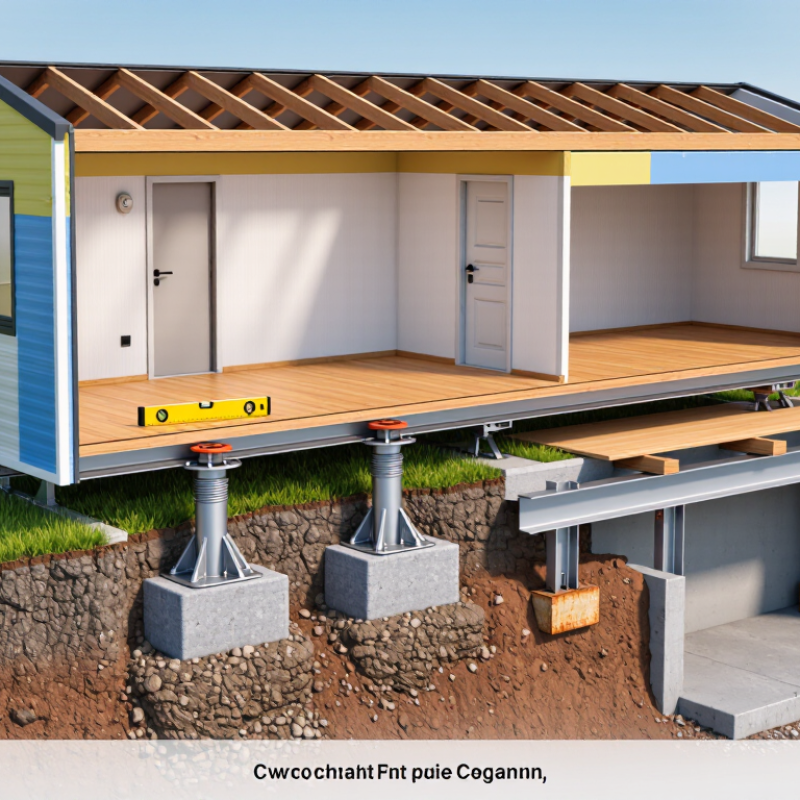
A mobile home leveling system is the set of supports beneath a home that helps keep its frame stable and evenly supported. It may include piers, adjustable supports, and properly fitted shims. The right arrangement depends on the home’s design, soil conditions, and existing foundation. A level home is not just more comfortable. Small shifts matter.
When supports settle unevenly, floors may feel sloped, doors can stick, and gaps may appear around windows. Plumbing connections can also experience strain. These signs do not prove that leveling is the only problem, but they deserve attention. Soil moisture, drainage, and damaged supports can all affect stability. A careful assessment should include the frame, support points, and the ground below them.
Leveling is different from anchoring. Supports carry the home’s weight; anchors help resist lateral movement. One does not replace the other. Buyers should ask what support method is suitable, how the site will be checked, and whether adjustments follow the home’s installation guidance. Do not rely on a quick visual check alone. Still, even a professional assessment can miss changing soil conditions, so periodic inspections are sensible.
2026 Best Mobile Home Leveling Systems for Buyers
How Mobile Home Leveling Systems Support and Stabilize a Home
A mobile home leveling system helps transfer the home’s weight into stable points beneath its frame. Adjustable piers or approved support assemblies can correct uneven bearing and reduce stress on floors, walls, and doors. When supports are properly positioned, a door that once rubbed its frame may close more smoothly. Small changes matter.
Stability depends on more than the supports themselves. Soil condition, drainage, pier spacing, and the home’s frame all affect performance. A low spot after heavy rain, for example, may signal shifting soil rather than a simple adjustment issue. A qualified installer can assess these conditions and check that supports carry loads as intended.
Leveling is not a cure-all. It does not replace sound tie-downs, proper drainage, or repairs to damaged framing. Nor does every sloping floor mean the support system has failed; older homes can have quirks that take careful inspection to understand. Check for recurring door gaps, soft spots, or visible changes around supports, and seek professional evaluation when movement continues. There is no perfect shortcut.
This illustrative example divides a 12,000 lb home load equally across six support points: 2,000 lb per point. Actual loads are rarely distributed perfectly evenly; support placement and capacity should be determined for the home and site by a qualified professional.
Buyers in 2026 will encounter several ways to support and level a manufactured home. Concrete block piers are common beneath floor beams and can work well when properly placed on stable footings. Precast concrete supports offer consistent dimensions, while adjustable steel piers allow fine height changes during installation or repair. Small details matter. The footing beneath a pier can be just as important as the pier itself.
Some homes use helical piles, which are turned into suitable soil and can provide support where conventional shallow footings are less practical. They require site evaluation and appropriate installation; they are not a universal shortcut. Existing homes may also have screw-jack systems for adjustment, but these should not be treated as a substitute for a properly designed foundation. A level floor does not automatically mean the home is adequately supported or anchored.
The right option depends on soil, drainage, home design, access, and whether the work is new construction or a correction. Ask how loads will be transferred, what each support rests on, and how the installation will be checked. The comparison is not perfectly tidy: two systems with similar materials can perform differently on different sites. Have a qualified professional assess the conditions before choosing, and keep installation records for future inspections.
Choosing a mobile home leveling system starts with the site, not the price tag. Soft soil, uneven ground, and poor drainage can affect how supports perform over time. Look for low spots after rain and note where water collects. A system suitable for firm, well-drained ground may need a different foundation plan on expansive or sloped soil. A qualified installer can assess conditions and check local requirements.
Home design matters, too. Older homes, additions, and different frame layouts may call for support points specific to the manufacturer’s specifications. Adjustable steel piers can allow future corrections, while approved concrete supports may suit some stable sites. Neither option fits every home. Ask what materials are included, how loads are distributed, and whether the estimate covers inspection and follow-up adjustments. The cheapest quote can leave important work unclear.
Tips: Compare written quotes line by line. Check the support spacing, soil assumptions, drainage work, warranty terms, and access needs. Keep a small reserve for repairs; hidden settling can change the scope. I’d be cautious about choosing from photos alone. A level floor today is useful, but it does not prove the underlying supports are sound.
| Support System | Best-Fit Site Conditions | Home Design and Use | Relative Initial Budget | Key Advantages | Limitations and Checks |
|---|---|---|---|---|---|
| Concrete masonry piers on engineered footings | Firm, well-drained ground with suitable bearing capacity; the footing design must account for local soil and frost conditions. | Common support approach for single- and multi-section manufactured homes when specified in the installation plan. | Low to medium | Durable materials; individual supports can be placed at required frame and perimeter locations. | Requires properly sized footings, correct pier construction, and suitable moisture and frost protection. Masonry units should not be stacked directly on soil. |
| Approved precast concrete pads with pier supports | Relatively level, stable sites where the soil can support the pad loads and the installation instructions permit this approach. | May suit homes with support points and loads covered by the applicable installation design. | Low to medium | Can reduce on-site concrete work and may allow a faster installation on prepared ground. | Not suitable for every soil, load, or site. Pad size and placement matter; loose, soft, or uneven ground may require engineered footings instead. |
| Adjustable steel piers | Prepared sites with stable bearing surfaces; the support must be rated and installed for the expected load and conditions. | Useful where accessible, adjustable supports are specified for a manufactured home or an approved repair. | Medium | Adjustment can help a qualified installer make level corrections; some systems are compact and straightforward to inspect. | Capacity, corrosion protection, bracing, and footing requirements vary by system. Adjustment does not replace adequate foundations or anchorage. |
| Helical piles with engineered brackets | Sites where conventional excavation is difficult or where soil conditions call for deep support, subject to geotechnical or engineering review. | Potential option for new installations or foundation work when designed for the home’s frame and site loads. | Medium to high | Can transfer loads to deeper soil layers and may require less excavation than some conventional footing methods. | Requires suitable soil evaluation, engineered sizing, specialist installation, and verification of pile capacity. Not a universal solution for weak or obstructed ground. |
| Poured concrete perimeter or continuous footings | Sites suitable for excavation and concrete work; design should address drainage, soil bearing, frost depth, and local code requirements. | May be selected for a more continuous foundation arrangement when required by the design, site, or local authority. | High | Provides a continuous concrete support element when properly designed and built. | More excavation and concrete work can increase cost and installation time. A perimeter footing alone does not automatically support every frame or interior load. |
| Professional releveling of existing supports | Existing home with settlement or uneven floors, after the cause and condition of the supports have been assessed. | For an installed home that needs adjustment or repairs; the method depends on its existing foundation and manufacturer’s requirements. | Low to medium for adjustment; higher if supports or footings need replacement | Can address unevenness without replacing the entire support system when the foundation remains serviceable. | Releveling alone will not fix inadequate footings, drainage problems, soil movement, or damaged framing. Use a qualified professional; avoid improvised shimming or lifting. |
Buyer note: These are general comparison categories, not a site-specific design or price quote. Final support type, spacing, footing size, anchorage, and installation should follow the home manufacturer’s instructions, applicable HUD installation requirements for covered new installations, and state and local codes. Soil conditions, access, climate, and permitting can substantially change the budget.
A mobile home leveling system must match the home’s frame, support points, soil, and exposure to wind or moisture. Installation is not simply a matter of raising low corners. A qualified installer should check the frame and foundation, then follow the home’s documentation and applicable local requirements. Poorly placed supports can concentrate stress and cause doors to stick or floors to feel uneven. Small changes matter.
Tips: Before work begins, photograph existing cracks and note doors that bind. Ask the installer to explain the support layout and how adjustments will be checked. Keep the written inspection findings.
After installation, inspect accessible supports for shifting, corrosion, standing water, or disturbed soil. Recheck after unusually wet weather or nearby ground work. Inside, watch for new gaps around trim, sloping floors, or changes in how windows close. These signs are clues, not a diagnosis. Avoid adjusting jacks yourself unless the system instructions specifically permit it; uneven lifting can damage the structure. Keep records of inspections and repairs, including dates and observed changes. An annual check is a useful routine, but site conditions may call for more frequent professional reviews.
We use cookies on our website to give you an improved browser experience. View our Privacy Policy for more information. Please make your selection to opt in or out of ALL cookies here: Accept or Decline
Do you consent to the use of ALL cookies?
901 2nd Court West
Birmingham, AL 35204
Sales: 866.481.4036
Logistics/Ops: 866.481.4036
2101 Dralle Road
University Park, IL 60466
Sales: 708.813.9070
Logistics/Ops: 708.235.4200
400 E. 13th Street
Little Rock, AR 72114
Sales: 866.760.5344
Logistics/Ops: 866.760.5344
225 Collins Road
Elkhart, IN 46515
Sales: 574.295.0214
Logistics/Ops: 574.607.4611
601 Berryman Pike
Tipton, IN 46072
Sales: 800.897.7591
Logistics/Ops: 800.897.7591
3900 Uvalda Street
Denver, CO 80239
Sales: 303.706.8000
Ops/Logistics: 303.576.8398
510 3rd Street E
Milan, IL 61264
Sales: 800.322.1052
Logistics/Ops: 800.322.1052
1660 E. Aurora
Des Moines, IA 50313
Sales: 800.671.1660
Logistics: 800.671.1660
86554 Gene Lasserre Blvd.
Yulee, FL 32097
Sales: 904.253.3060
Logistics/Ops: 904.225.3000
694 S.E. County Road 245
Lake City, FL 32025
Sales: 800.727.6706
Logistics/Ops: 386.752.7412
210 Neptune Road
Auburndale, FL 33823
Sales: 863.967.1131
Logistics/Ops: 863.777.9814
4601 McCoy Drive
Pensacola, FL 32503
Sales: 850.308.7030
Logistics/Ops: 850.434.5502
815 South 56th Street
Tampa, FL 33619
Sales: 813.302.1940
Logistics/Ops: 813.621.1352
200 Hosea Road
Lawrenceville, GA 30046
Sales: 770.953.7575
Logistics/Ops: 770.513.6000
Branch Product Guide
Branch Line Card
Moulding Offering
Cedar Offering
Column Offering
8173 Hwy. 165 North
Monroe, LA 71211
Sales: 800.256.4165
Logistics/Ops: 800.256.4165
508 Warren Avenue
Portland, ME 04103
Sales: 207.888.2331
Logistics/Ops: 207.797.6565
4300 Georgia Pacific Blvd.
Frederick, MD 21704
Sales: 301.798.7474
Logistics/Ops: 301.874.8000
419 Maple Street
Bellingham, MA 02019
Sales: 508.449.0535
Logistics/Ops: 508.966.5500
825 Buchanan Ave SW
Grand Rapids, MI 49507
Sales: 877.800.1180
Logistics/Ops: 616.278.0909
995 Pacific St. NW
Aitkin, MN 56431
Sales: 800.432.3727
Logistics/Ops: 218.212.7770
1102 Port Terminal Drive
Duluth, MN 55802
Sales: 800.951.9899
Logistics/Ops: 800.851.9899
9110 83rd Ave. North
Brooklyn Park, MN 55445
Sales: 763.425.0204
Logistics/Ops: 763.425.0204
910 E. Railroad Street
Long Beach, MS 39560
Sales: 866.535.4135
Logistics/Ops: 228.205.2400
1727 Warren Street
North Kansas City, MO 64116
Sales: 800.621.2611
Logistics/Ops: 800.621.2611
2123 North Golden
Springfield, MO 65803
Sales: 800.375.7891
Logistics/Ops: 800.375.7891
13860 Corp. Woods Trail
Bridgeton, MO 63044
Sales: 314.209.0800
Logistics/Ops: 314.209.0800
1109 South 19th Street
Omaha, NE 68108
Sales: 800.489.6637
Logistics/Ops: 800.489.6637
1 Luger Road
Denville, NJ 07834
Sales: 973-339-3539
Logistics/Ops: 973.625.1461
3720 Jeffrey Blvd.
Blasdell, NY 14219
Sales: 716.235.5989
Logistics/Ops: 716.825.6557
319 Yaphank Ave.
Yaphank, NY 11980
Sales: 631.358.5714
Logistics/Ops: 631.924.7401
3300 Parkside Drive
Charlotte, NC 28208
Sales: 800.839.2588
Logistics/Ops: 704.394.3172
1712 East D Street
Butner, NC 27509
Sales: 984.389.8200
Logistics/Ops: 919.575.3700
128 Foothills Drive
Statesville, NC 28687
Sales: 800.222.1414
Logistics/Ops: 704.394.3172
550 Munroe Falls Rd.
Tallmadge, OH 44278
Sales: 330.357.4506
Logistics/Ops: 330.794.1141
10347 Toebben Dr.
Independence, KY 41051
Sales: 859.298.3926
Logistics/Ops: 859.746.2250
450 N. MacArthur
Oklahoma City, OK 73127
Sales: 800.375.6025
Logistics/Ops: 800.375.6025
1680 North Aspen
Broken Arrow, OK 74012
Sales: 918.272.2212
Logistics/Ops: 918.272.2212
522 Bridge Street
Hunker, PA 15639
Sales: 878.217.2001
Logistics/Ops: 724.925.7285
4290 Atlanta Street
Charleston, SC 29418
Sales: 843.371.1420
Logistics/Ops: 843.554.8192
1040 S. Industrial Dr.
Erwin, TN 37650
Sales: 423.641.1005
Logistics/Ops: 423.742.5911
4287 Pilot Drive
Memphis, TN 38118
Sales: 901.365.2101
Logistics/Ops: 901.365.2101
700 Myatt Drive
Madison, TN 37115
Sales: 615.327.9547
Logistics/Ops: 629.777.4949
4747 Mark IV Parkway
Fort Worth, TX 76106
Sales: 866.323.5117
Logistics/Ops: 817.625.9091
6990 Market Avenue
El Paso, TX 79915
Sales: 915.778.6356
Logistics/Ops: 915.265.7200
2502 Wilson Road
Harlingen, TX 78552
Sales: 800.580.6711
Logistics/Ops: 800.580.6711
10,000 North Loop East
Houston, TX 77029
Sales: 713.921.1977
Logistics/Ops: 713.675.3544
702 East 44th St.
Lubbock, TX 79404
Sales: 866.454.6010
Logistics/Ops: 866.454.6010
535 N. WW White Road
San Antonio, TX 78219
Sales: 800.284.0488
Logistics/Ops: 210.333.8112
142 Pine Haven Shores Rd.
Shelburne, VT 05482
Sales: 802.800.2540
Logistics/Ops: 802.985.2512
4700 Bethlehem Road,
Richmond, VA 23230
Sales: 804.201.2400
Logistics/Ops: 804.342.1161
4516 N Barker Road
Spokane Valley, WA 99027
Phone: 509.892.9420
Toll free: 800.728.6157
8365 N. 76th Street
Milwaukee, WI 53223
Sales: 800.356.9245
Logistics/Ops: 800.356.9245
312 S. Chester Street
Sparta, WI 54656
Sales: 800.362.5864
Logistics/Ops: 800.362.5864
899 Grossman Drive
Schofield, WI 54476
Sales: 800.472.0017
Logistics/Ops: 800.472.0017
