
We use cookies on our website to give you an improved browser experience. View our Privacy Policy for more information. Please make your selection to opt in or out of ALL cookies here: Accept or Decline
Choosing a screw air compressor in 2026 is not simply a horsepower decision. It affects production stability, energy bills, maintenance time, and product quality. A machine may look efficient on its nameplate yet waste power during low-demand periods.
The U.S. Department of Energy reports that compressed air can represent 10% to 15% of industrial electricity use. Its guidance also notes that poorly managed systems may lose 20% to 30% of compressed air through leaks and artificial demand. That changes the buying question. The cheapest compressor is rarely the cheapest system. The real cost includes installation, controls, drying, filtration, service, and electricity over its working life.
Ron Marshall, a Compressed Air Challenge instructor and compressed-air auditor, has emphasized, “Compressed air is an expensive utility when poorly managed.” That warning deserves attention. It is easy to trust a brochure too quickly. I have seen specifications that ignore inlet conditions, pressure drops, and seasonal temperature changes. Those omissions can produce disappointing results.
This guide explains how to choose a screw air compressor for real operating conditions. It examines fixed-speed and variable-speed designs, oil-injected and oil-free technology, air quality classes, duty cycles, and lifecycle cost. It also considers heat recovery, remote monitoring, redundancy, and maintenance access. Some plants need maximum efficiency. Others need dependable backup capacity.
The correct choice depends on measured demand, not guesswork. Before comparing brands, record pressure, flow, operating hours, leakage, and future expansion. A careful decision may take longer. It usually costs less.
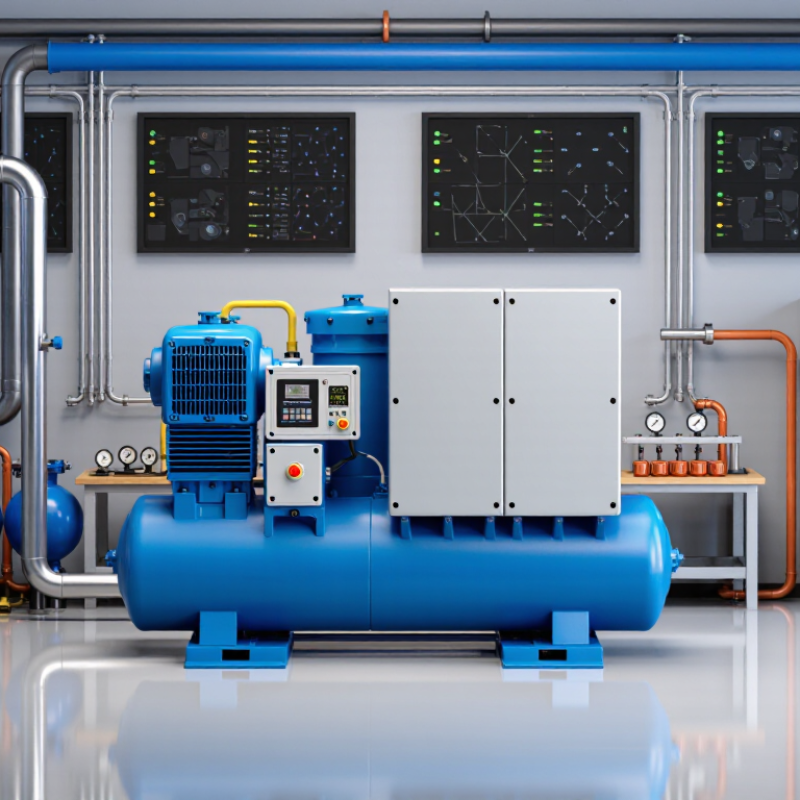
2026 How to Choose a Screw Air Compressor?
Understanding Screw Air Compressor Types and Operating Principles
A screw air compressor uses two interlocking rotors to trap and compress air continuously. The principle is simple. Air enters through an inlet valve, fills rotor grooves, and moves toward the discharge side. Oil-injected models use oil for sealing, cooling, and lubrication. A separator then removes most oil before delivery. Oil-free models use special coatings and external cooling, but they usually require tighter control and higher maintenance discipline.
Fixed-speed compressors suit stable production loads. Variable-speed models adjust motor speed when demand changes. This can reduce unloading losses, especially in factories with uneven air consumption. The U.S. Department of Energy reports that compressed air can represent about 10% of manufacturing electricity use. Its system guidance also identifies leaks, inappropriate pressure, and poor controls as major energy losses. These findings make compressor selection a system decision, not only a motor decision.
Check flow, pressure, duty cycle, air quality, and installation temperature. Measure actual demand with a flow meter before purchasing. A 7-bar requirement should not become an unnecessary 9-bar setting. Every extra bar may increase energy use, depending on system conditions. Industry guidance from the European Commission notes that compressed-air efficiency depends heavily on generation, distribution, and end-use equipment. In practice, the neat theory often fails. A smaller compressor with proper storage may outperform a larger unit running constantly. I would also question optimistic efficiency claims without site measurements, maintenance records, and independent test conditions.
Use this comparison to match compressor construction, control method, air-quality requirements, pressure, flow, and operating pattern with the application.
| Compressor Type | Operating Principle | Lubrication and Cooling | Typical Pressure Range | Flow and Load Behavior | Main Advantages | Typical Applications |
|---|---|---|---|---|---|---|
| Oil-Injected Twin-Screw | Two intermeshing rotors trap air in cavities. The air volume decreases as the cavities move toward the discharge port. Oil is injected into the compression chamber to seal clearances, remove heat, and lubricate the rotors and bearings. | Oil circulates through a separator, cooler, filter, and return system. A small amount of residual oil remains in the delivered air after separation. | Commonly 7–15 bar(g) for general industrial models; higher-pressure versions are available. | Suitable for continuous duty and stable compressed-air demand. Output is controlled by inlet modulation, unloading, or speed regulation. | High reliability, compact design, good specific power, and generally lower initial cost than oil-free equipment. | General manufacturing, workshops, machine tools, packaging, construction, and plant utility air. |
| Oil-Free Dry Twin-Screw | Two rotors compress air without oil entering the compression chamber. Timing gears maintain the required rotor clearance, while multiple stages may be used to reach higher pressure efficiently. | The compression chamber is oil-free. Bearings and timing gears require separate lubrication, and intercooling is commonly used between stages. | Commonly 7–10 bar(g) for many industrial models; multi-stage designs can provide higher pressures. | Best suited to continuous operation where delivered-air purity is critical. Performance depends strongly on inlet temperature, cooling, and rotor clearances. | No oil is intentionally introduced into the compression chamber, making it appropriate for demanding air-purity requirements. | Pharmaceuticals, food and beverage, electronics, medical air systems, textiles, and other sensitive processes. |
| Fixed-Speed Screw Compressor | The motor rotates at a substantially constant speed. The airend continues running while capacity is managed by loading, unloading, inlet throttling, or modulation. | Available in both oil-injected and oil-free configurations. Cooling may be air-cooled or water-cooled depending on size and installation conditions. | Often configured for 7, 8, 10, or 13 bar(g), depending on the required system pressure. | Performs efficiently when the air demand is relatively steady and the compressor operates near its design load for long periods. | Simple control architecture, predictable operation, robust construction, and often lower purchase cost. | Production lines with constant demand, centralized utility air, and applications with long periods of high load. |
| Variable-Speed Drive Screw Compressor | A frequency converter adjusts motor speed to follow changing air demand. The airend speed and delivered flow vary while the control system maintains the target pressure. | Commonly oil-injected, although variable-speed configurations can also be used with selected oil-free designs. The drive requires suitable ventilation and electrical protection. | Frequently selected for systems around 7–13 bar(g); the pressure set point depends on the application and control range. | Particularly effective where demand fluctuates. It reduces unloaded running and can lower energy consumption across a variable-load profile. | Improved part-load efficiency, tighter pressure control, reduced start-stop cycling, and lower energy waste in changing demand conditions. | Facilities with multiple shifts, variable production rates, intermittent processes, or changing compressed-air consumption. |
| Single-Stage Screw Compressor | The full pressure increase occurs in one rotor pair. Internal volume reduction continues from the inlet side to the discharge port during one compression process. | Usually oil-injected for heat control and sealing. Adequate aftercooling is required to reduce the temperature of discharged air. | Commonly used for approximately 5–13 bar(g), depending on airend design and operating conditions. | Efficient for low-to-medium pressure requirements. Efficiency may decline when operated significantly above its intended pressure ratio. | Straightforward design, compact package, easy installation, and broad availability for general industrial service. | Factory air, pneumatic tools, assembly, vehicle service, material handling, and standard process equipment. |
| Two-Stage Screw Compressor | Air is compressed in a first rotor pair, cooled in an intercooler, and then compressed further in a second rotor pair. Intercooling reduces the work required for the total pressure increase. | May be oil-injected or oil-free. Interstage cooling, condensate management, and appropriate final aftercooling are important. | Often selected for approximately 10–30 bar(g), depending on the number of stages, airend design, and intended duty. | Better suited to higher pressure and continuous-duty requirements than many single-stage arrangements. | Improved efficiency at higher pressure ratios, lower discharge temperature than an equivalent uncompounded arrangement, and strong continuous-duty capability. | High-pressure manufacturing, PET preforms, process air, testing systems, and applications requiring elevated plant pressure. |
| Air-Cooled Screw Compressor | Compression heat is transferred from the oil circuit, air circuit, or both to ambient air through finned heat exchangers and a fan. | Requires adequate room ventilation, clean cooler surfaces, and sufficient clearance around the package for heat removal. | Common across approximately 5–15 bar(g), depending on the compressor configuration. | Performance can be affected by high ambient temperature, blocked coolers, or insufficient ventilation. | Easier installation where cooling water is unavailable, with fewer water-treatment and water-maintenance requirements. | General industrial sites, workshops, mobile installations, and facilities without a reliable cooling-water system. |
| Water-Cooled Screw Compressor | Compression heat is transferred to a circulating water system through water-cooled heat exchangers. The water circuit removes heat from the oil and compressed air. | Requires controlled cooling-water flow, water-quality management, strainers, and periodic inspection of heat exchangers. | Common across approximately 7–30 bar(g), depending on the stage arrangement and model design. | Maintains stable performance in warm environments when the cooling-water system is correctly sized and maintained. | Lower package heat release to the room, stable cooling performance, and suitability for large continuous-duty installations. | Large factories, process plants, power-related facilities, and sites with an existing industrial cooling-water system. |
| Selection note: Confirm the required free air delivery, working pressure, air-quality class, duty cycle, ambient temperature, altitude, cooling method, receiver size, dryer requirements, and available electrical supply before final selection. Pressure values shown are typical engineering ranges rather than limits for every design. | ||||||
2026 How to Choose a Screw Air Compressor?
Start with air demand, not compressor horsepower. List every tool, valve, actuator, and process using compressed air. Record each flow rate in cubic feet per minute and measure peak demand during production. The U.S. Department of Energy reports that compressed air may consume about 10% of industrial electricity. It also notes that leaks can waste 20–30% of compressor output. Therefore, a demand survey can prevent an oversized machine from running unloaded for hours.
Pressure requirements need equal attention. Identify the minimum pressure at the most distant user, then add verified pipe, filter, dryer, and hose losses. Avoid adding an arbitrary pressure margin. Higher pressure usually increases energy use, while insufficient pressure causes unstable tools and rejected products. The Compressed Air and Gas Institute recommends evaluating flow, pressure, controls, and storage as one system. Duty cycle matters too. A compressor operating near continuous load needs different cooling, controls, and receiver capacity than one serving intermittent demand. A perfect estimate is unlikely. Recheck it after seasonal production changes.
Tips: Install temporary flow and pressure meters for several shifts. Compare weekday peaks with overnight demand. Inspect leaks with ultrasonic equipment, especially around couplings and drain valves. Select a screw compressor near the measured base load, not the highest short-term spike. Add storage or a trim unit when peaks are brief. Document assumptions clearly; that makes later corrections easier. As a practical warning, many sizing errors begin with one unverified nameplate number.
Defining Air Demand, Pressure, and Duty Cycle Requirements
The chart shows representative planning values for common compressed-air applications. Select a screw compressor based on measured or calculated air demand, required working pressure, and expected duty cycle. Allow additional capacity for leakage, future expansion, and peak consumption; the actual compressor should be verified against site measurements.
Air demand is shown as typical free-air delivery requirements in CFM. Pressure is shown as normal operating pressure in PSI. Duty cycle indicates the approximate percentage of operating time that compressed air is required.
Choosing a screw air compressor starts with actual air demand, not motor size. Record flow during normal production, startup, and peak shifts. Then compare free air delivery at the required pressure. A larger unit may seem safer, but constant low-load running wastes energy. Too small is worse. Pressure drops, heat rises, and production becomes unstable. Allow sensible capacity for future growth, perhaps 10 to 20 percent, rather than doubling the machine. Real measurements beat estimates.
Efficiency depends on more than the motor rating. Check specific power, cooling performance, pressure settings, and operating hours. A compressor operating at excessive pressure consumes energy without improving production. Leakage also matters; a small hiss near a fitting can become a serious annual cost. Variable-speed control can reduce waste when demand changes, but savings depend on the actual load profile. It is easy to overvalue the technology and undervalue maintenance.
Control systems should match the site’s rhythm. Fixed-speed models suit steady demand, while variable-speed systems respond better to fluctuating use. Look for accurate pressure sensors, adjustable setpoints, load sequencing, and clear alarm records. Remote monitoring is useful, but only when someone reviews the data. A perfect dashboard cannot repair a blocked filter. Keep service access practical, because neglected maintenance quickly reduces efficiency. Compare measured performance after installation, since calculated savings may prove optimistic.
Choosing a screw air compressor starts with the installation site, not the catalogue. Measure pressure demand, air quality, ambient temperature, and available floor space. A hot, dusty room can shorten separator and filter life. Poor ventilation also increases discharge temperature and electricity use. The U.S. Department of Energy recommends checking system pressure, storage, controls, and leakage before selecting capacity. Oversizing is common. It can create unnecessary cycling and higher capital costs.
Maintenance changes the total cost significantly. The DOE’s Improving Compressed Air System Performance guide states that leaks may waste 20–30% of compressor output in poorly maintained systems. A quarterly ultrasonic leak survey can expose hissing joints above production noise. Replace clogged filters on pressure-drop evidence, not habit alone. Follow ISO 11011 principles when auditing system efficiency and performance. Small details matter.
Electricity usually dominates lifecycle cost. The Carbon Trust reports that compressed air can represent around 10% of industrial electricity consumption. Compare purchase price, installation, ventilation, service labor, spare parts, and expected energy use. Request performance data at your real operating pressure, not only the advertised rating. My first estimate once ignored weekend idling; the spreadsheet looked convincing and was wrong. A practical review should include low-load hours, future expansion, and the cost of one unexpected shutdown. Perfect assumptions do not exist. Test them.
Choosing the best screw air compressor starts with the application, not the catalog horsepower. Record pressure, flow, duty cycle, air quality, ambient temperature, and available floor space. Measure demand during production peaks. A unit rated at 10 bar may deliver less air at your actual pressure. According to the U.S. Department of Energy’s Improving Compressed Air System Performance report, compressed air can consume about 10% of industrial electricity. That makes efficiency a production decision, not merely an equipment decision.
For steady loads, fixed-speed control can be simple and dependable. Variable-speed control can reduce unloaded running when demand changes frequently. It is not automatically better. Do not oversize casually. An oversized compressor may cycle frequently, waste energy, and increase service wear. DOE guidance estimates that leaks can waste 20–30% of compressor output. I have seen operators blame the compressor before checking open drains and leaking couplings. That diagnosis was wrong.
Air quality must match the process. ISO 8573-1 classifies compressed air by particles, water, and oil. Choose filtration and drying from that requirement, not habit. Oil-free equipment may be essential for sensitive processes, but it can be unnecessary elsewhere. Compare purchase cost, electricity, dryers, filters, maintenance, and downtime over the service life. My own selection sheets still miss short production surges. Real measurements remain imperfect. Install flow and pressure logging before final sizing.
We use cookies on our website to give you an improved browser experience. View our Privacy Policy for more information. Please make your selection to opt in or out of ALL cookies here: Accept or Decline
Do you consent to the use of ALL cookies?
901 2nd Court West
Birmingham, AL 35204
Sales: 866.481.4036
Logistics/Ops: 866.481.4036
2101 Dralle Road
University Park, IL 60466
Sales: 708.813.9070
Logistics/Ops: 708.235.4200
400 E. 13th Street
Little Rock, AR 72114
Sales: 866.760.5344
Logistics/Ops: 866.760.5344
225 Collins Road
Elkhart, IN 46515
Sales: 574.295.0214
Logistics/Ops: 574.607.4611
601 Berryman Pike
Tipton, IN 46072
Sales: 800.897.7591
Logistics/Ops: 800.897.7591
3900 Uvalda Street
Denver, CO 80239
Sales: 303.706.8000
Ops/Logistics: 303.576.8398
510 3rd Street E
Milan, IL 61264
Sales: 800.322.1052
Logistics/Ops: 800.322.1052
1660 E. Aurora
Des Moines, IA 50313
Sales: 800.671.1660
Logistics: 800.671.1660
86554 Gene Lasserre Blvd.
Yulee, FL 32097
Sales: 904.253.3060
Logistics/Ops: 904.225.3000
694 S.E. County Road 245
Lake City, FL 32025
Sales: 800.727.6706
Logistics/Ops: 386.752.7412
210 Neptune Road
Auburndale, FL 33823
Sales: 863.967.1131
Logistics/Ops: 863.777.9814
4601 McCoy Drive
Pensacola, FL 32503
Sales: 850.308.7030
Logistics/Ops: 850.434.5502
815 South 56th Street
Tampa, FL 33619
Sales: 813.302.1940
Logistics/Ops: 813.621.1352
200 Hosea Road
Lawrenceville, GA 30046
Sales: 770.953.7575
Logistics/Ops: 770.513.6000
Branch Product Guide
Branch Line Card
Moulding Offering
Cedar Offering
Column Offering
8173 Hwy. 165 North
Monroe, LA 71211
Sales: 800.256.4165
Logistics/Ops: 800.256.4165
508 Warren Avenue
Portland, ME 04103
Sales: 207.888.2331
Logistics/Ops: 207.797.6565
4300 Georgia Pacific Blvd.
Frederick, MD 21704
Sales: 301.798.7474
Logistics/Ops: 301.874.8000
419 Maple Street
Bellingham, MA 02019
Sales: 508.449.0535
Logistics/Ops: 508.966.5500
825 Buchanan Ave SW
Grand Rapids, MI 49507
Sales: 877.800.1180
Logistics/Ops: 616.278.0909
995 Pacific St. NW
Aitkin, MN 56431
Sales: 800.432.3727
Logistics/Ops: 218.212.7770
1102 Port Terminal Drive
Duluth, MN 55802
Sales: 800.951.9899
Logistics/Ops: 800.851.9899
9110 83rd Ave. North
Brooklyn Park, MN 55445
Sales: 763.425.0204
Logistics/Ops: 763.425.0204
910 E. Railroad Street
Long Beach, MS 39560
Sales: 866.535.4135
Logistics/Ops: 228.205.2400
1727 Warren Street
North Kansas City, MO 64116
Sales: 800.621.2611
Logistics/Ops: 800.621.2611
2123 North Golden
Springfield, MO 65803
Sales: 800.375.7891
Logistics/Ops: 800.375.7891
13860 Corp. Woods Trail
Bridgeton, MO 63044
Sales: 314.209.0800
Logistics/Ops: 314.209.0800
1109 South 19th Street
Omaha, NE 68108
Sales: 800.489.6637
Logistics/Ops: 800.489.6637
1 Luger Road
Denville, NJ 07834
Sales: 973-339-3539
Logistics/Ops: 973.625.1461
3720 Jeffrey Blvd.
Blasdell, NY 14219
Sales: 716.235.5989
Logistics/Ops: 716.825.6557
319 Yaphank Ave.
Yaphank, NY 11980
Sales: 631.358.5714
Logistics/Ops: 631.924.7401
3300 Parkside Drive
Charlotte, NC 28208
Sales: 800.839.2588
Logistics/Ops: 704.394.3172
1712 East D Street
Butner, NC 27509
Sales: 984.389.8200
Logistics/Ops: 919.575.3700
128 Foothills Drive
Statesville, NC 28687
Sales: 800.222.1414
Logistics/Ops: 704.394.3172
550 Munroe Falls Rd.
Tallmadge, OH 44278
Sales: 330.357.4506
Logistics/Ops: 330.794.1141
10347 Toebben Dr.
Independence, KY 41051
Sales: 859.298.3926
Logistics/Ops: 859.746.2250
450 N. MacArthur
Oklahoma City, OK 73127
Sales: 800.375.6025
Logistics/Ops: 800.375.6025
1680 North Aspen
Broken Arrow, OK 74012
Sales: 918.272.2212
Logistics/Ops: 918.272.2212
522 Bridge Street
Hunker, PA 15639
Sales: 878.217.2001
Logistics/Ops: 724.925.7285
4290 Atlanta Street
Charleston, SC 29418
Sales: 843.371.1420
Logistics/Ops: 843.554.8192
1040 S. Industrial Dr.
Erwin, TN 37650
Sales: 423.641.1005
Logistics/Ops: 423.742.5911
4287 Pilot Drive
Memphis, TN 38118
Sales: 901.365.2101
Logistics/Ops: 901.365.2101
700 Myatt Drive
Madison, TN 37115
Sales: 615.327.9547
Logistics/Ops: 629.777.4949
4747 Mark IV Parkway
Fort Worth, TX 76106
Sales: 866.323.5117
Logistics/Ops: 817.625.9091
6990 Market Avenue
El Paso, TX 79915
Sales: 915.778.6356
Logistics/Ops: 915.265.7200
2502 Wilson Road
Harlingen, TX 78552
Sales: 800.580.6711
Logistics/Ops: 800.580.6711
10,000 North Loop East
Houston, TX 77029
Sales: 713.921.1977
Logistics/Ops: 713.675.3544
702 East 44th St.
Lubbock, TX 79404
Sales: 866.454.6010
Logistics/Ops: 866.454.6010
535 N. WW White Road
San Antonio, TX 78219
Sales: 800.284.0488
Logistics/Ops: 210.333.8112
142 Pine Haven Shores Rd.
Shelburne, VT 05482
Sales: 802.800.2540
Logistics/Ops: 802.985.2512
4700 Bethlehem Road,
Richmond, VA 23230
Sales: 804.201.2400
Logistics/Ops: 804.342.1161
4516 N Barker Road
Spokane Valley, WA 99027
Phone: 509.892.9420
Toll free: 800.728.6157
8365 N. 76th Street
Milwaukee, WI 53223
Sales: 800.356.9245
Logistics/Ops: 800.356.9245
312 S. Chester Street
Sparta, WI 54656
Sales: 800.362.5864
Logistics/Ops: 800.362.5864
899 Grossman Drive
Schofield, WI 54476
Sales: 800.472.0017
Logistics/Ops: 800.472.0017
