
We use cookies on our website to give you an improved browser experience. View our Privacy Policy for more information. Please make your selection to opt in or out of ALL cookies here: Accept or Decline
Choosing a football surface is a long-term decision, not just a price comparison. In 2026, buyers face many manufacturers offering different yarn shapes, backing systems, and drainage designs. Football Fake Turf can look similar in product photos, yet perform differently under repeated play, rain, and changing temperatures. Details matter.
This guide introduces leading manufacturers and practical points buyers can use to compare them. It considers product range, production experience, quality documentation, customization, and support after delivery. It also explains why pile height alone cannot determine whether a surface suits a training ground, school pitch, or community club. The right choice depends on expected use, local weather, maintenance capacity, and project budget.
Buyers should request clear specifications and samples. Check fiber material, stitch rate, backing construction, drainage requirements, and warranty conditions. Ask how products are tested, and whether test results apply to the exact model being quoted. A brochure may be polished. The details still need checking.
Manufacturer rankings can offer a useful starting point, but they are not a substitute for project-specific evaluation. Production capacity, shipping times, installation guidance, and communication quality can matter as much as the turf itself. Some information may be difficult to compare across suppliers, so record assumptions and ask direct questions. A lower quotation may exclude essential components or services. A higher one may not guarantee better performance. The following overview helps buyers form a shortlist, verify claims, and make a more informed decision before requesting final proposals.
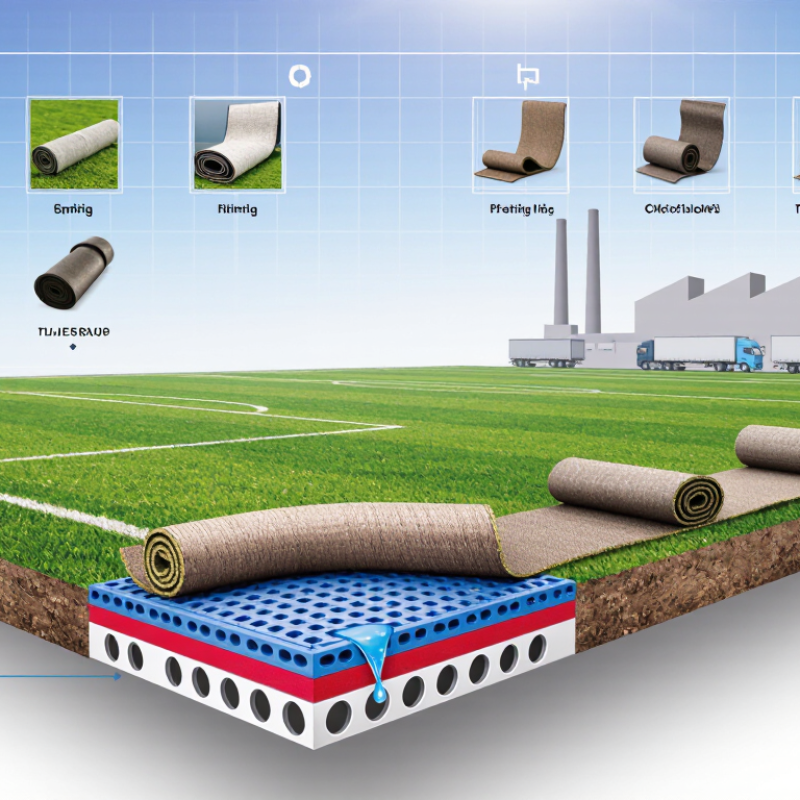
Football fake turf is a layered playing surface, not just green fibers. It usually combines synthetic grass, infill, and a prepared base. FIFA’s Quality Programme for Football Turf evaluates performance through tests including ball roll, shock absorption, vertical deformation, and rotational resistance. These measures help buyers compare how a surface may play and respond underfoot. A full-size international field, under FIFA’s Laws of the Game, measures 100–110 meters long and 64–75 meters wide. Smaller sites can use reduced layouts. Fit matters.
Common applications include community pitches, school grounds, training areas, and indoor football facilities. Synthetic turf can support frequent use where natural grass has limited recovery time, though drainage, maintenance, and local climate still matter. A school field may need durable fibers and clear line markings; a training pitch may prioritize consistent ball response. One detail is easy to overlook: a surface that feels firm in dry weather may behave differently after heavy rain or infill movement. Buyers should assess the base and drainage, not only the turf pile.
Tips: Ask for independent test results against FIFA football-turf criteria. Check sample areas underfoot, inspect seams, and confirm the proposed system suits the intended level of play. Small details count.
Football turf design starts with the way a field will be used. Designers consider player movement, expected foot traffic, local weather, and the base beneath the surface. Yarn shape and pile height affect how the ball rolls and how the surface feels underfoot. There is no single ideal specification for every site. A system that works well in a dry climate may need different drainage details in a rainy one. Small choices matter.
During manufacturing, synthetic yarn is extruded, tufted into a backing, and secured with a coating. The finished rolls are checked for pile consistency, backing strength, and dimensional stability. Drainage also depends on the prepared base, not just the turf itself. Infill can help support the fibers, but the amount and material should match the product design and maintenance plan. A common mistake is focusing only on appearance. A neat green sample cannot show how seams or drainage will perform after repeated use.
Tips: Ask for product test data and installation guidance, and inspect a full-size sample if possible. Check seam details and confirm that the proposed system suits your climate and field use. Even careful specifications cannot replace good installation; that part is easy to underestimate.
Buyers comparing football turf manufacturers should check complete-system test reports, not just yarn specifications. Relevant criteria include shock absorption, vertical deformation, rotational resistance, ball roll, and ball rebound. These measurements help show how the surface responds to players and match play. Confirm that the tested system matches the proposed turf, infill, and shock pad. Look for testing against recognized football-turf requirements, such as the applicable FIFA Quality Programme criteria, where relevant to the project. Numbers need context. Ask for the test date, laboratory, and sample construction.
Performance also depends on practical details. Pile height and stitch density affect surface feel, while infill depth can influence traction and ball movement. Check drainage capacity using the expected rainfall and the site’s sub-base design. Weak seams or uneven infill can undermine otherwise good test results. Ask how the manufacturer controls production consistency and supports installation checks. Request sample panels, then inspect backing, tuft bind, and fiber recovery after repeated bending. Test it wet. A specification cannot predict every site condition, and that is worth admitting. Sun exposure, maintenance habits, and local use may change performance over time. Compare warranties carefully, but treat them as supporting evidence, not proof of durability.
A brand-neutral evaluation framework for comparing football artificial-turf suppliers. Assess the complete tested system—not just the turf carpet—including infill, shockpad, base, installation, and maintenance requirements.
| Buyer Evaluation Factor | Relevant Standard or Reference | What to Compare | Evidence to Request |
|---|---|---|---|
| Football-specific performance certification | FIFA Quality Programme for Football Turf | Check whether the proposed system has been tested to the applicable FIFA category. Confirm that the tested construction matches the quoted carpet, infill, shockpad, and installation method. | Current certificate or test documentation; product and system identification; test date; and confirmation of the applicable FIFA requirements. |
| Outdoor synthetic-surface requirements | EN 15330-1, for synthetic turf and needle-punched surfaces primarily designed for outdoor sports use | Review the declared product characteristics and the test results relevant to the intended sport and project. Verify that the specification covers the complete proposed system. | Test reports identifying the tested product configuration, test methods, results, and laboratory. |
| Shock absorption and vertical deformation | FIFA football-turf test requirements; ASTM F355 is a test method for measuring impact attenuation of playing surfaces | Compare measured results with the limits for the selected certification category and the project specification. These are system-level properties and can change with the shockpad, infill, and base. | Test results for the specified system, plus confirmation of the test method, conditioning, and tested locations. |
| Ball roll and vertical ball rebound | FIFA Quality Programme test requirements; EN 15330-1 where applicable | Check measured ball-roll distance and rebound results against the applicable category requirements. Confirm that the test report refers to the proposed pile, infill, and system build-up. | Independent test report with the measured values, test conditions, and system configuration. |
| Rotational resistance and player-surface interaction | FIFA football-turf test requirements | Review the measured rotational-resistance result against the relevant category criteria. Confirm that the surface is tested with the specified infill and maintained at the stated level. | Test report with the measured result, test method, system details, and maintenance condition during testing. |
| Pile height and carpet construction | Project specification and the system configuration used in applicable performance tests | Football turf commonly uses pile heights in the approximate 40–60 mm range, but the correct specification depends on the tested system and intended use. Compare pile height, yarn type, stitch rate, gauge, backing, and total carpet mass. | Technical datasheet, product sample, manufacturing tolerances, and confirmation that the supplied carpet matches the tested construction. |
| Infill specification | Project requirements and applicable product-safety regulations | Compare declared infill type, particle size, required quantity per square metre, installation depth, and top-up needs. Options can include mineral, polymer, or organic materials; suitability depends on the complete system and local requirements. | Material declaration, safety data where applicable, installation specification, and system test documentation. |
| Drainage and water management | EN 15330-1 and project-specific drainage design | Check the system’s documented water permeability alongside the design of the sub-base, falls, drainage outlets, and local rainfall conditions. Carpet permeability alone does not establish field drainage capacity. | Permeability test results, civil-design drawings, drainage calculations, and installation details. |
| Weathering and colour durability | EN 14836, which addresses artificial weathering of synthetic sports surfaces | Compare evidence of resistance to weathering and colour change for the proposed materials. Ask how the test evidence relates to the climate and expected exposure at the project site. | Weathering test report, material identification, and product warranty terms for colour and material performance. |
| Seams, joints, and installation quality | Project specification, installation method statement, and applicable system test requirements | Review seam layout, jointing materials, edge details, infill installation, and quality-control checks. Site workmanship can affect both performance and service life. | Installation drawings, method statement, installer references, inspection records, and completed-field acceptance tests where specified. |
| Maintenance and service-life planning | Manufacturer’s written maintenance instructions and project operating plan | Compare routine brushing, infill redistribution, debris removal, inspection frequency, and expected maintenance resources. Service life depends on use, climate, construction, and maintenance. | Maintenance schedule, recommended equipment, annual service-cost estimate, and written warranty exclusions and conditions. |
| Environmental and quality-management documentation | ISO 9001 and ISO 14001, where claimed; applicable local environmental rules | Treat management-system certificates as evidence of management processes, not as proof of football-field performance. Review the declared material composition and applicable end-of-life or recycling options. | Valid certificates within their stated scope, material declarations, and project-specific environmental documentation. |
Buyer note: Standards and certification requirements may be revised. Confirm the applicable edition, category, and local requirements at the time of procurement. Compare independent test results for the exact system offered; do not treat a component-only test or a management-system certificate as proof that a complete field meets football performance requirements.
When comparing football turf manufacturers in 2026, look beyond pile height and sample color. Grand View Research valued the global artificial turf market at about USD 4.2 billion in 2023, but this figure covers multiple applications, not football turf alone. Treat market growth as context, not proof of product quality. FIFA’s Quality Programme for Football Turf uses laboratory and field testing to assess performance. Ask whether test results cover the exact proposed system, including turf, infill, and shock pad. Ask for proof.
Compare fiber shape, yarn thickness, stitch rate, backing, drainage design, and seam details. Request independent test reports and check their dates. FIFA field testing includes ball behavior, shock absorption, and player-surface interaction; a generic certificate may not represent a different system configuration. Check references for fields with similar use and climate. A clean sample can hide weak seams or inconsistent drainage. That is easy to miss.
Tips: Ask manufacturers for a written bill of materials, maintenance schedule, warranty exclusions, and replacement guidance. Compare installed cost, not just the turf price. Visit a completed field after rain, if possible, and inspect seams, infill distribution, and surface firmness. One uneasy point: brochures rarely show performance after years of heavy use, so request long-term project references and verify them independently.
Use these IFAB field-dimension ranges to check whether a proposed turf system can accommodate the intended pitch size.
Dimensions are in metres. The ranges come from IFAB’s Laws of the Game, Law 1. They describe permitted field dimensions—not manufacturer performance ratings. Confirm project requirements and competition rules before specifying a turf system.
2026 Top Football Fake Turf Manufacturers for Buyers
Choosing a football turf supplier takes more than comparing price per square metre. Ask how the surface is built: what yarn material, pile height, stitch rate, and backing are specified? Request a product sheet and independent test reports, then check that the tested product matches the quotation. A sample can feel soft in your hand yet behave differently under boots. Small details matter.
Tips: Ask about drainage performance, infill requirements, UV resistance, and recommended maintenance. Get installation responsibilities, delivery timing, and warranty exclusions in writing. Ask for references from fields with similar use and climate. If possible, inspect a finished pitch after rain and during play. Ask for proof.
Clarify who handles base preparation, seams, line markings, and repairs. A supplier should explain how the system suits training frequency, local weather, and expected user load. Ask what wear or damage is not covered by the warranty. Compare complete system costs, not just turf prices, since infill, transport, and installation can change the budget. I have seen buyers focus on the quoted lifespan; that figure is less useful without clear maintenance conditions and realistic usage assumptions. Review the details before committing.
We use cookies on our website to give you an improved browser experience. View our Privacy Policy for more information. Please make your selection to opt in or out of ALL cookies here: Accept or Decline
Do you consent to the use of ALL cookies?
901 2nd Court West
Birmingham, AL 35204
Sales: 866.481.4036
Logistics/Ops: 866.481.4036
2101 Dralle Road
University Park, IL 60466
Sales: 708.813.9070
Logistics/Ops: 708.235.4200
400 E. 13th Street
Little Rock, AR 72114
Sales: 866.760.5344
Logistics/Ops: 866.760.5344
225 Collins Road
Elkhart, IN 46515
Sales: 574.295.0214
Logistics/Ops: 574.607.4611
601 Berryman Pike
Tipton, IN 46072
Sales: 800.897.7591
Logistics/Ops: 800.897.7591
3900 Uvalda Street
Denver, CO 80239
Sales: 303.706.8000
Ops/Logistics: 303.576.8398
510 3rd Street E
Milan, IL 61264
Sales: 800.322.1052
Logistics/Ops: 800.322.1052
1660 E. Aurora
Des Moines, IA 50313
Sales: 800.671.1660
Logistics: 800.671.1660
86554 Gene Lasserre Blvd.
Yulee, FL 32097
Sales: 904.253.3060
Logistics/Ops: 904.225.3000
694 S.E. County Road 245
Lake City, FL 32025
Sales: 800.727.6706
Logistics/Ops: 386.752.7412
210 Neptune Road
Auburndale, FL 33823
Sales: 863.967.1131
Logistics/Ops: 863.777.9814
4601 McCoy Drive
Pensacola, FL 32503
Sales: 850.308.7030
Logistics/Ops: 850.434.5502
815 South 56th Street
Tampa, FL 33619
Sales: 813.302.1940
Logistics/Ops: 813.621.1352
200 Hosea Road
Lawrenceville, GA 30046
Sales: 770.953.7575
Logistics/Ops: 770.513.6000
Branch Product Guide
Branch Line Card
Moulding Offering
Cedar Offering
Column Offering
8173 Hwy. 165 North
Monroe, LA 71211
Sales: 800.256.4165
Logistics/Ops: 800.256.4165
508 Warren Avenue
Portland, ME 04103
Sales: 207.888.2331
Logistics/Ops: 207.797.6565
4300 Georgia Pacific Blvd.
Frederick, MD 21704
Sales: 301.798.7474
Logistics/Ops: 301.874.8000
419 Maple Street
Bellingham, MA 02019
Sales: 508.449.0535
Logistics/Ops: 508.966.5500
825 Buchanan Ave SW
Grand Rapids, MI 49507
Sales: 877.800.1180
Logistics/Ops: 616.278.0909
995 Pacific St. NW
Aitkin, MN 56431
Sales: 800.432.3727
Logistics/Ops: 218.212.7770
1102 Port Terminal Drive
Duluth, MN 55802
Sales: 800.951.9899
Logistics/Ops: 800.851.9899
9110 83rd Ave. North
Brooklyn Park, MN 55445
Sales: 763.425.0204
Logistics/Ops: 763.425.0204
910 E. Railroad Street
Long Beach, MS 39560
Sales: 866.535.4135
Logistics/Ops: 228.205.2400
1727 Warren Street
North Kansas City, MO 64116
Sales: 800.621.2611
Logistics/Ops: 800.621.2611
2123 North Golden
Springfield, MO 65803
Sales: 800.375.7891
Logistics/Ops: 800.375.7891
13860 Corp. Woods Trail
Bridgeton, MO 63044
Sales: 314.209.0800
Logistics/Ops: 314.209.0800
1109 South 19th Street
Omaha, NE 68108
Sales: 800.489.6637
Logistics/Ops: 800.489.6637
1 Luger Road
Denville, NJ 07834
Sales: 973-339-3539
Logistics/Ops: 973.625.1461
3720 Jeffrey Blvd.
Blasdell, NY 14219
Sales: 716.235.5989
Logistics/Ops: 716.825.6557
319 Yaphank Ave.
Yaphank, NY 11980
Sales: 631.358.5714
Logistics/Ops: 631.924.7401
3300 Parkside Drive
Charlotte, NC 28208
Sales: 800.839.2588
Logistics/Ops: 704.394.3172
1712 East D Street
Butner, NC 27509
Sales: 984.389.8200
Logistics/Ops: 919.575.3700
128 Foothills Drive
Statesville, NC 28687
Sales: 800.222.1414
Logistics/Ops: 704.394.3172
550 Munroe Falls Rd.
Tallmadge, OH 44278
Sales: 330.357.4506
Logistics/Ops: 330.794.1141
10347 Toebben Dr.
Independence, KY 41051
Sales: 859.298.3926
Logistics/Ops: 859.746.2250
450 N. MacArthur
Oklahoma City, OK 73127
Sales: 800.375.6025
Logistics/Ops: 800.375.6025
1680 North Aspen
Broken Arrow, OK 74012
Sales: 918.272.2212
Logistics/Ops: 918.272.2212
522 Bridge Street
Hunker, PA 15639
Sales: 878.217.2001
Logistics/Ops: 724.925.7285
4290 Atlanta Street
Charleston, SC 29418
Sales: 843.371.1420
Logistics/Ops: 843.554.8192
1040 S. Industrial Dr.
Erwin, TN 37650
Sales: 423.641.1005
Logistics/Ops: 423.742.5911
4287 Pilot Drive
Memphis, TN 38118
Sales: 901.365.2101
Logistics/Ops: 901.365.2101
700 Myatt Drive
Madison, TN 37115
Sales: 615.327.9547
Logistics/Ops: 629.777.4949
4747 Mark IV Parkway
Fort Worth, TX 76106
Sales: 866.323.5117
Logistics/Ops: 817.625.9091
6990 Market Avenue
El Paso, TX 79915
Sales: 915.778.6356
Logistics/Ops: 915.265.7200
2502 Wilson Road
Harlingen, TX 78552
Sales: 800.580.6711
Logistics/Ops: 800.580.6711
10,000 North Loop East
Houston, TX 77029
Sales: 713.921.1977
Logistics/Ops: 713.675.3544
702 East 44th St.
Lubbock, TX 79404
Sales: 866.454.6010
Logistics/Ops: 866.454.6010
535 N. WW White Road
San Antonio, TX 78219
Sales: 800.284.0488
Logistics/Ops: 210.333.8112
142 Pine Haven Shores Rd.
Shelburne, VT 05482
Sales: 802.800.2540
Logistics/Ops: 802.985.2512
4700 Bethlehem Road,
Richmond, VA 23230
Sales: 804.201.2400
Logistics/Ops: 804.342.1161
4516 N Barker Road
Spokane Valley, WA 99027
Phone: 509.892.9420
Toll free: 800.728.6157
8365 N. 76th Street
Milwaukee, WI 53223
Sales: 800.356.9245
Logistics/Ops: 800.356.9245
312 S. Chester Street
Sparta, WI 54656
Sales: 800.362.5864
Logistics/Ops: 800.362.5864
899 Grossman Drive
Schofield, WI 54476
Sales: 800.472.0017
Logistics/Ops: 800.472.0017
