
We use cookies on our website to give you an improved browser experience. View our Privacy Policy for more information. Please make your selection to opt in or out of ALL cookies here: Accept or Decline
Hose Clamps may look like simple bands of metal, but the right choice can protect a connection from leaks, vibration, and costly downtime. For global buyers, the decision involves more than size. Material, clamp style, tightening method, and working conditions all matter. A clamp suited to a smooth automotive hose may not be right for a thick industrial line. Small details count.
This guide uses a clearly fictional expert voice, Maya Chen, to express a practical buying principle: “Choose the clamp for the hose, the environment, and the load—not for price alone.” This is an editorially written line, not a verified quotation from a real industry expert. That distinction matters. Reliable purchasing advice should be traceable, and product claims should be checked against manufacturer specifications and test data.
The 2026 overview compares worm-drive, T-bolt, spring, ear, and other common Hose Clamps. It highlights where each type can work well, what buyers should inspect, and which trade-offs deserve attention. Stainless steel can help in corrosive settings, but grade and exposure still matter. A wide adjustment range is useful, yet it cannot fix a poorly matched hose. There is no universal winner. Real installations are messier than catalog tables, so buyers should confirm dimensions, pressure needs, temperature range, and service conditions before ordering.
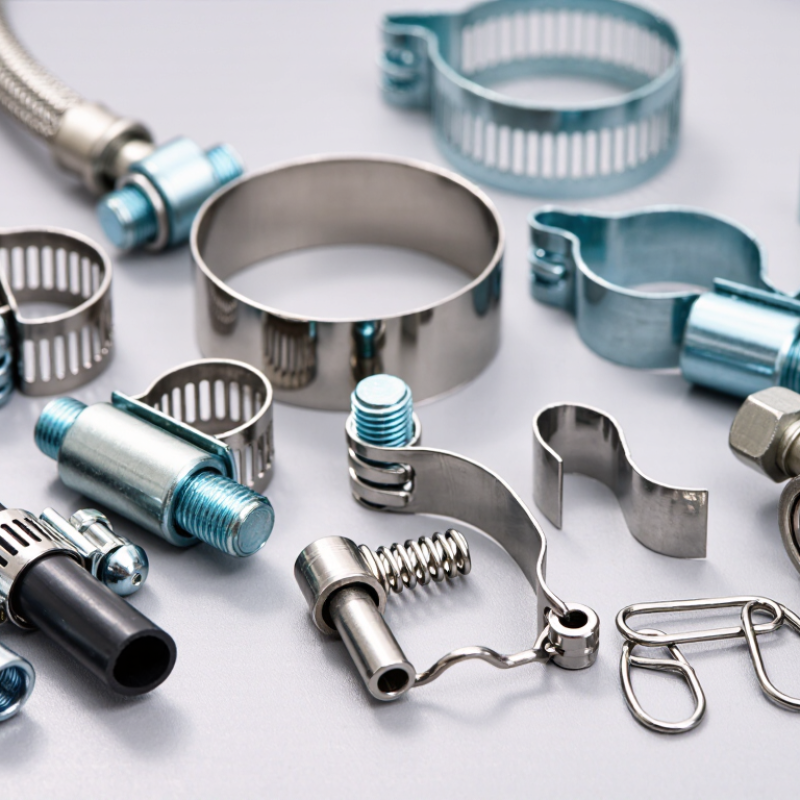
A hose clamp is a mechanical band that tightens around a hose and its fitting. The band compresses the hose against the fitting’s surface, helping resist leaks, vibration, and pull-off forces. On a workbench, the difference can be visible: a properly seated clamp leaves even pressure around the hose, not a deep bite on one side. Small gaps matter. Clamp choice depends on hose material, fluid, temperature, pressure, and exposure to corrosion. A clamp that fits a garden hose may not suit a vibrating engine line.
Common designs include screw-driven band clamps, spring clamps, and wire clamps. Screw-driven types allow adjustment; spring designs maintain force as hose dimensions shift with temperature. Yet no clamp can correct a damaged hose or mismatched fitting. That point is easy to overlook. SAE J1508 provides performance requirements and test methods for many automotive hose clamps, giving engineers a reference beyond appearance or nominal diameter. For compressed-air connections, the U.S. Department of Energy’s Compressed Air Tip Sheet #3 reports that leaks can waste 20–30% of compressor output in typical industrial systems. This figure concerns system leaks overall, not clamps alone, but it shows why connection checks matter. Inspect for looseness, corrosion, hose cuts, and uneven compression, then verify the joint under operating conditions. A tidy installation helps, but it is not proof of a leak-free seal.
What hose clamps are and how they secure connections
Hose clamps compress a hose around a fitting to help secure the connection. This chart compares representative band widths for common clamp types; actual dimensions vary by size and design. Choose a clamp compatible with the hose, fitting, operating conditions, and required tightening method.
Hose-clamp performance depends on more than tightening force. Band width, edge finish, screw geometry, and housing strength all affect how evenly pressure reaches the hose. A smooth, rounded band edge helps reduce cuts in soft rubber, while a perforated band can offer flexibility but may leave pressure marks. For thin-wall or reinforced hoses, match the clamp’s working range to the hose’s actual outside diameter—not just its nominal size. Small mismatch, big leak.
Material choice follows the operating environment. Galvanized carbon steel suits many dry, indoor applications; stainless steel is often selected where moisture or cleaning is frequent. World Stainless reported global stainless-steel crude production of 58.4 million tonnes in 2023, showing the scale of the material supply base, not a guarantee of clamp quality. For corrosive service, alloy grade matters: salt exposure, temperature, and trapped moisture can change performance. “Stainless” alone is not enough detail.
Design verification matters, too. SAE J1508 provides performance requirements for many automotive hose clamps, while ASTM B117 describes salt-spray testing. ASTM cautions that test results do not reliably predict service life in every environment. A clamp may pass a laboratory test and still fail early when crevices retain water or installation torque is inconsistent. Check the material specification, band dimensions, and test conditions against the real assembly. The overlooked detail is often the hose itself.
| Hose Clamp Type | Key Design Features | Common Materials | Typical Applications | Selection Considerations |
|---|---|---|---|---|
| Worm-Drive (Band) Clamp | A perforated or embossed band tightens around the hose when a screw engages with the band. Adjustable and generally reusable. | Stainless steel band and housing; stainless or plated-carbon-steel screw. Common stainless grades include 304 and, for greater corrosion resistance, 316. | General-purpose connections in automotive, plumbing, irrigation, and industrial service. | Check hose diameter range, band width, edge finish, and material compatibility. The screw and band should be tightened evenly without damaging soft hose. |
| T-Bolt Clamp | A wide band closes with a T-shaped bolt and nut, typically with a spring or bridge feature to maintain a secure, even circumferential load. | Stainless-steel band, bolt, and nut; some designs use plated or coated steel components. | Large-diameter or heavy-duty hose connections, including charge-air, industrial, and certain vehicle systems. | Choose a size and band width suited to the hose and connection. Confirm the clamp is designed for the system’s pressure, vibration, and temperature conditions. |
| Spring-Band Clamp | A formed spring-steel ring applies radial force and can accommodate modest hose-diameter changes as temperature varies. | Heat-treated spring steel, often with a corrosion-resistant coating; stainless spring steel is available for demanding environments. | Factory-installed automotive and appliance hose connections, especially where temperature cycling occurs. | Requires compatible hose geometry and suitable installation access. Verify the clamp’s operating range and corrosion resistance for the environment. |
| Constant-Tension Clamp | Uses a spring element, often combined with a band and bolt, to help maintain clamping force as the hose expands or contracts. | Stainless-steel band and hardware with a spring element made from spring steel or stainless spring material. | Hose assemblies exposed to temperature swings, vibration, or changing operating conditions. | Spring travel and clamp size must match the hose and connection. It does not replace proper hose selection or system-level pressure validation. |
| Ear Clamp | A one-piece band is tightened by crimping one or more raised “ears” with a suitable tool. The installed joint has a compact profile. | Stainless steel or zinc-coated carbon steel, depending on the required corrosion resistance and application. | Small-bore tubing and hose assemblies in automotive, appliance, and fluid-handling applications. | Installation usually requires a dedicated crimping tool, and removal may damage the clamp. Select the correct size for the hose and fitting combination. |
| Wire Clamp | One or two formed wire loops tighten around the hose, concentrating force along narrow contact areas. | Spring steel, plated steel, or stainless-steel wire. | Selected low-profile connections and applications where a narrow clamp is appropriate. | Confirm that the hose can tolerate the localized contact pressure. It may be unsuitable for hose constructions that require a broad, evenly distributed band. |
| V-Band Clamp | A V-shaped band draws matching flanges together when tightened, creating a quick-release joint between flanged components. | Stainless steel or plated steel; material selection depends on temperature, corrosion exposure, and joint requirements. | Flanged exhaust, turbocharger, ducting, and process-equipment connections. | Designed primarily to secure mating flanges rather than clamp a hose directly. Flange profile, alignment, temperature, and sealing method must be compatible. |
| Buyer note: Clamp performance depends on the hose, fitting, installation method, operating temperature, vibration, and fluid or environmental exposure. Verify dimensions, material specifications, and suitability against the equipment manufacturer’s requirements before purchase. | ||||
Worm-drive clamps remain a common choice for general-purpose hose connections. Their slotted bands tighten with a screw, making adjustment straightforward with basic hand tools. Buyers should check the clamp’s usable diameter range, band width, and edge finish against the hose. A sharp or poorly finished edge can damage softer hose material. T-bolt clamps provide broader band contact and strong tightening force, so they are often considered for larger hoses or equipment exposed to vibration. They need accurate sizing; overtightening can deform a hose. Small details matter.
Spring clamps use elastic force to maintain pressure as temperatures change, which can suit some automotive and heating applications. Wire clamps have a simple, lightweight design and are often used on smaller hoses where space is limited. Ear clamps create a compact, permanent connection when installed with the correct tool, but removal usually means replacing the clamp. Constant-tension designs may help where hoses experience repeated heat cycles. No type fits every job. Before ordering, compare hose outside diameter, working temperature, pressure, fluid exposure, and installation access. Ask suppliers for dimensional drawings and material details, then test a sample on the actual hose assembly when practical. Published sizing charts are useful, but real hose dimensions can vary slightly. That uncertainty deserves attention.
Match the clamp to the hose’s actual working conditions, not just its outside diameter. Check the hose maker’s pressure and temperature ratings, then consider pressure spikes, vibration, and fluid exposure. A worm-drive clamp can suit many low-pressure connections, while constant-tension designs help accommodate heat-related expansion and contraction. For high-pressure hydraulic systems, a clamp is not a substitute for a hose assembly and fitting rated for that duty.
SAE J1508 provides performance requirements for hose clamps; compare test documentation, not appearance alone. Small details matter.
Material and band design must also suit the hose. A wide, smooth band spreads load more evenly on soft rubber; a narrow or perforated band can cut into it if overtightened. Stainless steel can help resist corrosion, but confirm compatibility with the surrounding environment.
The U.S. Department of Energy’s compressed-air sourcebook reports that leaks can waste 20–30% of compressor output in typical systems, underscoring why a secure, inspected connection matters. ISO 6803 describes impulse testing for hydraulic hose assemblies, a reminder that pressure cycling deserves attention.
Measure the hose after installation, tighten to the supplier’s specified torque, and recheck after operation. I would still verify the joint under real conditions; a neat-looking clamp can hide a poor seal.
Hose clamp selection starts with the hose, not the catalog. Worm-drive clamps suit many general-purpose connections, while spring clamps maintain tension as temperatures change. T-bolt designs provide stronger, more even compression on larger hoses and equipment exposed to vibration. In a repair shop, a clamp must tighten without cutting the hose wall. Small details matter.
Quality checks should match the application. Buyers can request material grades, dimensional tolerances, torque guidance, and traceable inspection records. Stainless steel may resist corrosion, but its performance depends on the alloy, surface finish, and surrounding environment. Ask whether samples have been tested for corrosion, vibration, and repeated tightening. A neat datasheet is not proof. Industry certifications, such as an ISO 9001 quality-management certificate, can indicate controlled processes, but they do not guarantee every clamp suits a specific system.
Sourcing discussions should cover hose diameter range, band width, edge finish, screw engagement, packaging, and batch consistency. Confirm whether stated torque values are installation limits or test results; confusing them can damage a hose. For critical equipment, trial clamps on the actual hose and fitting under realistic temperatures. This takes time. It may still miss an unusual operating condition, so document the limits and review them with the engineering team before ordering at scale.
We use cookies on our website to give you an improved browser experience. View our Privacy Policy for more information. Please make your selection to opt in or out of ALL cookies here: Accept or Decline
Do you consent to the use of ALL cookies?
901 2nd Court West
Birmingham, AL 35204
Sales: 866.481.4036
Logistics/Ops: 866.481.4036
2101 Dralle Road
University Park, IL 60466
Sales: 708.813.9070
Logistics/Ops: 708.235.4200
400 E. 13th Street
Little Rock, AR 72114
Sales: 866.760.5344
Logistics/Ops: 866.760.5344
225 Collins Road
Elkhart, IN 46515
Sales: 574.295.0214
Logistics/Ops: 574.607.4611
601 Berryman Pike
Tipton, IN 46072
Sales: 800.897.7591
Logistics/Ops: 800.897.7591
3900 Uvalda Street
Denver, CO 80239
Sales: 303.706.8000
Ops/Logistics: 303.576.8398
510 3rd Street E
Milan, IL 61264
Sales: 800.322.1052
Logistics/Ops: 800.322.1052
1660 E. Aurora
Des Moines, IA 50313
Sales: 800.671.1660
Logistics: 800.671.1660
86554 Gene Lasserre Blvd.
Yulee, FL 32097
Sales: 904.253.3060
Logistics/Ops: 904.225.3000
694 S.E. County Road 245
Lake City, FL 32025
Sales: 800.727.6706
Logistics/Ops: 386.752.7412
210 Neptune Road
Auburndale, FL 33823
Sales: 863.967.1131
Logistics/Ops: 863.777.9814
4601 McCoy Drive
Pensacola, FL 32503
Sales: 850.308.7030
Logistics/Ops: 850.434.5502
815 South 56th Street
Tampa, FL 33619
Sales: 813.302.1940
Logistics/Ops: 813.621.1352
200 Hosea Road
Lawrenceville, GA 30046
Sales: 770.953.7575
Logistics/Ops: 770.513.6000
Branch Product Guide
Branch Line Card
Moulding Offering
Cedar Offering
Column Offering
8173 Hwy. 165 North
Monroe, LA 71211
Sales: 800.256.4165
Logistics/Ops: 800.256.4165
508 Warren Avenue
Portland, ME 04103
Sales: 207.888.2331
Logistics/Ops: 207.797.6565
4300 Georgia Pacific Blvd.
Frederick, MD 21704
Sales: 301.798.7474
Logistics/Ops: 301.874.8000
419 Maple Street
Bellingham, MA 02019
Sales: 508.449.0535
Logistics/Ops: 508.966.5500
825 Buchanan Ave SW
Grand Rapids, MI 49507
Sales: 877.800.1180
Logistics/Ops: 616.278.0909
995 Pacific St. NW
Aitkin, MN 56431
Sales: 800.432.3727
Logistics/Ops: 218.212.7770
1102 Port Terminal Drive
Duluth, MN 55802
Sales: 800.951.9899
Logistics/Ops: 800.851.9899
9110 83rd Ave. North
Brooklyn Park, MN 55445
Sales: 763.425.0204
Logistics/Ops: 763.425.0204
910 E. Railroad Street
Long Beach, MS 39560
Sales: 866.535.4135
Logistics/Ops: 228.205.2400
1727 Warren Street
North Kansas City, MO 64116
Sales: 800.621.2611
Logistics/Ops: 800.621.2611
2123 North Golden
Springfield, MO 65803
Sales: 800.375.7891
Logistics/Ops: 800.375.7891
13860 Corp. Woods Trail
Bridgeton, MO 63044
Sales: 314.209.0800
Logistics/Ops: 314.209.0800
1109 South 19th Street
Omaha, NE 68108
Sales: 800.489.6637
Logistics/Ops: 800.489.6637
1 Luger Road
Denville, NJ 07834
Sales: 973-339-3539
Logistics/Ops: 973.625.1461
3720 Jeffrey Blvd.
Blasdell, NY 14219
Sales: 716.235.5989
Logistics/Ops: 716.825.6557
319 Yaphank Ave.
Yaphank, NY 11980
Sales: 631.358.5714
Logistics/Ops: 631.924.7401
3300 Parkside Drive
Charlotte, NC 28208
Sales: 800.839.2588
Logistics/Ops: 704.394.3172
1712 East D Street
Butner, NC 27509
Sales: 984.389.8200
Logistics/Ops: 919.575.3700
128 Foothills Drive
Statesville, NC 28687
Sales: 800.222.1414
Logistics/Ops: 704.394.3172
550 Munroe Falls Rd.
Tallmadge, OH 44278
Sales: 330.357.4506
Logistics/Ops: 330.794.1141
10347 Toebben Dr.
Independence, KY 41051
Sales: 859.298.3926
Logistics/Ops: 859.746.2250
450 N. MacArthur
Oklahoma City, OK 73127
Sales: 800.375.6025
Logistics/Ops: 800.375.6025
1680 North Aspen
Broken Arrow, OK 74012
Sales: 918.272.2212
Logistics/Ops: 918.272.2212
522 Bridge Street
Hunker, PA 15639
Sales: 878.217.2001
Logistics/Ops: 724.925.7285
4290 Atlanta Street
Charleston, SC 29418
Sales: 843.371.1420
Logistics/Ops: 843.554.8192
1040 S. Industrial Dr.
Erwin, TN 37650
Sales: 423.641.1005
Logistics/Ops: 423.742.5911
4287 Pilot Drive
Memphis, TN 38118
Sales: 901.365.2101
Logistics/Ops: 901.365.2101
700 Myatt Drive
Madison, TN 37115
Sales: 615.327.9547
Logistics/Ops: 629.777.4949
4747 Mark IV Parkway
Fort Worth, TX 76106
Sales: 866.323.5117
Logistics/Ops: 817.625.9091
6990 Market Avenue
El Paso, TX 79915
Sales: 915.778.6356
Logistics/Ops: 915.265.7200
2502 Wilson Road
Harlingen, TX 78552
Sales: 800.580.6711
Logistics/Ops: 800.580.6711
10,000 North Loop East
Houston, TX 77029
Sales: 713.921.1977
Logistics/Ops: 713.675.3544
702 East 44th St.
Lubbock, TX 79404
Sales: 866.454.6010
Logistics/Ops: 866.454.6010
535 N. WW White Road
San Antonio, TX 78219
Sales: 800.284.0488
Logistics/Ops: 210.333.8112
142 Pine Haven Shores Rd.
Shelburne, VT 05482
Sales: 802.800.2540
Logistics/Ops: 802.985.2512
4700 Bethlehem Road,
Richmond, VA 23230
Sales: 804.201.2400
Logistics/Ops: 804.342.1161
4516 N Barker Road
Spokane Valley, WA 99027
Phone: 509.892.9420
Toll free: 800.728.6157
8365 N. 76th Street
Milwaukee, WI 53223
Sales: 800.356.9245
Logistics/Ops: 800.356.9245
312 S. Chester Street
Sparta, WI 54656
Sales: 800.362.5864
Logistics/Ops: 800.362.5864
899 Grossman Drive
Schofield, WI 54476
Sales: 800.472.0017
Logistics/Ops: 800.472.0017
