We use cookies on our website to give you an improved browser experience. View our Privacy Policy for more information. Please make your selection to opt in or out of ALL cookies here: Accept or Decline
The 2026 patio market is becoming more performance-driven. Global buyers now compare daylight, thermal control, security, and long-term maintenance.
This matters because a Patio Entry Door is a large opening in the building envelope. The U.S. Department of Energy estimates that windows can represent 25–30% of residential heating and cooling energy use (Energy Saver, 2024). Patio doors share similar heat-transfer risks, especially when glass areas are large. Small frame gaps can create noticeable drafts.
Market evidence supports this shift. Grand View Research’s 2024 Doors Market Size, Share & Trends Analysis Report identifies renovation, energy efficiency, and design flexibility as important demand factors. Freedonia’s Windows & Doors industry research also highlights replacement demand and improved product performance across mature markets. These findings suggest that global buyers should evaluate more than appearance.
Steve Baczek, a building-science consultant and window-performance educator, often states, “A window is a hole in the wall.” The same principle applies to a Patio Entry Door. Its frame, glass, sill, seals, and installation must work together.
That sounds simple.
It is not always simple.
A sliding door may suit compact terraces, while folding or French systems can provide wider openings. Yet wider glass can increase solar gain, cleaning effort, and hardware stress. Climate changes the decision. Coastal buyers may need corrosion-resistant components. Cold-region buyers may prioritize low U-values and airtight installation.
This guide examines the leading 2026 Patio Entry Door types for global buyers. It compares practical performance, design value, maintenance needs, and climate suitability. Product claims still require verification. No single door type fits every home.
A patio entry door connects indoor living areas with gardens, terraces, or balconies. Unlike a solid service door, it usually combines wide glazing with a weather-resistant frame. Common types include sliding, hinged French, folding, and multi-panel doors. Each design changes movement, ventilation, daylight, and furniture placement.
The choice affects more than appearance. The United Nations Environment Programme’s 2024 Global Status Report states that buildings consume about 32% of global energy and create roughly 34% of global carbon emissions.
A poorly sealed patio door can increase drafts, moisture risks, and cooling demand. The U.S. Department of Energy also reports that windows can represent 25–30% of household heating and cooling energy use. Patio glazing deserves similar attention.
Key design features include insulated glass, low-emissivity coatings, thermal breaks, adjustable rollers, drainage channels, and multi-point locks. U-factor measures heat transfer, while solar heat gain coefficient indicates how much sunlight enters. Lower U-factor usually supports colder climates; lower solar gain can suit hot regions. Local codes and exposure conditions still matter.
Experience shows that large glass panels look impressive, but they can create glare and privacy problems. Sliding doors save floor space, yet their tracks may collect grit near beaches or construction sites. Hinged doors provide a stronger traditional seal, though they need clear swing space. No design wins everywhere. Global buyers should check tested performance reports, installation tolerances, replacement parts, and warranty terms before selecting a configuration.
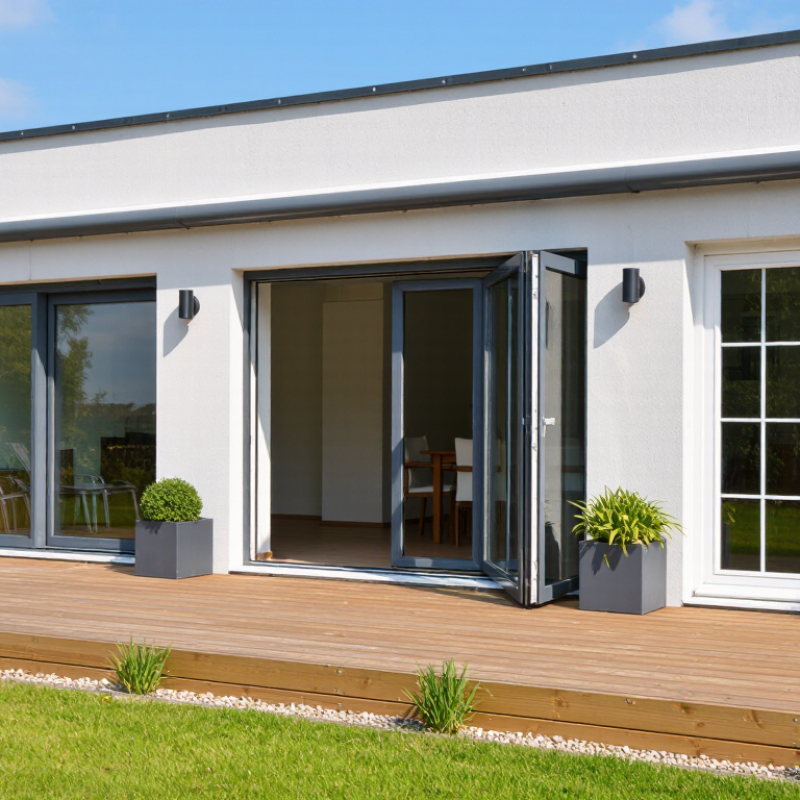
For homes, sliding patio doors remain practical where space is limited. Their panels move along a track, preserving furniture and walking areas. French patio doors suit traditional homes and provide a wider visual opening. Bi-fold doors create dramatic indoor-outdoor connections for modern residences, restaurants, and event spaces. Not every large opening needs a bi-fold system. Its hardware, alignment, and installation quality require careful attention.
Tips: Measure twice. Confirm the rough opening, drainage path, and threshold height before ordering. In colder regions, select insulated frames and low-emissivity glazing. In hot climates, prioritize solar control and shaded placement. Commercial buyers should also review traffic frequency, accessibility needs, emergency routes, and local building requirements. A beautiful door can still perform poorly when the threshold collects water.
Material choice affects long-term reliability. Aluminum offers slim sightlines and strong structural performance, while reinforced composite frames can support thermal efficiency with limited maintenance. Timber adds warmth, but it needs regular sealing in humid or coastal environments. Secure multi-point locks, laminated safety glass, and corrosion-resistant hardware are valuable for busy buildings. Project reviews often show that buyers focus on appearance first, then discover ventilation, cleaning, or replacement challenges. A more careful decision considers daily use, climate, installation skill, and future servicing.
2026 Top Patio Entry Door Types for Global Buyers
Hinged, sliding, and folding patio doors suit different openings and climates. Aluminum offers slim frames and strong corrosion resistance, while engineered wood provides warmth but needs careful sealing. Fiberglass resists moisture and temperature changes with less maintenance. A heavier door is not always safer. Frame strength, hinge quality, multipoint locking, and correct installation matter more.
Glass selection affects comfort, privacy, and security. Double glazing improves insulation in cold or hot regions, while low-emissivity coatings can reduce solar heat. Laminated glass holds together after impact and may improve forced-entry resistance. Tempered glass breaks into smaller pieces, but it does not prevent breakage. Check drainage channels, gaskets, and threshold height for wind-driven rain. Small gaps matter. Weather performance also depends on local exposure, wall construction, and installation quality.
Tips: Ask for tested air, water, and structural performance data for your climate. Confirm hardware resists corrosion near coastal areas. Inspect sample corners and seals before ordering. Do not rely on attractive glass alone. A secure door can still leak air if installed poorly. No specification is perfect, and supplier claims deserve independent verification. Test the opening after installation, especially following heavy rain or strong seasonal winds.
2026 Top Patio Entry Door Types for Global Buyers
How to Compare Patio Entry Doors for Global Buying Requirements
Compare patio entry doors by performance, not appearance alone. Sliding doors save interior space, while hinged doors usually provide a tighter seal. Folding systems create wide openings but require precise installation. Measure the rough opening, wall thickness, sill height, and clearance before requesting quotations. Small errors can cause expensive delays.
Climate should guide the specification. In coastal areas, ask for corrosion-resistant hardware and drainage details. Cold regions need low heat transfer, effective weather seals, and suitable glazing. Hot climates may require solar-control glass and shaded frame designs. Check wind, rain, and impact requirements with local professionals. A specification accepted in one country may fail another region’s building rules.
Global buyers should compare the complete supply package. Review packaging, lead time, replacement parts, installation drawings, warranty coverage, and after-sales communication. Confirm whether measurements use metric or imperial units. Examine thermal values carefully, because testing methods can differ between markets. A lower quote may exclude reinforced frames, screens, or delivery protection. That is easy to miss. In field checks, installation quality often affects performance as much as the door itself. I would not treat a perfect product sheet as proof of real-world reliability. Ask for test reports, project references, and clear responsibility when damage or fitting problems occur.
| Door Type | Typical Configuration | Common Material Options | Typical Size Range | Opening Space Required | Daylight & View | Thermal Performance | Weather & Air-Tightness Considerations | Accessibility & Operation | Best-Fit Climate or Project | Key Buying Checks for Global Orders |
|---|---|---|---|---|---|---|---|---|---|---|
| Sliding Patio Door | Two or more panels moving horizontally on top and bottom tracks; one panel commonly slides behind another. | Thermally broken aluminum, uPVC, engineered wood, or wood-aluminum composite. | Single opening: approximately 1.5–3.0 m wide and 2.0–2.4 m high; larger systems are available. | Low clearance outside the wall; no swing arc. | Large glazed area with a wide horizontal view; fixed panels can increase daylight. | Good when using double or triple insulating glass, warm-edge spacers, and thermally improved frames. | Track drainage, perimeter seals, interlocks, wind-load design, and water-test performance are important. | Generally easy to operate; select a low-threshold track for easier access, while confirming drainage requirements. | Compact balconies, apartments, modern homes, and projects where exterior space is limited. | Confirm panel weight limits, track design, corrosion protection, glass specification, handedness, and installation tolerances. |
| Hinged Patio Door | One or two leaf panels opening inward or outward from side hinges; may include a fixed sidelight. | uPVC, aluminum, fiberglass, engineered wood, or wood with weather-resistant exterior cladding. | Single leaf: approximately 0.7–1.0 m wide; double leaf: approximately 1.4–2.0 m wide; height commonly 2.0–2.4 m. | Requires a clear swing area equal to the door leaf depth. | Good daylight; paired leaves can create a broad central opening. | Often strong because the compression seal closes continuously around the frame. | Threshold height, hinge adjustment, multipoint locking, compression gaskets, and exposure to driving rain should be assessed. | Easy to use with lever hardware; outward-opening versions may improve interior space but need wind and egress review. | Traditional and contemporary residential entrances, terraces, and areas requiring a tight weather seal. | Check opening direction, local egress rules, hinge load capacity, hardware finish, threshold detail, and security requirements. |
| French Patio Door | Two hinged leaves meeting at the center, usually with a wide glazed area in each leaf. | uPVC, aluminum, timber, fiberglass, or hybrid wood-aluminum construction. | Overall width commonly 1.4–2.0 m; height commonly 2.0–2.4 m. | Requires swing space on one or both sides of the wall. | Excellent symmetrical appearance and broad clear opening when both leaves are open. | Good to very good with insulated frames, double/triple glazing, and a properly sealed meeting stile. | Center meeting-stile seals, astragal alignment, drainage, and resistance to wind-driven rain require careful specification. | Wide opening supports movement of furniture; a flush or reduced threshold can improve accessibility. | Garden rooms, villas, heritage-style projects, and homes where a classic appearance is preferred. | Confirm active/passive leaf arrangement, lock location, threshold height, swing direction, and local safety-glass rules. |
| Bi-Fold Patio Door | Two or more panels connected by hinges that fold and stack at one or both sides of the opening. | Thermally broken aluminum is common; timber and composite systems are also available. | Overall width commonly 2.4–6.0 m; individual panels are often about 0.6–1.0 m wide. | Limited swing space, but stacking panels require side parking zones. | Very wide opening and high connection between indoor and outdoor spaces. | Good to very good with thermally broken frames and insulated glazing; more panel joints can increase sealing complexity. | Track drainage, panel alignment, rollers, corner joints, weather seals, and deflection control are critical. | Low-floor systems can be convenient; operating force depends on panel size, hardware quality, and installation accuracy. | Large terraces, hospitality projects, warm climates, and indoor-outdoor entertainment areas. | Check maximum panel dimensions, stacking layout, sill drainage, wind exposure, floor-level tolerances, and replacement hardware access. |
| Multi-Slide Door | Several large panels slide along parallel tracks and usually stack or disappear into a wall pocket. | Thermally broken aluminum, with steel reinforcement where required by size or wind load. | System widths commonly range from about 3.0 m to more than 10 m; panel heights often reach 2.4–3.5 m depending on design. | Minimal swing space; stacking bays or concealed wall pockets are required. | Maximum uninterrupted glazing and very wide clear openings. | Good to very good when the frame, glass, spacers, and interlocks are engineered for the project climate. | Large glass areas require structural calculations, wind-load verification, accurate drainage, and careful site installation. | Can be easy to slide when correctly balanced; large panels may require assisted hardware or coordinated operation. | Premium residences, resorts, commercial lounges, and wide architectural openings. | Verify structural loads, panel weight, track count, pocket dimensions, wind and water ratings, delivery access, and service planning. |
| Lift-and-Slide Door | A handle lifts the panel slightly from its seals so it can move smoothly along a heavy-duty track; it then lowers to seal closed. | Thermally broken aluminum, wood-aluminum, or reinforced composite frames. | Panel widths commonly range from about 1.0–3.5 m; multi-panel openings may exceed 6 m. | Very little swing space; requires track and, in some designs, a stacking or pocket area. | Large panels with slim sightlines and wide exterior views. | Very good potential because the lowered panel can compress high-performance seals effectively. | Threshold drainage, track protection, seal compression, wind-load design, and glass deflection control are essential. | Smooth operation for heavy panels when properly installed; threshold design must balance accessibility with water management. | High-end homes, cold or windy regions, coastal projects, and large openings requiring strong weather control. | Confirm maximum sash weight, glass build-up, track configuration, locking points, corrosion class, and installation support. |
| Pivot Patio Door | A large door leaf rotates on concealed or visible pivot hardware positioned near the side or inside the leaf. | Aluminum, steel, fiberglass, engineered wood, or oversized composite construction. | Common leaf widths are approximately 1.0–2.0 m, with heights often around 2.1–3.2 m. | Requires a swing arc and sufficient clearance for the pivot offset. | Strong architectural impact with a large glazed or partially glazed leaf. | Varies significantly; performance depends on frame design, gasket continuity, panel size, and glass specification. | Threshold, pivot alignment, wind pressure, closing control, and perimeter seals need project-specific engineering. | Suitable for wide leaves, but operation can be affected by wind and panel weight; controlled closing hardware is advisable. | Contemporary villas, signature entrances, and projects prioritizing distinctive architectural design. | Check pivot capacity, swing clearance, wind restraint, emergency egress, replacement parts, and installation calibration. |
| Tilt-and-Slide Door | The panel tilts inward for controlled ventilation and slides horizontally for a larger opening. | uPVC, thermally broken aluminum, timber, or composite frames. | Typical panel widths are approximately 0.8–1.8 m; overall openings commonly reach 2.0–4.0 m. | Low exterior clearance; a small interior tilt clearance is needed for ventilation mode. | Good daylight and flexible ventilation without fully opening the door. | Good to very good with multi-chamber frames, insulated glazing, and continuous perimeter seals. | Hardware adjustment, locking points, drainage, and correct sash alignment are important for long-term performance. | Useful for controlled airflow; operation may be less intuitive than a standard sliding or hinged door. | Cool, mixed, and urban climates where ventilation and space efficiency are both priorities. | Confirm hardware availability, operating instructions, sash weight limits, security class, and compatibility with local installers. |

For global buyers, patio entry doors should match the building, climate, and daily traffic. Hinged doors provide a familiar seal and suit traditional openings. Sliding doors save space and work well beside narrow patios. Folding systems create wider openings, but their hardware needs careful alignment. Measure the opening twice. A small error can cause drafts, binding, or expensive alterations. Confirm the wall structure before ordering, especially when replacing a heavy glazed door.
Professional installation should include a level threshold, secure fixings, controlled drainage, and correctly sealed joints. In coastal regions, corrosion-resistant hardware is important. In cold climates, thermal breaks and insulated glazing can reduce heat loss. Ask suppliers for performance reports covering air leakage, water resistance, wind pressure, and security testing. Standards differ between countries, so local building codes must guide the final specification. Do not assume one certificate applies everywhere. That assumption can create delays.
Maintenance affects long-term value more than many buyers expect. Clean sliding tracks regularly and remove grit before it damages rollers. Inspect weather seals every season. Replace cracked seals early. Wooden doors may need renewed coatings, while metal frames require checks for surface corrosion. A neglected threshold often becomes the first failure point. No door is maintenance-free. Even excellent installation can age poorly without inspection. I would avoid judging value by appearance alone; repair access, replacement parts, energy performance, and documented testing matter just as much.
Indicative service-life and annual-maintenance benchmarks for common patio entry door configurations. Actual results depend on climate, installation quality, hardware, usage frequency, and local building requirements.
Hinged and French doors generally offer long service lives with relatively simple maintenance. Sliding and folding systems require more frequent track, roller, alignment, and hardware checks. Buyers should verify applicable thermal, weather-resistance, safety-glazing, accessibility, and egress standards in the target market.
We use cookies on our website to give you an improved browser experience. View our Privacy Policy for more information. Please make your selection to opt in or out of ALL cookies here: Accept or Decline
Do you consent to the use of ALL cookies?
901 2nd Court West
Birmingham, AL 35204
Sales: 866.481.4036
Logistics/Ops: 866.481.4036
2101 Dralle Road
University Park, IL 60466
Sales: 708.813.9070
Logistics/Ops: 708.235.4200
400 E. 13th Street
Little Rock, AR 72114
Sales: 866.760.5344
Logistics/Ops: 866.760.5344
225 Collins Road
Elkhart, IN 46515
Sales: 574.295.0214
Logistics/Ops: 574.607.4611
601 Berryman Pike
Tipton, IN 46072
Sales: 800.897.7591
Logistics/Ops: 800.897.7591
3900 Uvalda Street
Denver, CO 80239
Sales: 303.706.8000
Ops/Logistics: 303.576.8398
510 3rd Street E
Milan, IL 61264
Sales: 800.322.1052
Logistics/Ops: 800.322.1052
1660 E. Aurora
Des Moines, IA 50313
Sales: 800.671.1660
Logistics: 800.671.1660
86554 Gene Lasserre Blvd.
Yulee, FL 32097
Sales: 904.253.3060
Logistics/Ops: 904.225.3000
694 S.E. County Road 245
Lake City, FL 32025
Sales: 800.727.6706
Logistics/Ops: 386.752.7412
210 Neptune Road
Auburndale, FL 33823
Sales: 863.967.1131
Logistics/Ops: 863.777.9814
4601 McCoy Drive
Pensacola, FL 32503
Sales: 850.308.7030
Logistics/Ops: 850.434.5502
815 South 56th Street
Tampa, FL 33619
Sales: 813.302.1940
Logistics/Ops: 813.621.1352
200 Hosea Road
Lawrenceville, GA 30046
Sales: 770.953.7575
Logistics/Ops: 770.513.6000
Branch Product Guide
Branch Line Card
Moulding Offering
Cedar Offering
Column Offering
8173 Hwy. 165 North
Monroe, LA 71211
Sales: 800.256.4165
Logistics/Ops: 800.256.4165
508 Warren Avenue
Portland, ME 04103
Sales: 207.888.2331
Logistics/Ops: 207.797.6565
4300 Georgia Pacific Blvd.
Frederick, MD 21704
Sales: 301.798.7474
Logistics/Ops: 301.874.8000
419 Maple Street
Bellingham, MA 02019
Sales: 508.449.0535
Logistics/Ops: 508.966.5500
825 Buchanan Ave SW
Grand Rapids, MI 49507
Sales: 877.800.1180
Logistics/Ops: 616.278.0909
995 Pacific St. NW
Aitkin, MN 56431
Sales: 800.432.3727
Logistics/Ops: 218.212.7770
1102 Port Terminal Drive
Duluth, MN 55802
Sales: 800.951.9899
Logistics/Ops: 800.851.9899
9110 83rd Ave. North
Brooklyn Park, MN 55445
Sales: 763.425.0204
Logistics/Ops: 763.425.0204
910 E. Railroad Street
Long Beach, MS 39560
Sales: 866.535.4135
Logistics/Ops: 228.205.2400
1727 Warren Street
North Kansas City, MO 64116
Sales: 800.621.2611
Logistics/Ops: 800.621.2611
2123 North Golden
Springfield, MO 65803
Sales: 800.375.7891
Logistics/Ops: 800.375.7891
13860 Corp. Woods Trail
Bridgeton, MO 63044
Sales: 314.209.0800
Logistics/Ops: 314.209.0800
1109 South 19th Street
Omaha, NE 68108
Sales: 800.489.6637
Logistics/Ops: 800.489.6637
1 Luger Road
Denville, NJ 07834
Sales: 973-339-3539
Logistics/Ops: 973.625.1461
3720 Jeffrey Blvd.
Blasdell, NY 14219
Sales: 716.235.5989
Logistics/Ops: 716.825.6557
319 Yaphank Ave.
Yaphank, NY 11980
Sales: 631.358.5714
Logistics/Ops: 631.924.7401
3300 Parkside Drive
Charlotte, NC 28208
Sales: 800.839.2588
Logistics/Ops: 704.394.3172
1712 East D Street
Butner, NC 27509
Sales: 984.389.8200
Logistics/Ops: 919.575.3700
128 Foothills Drive
Statesville, NC 28687
Sales: 800.222.1414
Logistics/Ops: 704.394.3172
550 Munroe Falls Rd.
Tallmadge, OH 44278
Sales: 330.357.4506
Logistics/Ops: 330.794.1141
10347 Toebben Dr.
Independence, KY 41051
Sales: 859.298.3926
Logistics/Ops: 859.746.2250
450 N. MacArthur
Oklahoma City, OK 73127
Sales: 800.375.6025
Logistics/Ops: 800.375.6025
1680 North Aspen
Broken Arrow, OK 74012
Sales: 918.272.2212
Logistics/Ops: 918.272.2212
522 Bridge Street
Hunker, PA 15639
Sales: 878.217.2001
Logistics/Ops: 724.925.7285
4290 Atlanta Street
Charleston, SC 29418
Sales: 843.371.1420
Logistics/Ops: 843.554.8192
1040 S. Industrial Dr.
Erwin, TN 37650
Sales: 423.641.1005
Logistics/Ops: 423.742.5911
4287 Pilot Drive
Memphis, TN 38118
Sales: 901.365.2101
Logistics/Ops: 901.365.2101
700 Myatt Drive
Madison, TN 37115
Sales: 615.327.9547
Logistics/Ops: 629.777.4949
4747 Mark IV Parkway
Fort Worth, TX 76106
Sales: 866.323.5117
Logistics/Ops: 817.625.9091
6990 Market Avenue
El Paso, TX 79915
Sales: 915.778.6356
Logistics/Ops: 915.265.7200
2502 Wilson Road
Harlingen, TX 78552
Sales: 800.580.6711
Logistics/Ops: 800.580.6711
10,000 North Loop East
Houston, TX 77029
Sales: 713.921.1977
Logistics/Ops: 713.675.3544
702 East 44th St.
Lubbock, TX 79404
Sales: 866.454.6010
Logistics/Ops: 866.454.6010
535 N. WW White Road
San Antonio, TX 78219
Sales: 800.284.0488
Logistics/Ops: 210.333.8112
142 Pine Haven Shores Rd.
Shelburne, VT 05482
Sales: 802.800.2540
Logistics/Ops: 802.985.2512
4700 Bethlehem Road,
Richmond, VA 23230
Sales: 804.201.2400
Logistics/Ops: 804.342.1161
4516 N Barker Road
Spokane Valley, WA 99027
Phone: 509.892.9420
Toll free: 800.728.6157
8365 N. 76th Street
Milwaukee, WI 53223
Sales: 800.356.9245
Logistics/Ops: 800.356.9245
312 S. Chester Street
Sparta, WI 54656
Sales: 800.362.5864
Logistics/Ops: 800.362.5864
899 Grossman Drive
Schofield, WI 54476
Sales: 800.472.0017
Logistics/Ops: 800.472.0017