We use cookies on our website to give you an improved browser experience. View our Privacy Policy for more information. Please make your selection to opt in or out of ALL cookies here: Accept or Decline
The 2026 market for Sliding Closet Doors is becoming more design-led, space-conscious, and technically demanding. Global buyers now compare more than appearance. They examine opening width, track strength, acoustic performance, glass safety, finish durability, and installation support.
Industry reports indicate steady growth in adjacent categories. Grand View Research estimates the global interior doors market will expand through 2030, supported by renovation, urban housing, and flexible-room design. Mordor Intelligence also identifies space optimization as a major driver within the sliding doors market. These reports do not measure closet doors alone. That distinction matters. Still, their findings reveal a clear purchasing direction: smaller rooms need smarter movement, cleaner lines, and dependable hardware.
Installation remains the practical test. Gary Katz, a respected door-installation educator, offers a useful warning: “A door is only as good as its installation.” A beautiful panel can scrape, rattle, or derail when the wall is uneven. Small details matter. A two-millimetre gap can change daily comfort.
This guide evaluates the 2026 Top Sliding Closet Doors for Global Buyers through an experience-based lens. It considers materials, track systems, customization, maintenance, supplier reliability, and regional purchasing needs. Manufacturers may advertise silent operation. Buyers should request test evidence. Some rankings will remain imperfect because climate, building standards, and installation skills vary across countries. That limitation deserves attention, not concealment. The strongest choice is not always the most expensive door. It is the system that fits the room, the user, and the local service reality.
Sliding closet doors are panels that move sideways instead of swinging into a room. Each panel hangs from, or rests on, a track fixed above or below the opening. Rollers guide the movement, while guides or a bottom rail reduce sideways shaking. In daily use, the door needs only a small clearance. This makes it practical for narrow bedrooms, corridors, and compact apartments. The mechanism is simple, but alignment matters more than many buyers expect. A slightly uneven floor can make a panel drag, rattle, or stop halfway. I have seen this issue during site checks. It is often blamed on the rollers, although the opening may be the real cause.
Most systems use two or more overlapping panels. One panel slides behind another, creating access to part of the closet. A bypass system works this way. A front-hung system may use a visible upper track and no floor track, which simplifies cleaning. Floor-running designs can feel stable, but dust collects near the rollers. Soft-close hardware slows the panel near its end and prevents a hard impact. It does not correct poor installation. Buyers should check panel weight, track capacity, opening width, and replacement hardware availability. Measurements should include the finished floor, wall thickness, and ceiling level. Small errors become obvious after installation.
For international projects, material choice also affects performance. Aluminum resists moisture well, while engineered wood needs sealed edges in humid rooms. Glass panels require suitable safety specifications and careful handling. Local installers should confirm wall strength and fastening methods. I would not choose a door by appearance alone. A quiet test movement reveals more than a showroom photograph. Still, even a well-tested system can need adjustment after seasonal movement. Leave service access where possible, and record the track size for future repairs.
Sliding closet doors differ in movement, structure, and maintenance needs. Bypass doors slide past each other on parallel tracks. They suit narrow bedrooms because no swing space is required. Pocket doors disappear inside the wall, but installation demands careful framing and accurate measurements. Barn-style sliding doors move across the wall surface. They create a strong visual feature, although they may reduce access to part of the closet.
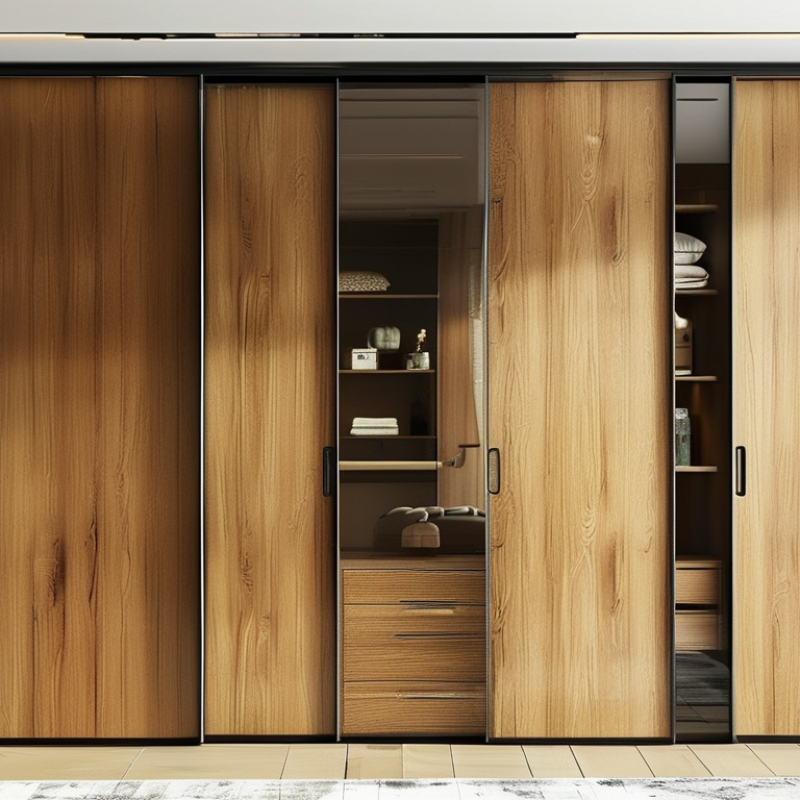
Panel doors offer a clean, balanced appearance. Mirrored panels make small rooms feel brighter and larger. Tempered glass provides a modern look and handles daily use well. It still needs edge protection and regular cleaning. Wood and engineered wood add warmth, while engineered panels usually resist warping more consistently in humid climates. Solid wood feels substantial, but its weight can stress rollers.
Aluminum frames are light and resist rust in many indoor environments. Steel offers strength, yet it may need protective coatings near coastal air. PVC panels can reduce cost and weight, but their surface quality varies. Check track smoothness, roller load ratings, panel thickness, and replacement-part availability. I have seen attractive doors fail because the bottom track collected dust. A soft-close system helps, though poorly adjusted hardware can still produce noise. Measurements are easy to underestimate. Leave room for floor movement and slightly uneven walls.
2026 Top Sliding Closet Doors for Global Buyers
Choosing a sliding closet door starts with the room, not the appearance. Measure the opening at three points, because walls are rarely perfectly straight. Record width, height, depth, and available clearance. A bedroom may suit mirrored or wood-panel doors, while a narrow hallway needs slim frames and quiet rollers. Keep heavy doors away from small children’s sleeping areas unless the track includes secure stopping hardware.
Storage needs also change the door choice. Deep wardrobes can use wider panels, but crowded shelves may block access behind overlapping doors. For folded clothes, two smooth panels often work well. A dressing room may benefit from wider openings and translucent panels. In bathrooms or humid coastal homes, moisture-resistant materials and corrosion-resistant fittings deserve more attention than decorative finishes. Ventilation still matters.
Installation quality is easy to underestimate. The track must be level, and the floor should support the lower guide without wobbling. Check the door weight against the hardware rating. A soft-close system can reduce impact, but it cannot correct a poorly aligned frame. I once assumed a standard opening would fit a replacement panel; small floor variations proved otherwise. That mistake was avoidable. Buyers should request verified measurements, maintenance instructions, and replacement-part availability from suppliers. Local building practices may differ, so a qualified installer should review unusual openings or unusually heavy panels.
2026 Top Sliding Closet Doors for Global Buyers
Installation, Safety, and Maintenance Requirements
Sliding closet doors look simple, but installation errors quickly create noise, gaps, and safety risks. I once underestimated the importance of a level track. A difference of only a few millimeters made one panel drift open overnight. Measure the opening at three points, then use the smallest width. Secure the upper track into solid framing, not only plasterboard. Leave the manufacturer’s clearance around rollers and guides. The ANSI/BHMA A156.14 standard provides recognized performance requirements for sliding door hardware, including operating force and durability.
Safety glazing deserves careful attention. Doors with large glass panels should use tempered or laminated safety glass, where local codes require it. The International Building Code identifies several door locations as hazardous glazing areas. A visible safety mark helps inspectors and installers verify the glass type. Harvard’s Joint Center for Housing Studies estimated U.S. homeowner improvement spending at 472 billion dollars in 2022. That scale shows why replacement work needs consistent installation quality, not rushed fitting.
Maintenance is modest, but it is not optional. Vacuum the bottom track monthly, especially in dusty rooms. Wipe rollers with a dry cloth before applying only approved lubricant. Do not overload shelves attached to the moving panel. Check loose screws, chipped glass, and uneven movement every three months. Stop using the door if it jumps from the track. Some instructions remain unclear across markets, and that is a problem worth reviewing. Buyers should request local code guidance, load limits, and spare hardware before installation.
| Door Type | Typical Panel Materials | Recommended Opening Width | Space-Saving Performance | Installation Requirements | Safety Requirements | Maintenance Requirements | Climate and Location Suitability | Typical Service Life | Global Buyer Considerations |
|---|---|---|---|---|---|---|---|---|---|
| Two-Panel Bypass Door | Tempered glass, wood-based panel, MDF, or laminated composite panel | 1,200–2,400 mm total opening width; commonly used for standard bedrooms | High | Requires a level top track, stable side jambs, correctly aligned bottom guides, and adequate wall clearance. The finished opening should be measured at several points before ordering. | Use safety glass where glass panels are installed. Fit anti-jump clips, positive stops, finger-safe clearances, and securely anchored tracks. Avoid loose or exposed fasteners. | Vacuum the track regularly, wipe rollers with a dry or slightly damp cloth, and check fasteners and anti-jump hardware at least twice a year. | Suitable for dry indoor rooms. Use corrosion-resistant hardware in coastal, humid, or tropical environments. | Approximately 10–20 years when properly installed and maintained | Confirm panel thickness, track load rating, opening dimensions, installation instructions, and replacement roller availability before purchase. |
| Three-Panel Bypass Door | Mirrored safety glass, decorative glass, laminate, or lightweight composite panels | 1,800–3,600 mm total opening width; useful for wider wardrobes | High | Needs a rigid, accurately leveled header and a track designed for three panels. The floor guide must be positioned so that panels remain stable throughout their travel. | Use shatter-resistant or tempered glazing, anti-lift devices, soft closing where available, and adequate overlap between panels to prevent derailment. | Clean each track channel, inspect all rollers for uneven wear, and verify that panels do not rub against the frame or one another. | Good for bedrooms, dressing areas, and apartment storage spaces; select moisture-resistant panels for humid regions. | Approximately 10–18 years | Check whether the supplied hardware supports the combined panel weight and whether the door can pass through local entrances and elevators. |
| Mirrored Sliding Door | Safety-backed mirror or tempered mirror glass with aluminum, steel, or composite framing | 900–1,200 mm per panel; commonly installed in pairs or larger sets | High | Requires a structurally sound wall or header, a level track, accurate roller adjustment, and careful handling during transport and installation. | Mirror panels should have a safety backing or safety film where required by local regulations. Use anti-jump brackets, edge protection, and controlled closing to reduce impact risk. | Use non-abrasive glass cleaner, keep abrasive particles out of the track, and inspect mirror backing, frame joints, rollers, and guides for damage. | Best for dry interior spaces. Avoid prolonged exposure to condensation unless the mirror backing and frame are rated for humid conditions. | Approximately 8–15 years, depending on hardware quality and glass protection | Verify glazing compliance, packaging protection, replacement panel options, import size limits, and local requirements for safety glass. |
| Frameless Glass Sliding Door | Tempered clear, frosted, tinted, or laminated safety glass | 600–1,000 mm per panel; generally used for premium wardrobe layouts | Medium–High | Needs precise structural support, certified glass hardware, a perfectly level track, and professional adjustment. The supporting wall must safely carry the total system load. | Use appropriately specified tempered or laminated safety glass, anti-derailment features, end stops, soft-close mechanisms, and visible safety markings where required. | Clean with a soft cloth, inspect clamps and fittings, and check for chips, cracks, loose hardware, or changes in roller movement. Damaged glass should not be used. | Suitable for dry indoor applications; stainless or treated hardware is preferred in humid or coastal locations. | Approximately 10–20 years with professional installation | Confirm glass thickness, hardware compatibility, maximum panel weight, certification documents, and access for future adjustment. |
| Wood or Wood-Effect Sliding Door | Solid wood, plywood, MDF, HDF, veneer, or melamine-faced board | 700–1,000 mm per panel; adaptable to most residential wardrobes | High | Requires a level track, appropriate roller capacity, moisture-protected edges, and sufficient clearance for seasonal material movement where natural wood is used. | Use rounded or protected edges, anti-jump hardware, secure end stops, and a track rated above the actual panel weight. Prevent children from hanging on the panels. | Dust with a soft cloth, clean spills promptly, lubricate only where recommended by the hardware supplier, and retighten handles and guides when needed. | Suitable for most interiors. Engineered boards with sealed edges perform better than untreated wood in humid climates. | Approximately 12–25 years, depending on material and finish | Check formaldehyde-emission documentation, panel moisture resistance, fire requirements, hardware load capacity, and local recycling rules. |
| Aluminum-Framed Panel Door | Aluminum frame with glass, mirror, laminate, acrylic, or composite infill | 700–1,200 mm per panel; suitable for medium and large openings | High | Requires accurate track alignment and correct frame assembly. The supporting surface must be flat enough to prevent twisting and uneven roller loading. | Use rounded frame profiles, secure infill retention, anti-jump devices, controlled stops, and safety glazing when glass or mirror infill is selected. | Wipe aluminum surfaces with mild soap and water, remove grit from tracks, and inspect corner joints, infill retainers, rollers, and corrosion points. | Well suited to humid, tropical, and coastal areas when anodized, powder-coated, or otherwise corrosion-resistant hardware is used. | Approximately 15–25 years | Ask for coating specifications, salt-spray or corrosion information where relevant, panel compatibility, and spare hardware dimensions. |
| Soft-Close Sliding Door | Wood-based panel, mirror, tempered glass, or aluminum-framed panel | 700–1,200 mm per panel; commonly selected for bedrooms and family homes | High | Needs a level track, correctly positioned activation triggers, a compatible damper, and accurate roller adjustment. Excessive panel weight can reduce closing performance. | Soft-close hardware reduces impact but does not replace anti-jump devices, end stops, safety glazing, or safe finger clearances. Do not force a door that has derailed. | Keep the track clean, test closing speed periodically, and replace worn dampers or rollers instead of applying unauthorized lubricants. | Suitable for most indoor climates; select sealed and corrosion-resistant components for humid environments. | Approximately 10–20 years; dampers may require earlier replacement | Verify maximum door weight, tested cycle rating, replacement damper availability, installation tolerances, and compatibility with the selected panel. |
| Top-Hung Sliding Door | Glass, timber, MDF, plywood, or aluminum-framed panels | 700–1,200 mm per panel; suitable when a clean floor line is preferred | High | Requires a strong and continuous header or ceiling support. The structure must be checked for load capacity, and a discreet floor guide is still normally required for lateral stability. | Use a load-rated track, secondary retention or anti-jump system, end stops, safety glazing where applicable, and professional structural anchoring. | Clean the upper track, inspect anchors and trolley wheels, check the floor guide, and monitor any change in noise, vibration, or panel alignment. | Good for clean, accessible floors; avoid unsupported installation on weak plasterboard or ceilings without suitable reinforcement. | Approximately 12–20 years | Confirm the substrate, anchoring method, total system weight, ceiling height, installation access, and local structural requirements. |
| Bottom-Rolling Sliding Door | Wood-based panel, glass, mirror, or aluminum-framed panel | 700–1,200 mm per panel; practical for heavy panels or limited header strength | High | Requires a level, clean, and durable floor track. The floor must be capable of accepting anchors without damaging underfloor services or finished surfaces. | Install anti-jump brackets, end stops, stable guides, and safety glazing where required. Protect the track from trip hazards and ensure it cannot be easily lifted out. | Remove dust and debris from the floor track frequently, inspect rollers for flat spots, and check that the track remains securely fixed and undamaged. | Suitable for many indoor applications; recessed or protected tracks are preferable in dusty or high-traffic environments. | Approximately 10–20 years | Review floor-track accessibility, threshold details, wheelchair and cleaning considerations, drainage exposure, and replacement roller specifications. |
| Bi-Parting Sliding Door Set | Timber, composite panel, mirrored glass, or framed safety glass | 1,600–3,000 mm total opening width; two panels meet at the center | High | Requires symmetrical opening measurements, accurately centered tracks, matching panel weights, and coordinated end stops or soft-close components. | Use anti-jump hardware on both panels, controlled meeting points, finger-safe center gaps, and safety glass specifications appropriate to the market. | Check that both panels meet evenly, clean the full track length, inspect guides and rollers, and adjust the center alignment if gaps change. | Suitable for larger wardrobes and dressing rooms; use moisture-resistant materials in humid or coastal locations. | Approximately 10–20 years | Confirm center-gap tolerances, panel matching, transport packaging, installation sequence, and availability of paired replacement components. |

General buyer note: Dimensions, load ratings, glazing requirements, fire performance, accessibility provisions, and installation rules vary by country and project. Always confirm the latest local building, consumer-product, and safety requirements before purchase or installation.
2026 Top Sliding Closet Doors for Global Buyers
Global Buying Factors for 2026 Door Selection
Choosing sliding closet doors in 2026 requires more than comparing catalog prices. Buyers should measure wall openings, ceiling height, panel weight, and available floor clearance before requesting quotations. A door that fits one apartment may fail in another because construction tolerances differ. Accurate drawings and sample measurements reduce expensive revisions.
Climate matters. In humid coastal regions, moisture-resistant boards, sealed edges, and corrosion-resistant hardware deserve careful attention. Dry climates may require materials that resist cracking and joint movement. Recycled content can support sustainability goals, but buyers should verify certificates and documented material sources. Marketing claims alone are not enough.
Safety and installation quality also affect international purchasing decisions. Check smooth running, anti-jump features, soft closing performance, and accessible handle heights. Local building and fire requirements must be reviewed by qualified professionals, since regulations vary by market. Packaging should protect corners and mirrors during long-distance shipping. I have seen attractive doors arrive with damaged tracks because packaging was treated as an afterthought. That mistake is costly.
Total cost includes freight, duties, replacement parts, installation, and future maintenance. Request a hardware schedule, tolerance range, warranty terms, and inspection procedure in writing. Yet even detailed documents can miss real site conditions. A trial installation remains valuable. It exposes noise, uneven floors, and clearance problems before full production. Low price can mislead.
We use cookies on our website to give you an improved browser experience. View our Privacy Policy for more information. Please make your selection to opt in or out of ALL cookies here: Accept or Decline
Do you consent to the use of ALL cookies?
901 2nd Court West
Birmingham, AL 35204
Sales: 866.481.4036
Logistics/Ops: 866.481.4036
2101 Dralle Road
University Park, IL 60466
Sales: 708.813.9070
Logistics/Ops: 708.235.4200
400 E. 13th Street
Little Rock, AR 72114
Sales: 866.760.5344
Logistics/Ops: 866.760.5344
225 Collins Road
Elkhart, IN 46515
Sales: 574.295.0214
Logistics/Ops: 574.607.4611
601 Berryman Pike
Tipton, IN 46072
Sales: 800.897.7591
Logistics/Ops: 800.897.7591
3900 Uvalda Street
Denver, CO 80239
Sales: 303.706.8000
Ops/Logistics: 303.576.8398
510 3rd Street E
Milan, IL 61264
Sales: 800.322.1052
Logistics/Ops: 800.322.1052
1660 E. Aurora
Des Moines, IA 50313
Sales: 800.671.1660
Logistics: 800.671.1660
86554 Gene Lasserre Blvd.
Yulee, FL 32097
Sales: 904.253.3060
Logistics/Ops: 904.225.3000
694 S.E. County Road 245
Lake City, FL 32025
Sales: 800.727.6706
Logistics/Ops: 386.752.7412
210 Neptune Road
Auburndale, FL 33823
Sales: 863.967.1131
Logistics/Ops: 863.777.9814
4601 McCoy Drive
Pensacola, FL 32503
Sales: 850.308.7030
Logistics/Ops: 850.434.5502
815 South 56th Street
Tampa, FL 33619
Sales: 813.302.1940
Logistics/Ops: 813.621.1352
200 Hosea Road
Lawrenceville, GA 30046
Sales: 770.953.7575
Logistics/Ops: 770.513.6000
Branch Product Guide
Branch Line Card
Moulding Offering
Cedar Offering
Column Offering
8173 Hwy. 165 North
Monroe, LA 71211
Sales: 800.256.4165
Logistics/Ops: 800.256.4165
508 Warren Avenue
Portland, ME 04103
Sales: 207.888.2331
Logistics/Ops: 207.797.6565
4300 Georgia Pacific Blvd.
Frederick, MD 21704
Sales: 301.798.7474
Logistics/Ops: 301.874.8000
419 Maple Street
Bellingham, MA 02019
Sales: 508.449.0535
Logistics/Ops: 508.966.5500
825 Buchanan Ave SW
Grand Rapids, MI 49507
Sales: 877.800.1180
Logistics/Ops: 616.278.0909
995 Pacific St. NW
Aitkin, MN 56431
Sales: 800.432.3727
Logistics/Ops: 218.212.7770
1102 Port Terminal Drive
Duluth, MN 55802
Sales: 800.951.9899
Logistics/Ops: 800.851.9899
9110 83rd Ave. North
Brooklyn Park, MN 55445
Sales: 763.425.0204
Logistics/Ops: 763.425.0204
910 E. Railroad Street
Long Beach, MS 39560
Sales: 866.535.4135
Logistics/Ops: 228.205.2400
1727 Warren Street
North Kansas City, MO 64116
Sales: 800.621.2611
Logistics/Ops: 800.621.2611
2123 North Golden
Springfield, MO 65803
Sales: 800.375.7891
Logistics/Ops: 800.375.7891
13860 Corp. Woods Trail
Bridgeton, MO 63044
Sales: 314.209.0800
Logistics/Ops: 314.209.0800
1109 South 19th Street
Omaha, NE 68108
Sales: 800.489.6637
Logistics/Ops: 800.489.6637
1 Luger Road
Denville, NJ 07834
Sales: 973-339-3539
Logistics/Ops: 973.625.1461
3720 Jeffrey Blvd.
Blasdell, NY 14219
Sales: 716.235.5989
Logistics/Ops: 716.825.6557
319 Yaphank Ave.
Yaphank, NY 11980
Sales: 631.358.5714
Logistics/Ops: 631.924.7401
3300 Parkside Drive
Charlotte, NC 28208
Sales: 800.839.2588
Logistics/Ops: 704.394.3172
1712 East D Street
Butner, NC 27509
Sales: 984.389.8200
Logistics/Ops: 919.575.3700
128 Foothills Drive
Statesville, NC 28687
Sales: 800.222.1414
Logistics/Ops: 704.394.3172
550 Munroe Falls Rd.
Tallmadge, OH 44278
Sales: 330.357.4506
Logistics/Ops: 330.794.1141
10347 Toebben Dr.
Independence, KY 41051
Sales: 859.298.3926
Logistics/Ops: 859.746.2250
450 N. MacArthur
Oklahoma City, OK 73127
Sales: 800.375.6025
Logistics/Ops: 800.375.6025
1680 North Aspen
Broken Arrow, OK 74012
Sales: 918.272.2212
Logistics/Ops: 918.272.2212
522 Bridge Street
Hunker, PA 15639
Sales: 878.217.2001
Logistics/Ops: 724.925.7285
4290 Atlanta Street
Charleston, SC 29418
Sales: 843.371.1420
Logistics/Ops: 843.554.8192
1040 S. Industrial Dr.
Erwin, TN 37650
Sales: 423.641.1005
Logistics/Ops: 423.742.5911
4287 Pilot Drive
Memphis, TN 38118
Sales: 901.365.2101
Logistics/Ops: 901.365.2101
700 Myatt Drive
Madison, TN 37115
Sales: 615.327.9547
Logistics/Ops: 629.777.4949
4747 Mark IV Parkway
Fort Worth, TX 76106
Sales: 866.323.5117
Logistics/Ops: 817.625.9091
6990 Market Avenue
El Paso, TX 79915
Sales: 915.778.6356
Logistics/Ops: 915.265.7200
2502 Wilson Road
Harlingen, TX 78552
Sales: 800.580.6711
Logistics/Ops: 800.580.6711
10,000 North Loop East
Houston, TX 77029
Sales: 713.921.1977
Logistics/Ops: 713.675.3544
702 East 44th St.
Lubbock, TX 79404
Sales: 866.454.6010
Logistics/Ops: 866.454.6010
535 N. WW White Road
San Antonio, TX 78219
Sales: 800.284.0488
Logistics/Ops: 210.333.8112
142 Pine Haven Shores Rd.
Shelburne, VT 05482
Sales: 802.800.2540
Logistics/Ops: 802.985.2512
4700 Bethlehem Road,
Richmond, VA 23230
Sales: 804.201.2400
Logistics/Ops: 804.342.1161
4516 N Barker Road
Spokane Valley, WA 99027
Phone: 509.892.9420
Toll free: 800.728.6157
8365 N. 76th Street
Milwaukee, WI 53223
Sales: 800.356.9245
Logistics/Ops: 800.356.9245
312 S. Chester Street
Sparta, WI 54656
Sales: 800.362.5864
Logistics/Ops: 800.362.5864
899 Grossman Drive
Schofield, WI 54476
Sales: 800.472.0017
Logistics/Ops: 800.472.0017