
We use cookies on our website to give you an improved browser experience. View our Privacy Policy for more information. Please make your selection to opt in or out of ALL cookies here: Accept or Decline
Aluminum Sliding Glass Doors can bring daylight, wider views, and easier access to a patio or balcony. Their slim frames often leave more glass visible than bulkier designs. But appearance is only part of the decision. Track quality, panel weight, glazing, weather seals, and installation all affect daily use. A beautiful door that sticks after a rainy season is not a good choice.
This guide looks at seven strong options and explains what sets each apart. It considers frame construction, glass performance, security features, customization, maintenance, and overall value. Not every model suits every opening or climate. A coastal home, a cold region, and a compact apartment may need different features. Check the manufacturer’s current specifications, warranty terms, and available sizes before comparing prices. If possible, inspect a working display model; the handle, rollers, and closing feel can reveal details a brochure cannot. Small details matter.
A polished product page can still leave questions unanswered. For example, published performance figures may depend on the glass package or installation method. Measure the opening carefully, and ask a qualified installer to confirm what your home can support. The “best” option is the one that balances smooth operation, dependable sealing, suitable energy performance, and a realistic budget. This overview offers a practical starting point, not a substitute for project-specific advice.
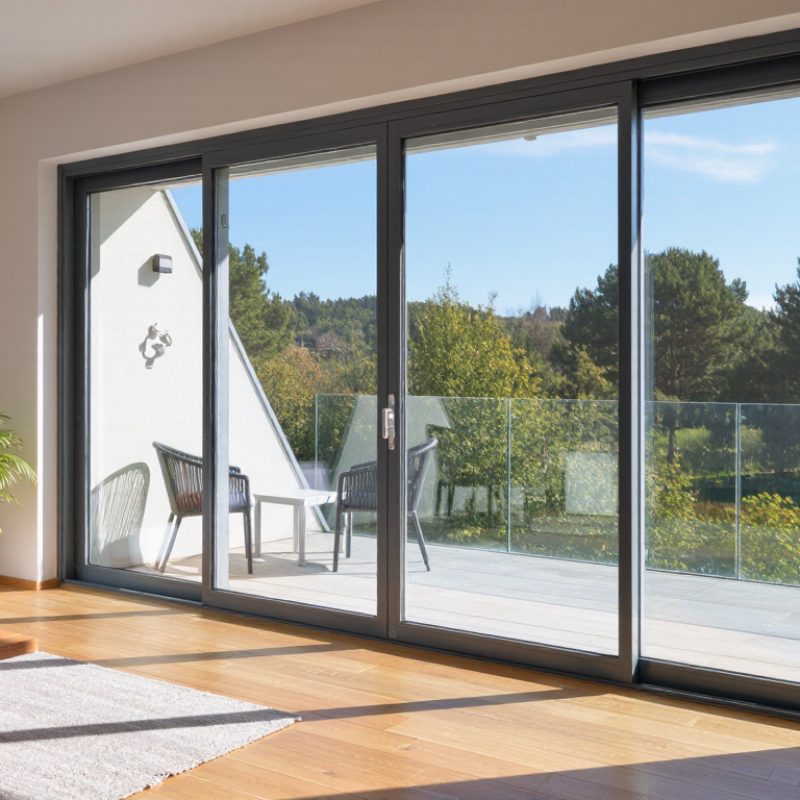
What Are the 7 Best Aluminum Sliding Glass Doors?
Aluminum Sliding Glass Doors: Frames, Tracks, Panels, and Glazing
The best option depends on the opening, climate, and daily use. Consider seven practical designs: slim-frame, thermally broken, double-pane, low-emissivity glazed, two-panel, multi-track, and lift-and-slide doors. Each suits a different need. Slim frames maximize the view, while thermal breaks reduce heat transfer through the metal. Double glazing can improve comfort and reduce outside noise. Check the glass specifications, not just its appearance.
Tracks and panels affect how a door feels after years of use. A two-panel slider is simple and space-efficient; multi-track systems create wider openings but need more floor space and careful cleaning. Rollers should move smoothly without rattling. The frame must be square, and drainage paths must stay clear. Small details matter. A beautiful door can still frustrate if its track collects grit or its panels are too heavy for frequent use.
Tips: Before buying, measure the opening in several places and ask how the sill drains. Test the handle and rollers in person, if possible. Choose glazing for your local weather, and confirm that replacement rollers and seals are accessible. I would not judge quality by frame thickness alone; installation and hardware matter just as much. A little uncertainty remains until the door is fitted and used through changing seasons.
Compare representative center-of-glass U-factors for common glazing configurations. Lower U-factor means less heat transfer through the glass. Actual whole-door ratings vary with the frame, spacer, coatings, gas fill, and product design.
Values are approximate representative figures, not ratings for a specific sliding door. Check the door’s NFRC label for its certified whole-product performance.
When comparing aluminum sliding glass doors, read the NFRC label as a set of measurements, not a single quality score. U-factor describes heat flow through the complete door; a lower number generally means better insulation. SHGC, shown from 0 to 1, estimates how much solar heat enters through the glazing. A lower value can help limit heat gain in sunny rooms, while a higher one may bring useful warmth in colder conditions. Numbers need context.
Visible transmittance, or VT, estimates how much visible daylight passes through the glass. Higher VT can brighten a hallway, but it may also increase glare on a nearby screen. Compare ratings for the same door size and glass configuration, since options can change performance. The frame matters, too: aluminum conducts heat readily, so thermal breaks can affect whole-door results. Check that the label applies to the exact configuration being considered. Installation, shading, and orientation also shape real-world comfort, even when ratings look strong. I would not choose by one number alone; the trade-off deserves a closer look.
A credible comparison of seven aluminum sliding glass doors starts with comparable test data, not appearance alone. The AAMA/WDMA/CSA 101/I.S.2/A440 standard evaluates air leakage, water penetration, and structural performance under specified conditions. Look for each unit’s performance grade and product class in a test report or certification listing. Details matter.
Compare doors tested in similar sizes and configurations. A rating for one panel arrangement may not apply to a wider opening or different sill. Check that the report identifies the glazing, frame, hardware, and tested dimensions. A strong structural rating alone does not show how well a door resists wind-driven rain or air infiltration. Review those results separately.
Installation conditions matter, too. A lab-tested assembly cannot guarantee a perfect seal if the sill is poorly flashed or the frame is out of square. I would be cautious with comparison tables that show one impressive number but omit test details. For comfort and energy use, compare verified U-factor and solar heat gain data separately; these are not substitutes for NAFS air, water, and structural results.
This shortlist compares common aluminum sliding-door configurations by use and design. It is not a ranking of tested products: NAFS performance results depend on the specific door system, dimensions, glazing, hardware, and tested specimen. No air, water, structural, or forced-entry ratings are assumed here.
| Door configuration | Typical layout | Best suited to | Main advantage | Key trade-off | What to verify in AAMA/WDMA/CSA 101/I.S.2/A440 documentation |
|---|---|---|---|---|---|
| 1. Thermally broken two-panel slider | One operable panel and one fixed panel; commonly configured to open left or right. | Patios, balconies, and rooms needing a straightforward outdoor connection. | Simple operation and fewer moving panels than multi-panel layouts. | About half the framed opening is typically occupied by the fixed panel. | Confirm the tested handing, overall frame size, air-leakage result, water-penetration resistance, and structural performance grade. |
| 2. Large-format two-panel slider | One larger operable panel paired with one fixed panel. | Wide views and openings where a large clear-glass area is a priority. | Broad, uninterrupted views with a familiar two-panel arrangement. | Larger, heavier panels can place greater demands on rollers, tracks, and frame stiffness. | Check that the reported results apply to the specified panel size and glass make-up; do not extrapolate from a smaller tested unit. |
| 3. Three-panel, two-track slider | Three panels share two tracks; the number and position of operable panels vary by system. | Wider rooms where a two-panel door does not provide enough opening width. | Can provide a wider passage than a basic two-panel layout. | Track and panel arrangement affects the clear opening; more components require careful adjustment and maintenance. | Verify the exact panel arrangement, active-panel configuration, tested size, water performance, and structural grade. |
| 4. Three-panel, three-track slider | Three panels run on separate tracks and may stack to one side, depending on the design. | Openings where a larger portion of the doorway should be operable. | Multiple panels can create a broad opening while retaining sliding operation. | Requires more frame depth for the additional track; the opening and stacking behavior are system-specific. | Confirm that the tested specimen uses the same track count, panel sequence, hardware, and dimensions as the planned installation. |
| 5. Four-panel, two-track slider | Four panels operate on two tracks; configurations may include center-opening or side-opening layouts. | Large living areas and broad exterior openings. | Can serve a wide opening with a symmetrical or multi-panel appearance. | More panel joints and interlocks mean more seals and adjustments to maintain. | Check the tested configuration, including which panels move, interlock details, frame size, and applicable performance results. |
| 6. Multi-panel stacking slider | Several panels slide and stack together, often using multiple tracks. | Expansive openings where a large clear passage is desired when the door is open. | Can open a substantial portion of the wall compared with a conventional two-panel slider. | More tracks, panels, and hardware can increase installation and adjustment complexity. | Request test documentation for the exact panel count and layout. Confirm tested structural performance and water resistance for the intended exposure. |
| 7. Lift-and-slide aluminum door | A handle-operated mechanism lifts the panel slightly for movement and lowers it onto seals when closed; available in different panel layouts. | Large or heavy panels where smoother movement and a compression-style closed seal are desired. | The lifting mechanism can make a heavy panel easier to move when operated as designed. | Requires compatible hardware and correct adjustment; operation and performance vary by system. | Verify that the complete lift-and-slide configuration—not merely its hardware—has applicable NAFS test results for the specified size and glazing. |
How to compare verified performance: Request the manufacturer’s test report or certification for the exact configuration and compare its air-leakage, water-penetration, and structural-performance results, as well as its Design Pressure (DP) or Performance Grade (PG), where reported. Check that the report identifies the applicable AAMA/WDMA/CSA 101/I.S.2/A440 edition and matches the proposed size, glazing, panel layout, and installation conditions. A configuration name alone is not evidence of a particular rating.
For an aluminum sliding glass door, safety is not determined by the frame alone. The glass should meet applicable safety-glazing requirements for its location and use. In the United States, CPSC 16 CFR 1201 sets impact-performance requirements for certain architectural glazing. ANSI Z97.1 is another safety-glazing standard, with tests for impact resistance and safe breakage. Small detail. The exact requirement can depend on the door’s size, placement, and local building code.
Check the product label and request documentation for the specific door configuration, not just a general sales sheet. Look for the standard cited, the glass type, and any applicable category or test information. Tempered glass usually breaks into small pieces, while laminated glass tends to remain held together; neither description alone proves compliance. A missing or hidden label is not automatic proof of a problem, but it is a reason to ask for records. Also inspect the installed door: damaged edges, loose glazing beads, or incorrect installation can affect safety. Standards and code requirements vary by location, so confirm details with the supplier or local building professional before buying.
What Are the 7 Best Aluminum Sliding Glass Doors?
The best choice depends on your opening, climate, and comfort priorities. A two-panel slider suits a modest patio; three- or four-panel layouts create a wider view. Multi-slide and pocket systems stack or disappear into a wall, but need careful planning for tracks and drainage. Corner-opening designs can brighten a room, though they often require more structural coordination. A thermally improved standard slider may be the practical option when space or budget is limited. There is no single winner for every home.
Tips: Compare the whole door, not just the glass. Aluminum transfers heat readily, so look for a continuous thermal break between the interior and exterior frame. Check published U-factor, solar heat gain coefficient, and air and water performance ratings. Lower U-factor generally means less heat transfer; the best solar heat gain depends on your climate and window exposure. Measure twice.
Before choosing, consider the direction of strong rain, afternoon sun, and prevailing wind. A sunny room may benefit from a lower solar heat gain, while a cold climate calls for stronger insulation. Ask how the sill handles water and whether the tested rating fits your exposure. Small details matter: a stiff frame, smooth rollers, and a well-sealed meeting rail affect daily use. I would not choose by appearance alone; ratings can be easy to overlook.
We use cookies on our website to give you an improved browser experience. View our Privacy Policy for more information. Please make your selection to opt in or out of ALL cookies here: Accept or Decline
Do you consent to the use of ALL cookies?
901 2nd Court West
Birmingham, AL 35204
Sales: 866.481.4036
Logistics/Ops: 866.481.4036
2101 Dralle Road
University Park, IL 60466
Sales: 708.813.9070
Logistics/Ops: 708.235.4200
400 E. 13th Street
Little Rock, AR 72114
Sales: 866.760.5344
Logistics/Ops: 866.760.5344
225 Collins Road
Elkhart, IN 46515
Sales: 574.295.0214
Logistics/Ops: 574.607.4611
601 Berryman Pike
Tipton, IN 46072
Sales: 800.897.7591
Logistics/Ops: 800.897.7591
3900 Uvalda Street
Denver, CO 80239
Sales: 303.706.8000
Ops/Logistics: 303.576.8398
510 3rd Street E
Milan, IL 61264
Sales: 800.322.1052
Logistics/Ops: 800.322.1052
1660 E. Aurora
Des Moines, IA 50313
Sales: 800.671.1660
Logistics: 800.671.1660
86554 Gene Lasserre Blvd.
Yulee, FL 32097
Sales: 904.253.3060
Logistics/Ops: 904.225.3000
694 S.E. County Road 245
Lake City, FL 32025
Sales: 800.727.6706
Logistics/Ops: 386.752.7412
210 Neptune Road
Auburndale, FL 33823
Sales: 863.967.1131
Logistics/Ops: 863.777.9814
4601 McCoy Drive
Pensacola, FL 32503
Sales: 850.308.7030
Logistics/Ops: 850.434.5502
815 South 56th Street
Tampa, FL 33619
Sales: 813.302.1940
Logistics/Ops: 813.621.1352
200 Hosea Road
Lawrenceville, GA 30046
Sales: 770.953.7575
Logistics/Ops: 770.513.6000
Branch Product Guide
Branch Line Card
Moulding Offering
Cedar Offering
Column Offering
8173 Hwy. 165 North
Monroe, LA 71211
Sales: 800.256.4165
Logistics/Ops: 800.256.4165
508 Warren Avenue
Portland, ME 04103
Sales: 207.888.2331
Logistics/Ops: 207.797.6565
4300 Georgia Pacific Blvd.
Frederick, MD 21704
Sales: 301.798.7474
Logistics/Ops: 301.874.8000
419 Maple Street
Bellingham, MA 02019
Sales: 508.449.0535
Logistics/Ops: 508.966.5500
825 Buchanan Ave SW
Grand Rapids, MI 49507
Sales: 877.800.1180
Logistics/Ops: 616.278.0909
995 Pacific St. NW
Aitkin, MN 56431
Sales: 800.432.3727
Logistics/Ops: 218.212.7770
1102 Port Terminal Drive
Duluth, MN 55802
Sales: 800.951.9899
Logistics/Ops: 800.851.9899
9110 83rd Ave. North
Brooklyn Park, MN 55445
Sales: 763.425.0204
Logistics/Ops: 763.425.0204
910 E. Railroad Street
Long Beach, MS 39560
Sales: 866.535.4135
Logistics/Ops: 228.205.2400
1727 Warren Street
North Kansas City, MO 64116
Sales: 800.621.2611
Logistics/Ops: 800.621.2611
2123 North Golden
Springfield, MO 65803
Sales: 800.375.7891
Logistics/Ops: 800.375.7891
13860 Corp. Woods Trail
Bridgeton, MO 63044
Sales: 314.209.0800
Logistics/Ops: 314.209.0800
1109 South 19th Street
Omaha, NE 68108
Sales: 800.489.6637
Logistics/Ops: 800.489.6637
1 Luger Road
Denville, NJ 07834
Sales: 973-339-3539
Logistics/Ops: 973.625.1461
3720 Jeffrey Blvd.
Blasdell, NY 14219
Sales: 716.235.5989
Logistics/Ops: 716.825.6557
319 Yaphank Ave.
Yaphank, NY 11980
Sales: 631.358.5714
Logistics/Ops: 631.924.7401
3300 Parkside Drive
Charlotte, NC 28208
Sales: 800.839.2588
Logistics/Ops: 704.394.3172
1712 East D Street
Butner, NC 27509
Sales: 984.389.8200
Logistics/Ops: 919.575.3700
128 Foothills Drive
Statesville, NC 28687
Sales: 800.222.1414
Logistics/Ops: 704.394.3172
550 Munroe Falls Rd.
Tallmadge, OH 44278
Sales: 330.357.4506
Logistics/Ops: 330.794.1141
10347 Toebben Dr.
Independence, KY 41051
Sales: 859.298.3926
Logistics/Ops: 859.746.2250
450 N. MacArthur
Oklahoma City, OK 73127
Sales: 800.375.6025
Logistics/Ops: 800.375.6025
1680 North Aspen
Broken Arrow, OK 74012
Sales: 918.272.2212
Logistics/Ops: 918.272.2212
522 Bridge Street
Hunker, PA 15639
Sales: 878.217.2001
Logistics/Ops: 724.925.7285
4290 Atlanta Street
Charleston, SC 29418
Sales: 843.371.1420
Logistics/Ops: 843.554.8192
1040 S. Industrial Dr.
Erwin, TN 37650
Sales: 423.641.1005
Logistics/Ops: 423.742.5911
4287 Pilot Drive
Memphis, TN 38118
Sales: 901.365.2101
Logistics/Ops: 901.365.2101
700 Myatt Drive
Madison, TN 37115
Sales: 615.327.9547
Logistics/Ops: 629.777.4949
4747 Mark IV Parkway
Fort Worth, TX 76106
Sales: 866.323.5117
Logistics/Ops: 817.625.9091
6990 Market Avenue
El Paso, TX 79915
Sales: 915.778.6356
Logistics/Ops: 915.265.7200
2502 Wilson Road
Harlingen, TX 78552
Sales: 800.580.6711
Logistics/Ops: 800.580.6711
10,000 North Loop East
Houston, TX 77029
Sales: 713.921.1977
Logistics/Ops: 713.675.3544
702 East 44th St.
Lubbock, TX 79404
Sales: 866.454.6010
Logistics/Ops: 866.454.6010
535 N. WW White Road
San Antonio, TX 78219
Sales: 800.284.0488
Logistics/Ops: 210.333.8112
142 Pine Haven Shores Rd.
Shelburne, VT 05482
Sales: 802.800.2540
Logistics/Ops: 802.985.2512
4700 Bethlehem Road,
Richmond, VA 23230
Sales: 804.201.2400
Logistics/Ops: 804.342.1161
4516 N Barker Road
Spokane Valley, WA 99027
Phone: 509.892.9420
Toll free: 800.728.6157
8365 N. 76th Street
Milwaukee, WI 53223
Sales: 800.356.9245
Logistics/Ops: 800.356.9245
312 S. Chester Street
Sparta, WI 54656
Sales: 800.362.5864
Logistics/Ops: 800.362.5864
899 Grossman Drive
Schofield, WI 54476
Sales: 800.472.0017
Logistics/Ops: 800.472.0017
