We use cookies on our website to give you an improved browser experience. View our Privacy Policy for more information. Please make your selection to opt in or out of ALL cookies here: Accept or Decline
Outdoor Wpc Wall Panel systems are moving from niche landscaping projects into mainstream commercial and residential construction. Grand View Research estimates the global wood-plastic composites market reached approximately USD 7.45 billion in 2023. It also projects continued growth through 2030. Mordor Intelligence reports different values, reminding buyers that market boundaries and research methods vary. The trend is clear. Demand is rising.
Professor Andrzej K. Bledzki, a recognized wood-plastic composites researcher, has described WPCs as materials that “combine the advantages of wood and plastics.” That balance matters outdoors. A suitable panel should resist moisture, ultraviolet exposure, temperature changes, and surface staining. It should also provide stable fixing around corners, windows, and ventilated façades. A beautiful sample is not enough.
This guide reviews seven Outdoor Wpc Wall Panel options for global buyers. It considers polymer content, wood-fiber quality, surface texture, drainage design, fire documentation, installation requirements, and long-term maintenance. Product claims still require careful checking. “Low maintenance” does not mean maintenance-free. Coastal salt, poor spacing, and trapped water can shorten service life. Small details matter.
Look beyond color. Check test reports, warranty limits, dimensional tolerances, and available replacement profiles. Compare products under the climate where they will be installed. A panel performing well in a dry inland city may behave differently beside a humid coastline. The strongest choice is not always the cheapest one. It is the one supported by transparent data, practical installation guidance, and consistent manufacturing quality.
Outdoor WPC wall panels combine wood fibers with thermoplastics, stabilizers, and color additives. The wood content creates a natural grain, while the polymer improves moisture resistance. Solid panels offer stronger impact resistance. Hollow panels reduce weight and installation effort. Co-extruded panels add a protective outer layer against stains, ultraviolet exposure, and surface fading.
Among seven practical panel styles, buyers may consider embossed boards, grooved boards, slatted panels, smooth boards, hollow boards, solid boards, and co-extruded boards. Each style serves a different purpose. Slatted panels suit balconies and covered patios. Grooved designs can improve facade texture. Smooth surfaces work well around outdoor kitchens, but grease still requires prompt cleaning. No panel is maintenance-free.
Temperature changes matter. WPC expands and contracts, so installers should leave movement gaps and use corrosion-resistant fasteners. A ventilated substructure helps drainage behind the wall. Panels should not touch standing water or poorly sealed ground surfaces. Product testing for water absorption, flexural strength, fire behavior, and color stability supports more reliable purchasing decisions. However, test results may vary by formulation and climate. A specification sheet alone cannot replace a site inspection. Coastal air, intense sunlight, and freeze-thaw cycles can expose weak designs quickly. Careful buyers should match panel density, surface treatment, and installation method to the building’s actual environment.
Outdoor WPC Wall Panels: Materials, Features, and Common Applications
The chart shows representative dimensions commonly found in outdoor WPC wall-panel products: panel length, face width, and thickness. Actual specifications vary by manufacturer, profile design, installation system, climate requirements, and local building regulations. WPC panels are commonly used for exterior façades, balconies, garden walls, residential cladding, commercial buildings, and hospitality projects.
Outdoor WPC wall panels should match the climate, not only the project’s visual style. In coastal areas, salt spray can attack exposed fasteners and weaken poorly protected surfaces. Choose panels with verified UV resistance, low water absorption, and corrosion-resistant fixing systems. For wet regions, inspect the panel edges, joints, and drainage gaps carefully. Water trapped behind cladding often causes more trouble than rain itself.
Freeze-thaw climates require stable dimensions and reliable expansion spacing. Hot, sunny walls may need lighter colors and ventilated installation to reduce heat buildup. In dry regions, dust can collect in textured grooves, so cleaning access matters. Review test reports for weathering, impact, moisture, and fire performance. Local building requirements still apply. A product may perform well in one country but need different installation details elsewhere.
Tips: Request samples. Leave them outdoors for several weeks. Check color change, warping, surface marks, and cleaning difficulty. Ask for installation guidance, warranty limits, and batch consistency. Measure expansion gaps with the expected temperature range in mind. I have seen attractive panels fail because installers treated them like indoor boards. That mistake is easy to make. Independent test data is useful, but real site conditions can be harsher. Inspect the backing wall, ventilation path, and fasteners before approving the final specification.
Outdoor WPC wall panels can give exterior spaces a warmer, more structured appearance. For global buyers, the right style depends on climate, building design, and installation conditions. These seven options are practical choices for balconies, garden walls, façades, and covered outdoor rooms.
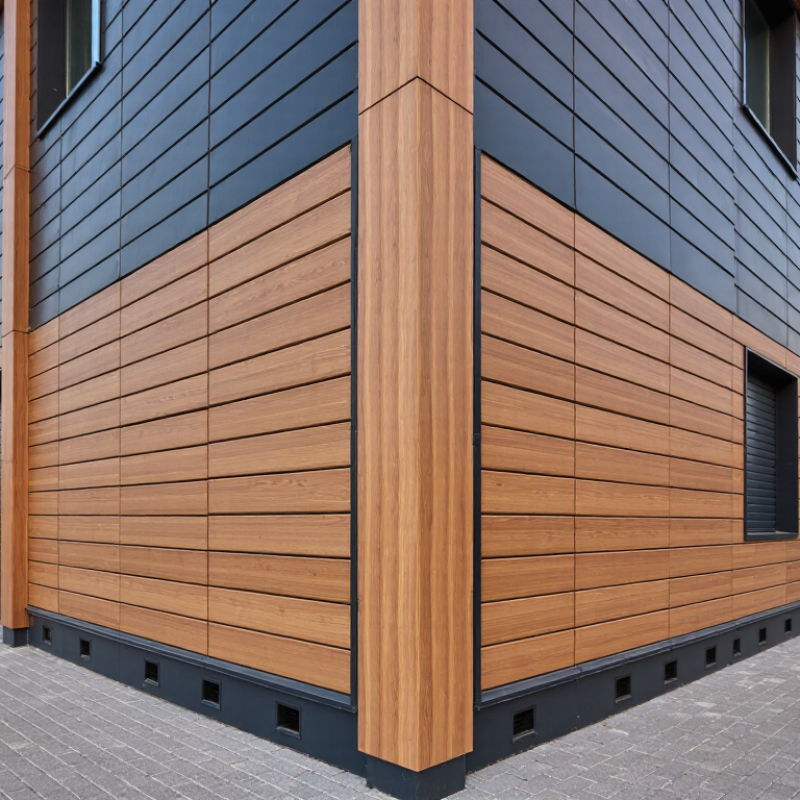
Slatted panels create narrow shadows and improve the feeling of height.
Flush panels offer a cleaner appearance for modern buildings.
Woodgrain panels suit buyers who want timber character without regular painting.
Stone-look panels add a heavier architectural impression to entrance walls.
Three-dimensional geometric panels create strong visual depth, especially under evening lighting.
Louvered panels provide a light, ventilated appearance, but they need careful fixing in windy areas.
Mixed-width panels combine broad and narrow boards for a less repetitive façade.
Real projects have taught me that appearance is only one decision.
Check UV, moisture, thermal movement, and impact test information before ordering.
A sample can mislead.
Large walls may show color variation between batches, so buyers should confirm production consistency.
Leave suitable expansion gaps and keep the lower edge away from standing water.
Local building requirements still matter, particularly for fire performance and structural fixing.
I would also request installation drawings, maintenance guidance, and warranty terms in writing.
Dark colors can become noticeably hotter in direct sun, while textured surfaces may collect dust after rain.
Even a well-designed panel may need occasional cleaning.
Outdoor WPC wall panels perform best when installation matches the building’s structure, climate, and drainage plan. On masonry, installers can use corrosion-resistant clips or screws after checking surface flatness. On framed walls, a galvanized or aluminum subframe creates a ventilated cavity behind the boards. Keep the cavity open at the bottom and protect openings with insect mesh. Water needs somewhere to go. Before fixing panels, measure wind exposure, panel weight, and the substrate’s load capacity. A weak wall can make a strong panel unsafe. That sounds obvious. It is still missed.
Leave movement gaps at corners, ends, and around windows, following the supplier’s technical data. WPC expands with heat and contracts in cold weather. Tight joints may buckle in direct sun. Use stainless or suitably coated fasteners, and pre-drill near board ends to reduce splitting. Align every support rail, because small errors become visible across a long façade. Do not rely on adhesive alone unless an engineered system permits it. Coastal sites need extra attention to salt corrosion. High-wind or tall buildings may require calculations by a qualified engineer.
Safety starts before the first cut. Check fire classification, reaction-to-fire requirements, and local building regulations. Some façades need fire stops or wider separation from openings. Wear eye protection, gloves, hearing protection, and a suitable dust mask during cutting. Secure ladders and lifting tools on wet or windy days. Inspect every fixing, especially near corners and rooflines. I once saw a neat wall fail because drainage was blocked by debris. Good appearance is not proof of good performance. Record fastener types, clearances, and inspection dates for future maintenance.
| Panel Type | Typical Panel Size and Weight | Recommended Outdoor Applications | Preferred Installation Method | Structural Requirements | Movement and Drainage Provisions | Key Safety Considerations |
|---|---|---|---|---|---|---|
| 1. Hollow-Core Plank Panels Lightweight Ventilated façade | Typical width: 140–180 mm Thickness: 20–30 mm Length: 2.9–5.8 m Approximate mass: 6–12 kg/m² | Residential façades, balcony privacy walls, garden structures, covered entrances, and low-rise commercial exteriors. | Install horizontally or vertically on corrosion-resistant aluminum or galvanized-steel rails. Use concealed clips where the profile permits; use face screws at end joints or exposed edges. | Non-load-bearing cladding only. Provide a continuous, rigid subframe with support rails generally spaced 400–600 mm apart, subject to wind-load calculations. Fix rails to sound masonry, concrete, timber, or engineered framing. | Leave a continuous ventilated cavity, typically 20–40 mm. Maintain end gaps at panel joints according to the thermal movement calculation; provide larger clearances around corners, flashings, and penetrations. | Hollow sections must not be used as handrails, guardrails, structural beams, or anchorage for heavy fixtures. Seal or cap open ends where insects, water, or debris could enter. Use compatible fasteners to avoid galvanic corrosion. |
| 2. Solid-Core Cladding Boards High impact resistance Robust finish | Typical width: 145–200 mm Thickness: 18–25 mm Length: 2.9–5.8 m Approximate mass: 15–25 kg/m² | High-traffic exterior walls, entrance surrounds, podium walls, service yards, and façades exposed to frequent contact. | Clip-and-rail installation for concealed fixing, or direct face-fixing with predrilled holes. Stagger joints and avoid placing several end joints on one short rail section. | The substrate and anchors must resist the calculated dead load plus wind suction and pressure. Use rails normally at 400–600 mm centers; reduce spacing where high wind, impact, or heavy boards increase demand. | Allow for longitudinal expansion and contraction at board ends. Keep the rear of the boards dry with a drained and ventilated cavity; do not block weep paths at the base or above openings. | Boards are heavy and require two-person handling or mechanical assistance for long lengths. Edges can be sharp after cutting. Wear eye, respiratory, and hearing protection during sawing and drilling. |
| 3. Co-Extruded Capped Panels Enhanced weathering Low-maintenance surface | Typical width: 140–220 mm Thickness: 20–30 mm Length: 2.9–5.8 m Approximate mass: 8–18 kg/m² | Fully exposed façades, coastal or high-UV locations, feature walls, hospitality projects, and areas requiring improved stain resistance. | Use the manufacturer’s compatible concealed clips or stainless-steel face screws. Keep the capped surface undamaged; do not cut through the protective layer unless the cut edge is treated as specified. | Provide a stable, aligned subframe and design the fixing pattern for the local wind zone, building height, exposure category, and panel weight. The cap layer improves weather resistance but does not make the panel structural. | Preserve rear ventilation and drainage. Use expansion gaps based on the panel’s coefficient of thermal expansion and the expected installation-temperature range; avoid rigidly fixing every point. | Confirm the product’s tested reaction-to-fire classification for the intended wall build-up. Do not assume that a capped WPC panel is fire-rated; cavity barriers and non-combustible components may be required by code. |
| 4. Ribbed or 3D Decorative Panels Architectural texture Accent façades | Typical module width: 150–300 mm Overall thickness: 20–45 mm Length: 2.9–5.8 m Approximate mass: 10–22 kg/m² | Entrance features, retail façades, hotel exteriors, balcony screens, soffit accents, and protected outdoor feature walls. | Fix to a level secondary rail system using concealed clips or screws placed in the structurally supported flat zones. Use a starter profile to control alignment and prevent panel rotation. | The decorative ribs are not intended to carry structural loads. Support rails should generally be 300–500 mm apart where the profile has deep relief or where wind exposure is high. | Keep the cavity open at the bottom and top, while protecting it with insect mesh and appropriate flashings. Provide additional clearance where the textured face meets windows, doors, and corner trims. | Deep profiles may collect dust, leaves, or snow; inspect and clean drainage paths. Avoid using the ribs as steps, footholds, climbing grips, or attachment points for signage. |
| 5. Slatted WPC Screen Panels Privacy screening Airflow control | Typical slat width: 40–70 mm Slat depth: 30–60 mm Module width: 150–300 mm Approximate mass: 8–20 kg/m² | Privacy screens, balcony dividers, rooftop enclosures, plant-room screening, parking façades, and semi-open outdoor partitions. | Install as a complete engineered screen system on posts, rails, or a framed backing structure. Use stainless-steel or appropriately protected screws and provide positive restraint against twisting. | Design the frame and foundations for wind pressure, suction, and overturning. Open screens can experience substantial local wind forces; post spacing and anchor size must be engineer-approved. | Maintain a clear gap between the lowest slat and finished ground level to prevent standing water and splash-back. Include drainage at post bases and allow movement at slat ends. | Do not treat a screen as a compliant balcony guard unless the complete system has been tested and designed for guard loading. Check opening sizes, climbability, and fall-protection requirements. |
| 6. Grooved Clip-Fixed Wall Boards Fast installation Clean joint lines | Typical width: 135–180 mm Thickness: 20–25 mm Length: 2.9–5.8 m Approximate mass: 7–16 kg/m² | Standard residential façades, covered terraces, garden offices, exterior walls, and renovation projects with a prepared backing wall. | Start with a level base trim, then engage corrosion-resistant clips into the longitudinal groove. Add approved face fixings at termination points, corners, and locations subject to higher wind loads. | Install on straight, adequately anchored battens or rails. Typical rail spacing is 400–600 mm, but it should be reduced near panel ends, openings, corners, and high-wind zones when required by testing or engineering. | Use open-jointed trims or drained flashing details rather than sealing the entire façade. Provide end clearances at abutments and avoid trapping water behind the grooved joints. | Clips must be fully engaged and not over-tightened. Incorrect clip spacing can cause bowing, rattling, or pull-out. Confirm that the selected clip system is compatible with the exact board profile. |
| 7. Perforated or Ventilated WPC Panels Decorative ventilation Light transmission | Typical module width: 150–300 mm Thickness: 20–35 mm Length: 2.0–4.0 m Approximate mass: 8–18 kg/m² | Sun screens, semi-open façades, balcony dividers, covered walkways, outdoor restaurants, and ventilation enclosures. | Mount to a rigid perimeter frame with intermediate supports. Use mechanical fasteners around the panel perimeter and at engineered intermediate points; do not rely only on adhesive outdoors. | Account for the reduced net section caused by perforations. The frame, anchors, and foundations should be checked for wind loads, vibration, differential movement, and the required serviceability limits. | Keep perforations and rear cavities free from blocked drainage. Provide edge clearances and flexible joints where the panel meets dissimilar materials such as concrete, steel, glass, or masonry. | Check finger, head, and foothold openings where children may access the screen. Confirm the required fall protection, fire performance, wind-borne debris resistance, and cleaning access for the project location. |

The seven best outdoor WPC wall panels are not identical in performance. Solid panels suit exposed walls and high-impact areas, while hollow panels reduce weight and freight costs. Co-extruded panels usually resist stains and fading better. Grooved, slatted, embossed, recycled-content, and fire-tested panels serve different project needs. Check the wall location before choosing a surface pattern.
Maintenance is simple, but not zero. Rinse dust and salt from the panels every few months, especially near coastlines. Use mild soap and a soft brush for marks. Avoid abrasive pads, strong solvents, and unapproved pressure washing. Good WPC should resist moisture, insects, and ordinary sunlight. However, dark colors can heat up and expand more noticeably. Allow movement gaps, use compatible fasteners, and follow the installation guide. Small installation mistakes can become expensive later.
Tips: Ask for UV, water absorption, impact, and fire-test reports before ordering. Compare the full landed price, including packaging, freight, insurance, duties, and local handling. Confirm panel length, thickness, weight, color consistency, minimum order quantity, and replacement policy in writing. Request a physical sample first. Photos can hide texture differences. International buyers should also check container loading plans and export documents. A cheaper panel may become costly after customs delays, damaged edges, or unsuitable accessories. Supplier claims deserve verification, not blind trust.
We use cookies on our website to give you an improved browser experience. View our Privacy Policy for more information. Please make your selection to opt in or out of ALL cookies here: Accept or Decline
Do you consent to the use of ALL cookies?
901 2nd Court West
Birmingham, AL 35204
Sales: 866.481.4036
Logistics/Ops: 866.481.4036
2101 Dralle Road
University Park, IL 60466
Sales: 708.813.9070
Logistics/Ops: 708.235.4200
400 E. 13th Street
Little Rock, AR 72114
Sales: 866.760.5344
Logistics/Ops: 866.760.5344
225 Collins Road
Elkhart, IN 46515
Sales: 574.295.0214
Logistics/Ops: 574.607.4611
601 Berryman Pike
Tipton, IN 46072
Sales: 800.897.7591
Logistics/Ops: 800.897.7591
3900 Uvalda Street
Denver, CO 80239
Sales: 303.706.8000
Ops/Logistics: 303.576.8398
510 3rd Street E
Milan, IL 61264
Sales: 800.322.1052
Logistics/Ops: 800.322.1052
1660 E. Aurora
Des Moines, IA 50313
Sales: 800.671.1660
Logistics: 800.671.1660
86554 Gene Lasserre Blvd.
Yulee, FL 32097
Sales: 904.253.3060
Logistics/Ops: 904.225.3000
694 S.E. County Road 245
Lake City, FL 32025
Sales: 800.727.6706
Logistics/Ops: 386.752.7412
210 Neptune Road
Auburndale, FL 33823
Sales: 863.967.1131
Logistics/Ops: 863.777.9814
4601 McCoy Drive
Pensacola, FL 32503
Sales: 850.308.7030
Logistics/Ops: 850.434.5502
815 South 56th Street
Tampa, FL 33619
Sales: 813.302.1940
Logistics/Ops: 813.621.1352
200 Hosea Road
Lawrenceville, GA 30046
Sales: 770.953.7575
Logistics/Ops: 770.513.6000
Branch Product Guide
Branch Line Card
Moulding Offering
Cedar Offering
Column Offering
8173 Hwy. 165 North
Monroe, LA 71211
Sales: 800.256.4165
Logistics/Ops: 800.256.4165
508 Warren Avenue
Portland, ME 04103
Sales: 207.888.2331
Logistics/Ops: 207.797.6565
4300 Georgia Pacific Blvd.
Frederick, MD 21704
Sales: 301.798.7474
Logistics/Ops: 301.874.8000
419 Maple Street
Bellingham, MA 02019
Sales: 508.449.0535
Logistics/Ops: 508.966.5500
825 Buchanan Ave SW
Grand Rapids, MI 49507
Sales: 877.800.1180
Logistics/Ops: 616.278.0909
995 Pacific St. NW
Aitkin, MN 56431
Sales: 800.432.3727
Logistics/Ops: 218.212.7770
1102 Port Terminal Drive
Duluth, MN 55802
Sales: 800.951.9899
Logistics/Ops: 800.851.9899
9110 83rd Ave. North
Brooklyn Park, MN 55445
Sales: 763.425.0204
Logistics/Ops: 763.425.0204
910 E. Railroad Street
Long Beach, MS 39560
Sales: 866.535.4135
Logistics/Ops: 228.205.2400
1727 Warren Street
North Kansas City, MO 64116
Sales: 800.621.2611
Logistics/Ops: 800.621.2611
2123 North Golden
Springfield, MO 65803
Sales: 800.375.7891
Logistics/Ops: 800.375.7891
13860 Corp. Woods Trail
Bridgeton, MO 63044
Sales: 314.209.0800
Logistics/Ops: 314.209.0800
1109 South 19th Street
Omaha, NE 68108
Sales: 800.489.6637
Logistics/Ops: 800.489.6637
1 Luger Road
Denville, NJ 07834
Sales: 973-339-3539
Logistics/Ops: 973.625.1461
3720 Jeffrey Blvd.
Blasdell, NY 14219
Sales: 716.235.5989
Logistics/Ops: 716.825.6557
319 Yaphank Ave.
Yaphank, NY 11980
Sales: 631.358.5714
Logistics/Ops: 631.924.7401
3300 Parkside Drive
Charlotte, NC 28208
Sales: 800.839.2588
Logistics/Ops: 704.394.3172
1712 East D Street
Butner, NC 27509
Sales: 984.389.8200
Logistics/Ops: 919.575.3700
128 Foothills Drive
Statesville, NC 28687
Sales: 800.222.1414
Logistics/Ops: 704.394.3172
550 Munroe Falls Rd.
Tallmadge, OH 44278
Sales: 330.357.4506
Logistics/Ops: 330.794.1141
10347 Toebben Dr.
Independence, KY 41051
Sales: 859.298.3926
Logistics/Ops: 859.746.2250
450 N. MacArthur
Oklahoma City, OK 73127
Sales: 800.375.6025
Logistics/Ops: 800.375.6025
1680 North Aspen
Broken Arrow, OK 74012
Sales: 918.272.2212
Logistics/Ops: 918.272.2212
522 Bridge Street
Hunker, PA 15639
Sales: 878.217.2001
Logistics/Ops: 724.925.7285
4290 Atlanta Street
Charleston, SC 29418
Sales: 843.371.1420
Logistics/Ops: 843.554.8192
1040 S. Industrial Dr.
Erwin, TN 37650
Sales: 423.641.1005
Logistics/Ops: 423.742.5911
4287 Pilot Drive
Memphis, TN 38118
Sales: 901.365.2101
Logistics/Ops: 901.365.2101
700 Myatt Drive
Madison, TN 37115
Sales: 615.327.9547
Logistics/Ops: 629.777.4949
4747 Mark IV Parkway
Fort Worth, TX 76106
Sales: 866.323.5117
Logistics/Ops: 817.625.9091
6990 Market Avenue
El Paso, TX 79915
Sales: 915.778.6356
Logistics/Ops: 915.265.7200
2502 Wilson Road
Harlingen, TX 78552
Sales: 800.580.6711
Logistics/Ops: 800.580.6711
10,000 North Loop East
Houston, TX 77029
Sales: 713.921.1977
Logistics/Ops: 713.675.3544
702 East 44th St.
Lubbock, TX 79404
Sales: 866.454.6010
Logistics/Ops: 866.454.6010
535 N. WW White Road
San Antonio, TX 78219
Sales: 800.284.0488
Logistics/Ops: 210.333.8112
142 Pine Haven Shores Rd.
Shelburne, VT 05482
Sales: 802.800.2540
Logistics/Ops: 802.985.2512
4700 Bethlehem Road,
Richmond, VA 23230
Sales: 804.201.2400
Logistics/Ops: 804.342.1161
4516 N Barker Road
Spokane Valley, WA 99027
Phone: 509.892.9420
Toll free: 800.728.6157
8365 N. 76th Street
Milwaukee, WI 53223
Sales: 800.356.9245
Logistics/Ops: 800.356.9245
312 S. Chester Street
Sparta, WI 54656
Sales: 800.362.5864
Logistics/Ops: 800.362.5864
899 Grossman Drive
Schofield, WI 54476
Sales: 800.472.0017
Logistics/Ops: 800.472.0017