
We use cookies on our website to give you an improved browser experience. View our Privacy Policy for more information. Please make your selection to opt in or out of ALL cookies here: Accept or Decline
A Bunk Bed Frame is more than a stacked sleeping platform. It is a space-saving structure that combines two beds vertically, usually with a ladder, guardrails, and supporting slats. The familiar twin-over-twin model commonly fits mattresses measuring about 38 by 75 inches. However, manufacturers may adjust the frame width, length, and rail height. Checking the product specifications remains essential.
“Children under six years of age should never sleep in the upper bunk,” warned CPSC Chairman Inez Tenenbaum. This safety guidance gives the subject practical weight. A reliable Bunk Bed Frame should have strong guardrails on the upper level, stable joints, and a ladder that does not wobble under normal use. The mattress must also match the recommended thickness. A mattress that sits too high can reduce guardrail protection.
Size descriptions can be confusing. A twin-over-full frame usually holds a twin mattress above and a full mattress below. The upper mattress is about 38 by 75 inches, while the lower mattress is about 54 by 75 inches. Full-over-full designs use two wider mattresses. Room height matters, too. Leave enough clearance between the top mattress and ceiling for comfortable movement. Measure carefully.
A small mistake can matter. Some frames list outside dimensions instead of mattress dimensions, and those numbers are not interchangeable. This guide examines standard Bunk Bed Frame sizes, construction details, room planning, and the practical limits buyers sometimes overlook. Manufacturers differ. Real rooms differ more.
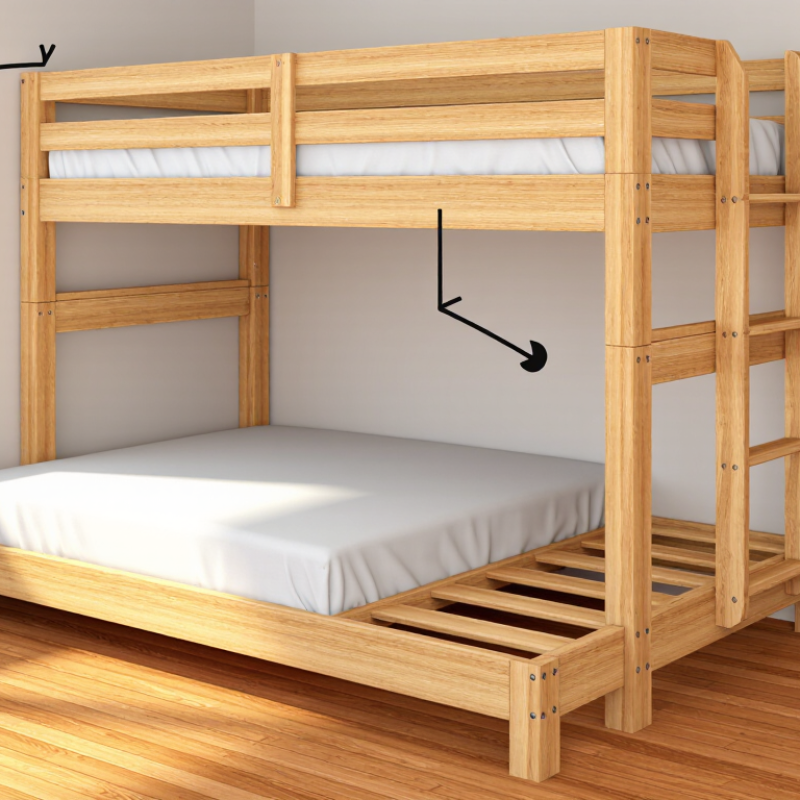
A bunk bed frame is a raised, stacked sleeping structure that supports two mattresses in one vertical footprint. Its main features include vertical posts, side rails, mattress slats, a ladder, and upper-level guardrails. Some frames separate into two single beds, while others remain permanently stacked. In practical room planning, the common twin mattress measures about 38 by 75 inches. A full mattress is approximately 54 by 75 inches, according to standard bedding dimension guides. The frame will be larger, often by several inches on each side.
Safety is part of the definition, not an optional detail. ASTM F1427, the U.S. voluntary safety specification for bunk beds, addresses guardrail performance, openings, access, and structural strength. U.S. Consumer Product Safety Commission guidance also emphasizes mattress fit, secure ladders, and guardrails on both sides of the upper bed. A poorly fitted mattress can create a dangerous gap. That detail is easy to miss during online shopping. The upper bunk usually needs at least one continuous guardrail, while the ladder should feel rigid under an adult’s weight. Exact requirements may vary by market and product design.
Measure ceiling height carefully. A sleeper needs sitting clearance above the mattress, not just space below it. I have found that drawings can make a frame look compact, yet ladder clearance changes the usable footprint. Twin-over-twin designs save floor space, but twin-over-full models need a wider room. That trade-off deserves more attention than it usually receives.
| Dimension or Feature | Typical Specification | Practical Details |
|---|---|---|
| Definition | A bunk bed frame is a stacked sleeping structure with two or more bed platforms arranged vertically. | It uses vertical space to provide multiple sleeping surfaces within approximately the floor area of one bed. |
| Common Mattress Size | Single or twin: approximately 38 × 75 in (97 × 191 cm). | This is one of the most common sizes for bunk beds. The mattress must match the frame's specified length and width. |
| Other Mattress Sizes | Full or double: approximately 54 × 75 in (137 × 191 cm); twin-over-full designs combine twin and full sizes. | Some frames are also designed for extra-long twin mattresses, approximately 38 × 80 in (97 × 203 cm). Always check the required mattress dimensions. |
| Overall Width | Usually about 40–60 in (102–152 cm), depending on mattress size, ladder placement, and side rails. | A full-size lower bunk generally requires more width than a twin-size bunk. |
| Overall Length | Usually about 78–82 in (198–208 cm) for standard twin or full mattresses. | The frame is longer than the mattress to accommodate rails, end panels, and structural components. |
| Overall Height | Commonly about 60–75 in (152–191 cm) from the floor to the top of the upper guardrail. | Low-profile models may be shorter, while designs with storage or a taller clearance may be higher. |
| Space Between Bunks | Often about 28–36 in (71–91 cm) between the top surface of the lower mattress and the underside of the upper bunk. | The actual clearance depends on the frame design and mattress thickness. A thicker mattress reduces usable headroom. |
| Upper-Bunk Guardrail | The upper bunk normally includes a guardrail on the exposed sides. | Guardrails help reduce the risk of falls. The mattress should not be thick enough to rise above the guardrail's intended protective height. |
| Ladder | Usually integrated into one end or side of the frame, with evenly spaced steps or rungs. | A fixed ladder saves floor space and should be securely attached before use. |
| Bed Slats | Wooden or metal slats support the mattress and allow ventilation beneath it. | Slat spacing and the required center support vary by design. Use only the mattress type and foundation specified for the frame. |
| Common Materials | Solid wood, engineered wood, steel, or combinations of these materials. | Material affects weight, appearance, durability, maintenance, and the total weight of the frame. |
| Weight Capacity | Often ranges from approximately 150–400 lb (68–181 kg) per sleeping level. | Capacity is model-specific and may include the sleeper, mattress, bedding, and accessories. Follow the frame's stated limit. |
| Typical Footprint | A twin-over-twin frame commonly occupies roughly 40–45 in × 78–82 in (102–114 cm × 198–208 cm), excluding ladder projection. | Leave additional clearance for climbing, changing bedding, opening drawers, and walking around the frame. |
| Convertible Designs | Some bunk frames separate into two independent beds. | Conversion is possible only when the frame is specifically designed for it; follow the assembly instructions for each configuration. |
| Recommended Room Conditions | The room should provide enough ceiling height for the upper sleeper to sit safely without contacting the ceiling or light fixtures. | Measure the assembled frame, mattress thickness, ceiling height, doorways, stairways, and delivery path before purchase or installation. |
| Safety Consideration | Upper bunks should have secure guardrails, a stable ladder, tight fasteners, and a correctly fitted mattress. | Use the bed according to the applicable safety instructions and age guidance. Children under six are generally not recommended to use the upper bunk. |
What Is a Bunk Bed Frame and What Size Is It?
Common Bunk Bed Frame Designs and Configurations
A bunk bed frame supports two sleeping surfaces in a vertical arrangement. The most common configuration places one twin bed above another twin bed. A standard twin mattress is usually about 38 by 75 inches, but exact dimensions can vary by region and manufacturer. Measure the mattress, frame, ladder, and room before choosing a model. Ceiling height matters too. A sleeper needs comfortable space above the top mattress, not just enough room to sit.
A twin-over-full design combines a narrow upper bunk with a wider lower bed. It works well when siblings share a room or when guests need more sleeping space. L-shaped bunk beds turn the bunks at a right angle, creating a more open layout. Some versions include drawers, shelves, or a small desk beneath one side. These features are useful, although they can make the frame deeper and harder to move.
Loft frames remove the lower bunk and leave open space underneath. That area can hold a desk, reading chair, or storage bins. A trundle configuration adds a low rolling bed beneath the lower frame. It saves floor space, but the trundle still needs clear pulling room. I once assumed every bunk ladder would fit beside a wall; that was a poor assumption. Check ladder clearance, guardrail height, mattress thickness, and assembly instructions carefully. Small measurement errors can affect daily comfort and safe access.
Most bunk bed frames are designed for twin-size mattresses, measuring approximately 38 × 75 inches. Twin XL and full-size configurations are also available, but the frame must be specifically designed for the mattress dimensions and required clearance.
What Is a Bunk Bed Frame and What Size Is?
A bunk bed frame supports two sleeping surfaces in a vertical arrangement. Its size depends on the mattress, ladder, guardrails, and clearance between levels. Standard twin mattresses measure about 38 by 75 inches, according to Sleep Foundation’s mattress-size guide. Twin XL mattresses usually measure 38 by 80 inches. Full mattresses are wider, at approximately 54 by 75 inches.
Twin-over-twin remains the most common configuration. A typical frame may measure 40 to 44 inches wide and 78 to 82 inches long, allowing room for rails and hardware. Twin-over-full designs need more floor space. Their lower sleeping platform usually matches the 54-inch mattress width. Measure the bedroom carefully. Door swings, ceiling fans, and window trim can change the usable area.
Ceiling clearance matters.
Leave enough space for the upper sleeper to sit without striking the ceiling. The U.S. Consumer Product Safety Commission’s bunk-bed rule, 16 CFR Part 1213, addresses guardrails and structural safety. Use a mattress that matches the frame’s stated thickness. A thicker mattress can reduce guardrail height. The CPSC advises using guardrails on both sides of the upper bunk, with the wall-side rail continuous from end to end.
Real rooms are rarely perfectly square. That is easy to overlook. Recheck the frame, mattress, and stair clearance before purchase. A few inches can decide whether the bed feels practical or cramped.
A bunk bed frame is a raised sleeping structure with one bed above another. It usually includes ladders, guardrails, and supporting slats. Common mattress widths are twin, full, or twin-over-full. The frame itself may extend several inches beyond the mattress, so measure the furniture, not only the bedding.
Measure the room’s length and width with a steel tape. Record the smallest measurement if walls are uneven. Leave at least 60 centimeters around the ladder and open side for safer movement. Mark the planned frame with painter’s tape on the floor. This simple step can reveal blocked doors, drawers, or heating vents.
Look upward, too. Measure from the floor to the ceiling, then subtract the frame height and mattress thickness. Leave enough clearance for the upper sleeper to sit without touching the ceiling. A practical target is about 75 to 90 centimeters above the mattress, though the manufacturer’s instructions should control. Check ceiling lights, fans, windows, and low shelves. I once focused on floor space and missed a swinging closet door. That mistake was avoidable.
Measure twice.
Also inspect the route into the room. Measure door openings, hallways, stair turns, and lift interiors. Compare those dimensions with the packaged frame pieces. Room measurements can look perfect, yet delivery access may fail. Keep the floor level and wall condition in mind, because an uneven surface can make a tall frame feel unstable. Personally, I would leave extra space rather than trust an exact fit. Furniture measurements are not always perfectly consistent.
A bunk bed frame supports two mattresses in a vertical layout, saving floor space in small bedrooms. Common dimensions include twin-over-twin, twin-over-full, and full-over-full. A standard twin mattress measures about 75 by 39 inches, while a full mattress measures about 75 by 54 inches. The frame usually extends beyond these measurements for ladders, rails, and structural joints. Measure the room carefully, including ceiling clearance.
Safety depends on more than appearance. The U.S. Consumer Product Safety Commission has reported approximately 36,000 bunk-bed-related injuries annually, based on emergency-department data. That figure deserves attention. Guardrails should remain securely attached on the upper bunk, and the ladder should not wobble under normal use. ASTM F1427 provides voluntary safety guidance, while federal bunk-bed rules address guardrails, entrapment spaces, and structural performance. Children under six should not use the upper bunk.
Solid wood and welded steel can provide strong support when joints are engineered correctly. Composite panels may work, but damaged edges and loose fasteners need inspection. Weight capacity must include the sleeper, mattress, bedding, and movement. A 250-pound rating may not support two 125-pound users safely if the manufacturer excludes mattress weight. Capacity figures are not perfectly comparable. Check the frame label and assembly instructions. I have found that ignored bolts, not dramatic breakage, often reveal the real weakness. Recheck every connection after assembly and after the first week of use.
We use cookies on our website to give you an improved browser experience. View our Privacy Policy for more information. Please make your selection to opt in or out of ALL cookies here: Accept or Decline
Do you consent to the use of ALL cookies?
901 2nd Court West
Birmingham, AL 35204
Sales: 866.481.4036
Logistics/Ops: 866.481.4036
2101 Dralle Road
University Park, IL 60466
Sales: 708.813.9070
Logistics/Ops: 708.235.4200
400 E. 13th Street
Little Rock, AR 72114
Sales: 866.760.5344
Logistics/Ops: 866.760.5344
225 Collins Road
Elkhart, IN 46515
Sales: 574.295.0214
Logistics/Ops: 574.607.4611
601 Berryman Pike
Tipton, IN 46072
Sales: 800.897.7591
Logistics/Ops: 800.897.7591
3900 Uvalda Street
Denver, CO 80239
Sales: 303.706.8000
Ops/Logistics: 303.576.8398
510 3rd Street E
Milan, IL 61264
Sales: 800.322.1052
Logistics/Ops: 800.322.1052
1660 E. Aurora
Des Moines, IA 50313
Sales: 800.671.1660
Logistics: 800.671.1660
86554 Gene Lasserre Blvd.
Yulee, FL 32097
Sales: 904.253.3060
Logistics/Ops: 904.225.3000
694 S.E. County Road 245
Lake City, FL 32025
Sales: 800.727.6706
Logistics/Ops: 386.752.7412
210 Neptune Road
Auburndale, FL 33823
Sales: 863.967.1131
Logistics/Ops: 863.777.9814
4601 McCoy Drive
Pensacola, FL 32503
Sales: 850.308.7030
Logistics/Ops: 850.434.5502
815 South 56th Street
Tampa, FL 33619
Sales: 813.302.1940
Logistics/Ops: 813.621.1352
200 Hosea Road
Lawrenceville, GA 30046
Sales: 770.953.7575
Logistics/Ops: 770.513.6000
Branch Product Guide
Branch Line Card
Moulding Offering
Cedar Offering
Column Offering
8173 Hwy. 165 North
Monroe, LA 71211
Sales: 800.256.4165
Logistics/Ops: 800.256.4165
508 Warren Avenue
Portland, ME 04103
Sales: 207.888.2331
Logistics/Ops: 207.797.6565
4300 Georgia Pacific Blvd.
Frederick, MD 21704
Sales: 301.798.7474
Logistics/Ops: 301.874.8000
419 Maple Street
Bellingham, MA 02019
Sales: 508.449.0535
Logistics/Ops: 508.966.5500
825 Buchanan Ave SW
Grand Rapids, MI 49507
Sales: 877.800.1180
Logistics/Ops: 616.278.0909
995 Pacific St. NW
Aitkin, MN 56431
Sales: 800.432.3727
Logistics/Ops: 218.212.7770
1102 Port Terminal Drive
Duluth, MN 55802
Sales: 800.951.9899
Logistics/Ops: 800.851.9899
9110 83rd Ave. North
Brooklyn Park, MN 55445
Sales: 763.425.0204
Logistics/Ops: 763.425.0204
910 E. Railroad Street
Long Beach, MS 39560
Sales: 866.535.4135
Logistics/Ops: 228.205.2400
1727 Warren Street
North Kansas City, MO 64116
Sales: 800.621.2611
Logistics/Ops: 800.621.2611
2123 North Golden
Springfield, MO 65803
Sales: 800.375.7891
Logistics/Ops: 800.375.7891
13860 Corp. Woods Trail
Bridgeton, MO 63044
Sales: 314.209.0800
Logistics/Ops: 314.209.0800
1109 South 19th Street
Omaha, NE 68108
Sales: 800.489.6637
Logistics/Ops: 800.489.6637
1 Luger Road
Denville, NJ 07834
Sales: 973-339-3539
Logistics/Ops: 973.625.1461
3720 Jeffrey Blvd.
Blasdell, NY 14219
Sales: 716.235.5989
Logistics/Ops: 716.825.6557
319 Yaphank Ave.
Yaphank, NY 11980
Sales: 631.358.5714
Logistics/Ops: 631.924.7401
3300 Parkside Drive
Charlotte, NC 28208
Sales: 800.839.2588
Logistics/Ops: 704.394.3172
1712 East D Street
Butner, NC 27509
Sales: 984.389.8200
Logistics/Ops: 919.575.3700
128 Foothills Drive
Statesville, NC 28687
Sales: 800.222.1414
Logistics/Ops: 704.394.3172
550 Munroe Falls Rd.
Tallmadge, OH 44278
Sales: 330.357.4506
Logistics/Ops: 330.794.1141
10347 Toebben Dr.
Independence, KY 41051
Sales: 859.298.3926
Logistics/Ops: 859.746.2250
450 N. MacArthur
Oklahoma City, OK 73127
Sales: 800.375.6025
Logistics/Ops: 800.375.6025
1680 North Aspen
Broken Arrow, OK 74012
Sales: 918.272.2212
Logistics/Ops: 918.272.2212
522 Bridge Street
Hunker, PA 15639
Sales: 878.217.2001
Logistics/Ops: 724.925.7285
4290 Atlanta Street
Charleston, SC 29418
Sales: 843.371.1420
Logistics/Ops: 843.554.8192
1040 S. Industrial Dr.
Erwin, TN 37650
Sales: 423.641.1005
Logistics/Ops: 423.742.5911
4287 Pilot Drive
Memphis, TN 38118
Sales: 901.365.2101
Logistics/Ops: 901.365.2101
700 Myatt Drive
Madison, TN 37115
Sales: 615.327.9547
Logistics/Ops: 629.777.4949
4747 Mark IV Parkway
Fort Worth, TX 76106
Sales: 866.323.5117
Logistics/Ops: 817.625.9091
6990 Market Avenue
El Paso, TX 79915
Sales: 915.778.6356
Logistics/Ops: 915.265.7200
2502 Wilson Road
Harlingen, TX 78552
Sales: 800.580.6711
Logistics/Ops: 800.580.6711
10,000 North Loop East
Houston, TX 77029
Sales: 713.921.1977
Logistics/Ops: 713.675.3544
702 East 44th St.
Lubbock, TX 79404
Sales: 866.454.6010
Logistics/Ops: 866.454.6010
535 N. WW White Road
San Antonio, TX 78219
Sales: 800.284.0488
Logistics/Ops: 210.333.8112
142 Pine Haven Shores Rd.
Shelburne, VT 05482
Sales: 802.800.2540
Logistics/Ops: 802.985.2512
4700 Bethlehem Road,
Richmond, VA 23230
Sales: 804.201.2400
Logistics/Ops: 804.342.1161
4516 N Barker Road
Spokane Valley, WA 99027
Phone: 509.892.9420
Toll free: 800.728.6157
8365 N. 76th Street
Milwaukee, WI 53223
Sales: 800.356.9245
Logistics/Ops: 800.356.9245
312 S. Chester Street
Sparta, WI 54656
Sales: 800.362.5864
Logistics/Ops: 800.362.5864
899 Grossman Drive
Schofield, WI 54476
Sales: 800.472.0017
Logistics/Ops: 800.472.0017
