
We use cookies on our website to give you an improved browser experience. View our Privacy Policy for more information. Please make your selection to opt in or out of ALL cookies here: Accept or Decline
What Is a butterfly valve and How Does It Work? This guide examines the compact device behind many water, air, chemical, and process-control systems. A butterfly valve uses a circular disc mounted on a rotating shaft. The disc turns inside the pipe. A quarter-turn usually moves it from fully open to fully closed. Simple movement. Serious engineering.
Greg Johnson, a longtime valve-industry educator, states, “Valve selection begins with the process, not the product name.” That principle deserves attention. Pipe size alone cannot determine the correct butterfly valve. Engineers must consider pressure, temperature, fluid composition, flow speed, seat material, and operating frequency. A rubber-lined valve may perform well in clean water. It may struggle with abrasive slurry or aggressive chemicals. The same design can behave differently across two nearby facilities.
When the handle or actuator rotates the shaft, the disc changes the available flow area. In the open position, the disc aligns with the fluid path. In the closed position, it blocks the passage and presses against the seat. Lug, wafer, and double-flanged bodies suit different installation needs. Electric and pneumatic actuators support remote control. Manual handles remain useful for smaller lines.
The explanation can sound too neat. Real systems are less forgiving. Incorrect alignment can damage the seat. Excessive throttling may create turbulence, noise, or premature wear. Even a dependable butterfly valve needs inspection, correct torque, and suitable materials. This article explores its parts, operating principle, advantages, limitations, and practical selection criteria. It also questions where this valve works well—and where another design deserves a closer look.
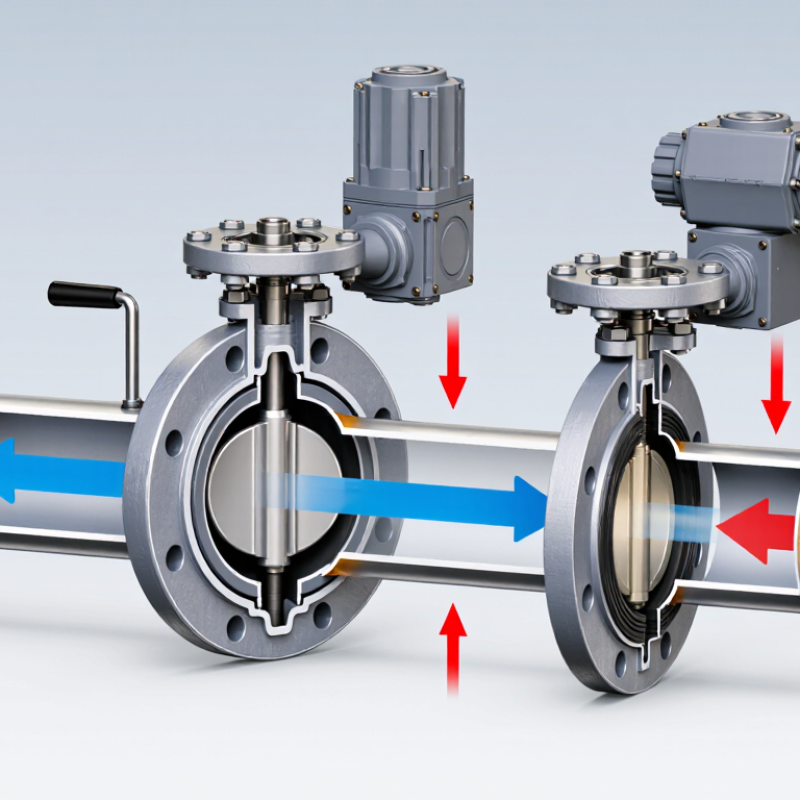
A butterfly valve is a quarter-turn device used to start, stop, or regulate fluid flow. Its main part is a circular disc mounted inside a pipe. A stem connects the disc to a handle or actuator. When the stem turns, the disc rotates around its central axis.
The basic design is compact and relatively light. The valve body fits between pipe flanges, while a resilient seat surrounds the disc and limits leakage. With the disc aligned with the pipe, fluid passes through the opening. A 90-degree turn places the disc across the passage and stops most flow. This movement is quick and easy to observe during routine maintenance.
That simplicity can mislead.
In field inspections, a valve may look closed while the disc remains slightly misaligned. Sediment, worn seats, or incorrect installation can affect sealing performance. Operators should check the flow direction, flange alignment, stem movement, and actuator settings. Material selection also matters because temperature, pressure, and fluid chemistry influence service life. A valve suitable for clean water may perform poorly with abrasive slurry or corrosive chemicals.
Butterfly valves are often effective for isolation and moderate flow control, but they are not perfect throttling devices. At partial opening, the disc can create turbulence, vibration, and pressure loss. Engineers usually confirm the pressure rating and operating temperature before selection. The smallest detail matters. A damaged seat can turn a reliable design into a persistent leak.
A butterfly valve controls flow with a circular disc mounted inside a pipe. When the disc turns parallel to the flow, liquid or gas passes with limited resistance. Turning it across the passage blocks the route. Most designs use a quarter-turn movement, making operation quick. The body supports the pressure boundary and connects to the piping system. Its internal finish also matters because rough surfaces can disturb flow or collect deposits.
The disc is the main throttling element, while the stem transfers movement from the actuator to the disc. A resilient or metal seat creates the sealing line around the disc. Stem seals help prevent leakage into the surrounding area. The actuator may be a hand lever, gearbox, pneumatic unit, or electric unit. Each option requires suitable operating torque. A lever looks simple, but vibration can make the position indicator less reliable than expected. Small details matter here.
During inspection, technicians check the disc edge, seat condition, stem movement, and actuator response. They also verify pressure ratings and flange alignment before operation. Misalignment can increase friction and damage the seat. A valve may appear closed while a damaged seat still allows passage. This is an easy point to overlook. In real installations, no component works alone; pipe strain, dirt, temperature, and incorrect torque can all affect sealing performance. The design seems simple, but maintenance decisions still require careful judgment.
What Is a Butterfly Valve and How Does It Work?
A butterfly valve controls flow with a circular disc inside the pipe. Its operation is simple, but timing matters. When the actuator turns the stem, the disc rotates around its central axis. At 0 degrees, the disc aligns with the pipeline and allows near-full flow. As it turns toward 90 degrees, the disc blocks the passage. The seal then presses against the disc edge, limiting leakage. Operators may use a hand lever, gearbox, pneumatic actuator, or electric actuator. Each option changes response speed and maintenance needs.
During partial opening, flow strikes the disc and creates turbulence. This can increase noise, vibration, and pressure loss. A 2024 report from Fortune Business Insights valued the global industrial valve market at about USD 78.3 billion in 2023, showing the scale of systems that depend on reliable flow control. Yet market size does not guarantee correct selection. Disc material, seat design, pressure rating, and fluid temperature must match actual service conditions. Small errors become expensive quickly.
Tips: Confirm the valve’s pressure class before installation. Check the stem position visually. Exercise the valve periodically to prevent sticking. Do not assume a standard seat suits abrasive fluid. In field work, a partly open disc may look harmless, but it can wear quickly under high velocity. My practical view is cautious: butterfly valves are efficient isolators, but they are not always ideal for precise throttling. The correct answer depends on the whole piping system.
| Category | Data Dimension | Factual Description | Operating Significance |
|---|---|---|---|
| Basic Definition | Valve type | A butterfly valve is a quarter-turn rotary valve used to start, stop, or regulate fluid flow. | A 90-degree rotation moves the valve between its main open and closed positions. |
| Main closure element | A circular disc mounted inside the flow passage. | The disc changes the available flow area as it rotates. | |
| Typical movement | The disc rotates around a shaft or stem. | The movement is compact and requires less space than many multi-turn valve designs. | |
| Primary flow paths | The valve may be installed in liquid, gas, or slurry piping when the selected design is suitable for the service. | Media compatibility depends on the body, disc, shaft, seat, pressure, temperature, and fluid properties. | |
| Common body styles | Wafer, lug, flanged, and double-flanged configurations are commonly used. | The connection style determines how the valve is positioned and secured between or to pipe flanges. | |
| Control function | Butterfly valves can provide isolation or throttling, depending on their design and service requirements. | Frequent throttling should only be performed when the valve is rated for control duty. | |
| Sealing method | A resilient seat or a metal-seated arrangement forms the shutoff interface. | The seat material and design influence leakage performance, temperature capability, and chemical compatibility. | |
| Actuation options | Manual handles, gear operators, pneumatic actuators, electric actuators, and hydraulic actuators may be used. | The actuator must provide enough torque for the operating pressure, seat friction, and safety requirements. | |
| Operating Sequence | Step 1: Closed position | The disc is positioned across the pipe bore. | The disc and seat restrict the passage and provide shutoff when the valve is correctly selected and installed. |
| Step 2: Input from operator | A hand lever, gearbox, or actuator applies rotational force to the stem. | The applied torque overcomes resistance from the seat, disc, shaft, and differential pressure. | |
| Step 3: Stem rotation | The stem transfers the turning force to the disc. | The disc rotates about its shaft axis rather than moving linearly along the pipe. | |
| Step 4: Opening begins | As the disc turns away from the crosswise position, the flow area increases. | Fluid flow usually increases as the disc angle opens, although the relationship is not perfectly linear. | |
| Step 5: Intermediate position | The disc is partly rotated across the bore. | The partial opening creates a restriction and can be used for flow control when permitted by the valve design. | |
| Step 6: Fully open position | The disc is rotated approximately 90 degrees from the closed position and lies broadly parallel to the flow. | The passage is at or near its maximum effective area, minimizing the valve's flow restriction for that installation. | |
| Step 7: Closing | The actuator reverses the stem rotation until the disc returns to the seat. | The seat contacts the disc perimeter and limits or stops flow, subject to the valve's specified shutoff performance. | |
| Performance Factors | Pressure drop | The disc remains in the flow path even when open. | This can create more pressure loss than a full-bore valve with an unobstructed passage. |
| Flow control behavior | Flow changes with disc angle, pressure differential, and fluid properties. | A valve characteristic curve should be used when accurate modulation is required. | |
| Torque requirement | Torque is affected by valve size, pressure differential, seat friction, temperature, and media. | Actuator sizing should use the manufacturer's certified torque data for the specific valve construction. | |
| Installation alignment | The disc needs adequate clearance inside the pipe and must not strike adjacent components. | Incorrect alignment can damage the disc or seat and may prevent full opening or closing. | |
| Temperature limit | The allowable temperature is determined largely by the seat, seals, body, and disc materials. | The published pressure-temperature rating must be checked before operation. | |
| Maintenance focus | Inspection commonly includes the seat, disc edge, shaft, actuator, fasteners, and external leakage points. | Periodic functional checks help confirm that the valve reaches both defined end positions. | |
| Safety requirement | The line should be isolated and depressurized before maintenance or disassembly. | Lockout and tagout procedures should be followed because stored pressure and automatic actuators can create hazards. |
A butterfly valve controls flow with a circular disc mounted on a rotating shaft. The disc turns inside the pipe, opening, throttling, or stopping media movement. A quarter-turn usually moves the valve from closed to open. Its compact body makes it useful where installation space is limited. During field checks, technicians often inspect disc clearance, shaft alignment, and seat condition before operation.
Common configurations include wafer, lug, and double-flanged designs. A wafer valve fits between two pipe flanges and suits many space-conscious installations. A lug valve has threaded inserts, allowing one pipe section to be removed while the opposite side remains secured. Double-flanged models use flanges on both ends and provide stronger support for larger or heavier piping. Each arrangement affects maintenance access and installation cost.
Butterfly valves also differ by seat and disc design. Resilient-seated valves offer reliable shutoff for water and many low-temperature services. High-performance valves often use an offset shaft, reducing seat friction during rotation. Metal-seated versions handle higher temperatures and abrasive conditions, but they may permit slight leakage. Manual levers work well for small valves, while gearboxes or actuators support larger sizes and remote control. The simple appearance can mislead. Incorrect seat material, pressure rating, or actuator sizing may cause early failure. A careful selection should consider fluid properties, temperature, pressure, pipe alignment, and the required control accuracy.
Butterfly valves are quarter-turn valves that regulate or isolate flow by rotating a disc around a central or offset shaft. The chart shows indicative pressure-rating bands commonly associated with major butterfly valve configurations.
Wafer and lug designs are commonly used in lower- to medium-pressure piping, while double-flanged and triple-offset designs are often selected for larger sizes, higher pressures, higher temperatures, or tighter shutoff requirements. Actual ratings depend on the applicable standard, body and seat materials, valve size, and operating temperature.
A butterfly valve controls flow with a circular disc mounted on a rotating stem. Turning the stem about a quarter turn moves the disc from open to closed. When the disc aligns with the pipe, fluid passes through with limited resistance. At a right angle, the disc blocks the passage. Operators commonly use these valves in water treatment, HVAC systems, irrigation lines, and industrial process piping.
Their compact body saves space between pipe flanges. They also weigh less than many gate or globe valves, which can simplify installation and maintenance. Quarter-turn operation supports quick shutoff during routine servicing. However, a butterfly valve is not automatically suitable for every application. Partial opening can create turbulence, vibration, and disc wear. Abrasive media may damage the sealing surface. High temperatures can also exceed the limits of the seat material. It depends on the design.
Tips: Check the medium, pressure, temperature, and pipe size before selection. During inspection, look for stem looseness, seat damage, and unusual operating torque. A valve that feels stiff may need attention, not force. For accurate control, confirm its tested flow characteristics rather than relying only on its compact appearance. In field work, small alignment errors can cause leakage. That detail is easy to underestimate.
We use cookies on our website to give you an improved browser experience. View our Privacy Policy for more information. Please make your selection to opt in or out of ALL cookies here: Accept or Decline
Do you consent to the use of ALL cookies?
901 2nd Court West
Birmingham, AL 35204
Sales: 866.481.4036
Logistics/Ops: 866.481.4036
2101 Dralle Road
University Park, IL 60466
Sales: 708.813.9070
Logistics/Ops: 708.235.4200
400 E. 13th Street
Little Rock, AR 72114
Sales: 866.760.5344
Logistics/Ops: 866.760.5344
225 Collins Road
Elkhart, IN 46515
Sales: 574.295.0214
Logistics/Ops: 574.607.4611
601 Berryman Pike
Tipton, IN 46072
Sales: 800.897.7591
Logistics/Ops: 800.897.7591
3900 Uvalda Street
Denver, CO 80239
Sales: 303.706.8000
Ops/Logistics: 303.576.8398
510 3rd Street E
Milan, IL 61264
Sales: 800.322.1052
Logistics/Ops: 800.322.1052
1660 E. Aurora
Des Moines, IA 50313
Sales: 800.671.1660
Logistics: 800.671.1660
86554 Gene Lasserre Blvd.
Yulee, FL 32097
Sales: 904.253.3060
Logistics/Ops: 904.225.3000
694 S.E. County Road 245
Lake City, FL 32025
Sales: 800.727.6706
Logistics/Ops: 386.752.7412
210 Neptune Road
Auburndale, FL 33823
Sales: 863.967.1131
Logistics/Ops: 863.777.9814
4601 McCoy Drive
Pensacola, FL 32503
Sales: 850.308.7030
Logistics/Ops: 850.434.5502
815 South 56th Street
Tampa, FL 33619
Sales: 813.302.1940
Logistics/Ops: 813.621.1352
200 Hosea Road
Lawrenceville, GA 30046
Sales: 770.953.7575
Logistics/Ops: 770.513.6000
Branch Product Guide
Branch Line Card
Moulding Offering
Cedar Offering
Column Offering
8173 Hwy. 165 North
Monroe, LA 71211
Sales: 800.256.4165
Logistics/Ops: 800.256.4165
508 Warren Avenue
Portland, ME 04103
Sales: 207.888.2331
Logistics/Ops: 207.797.6565
4300 Georgia Pacific Blvd.
Frederick, MD 21704
Sales: 301.798.7474
Logistics/Ops: 301.874.8000
419 Maple Street
Bellingham, MA 02019
Sales: 508.449.0535
Logistics/Ops: 508.966.5500
825 Buchanan Ave SW
Grand Rapids, MI 49507
Sales: 877.800.1180
Logistics/Ops: 616.278.0909
995 Pacific St. NW
Aitkin, MN 56431
Sales: 800.432.3727
Logistics/Ops: 218.212.7770
1102 Port Terminal Drive
Duluth, MN 55802
Sales: 800.951.9899
Logistics/Ops: 800.851.9899
9110 83rd Ave. North
Brooklyn Park, MN 55445
Sales: 763.425.0204
Logistics/Ops: 763.425.0204
910 E. Railroad Street
Long Beach, MS 39560
Sales: 866.535.4135
Logistics/Ops: 228.205.2400
1727 Warren Street
North Kansas City, MO 64116
Sales: 800.621.2611
Logistics/Ops: 800.621.2611
2123 North Golden
Springfield, MO 65803
Sales: 800.375.7891
Logistics/Ops: 800.375.7891
13860 Corp. Woods Trail
Bridgeton, MO 63044
Sales: 314.209.0800
Logistics/Ops: 314.209.0800
1109 South 19th Street
Omaha, NE 68108
Sales: 800.489.6637
Logistics/Ops: 800.489.6637
1 Luger Road
Denville, NJ 07834
Sales: 973-339-3539
Logistics/Ops: 973.625.1461
3720 Jeffrey Blvd.
Blasdell, NY 14219
Sales: 716.235.5989
Logistics/Ops: 716.825.6557
319 Yaphank Ave.
Yaphank, NY 11980
Sales: 631.358.5714
Logistics/Ops: 631.924.7401
3300 Parkside Drive
Charlotte, NC 28208
Sales: 800.839.2588
Logistics/Ops: 704.394.3172
1712 East D Street
Butner, NC 27509
Sales: 984.389.8200
Logistics/Ops: 919.575.3700
128 Foothills Drive
Statesville, NC 28687
Sales: 800.222.1414
Logistics/Ops: 704.394.3172
550 Munroe Falls Rd.
Tallmadge, OH 44278
Sales: 330.357.4506
Logistics/Ops: 330.794.1141
10347 Toebben Dr.
Independence, KY 41051
Sales: 859.298.3926
Logistics/Ops: 859.746.2250
450 N. MacArthur
Oklahoma City, OK 73127
Sales: 800.375.6025
Logistics/Ops: 800.375.6025
1680 North Aspen
Broken Arrow, OK 74012
Sales: 918.272.2212
Logistics/Ops: 918.272.2212
522 Bridge Street
Hunker, PA 15639
Sales: 878.217.2001
Logistics/Ops: 724.925.7285
4290 Atlanta Street
Charleston, SC 29418
Sales: 843.371.1420
Logistics/Ops: 843.554.8192
1040 S. Industrial Dr.
Erwin, TN 37650
Sales: 423.641.1005
Logistics/Ops: 423.742.5911
4287 Pilot Drive
Memphis, TN 38118
Sales: 901.365.2101
Logistics/Ops: 901.365.2101
700 Myatt Drive
Madison, TN 37115
Sales: 615.327.9547
Logistics/Ops: 629.777.4949
4747 Mark IV Parkway
Fort Worth, TX 76106
Sales: 866.323.5117
Logistics/Ops: 817.625.9091
6990 Market Avenue
El Paso, TX 79915
Sales: 915.778.6356
Logistics/Ops: 915.265.7200
2502 Wilson Road
Harlingen, TX 78552
Sales: 800.580.6711
Logistics/Ops: 800.580.6711
10,000 North Loop East
Houston, TX 77029
Sales: 713.921.1977
Logistics/Ops: 713.675.3544
702 East 44th St.
Lubbock, TX 79404
Sales: 866.454.6010
Logistics/Ops: 866.454.6010
535 N. WW White Road
San Antonio, TX 78219
Sales: 800.284.0488
Logistics/Ops: 210.333.8112
142 Pine Haven Shores Rd.
Shelburne, VT 05482
Sales: 802.800.2540
Logistics/Ops: 802.985.2512
4700 Bethlehem Road,
Richmond, VA 23230
Sales: 804.201.2400
Logistics/Ops: 804.342.1161
4516 N Barker Road
Spokane Valley, WA 99027
Phone: 509.892.9420
Toll free: 800.728.6157
8365 N. 76th Street
Milwaukee, WI 53223
Sales: 800.356.9245
Logistics/Ops: 800.356.9245
312 S. Chester Street
Sparta, WI 54656
Sales: 800.362.5864
Logistics/Ops: 800.362.5864
899 Grossman Drive
Schofield, WI 54476
Sales: 800.472.0017
Logistics/Ops: 800.472.0017
