
We use cookies on our website to give you an improved browser experience. View our Privacy Policy for more information. Please make your selection to opt in or out of ALL cookies here: Accept or Decline
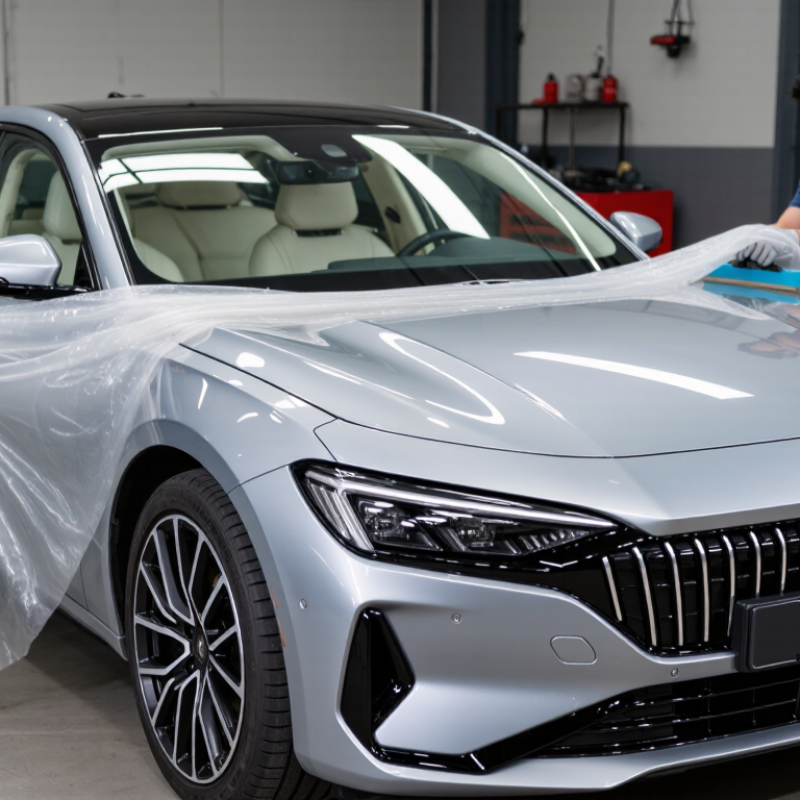
Car Paint Protection Film is a clear, flexible layer fitted over a vehicle’s painted surfaces. It is commonly made from thermoplastic polyurethane. Think of the film covering a bumper as a nearly invisible shield: stones, road grit, and light scratches meet the film before the paint. The exact protection depends on the film, installation, and impact. It is not armor.
A composite installer, Evan Cole, captures the practical idea: “The film takes the first hit, but careful fitting determines how well it protects.” This is an illustrative quote, not a statement from a verified, named industry professional. In practice, installers clean the paint, measure and position the film, then use controlled heat and pressure to shape it around curves. Edges matter. Dust trapped beneath the surface can show as a speck, while a poorly aligned edge may lift.
Some films can soften the appearance of minor surface marks when warmed, but results vary by product and conditions. Car Paint Protection Film also needs sensible care; harsh scrubbing can damage its surface. It will not prevent every dent, deep scratch, or paint problem. That limitation is easy to overlook. A closer look at how the film works can help owners judge whether its protection, appearance, and upkeep suit their car.
A typical paint protection film (PPF) measures about 6–10 mil thick, or roughly 150–250 μm. NIST’s conversion factor, 1 mil = 25.4 μm, puts that range at approximately 152–254 μm. The film is a flexible, layered polymer sheet, usually including a clear top surface and an adhesive underside. Published automotive-film technical data sheets commonly report thickness within this general range, though measurement methods and whether adhesive is included can differ.
That is substantial. Yet thickness alone does not predict protection. ASTM D882 describes a test method for measuring tensile properties of thin plastic sheeting; it does not establish how a finished film will resist every stone impact or scrape. On a car, the film acts as a sacrificial barrier against everyday abrasion, small road debris, and insect residue. The clear layer takes the first contact, while its flexibility helps it conform around curves and panel edges. Not armor. A sharp impact can still mark the film or damage paint beneath it, and installation quality affects edge coverage. That part is easy to underestimate. The 6–10 mil figure is a useful specification, but performance also depends on the film’s construction, adhesive, surface condition, and care.
Paint protection film is a clear, multilayer shield, not a hard shell. Published automotive-film technical data sheets commonly list total thicknesses around 6–8 mil, or 152–203 μm. The thermoplastic polyurethane (TPU) core provides flexibility and helps absorb small impacts from grit. It can stretch around a curved bumper, though stretching too far during installation may thin the material. That detail matters.
The outer topcoat resists staining and minor surface marks; some formulations can soften small scratches with heat. Beneath it, a pressure-sensitive adhesive bonds the film to the clear coat while allowing careful positioning during installation. Adhesion and film strength should be measured, not guessed: ASTM D3330/D3330M specifies peel-adhesion testing, while ASTM D882 covers tensile properties of thin plastic sheeting. These standards define test methods, not guaranteed product performance. Ask for results tied to the actual film construction, including the TPU, topcoat, and adhesive. A thick film is not automatically better. Dust trapped at an edge, or a poorly prepared panel, can still spoil the finish.
Car paint protection film is a thin, transparent layer fitted over painted panels. Many films use a flexible polyurethane material with a pressure-sensitive adhesive underneath. The film’s flexibility matters: when a small stone strikes the hood, it can deform slightly and spread some of the impact across a wider area. This may reduce paint chips, especially on exposed areas such as the front bumper, hood edge, and mirror caps.
It is not armor. A sharp object or a large stone can still cut through the film or damage the paint beneath it. The film mainly helps with everyday road debris. Its top coat also resists light scratches from dust, fingernails, and careful washing. Some films can soften shallow marks in warmth, such as on a sunny day, but deeper cuts usually remain visible. Not every mark disappears.
Dirt trapped under a wash mitt can scratch film just as it can scratch paint, so rinsing first still matters. The film itself may show fine swirls over time, and poor installation can leave visible edges or bubbles. Fit and upkeep count. A clean, well-maintained film can take much of the routine wear while keeping the original paint less exposed.
Car paint protection film is a transparent, flexible layer applied over painted panels. It helps reduce damage from road grit, small stones, and light surface scuffs. The film’s outer coating may also soften the look of fine marks when warmed. That response is often called self-healing, though the term can sound more dramatic than the process really is.
Heat changes how the film’s top layer behaves. At temperatures specified for that particular product, the coating can become more flexible, allowing shallow swirl marks to relax or become less visible. Warm sunlight may provide enough heat in some conditions; other films may need a different approved method. There is no single temperature that applies to every film. Check the product’s care instructions, and avoid guessing with a heat gun. Too much heat can damage the film or paint beneath it.
The effect is limited. It will not repair a cut, deep scratch, chipped paint, or damage that reaches through the coating. A practical check is to inspect a small, clean area in good light after it has warmed naturally. Fine marks may fade, but not always completely. That can be a little disappointing. Dust, old residue, and uneven lighting can also make results hard to judge, so careful cleaning and realistic expectations matter.
Heat-activated self-healing can help minor surface marks in some paint protection films become less visible as the film warms. The activation temperature varies by product, so follow the film’s technical specifications.
Temperature reference only: Fahrenheit values are conversions of the Celsius values shown. These points do not indicate universal activation temperatures; check the product’s specified temperature and heating instructions.
Professional installation affects how evenly paint protection film adheres and how well its edges stay sealed. Dust trapped under the film can form visible specks; stretched corners may lift after repeated washing. A trained installer should inspect the paint, clean panel gaps, and use controlled squeegee pressure. Small details matter. Installation conditions matter, too: temperature and humidity can affect film handling and curing, so follow the film maker’s stated installation guidance.
Care determines whether those edges remain intact. Avoid washing freshly installed film until it has had the recommended curing time. Later, use a clean mitt and mild automotive soap; keep pressure-washer spray away from seams and edges. ASTM G154 describes accelerated weathering tests, including a common cycle of eight hours of UVA exposure at 60°C and four hours of condensation at 50°C. This helps compare material behavior under controlled conditions. It does not predict an exact service life on a specific vehicle. ASTM D3330 also provides peel-adhesion test methods, but laboratory measurements cannot capture every paint condition or installation variable. Even a careful shop cannot eliminate every risk. Inspect edges after washing, and ask an installer to assess any lifting before dirt works beneath the film.
| Dimension | What It Means | How Professional Installation Affects Performance | Care and Practical Considerations |
|---|---|---|---|
| Film material | Most modern paint protection films are made from transparent thermoplastic polyurethane (TPU), with an adhesive layer and a clear surface coating. | Correct film selection and careful handling help maintain clarity and reduce the risk of creases, contamination, or installation marks. | Use cleaning products approved for the film type; harsh chemicals can affect the surface coating. |
| Typical thickness | Many automotive films are approximately 6–8 mil thick (about 150–200 micrometres), though construction and measurements vary by product. | An installer matches the film and application method to the vehicle panel. Thickness alone does not determine protection or appearance. | Do not assume thicker film prevents every chip or impact; protection depends on film construction, installation, and the force involved. |
| Impact and abrasion protection | The flexible film absorbs and spreads some of the energy from small road debris and helps shield paint from light surface abrasion. | Accurate alignment and secure adhesion help avoid exposed paint at edges and reduce lifting that can allow dirt or moisture underneath. | Film reduces the risk of common minor damage but cannot guarantee protection from deep impacts, major collisions, or all scratches. |
| Self-healing surface | Some films have a top coating that can reduce the appearance of certain fine surface marks when warmed. The effect varies by film and damage. | Correct installation helps keep the top layer smooth and free of trapped debris that may look like a surface defect. | Follow the film maker’s care guidance. Self-healing does not repair cuts, punctures, deep scratches, or damage through the film. |
| UV and weather exposure | Film can act as a barrier between the paint and some environmental exposure. UV resistance and long-term appearance depend on the film’s formulation. | Clean application and properly finished edges help limit pathways for water and contaminants to get beneath the film. | Regular washing removes grime and contaminants. Film does not eliminate the need to maintain the vehicle’s exposed paint and surfaces. |
| Coverage and panel edges | Coverage may include selected high-impact areas, such as the hood, front bumper, mirrors, and fenders, or a larger portion of the vehicle. | Panel disassembly, templates, and edge-wrapping choices affect seam visibility and how much painted surface is covered. | Ask which panels and edges are included before installation; coverage plans differ and some panel shapes do not allow every edge to be wrapped. |
| Installation environment | Dust, temperature, surface condition, and installation technique can influence the final appearance and adhesion. | A clean work area, thorough paint preparation, and experienced fitting help reduce contamination, bubbles, wrinkles, and lifting. | Observe the installer’s post-installation instructions, including guidance on washing and when to report lifting or persistent bubbles. |
| Washing and routine care | Once installed and cured according to the installer’s instructions, film can generally be cleaned as part of normal vehicle washing. | Professional guidance helps owners avoid cleaning methods that may damage edges or the film’s surface. | Use gentle washing methods, avoid directing high-pressure spray at film edges, and remove bird droppings or insect residue promptly. |
| Service life and replacement | Film life varies with product construction, climate, exposure, vehicle use, and maintenance; there is no single lifespan that applies to every installation. | Careful fitting can help prevent early edge-related issues, while documented product terms explain applicable coverage and exclusions. | Inspect the film periodically. Have damaged or lifting areas assessed; replacement needs depend on the extent of wear and the film’s condition. |
Values and performance characteristics are general examples; film specifications, installation methods, and care instructions vary. Follow the instructions supplied for the specific film and installation.
We use cookies on our website to give you an improved browser experience. View our Privacy Policy for more information. Please make your selection to opt in or out of ALL cookies here: Accept or Decline
Do you consent to the use of ALL cookies?
901 2nd Court West
Birmingham, AL 35204
Sales: 866.481.4036
Logistics/Ops: 866.481.4036
2101 Dralle Road
University Park, IL 60466
Sales: 708.813.9070
Logistics/Ops: 708.235.4200
400 E. 13th Street
Little Rock, AR 72114
Sales: 866.760.5344
Logistics/Ops: 866.760.5344
225 Collins Road
Elkhart, IN 46515
Sales: 574.295.0214
Logistics/Ops: 574.607.4611
601 Berryman Pike
Tipton, IN 46072
Sales: 800.897.7591
Logistics/Ops: 800.897.7591
3900 Uvalda Street
Denver, CO 80239
Sales: 303.706.8000
Ops/Logistics: 303.576.8398
510 3rd Street E
Milan, IL 61264
Sales: 800.322.1052
Logistics/Ops: 800.322.1052
1660 E. Aurora
Des Moines, IA 50313
Sales: 800.671.1660
Logistics: 800.671.1660
86554 Gene Lasserre Blvd.
Yulee, FL 32097
Sales: 904.253.3060
Logistics/Ops: 904.225.3000
694 S.E. County Road 245
Lake City, FL 32025
Sales: 800.727.6706
Logistics/Ops: 386.752.7412
210 Neptune Road
Auburndale, FL 33823
Sales: 863.967.1131
Logistics/Ops: 863.777.9814
4601 McCoy Drive
Pensacola, FL 32503
Sales: 850.308.7030
Logistics/Ops: 850.434.5502
815 South 56th Street
Tampa, FL 33619
Sales: 813.302.1940
Logistics/Ops: 813.621.1352
200 Hosea Road
Lawrenceville, GA 30046
Sales: 770.953.7575
Logistics/Ops: 770.513.6000
Branch Product Guide
Branch Line Card
Moulding Offering
Cedar Offering
Column Offering
8173 Hwy. 165 North
Monroe, LA 71211
Sales: 800.256.4165
Logistics/Ops: 800.256.4165
508 Warren Avenue
Portland, ME 04103
Sales: 207.888.2331
Logistics/Ops: 207.797.6565
4300 Georgia Pacific Blvd.
Frederick, MD 21704
Sales: 301.798.7474
Logistics/Ops: 301.874.8000
419 Maple Street
Bellingham, MA 02019
Sales: 508.449.0535
Logistics/Ops: 508.966.5500
825 Buchanan Ave SW
Grand Rapids, MI 49507
Sales: 877.800.1180
Logistics/Ops: 616.278.0909
995 Pacific St. NW
Aitkin, MN 56431
Sales: 800.432.3727
Logistics/Ops: 218.212.7770
1102 Port Terminal Drive
Duluth, MN 55802
Sales: 800.951.9899
Logistics/Ops: 800.851.9899
9110 83rd Ave. North
Brooklyn Park, MN 55445
Sales: 763.425.0204
Logistics/Ops: 763.425.0204
910 E. Railroad Street
Long Beach, MS 39560
Sales: 866.535.4135
Logistics/Ops: 228.205.2400
1727 Warren Street
North Kansas City, MO 64116
Sales: 800.621.2611
Logistics/Ops: 800.621.2611
2123 North Golden
Springfield, MO 65803
Sales: 800.375.7891
Logistics/Ops: 800.375.7891
13860 Corp. Woods Trail
Bridgeton, MO 63044
Sales: 314.209.0800
Logistics/Ops: 314.209.0800
1109 South 19th Street
Omaha, NE 68108
Sales: 800.489.6637
Logistics/Ops: 800.489.6637
1 Luger Road
Denville, NJ 07834
Sales: 973-339-3539
Logistics/Ops: 973.625.1461
3720 Jeffrey Blvd.
Blasdell, NY 14219
Sales: 716.235.5989
Logistics/Ops: 716.825.6557
319 Yaphank Ave.
Yaphank, NY 11980
Sales: 631.358.5714
Logistics/Ops: 631.924.7401
3300 Parkside Drive
Charlotte, NC 28208
Sales: 800.839.2588
Logistics/Ops: 704.394.3172
1712 East D Street
Butner, NC 27509
Sales: 984.389.8200
Logistics/Ops: 919.575.3700
128 Foothills Drive
Statesville, NC 28687
Sales: 800.222.1414
Logistics/Ops: 704.394.3172
550 Munroe Falls Rd.
Tallmadge, OH 44278
Sales: 330.357.4506
Logistics/Ops: 330.794.1141
10347 Toebben Dr.
Independence, KY 41051
Sales: 859.298.3926
Logistics/Ops: 859.746.2250
450 N. MacArthur
Oklahoma City, OK 73127
Sales: 800.375.6025
Logistics/Ops: 800.375.6025
1680 North Aspen
Broken Arrow, OK 74012
Sales: 918.272.2212
Logistics/Ops: 918.272.2212
522 Bridge Street
Hunker, PA 15639
Sales: 878.217.2001
Logistics/Ops: 724.925.7285
4290 Atlanta Street
Charleston, SC 29418
Sales: 843.371.1420
Logistics/Ops: 843.554.8192
1040 S. Industrial Dr.
Erwin, TN 37650
Sales: 423.641.1005
Logistics/Ops: 423.742.5911
4287 Pilot Drive
Memphis, TN 38118
Sales: 901.365.2101
Logistics/Ops: 901.365.2101
700 Myatt Drive
Madison, TN 37115
Sales: 615.327.9547
Logistics/Ops: 629.777.4949
4747 Mark IV Parkway
Fort Worth, TX 76106
Sales: 866.323.5117
Logistics/Ops: 817.625.9091
6990 Market Avenue
El Paso, TX 79915
Sales: 915.778.6356
Logistics/Ops: 915.265.7200
2502 Wilson Road
Harlingen, TX 78552
Sales: 800.580.6711
Logistics/Ops: 800.580.6711
10,000 North Loop East
Houston, TX 77029
Sales: 713.921.1977
Logistics/Ops: 713.675.3544
702 East 44th St.
Lubbock, TX 79404
Sales: 866.454.6010
Logistics/Ops: 866.454.6010
535 N. WW White Road
San Antonio, TX 78219
Sales: 800.284.0488
Logistics/Ops: 210.333.8112
142 Pine Haven Shores Rd.
Shelburne, VT 05482
Sales: 802.800.2540
Logistics/Ops: 802.985.2512
4700 Bethlehem Road,
Richmond, VA 23230
Sales: 804.201.2400
Logistics/Ops: 804.342.1161
4516 N Barker Road
Spokane Valley, WA 99027
Phone: 509.892.9420
Toll free: 800.728.6157
8365 N. 76th Street
Milwaukee, WI 53223
Sales: 800.356.9245
Logistics/Ops: 800.356.9245
312 S. Chester Street
Sparta, WI 54656
Sales: 800.362.5864
Logistics/Ops: 800.362.5864
899 Grossman Drive
Schofield, WI 54476
Sales: 800.472.0017
Logistics/Ops: 800.472.0017
