
How to Choose the Best Mining Dump Truck for Your Operations?

Choosing the right Mining Dump Truck can significantly influence operational efficiency and safety. Industry expert John Smith, a seasoned mining consultant, emphasizes, "The right dump truck is essential to optimize performance in demanding environments." With various models available, making an informed decision is vital.

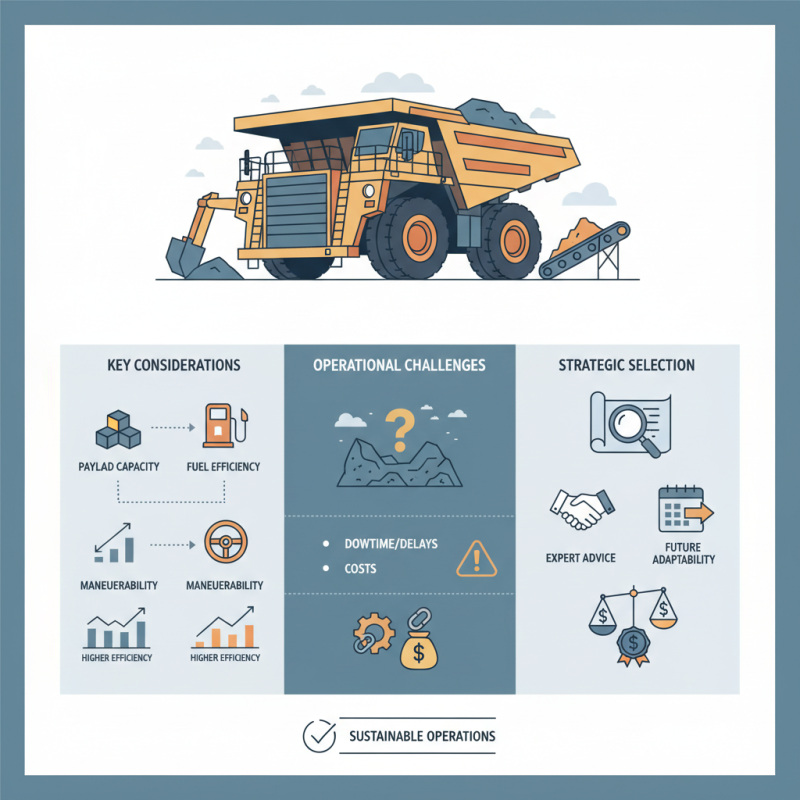
Mining operations face unique challenges. Factors such as payload capacity, fuel efficiency, and maneuverability play a crucial role. Each mining site has its own requirements, which can complicate the selection process. It's important to consider the specific needs of your operation.

Reliability is key. A Mining Dump Truck that frequently breaks down can lead to costly delays. Researching models and seeking expert advice can help avoid common pitfalls. The right truck not only fulfills immediate requirements but also adapts to future needs. Balancing quality with cost-effectiveness can also be a challenge. Careful consideration is essential for sustainable operations.
How to Choose the Best Mining Dump Truck for Your Operations?

Factors to Consider When Selecting a Mining Dump Truck

Choosing the right mining dump truck is crucial for operational efficiency. Several factors significantly influence this decision. First, consider the truck's payload capacity. It's vital to match this with your expected load. A truck that’s too small will lead to inefficiencies and increased trips. Conversely, a truck that's too large may lead to overloading, which can cause mechanical issues.

Another key factor is the terrain of your operations. If you work in rugged areas, a truck with advanced traction systems may be essential. Standard models may struggle in difficult conditions, leading to potential delays. Fuel efficiency also plays a critical role. A truck that consumes more fuel may seem cheaper initially but will increase costs over time.

Maintenance is frequently overlooked. Understanding your ability to service the truck is important. Some models require specialized parts and knowledge, complicating repairs. Reflect on your maintenance capabilities to avoid prolonged downtimes. Selecting a mining dump truck demands careful analysis of these factors, ensuring it meets both current and future operational needs.

Comparative Analysis of Dump Truck Types: Articulated vs. Rigid

Choosing the right mining dump truck can significantly impact operational efficiency. Two main types are articulated and rigid dump trucks. Each has its own strengths and weaknesses, making the choice dependent on specific operational needs.

Articulated dump trucks are versatile and adept at navigating rough terrain. They can maneuver easily around obstacles, making them suitable for hilly sites. Their jointed design allows for increased flexibility, but this can sometimes lead to stability issues in extreme conditions. Operators may find that this design sacrifices load capacity for maneuverability. Rigid dump trucks, however, excel in load-carrying capacity and durability. They are best suited for flat terrains and can transport heavier loads without the risk of tipping.

Evaluating these two types involves assessing project demands. A mine with varied terrain might benefit from an articulated truck despite potential limitations. Conversely, operations focused on heavy material transport may prefer rigid trucks for their capacity. Operators need to weigh these factors carefully, considering the unique challenges they face in their environments.

How to Choose the Best Mining Dump Truck for Your Operations?

Feature Articulated Dump Trucks Rigid Dump Trucks
Maneuverability High - suitable for rough terrains Moderate - best for flat, open areas
Payload Capacity 20-40 tons 30-100 tons
Terrain Handling Excellent on uneven surfaces Best on paved or well-maintained roads
Cost Lower initial cost Higher initial cost
Maintenance Generally easier to maintain More complex maintenance due to design
Typical Applications Construction, forestry, mining in hilly areas Heavy mining, quarrying, large-scale earthworks

Understanding Load Capacity and its Impact on Operational Efficiency

When selecting a mining dump truck, understanding load capacity is crucial. Load capacity directly impacts operational efficiency. A truck with an inadequate load capacity can slow down production. It may lead to frequent trips and increased fuel consumption. Choosing a truck with the right capacity can streamline processes and reduce costs.

It's essential to assess your specific needs. Consider the terrain and the types of materials being transported. A truck that works efficiently on smooth ground may struggle on rough surfaces. Think about weight distribution and how it affects stability. A truck that can handle heavier loads under challenging conditions provides a competitive edge. Missed opportunities can arise from underestimating these factors.

Regularly reviewing load capacity helps maintain efficiency. Over time, wear and tear can lead to capacity loss. Keeping an eye on the truck’s performance ensures reliability over the long haul. Each operation is unique, requiring tailored solutions to maximize productivity. Reflecting on both successes and challenges allows for better decisions in the future.

Load Capacity vs. Operational Efficiency of Mining Dump Trucks

Evaluating Dump Truck Fuel Efficiency: Key Metrics and Trends

Fuel efficiency is a major concern in the mining industry. Mining dump trucks are essential for transporting materials. However, fuel costs can account for about 30% of total operational expenses. Evaluating the fuel efficiency of these trucks is crucial.

Key metrics to consider include fuel consumption per hour and payload capacity. Industry data shows that newer models often consume up to 15% less fuel than older ones. This reduction significantly impacts long-term costs. Monitoring these parameters can help operations make informed decisions.

Trends indicate a shift towards hybrid and electric dump trucks. These innovations promise even lower fuel consumption. However, initial investments can be high. Operators must analyze both short-term costs and long-term savings. Balancing budget constraints with environmental responsibility remains a challenge.

Safety Features and Technology in Modern Mining Dump Trucks

In modern mining operations, safety features in dump trucks play a critical role. Technology advancements have led to new standards in driver protection. According to a report by the International Council on Mining and Metals, over 20% of mining fatalities involve vehicle incidents. Integrating advanced safety systems can significantly reduce these risks.

Modern mining dump trucks often include features like stability control and collision avoidance systems. For instance, sensors detect obstacles, preventing dangerous accidents. A study by the Mining Safety and Health Administration highlighted that such technologies could decrease incident rates by 30%. It’s essential to evaluate these features when selecting equipment.

However, not all trucks are equipped with top-of-the-line safety technology. Budget constraints may lead some operations to overlook critical advancements. Mining companies must weigh short-term savings against potential long-term costs.

Investing in safety features can enhance protection for equipment and personnel, fostering a safer work environment. Ultimately, the choice of a dump truck should prioritize both operational efficiency and employee safety.