
We use cookies on our website to give you an improved browser experience. View our Privacy Policy for more information. Please make your selection to opt in or out of ALL cookies here: Accept or Decline
Choosing a dry type transformer in 2026 requires more than comparing kVA ratings and purchase prices. Modern facilities face rising electricity demand, stricter efficiency expectations, limited indoor space, and higher fire-safety concerns. The International Energy Agency’s Electricity 2024 report projects global electricity demand to grow strongly through 2026, driven by data centers, industry, cooling, and electrification. That pressure makes transformer losses, thermal performance, and service life financially important.
Begin with the load profile. Record peak demand, harmonics, motor starting current, ambient temperature, altitude, and future expansion. A 1,000 kVA unit may look adequate on paper, yet repeated overloads can raise winding temperature and shorten insulation life. No checklist is perfect. Real operating conditions matter.
IEEE Fellow John D. McDonald, a recognized power-system engineer and transformer author, offers a practical principle: “Start with the load profile, not the transformer brochure.” That advice should guide every specification. Compare cast-resin and VPI designs, then verify compliance with IEC 60076-11 or applicable IEEE standards. Review noise data, enclosure protection, partial-discharge performance, cooling class, and maintenance access.
Industry research also signals sustained demand. MarketsandMarkets has forecast continued growth in the dry-type transformer market, supported by renewable projects, commercial buildings, and infrastructure upgrades. However, market growth does not guarantee a suitable product. A lower initial price can hide ventilation costs, harmonic derating, difficult replacement access, or weak after-sales support.
This guide explains how to select a dry type transformer that fits the electrical system, installation environment, safety objectives, and realistic operating future.
How to Choose a Dry Type Transformer in 2026?
Define Dry-Type Transformers and Their Main Applications
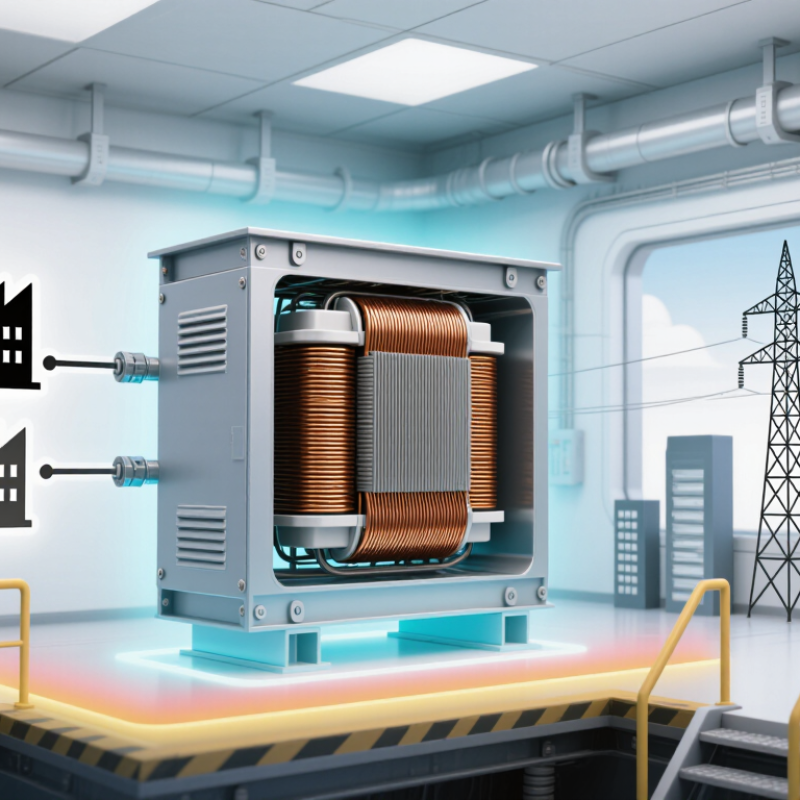
A dry-type transformer transfers electrical energy without liquid insulation or cooling oil. Its windings use air, resin, or solid insulation materials for electrical separation. This design reduces leakage risks and simplifies indoor installation. It is often selected for buildings where fire safety and clean operation matter.
Common applications include hospitals, schools, offices, factories, data centers, and underground facilities. Dry-type units also support solar plants, battery systems, and industrial control equipment. A hospital may place one near critical loads, while a factory may use it beside motor control panels. Each location has different demands for noise, heat, dust, and available space.
Choosing the correct unit requires more than checking voltage and capacity. Engineers should review load patterns, harmonic currents, ambient temperature, altitude, enclosure rating, and ventilation. Standards such as IEC 60076-11 and IEEE C57.12.01 can support a reliable technical evaluation. Field inspections often reveal a simple problem: the room has enough floor space, but not enough cooling airflow. That detail is easy to miss.
A practical selection also considers future expansion. Oversizing can increase cost and reduce efficiency at light loads. Undersizing can cause overheating during peak operation. The first estimate is not always right. Measure real demand, discuss operating conditions, and confirm protection settings before installation.
Typical dry-type transformer rating ranges by main application
Dry-type transformers transfer electrical power without liquid insulation, using air and solid insulation systems instead. They are commonly selected for indoor commercial buildings, data centers, healthcare facilities, industrial plants, and renewable-energy installations. The ranges shown are typical engineering selection ranges in kVA; the final choice depends on load demand, voltage, short-circuit level, cooling method, installation environment, efficiency, and required temperature rise.
Choosing a dry type transformer in 2026 starts with electrical requirements, not cabinet size. The IEA Electricity 2024 report forecasts global electricity demand to grow by about 4% annually through 2026. That growth makes future loading important. Record the primary and secondary voltage, frequency, phase, available fault current, and required kVA. A neat kVA match is not enough. Motors, variable-speed drives, and data equipment can create inrush current or harmonics. Check the transformer’s impedance, temperature-rise rating, short-circuit strength, and neutral capacity under real operating conditions.
Then examine the installation environment. IEC 60076-11 covers dry-type transformer requirements, including insulation systems and environmental considerations. Specify altitude, ambient temperature, dust, moisture, ventilation, and indoor or outdoor exposure. A clean electrical room may still collect conductive dust near construction areas. That detail is easy to miss.
Use an enclosure and cooling method suited to the site, while maintaining manufacturer-specified clearances. For sensitive facilities, compare sound levels and fire performance with the project’s safety requirements, rather than relying on generic “low-noise” language.
Load behavior deserves a practical review. Estimate normal demand, continuous loading, emergency loading, and expected expansion over ten years. The U.S. Department of Energy’s 2024 distribution-transformer efficiency rule reinforces the importance of reducing no-load and load losses across equipment life. However, higher efficiency does not correct poor sizing. I would request measured harmonic data when possible, then review it with the design engineer. Guessing is cheaper at first, but it can produce heat, nuisance trips, and disappointing service life.
Choosing a dry type transformer starts with the load, not the catalog. Record voltage, frequency, starting current, harmonics, and daily operating hours. A cast-resin design suits damp or dusty rooms because its sealed windings resist moisture. VPI designs can offer efficient heat transfer and easier inspection. The best design depends on location, maintenance access, and fault exposure. Start with the load.
Insulation class determines how much thermal stress the windings can tolerate. Class F supports higher temperatures than Class B, while Class H provides greater thermal margin. However, a higher class does not automatically improve service life. Ambient temperature, altitude, and ventilation still control winding temperature. Measure twice. In one factory assessment, a transformer met the nameplate rating but overheated near a blocked wall grille. Installation space mattered more than expected.
Cooling methods should match the real heat pattern. AN cooling uses natural air movement and suits moderate loads with clear airflow. AF cooling adds fans for temporary overloads or compact installations. Fans also create noise, maintenance needs, and failure points. Check whether the control system can alarm on fan failure. I would not select forced air only for a short overload that rarely occurs. That choice may increase complexity without meaningful value. Review test reports, temperature-rise data, noise limits, and local electrical requirements before approval.
Efficiency should be checked under real load, not only at rated capacity. Ask for no-load and load-loss data from the test report. The U.S. Department of Energy estimates that its distribution transformer standards could save about 3.63 quadrillion British thermal units over 30 years. That figure shows why small efficiency differences matter. IEC 60076-11 and IEEE C57.12.01 provide useful technical references. Still, a compliant transformer may perform poorly in a hot, dusty room.
Safety features deserve equal attention. Temperature sensors, winding alarms, automatic shutdown, and fire-resistant insulation can reduce operational risk. A sealed enclosure may suit dusty areas, while ventilated designs need clean airflow. Check altitude, humidity, noise limits, short-circuit strength, and available clearance. NFPA 70 requirements may apply in the United States, but local installation rules can differ. That part is easy to overlook.
Tips: Match the transformer to the measured load profile. Leave practical space for cable bending and inspection. Confirm the enclosure rating before ordering. Request routine-test results, thermal data, and installation instructions. During site visits, I have seen ventilation blocked by storage boxes. The specification was correct. The installation was not. Also, oversizing feels safer, but it can increase losses and cost during lightly loaded operation. Use lifecycle calculations, not purchase price alone.
Selecting a dry type transformer now requires more than comparing purchase prices. Specify voltage, load profile, harmonics, altitude, enclosure rating, and required cooling class. Ask suppliers for routine test records, temperature-rise results, short-circuit withstand data, and applicable IEC 60076-11 or IEEE documentation. A credible supplier explains assumptions clearly. Vague answers are warning signs.
The U.S. Department of Energy’s 2024 distribution-transformer analysis estimated 3.6 quadrillion Btu in energy savings over 30 years from updated efficiency standards. Efficiency matters, but operating conditions matter too. Request verified no-load and load-loss figures, not brochure estimates. Check production traceability, factory quality controls, spare-part availability, and local service response. A cheap unit can become expensive during a three-day shutdown.
Maintenance planning should begin before delivery. NFPA 70B emphasizes a documented electrical-equipment maintenance program, while IEEE guidance supports inspection and testing for dry-type transformers. Build a schedule around infrared scans, ventilation checks, torque verification, insulation resistance, and cleaning dust from cooling channels. Record ambient temperature and loading during each inspection. Keep critical spares on site. This is often overlooked. I would also challenge fixed annual intervals; heavily polluted or highly loaded sites may need shorter cycles. Supplier support after commissioning should include baseline measurements, alarm settings, training, and clear warranty conditions. A technically strong transformer still fails when maintenance ownership is unclear.
We use cookies on our website to give you an improved browser experience. View our Privacy Policy for more information. Please make your selection to opt in or out of ALL cookies here: Accept or Decline
Do you consent to the use of ALL cookies?
901 2nd Court West
Birmingham, AL 35204
Sales: 866.481.4036
Logistics/Ops: 866.481.4036
2101 Dralle Road
University Park, IL 60466
Sales: 708.813.9070
Logistics/Ops: 708.235.4200
400 E. 13th Street
Little Rock, AR 72114
Sales: 866.760.5344
Logistics/Ops: 866.760.5344
225 Collins Road
Elkhart, IN 46515
Sales: 574.295.0214
Logistics/Ops: 574.607.4611
601 Berryman Pike
Tipton, IN 46072
Sales: 800.897.7591
Logistics/Ops: 800.897.7591
3900 Uvalda Street
Denver, CO 80239
Sales: 303.706.8000
Ops/Logistics: 303.576.8398
510 3rd Street E
Milan, IL 61264
Sales: 800.322.1052
Logistics/Ops: 800.322.1052
1660 E. Aurora
Des Moines, IA 50313
Sales: 800.671.1660
Logistics: 800.671.1660
86554 Gene Lasserre Blvd.
Yulee, FL 32097
Sales: 904.253.3060
Logistics/Ops: 904.225.3000
694 S.E. County Road 245
Lake City, FL 32025
Sales: 800.727.6706
Logistics/Ops: 386.752.7412
210 Neptune Road
Auburndale, FL 33823
Sales: 863.967.1131
Logistics/Ops: 863.777.9814
4601 McCoy Drive
Pensacola, FL 32503
Sales: 850.308.7030
Logistics/Ops: 850.434.5502
815 South 56th Street
Tampa, FL 33619
Sales: 813.302.1940
Logistics/Ops: 813.621.1352
200 Hosea Road
Lawrenceville, GA 30046
Sales: 770.953.7575
Logistics/Ops: 770.513.6000
Branch Product Guide
Branch Line Card
Moulding Offering
Cedar Offering
Column Offering
8173 Hwy. 165 North
Monroe, LA 71211
Sales: 800.256.4165
Logistics/Ops: 800.256.4165
508 Warren Avenue
Portland, ME 04103
Sales: 207.888.2331
Logistics/Ops: 207.797.6565
4300 Georgia Pacific Blvd.
Frederick, MD 21704
Sales: 301.798.7474
Logistics/Ops: 301.874.8000
419 Maple Street
Bellingham, MA 02019
Sales: 508.449.0535
Logistics/Ops: 508.966.5500
825 Buchanan Ave SW
Grand Rapids, MI 49507
Sales: 877.800.1180
Logistics/Ops: 616.278.0909
995 Pacific St. NW
Aitkin, MN 56431
Sales: 800.432.3727
Logistics/Ops: 218.212.7770
1102 Port Terminal Drive
Duluth, MN 55802
Sales: 800.951.9899
Logistics/Ops: 800.851.9899
9110 83rd Ave. North
Brooklyn Park, MN 55445
Sales: 763.425.0204
Logistics/Ops: 763.425.0204
910 E. Railroad Street
Long Beach, MS 39560
Sales: 866.535.4135
Logistics/Ops: 228.205.2400
1727 Warren Street
North Kansas City, MO 64116
Sales: 800.621.2611
Logistics/Ops: 800.621.2611
2123 North Golden
Springfield, MO 65803
Sales: 800.375.7891
Logistics/Ops: 800.375.7891
13860 Corp. Woods Trail
Bridgeton, MO 63044
Sales: 314.209.0800
Logistics/Ops: 314.209.0800
1109 South 19th Street
Omaha, NE 68108
Sales: 800.489.6637
Logistics/Ops: 800.489.6637
1 Luger Road
Denville, NJ 07834
Sales: 973-339-3539
Logistics/Ops: 973.625.1461
3720 Jeffrey Blvd.
Blasdell, NY 14219
Sales: 716.235.5989
Logistics/Ops: 716.825.6557
319 Yaphank Ave.
Yaphank, NY 11980
Sales: 631.358.5714
Logistics/Ops: 631.924.7401
3300 Parkside Drive
Charlotte, NC 28208
Sales: 800.839.2588
Logistics/Ops: 704.394.3172
1712 East D Street
Butner, NC 27509
Sales: 984.389.8200
Logistics/Ops: 919.575.3700
128 Foothills Drive
Statesville, NC 28687
Sales: 800.222.1414
Logistics/Ops: 704.394.3172
550 Munroe Falls Rd.
Tallmadge, OH 44278
Sales: 330.357.4506
Logistics/Ops: 330.794.1141
10347 Toebben Dr.
Independence, KY 41051
Sales: 859.298.3926
Logistics/Ops: 859.746.2250
450 N. MacArthur
Oklahoma City, OK 73127
Sales: 800.375.6025
Logistics/Ops: 800.375.6025
1680 North Aspen
Broken Arrow, OK 74012
Sales: 918.272.2212
Logistics/Ops: 918.272.2212
522 Bridge Street
Hunker, PA 15639
Sales: 878.217.2001
Logistics/Ops: 724.925.7285
4290 Atlanta Street
Charleston, SC 29418
Sales: 843.371.1420
Logistics/Ops: 843.554.8192
1040 S. Industrial Dr.
Erwin, TN 37650
Sales: 423.641.1005
Logistics/Ops: 423.742.5911
4287 Pilot Drive
Memphis, TN 38118
Sales: 901.365.2101
Logistics/Ops: 901.365.2101
700 Myatt Drive
Madison, TN 37115
Sales: 615.327.9547
Logistics/Ops: 629.777.4949
4747 Mark IV Parkway
Fort Worth, TX 76106
Sales: 866.323.5117
Logistics/Ops: 817.625.9091
6990 Market Avenue
El Paso, TX 79915
Sales: 915.778.6356
Logistics/Ops: 915.265.7200
2502 Wilson Road
Harlingen, TX 78552
Sales: 800.580.6711
Logistics/Ops: 800.580.6711
10,000 North Loop East
Houston, TX 77029
Sales: 713.921.1977
Logistics/Ops: 713.675.3544
702 East 44th St.
Lubbock, TX 79404
Sales: 866.454.6010
Logistics/Ops: 866.454.6010
535 N. WW White Road
San Antonio, TX 78219
Sales: 800.284.0488
Logistics/Ops: 210.333.8112
142 Pine Haven Shores Rd.
Shelburne, VT 05482
Sales: 802.800.2540
Logistics/Ops: 802.985.2512
4700 Bethlehem Road,
Richmond, VA 23230
Sales: 804.201.2400
Logistics/Ops: 804.342.1161
4516 N Barker Road
Spokane Valley, WA 99027
Phone: 509.892.9420
Toll free: 800.728.6157
8365 N. 76th Street
Milwaukee, WI 53223
Sales: 800.356.9245
Logistics/Ops: 800.356.9245
312 S. Chester Street
Sparta, WI 54656
Sales: 800.362.5864
Logistics/Ops: 800.362.5864
899 Grossman Drive
Schofield, WI 54476
Sales: 800.472.0017
Logistics/Ops: 800.472.0017
