
We use cookies on our website to give you an improved browser experience. View our Privacy Policy for more information. Please make your selection to opt in or out of ALL cookies here: Accept or Decline
Choosing a Prefabricated House in 2026 requires more than comparing attractive floor plans online. Buyers must examine construction quality, energy performance, delivery logistics, and long-term maintenance. A polished showroom can hide practical weaknesses. Look beyond appearance.
This guide introduces a careful method for evaluating manufacturers, designs, materials, and total costs. It considers factory production records, independent inspections, warranty terms, and customer feedback. Regional building requirements also matter, because approval processes and climate demands vary widely. Confirm technical details with qualified local professionals before signing a contract. An experienced inspector may notice moisture risks, weak insulation joints, or difficult service access that photographs cannot show.
Real decisions happen on the building site. Picture a narrow access road, a rainy delivery day, or a kitchen wall facing strong afternoon sunlight. These details can affect transport costs, comfort, and future repairs. Compare the advertised price with foundations, utility connections, permits, interior finishes, and possible site preparation. Some manufacturers provide clear documentation. Others leave important assumptions unexplained.
No Prefabricated House is perfect. A lower price may bring fewer customization options, while a premium model may still have unsuitable materials for your climate. Check the facts carefully. This article’s outline will help readers ask better questions, compare evidence, and identify compromises before purchase. It also encourages reflection: a beautiful design is not automatically a practical home. Sound judgment comes from balancing professional advice, verified specifications, personal needs, and realistic expectations.
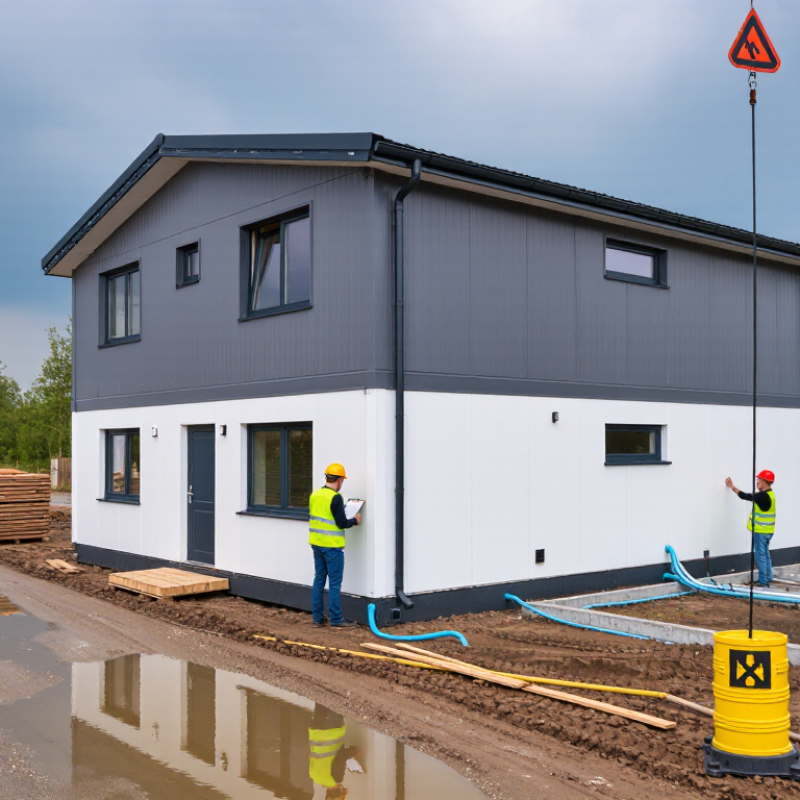
Choosing a prefabricated house in 2026 starts with three measurements: usable space, confirmed budget, and required move-in date. Avoid selecting a floor plan before measuring furniture, storage, parking, and service access. A 90-square-meter home may feel generous on paper, yet narrow corridors can waste daily space.
McKinsey’s report “Modular Construction: From Projects to Products” found that modular building can reduce schedules by 20–50%. Treat that as a planning benchmark, not a promise. Site preparation, permits, transport, utility connections, and weather can erase part of the gain. I would request a week-by-week program, including factory completion, delivery, installation, and inspection. Keep contingency time.
Budgeting needs similar discipline. Separate the factory price from foundations, groundworks, cranes, taxes, professional fees, and connection charges. Ask for written allowances, not optimistic estimates. A cheaper module can become expensive after difficult site work.
This is where my own preference changes: I would spend more on insulation, ventilation, and durable finishes before adding decorative space.
The United Nations Environment Programme’s 2023 Global Status Report stated that buildings and construction contributed about 37% of global energy-related and process emissions. Therefore, compare thermal performance, airtightness, heating demand, and material durability. Request test certificates and maintenance assumptions. Check local building rules independently. A polished brochure is not evidence. Inspect a completed home if possible, and question every figure that lacks a clear measurement method.
How to Choose a Prefabricated House in 2026?
Verify Building Codes, Certifications, and Site Limits Before Ordering
A prefabricated house is not automatically approved for your land. Ask the local building department for written requirements before paying a deposit. Check zoning, setbacks, height limits, fire separation, energy standards, and foundation rules. The 2024 International Building Code and 2024 International Residential Code are widely used references, but local amendments can change critical details. A coastal site may require stronger wind resistance. A mountain plot may need higher snow-load calculations. Small differences matter.
Request stamped structural drawings, product certificates, inspection records, and the factory’s quality-control process. Certification should identify the tested product and its applicable standard. It should not merely display a general “compliant” label. The Modular Building Institute’s 2024 Permanent Modular Construction Report reported 20.3 billion dollars in North American industry volume for 2023, showing the sector’s scale. Yet scale does not guarantee suitability. I would verify every document with the authority having jurisdiction.
Measure the site carefully. Include driveway width, turning space, overhead cables, crane placement, drainage, utility connections, and soil bearing capacity. FEMA flood maps and local hazard data can reveal restrictions that sales drawings miss. Transport routes also need checking; a house may fit the lot but not the bridge or corner. I once underestimated delivery access on a narrow site. That mistake would have been expensive. A second independent review is often worth the delay.
Choosing a prefabricated house requires more than comparing floor plans and prices. Visit the factory if possible. Observe material storage, cutting stations, and inspection points. A clean production line can reveal disciplined quality control. Ask how workers record moisture levels, joint alignment, insulation thickness, and electrical testing. These details affect comfort long after installation.
Waste data deserves careful attention. Some manufacturers report up to 90% less construction waste than conventional building methods. However, “up to” is not a typical result. Request the measurement period, project type, baseline, and independent verification. Reliable records should separate timber offcuts, packaging, damaged materials, and recycled content. Factory production can improve accuracy, but transport damage and site adjustments still create waste. That part is easy to overlook.
Tips: Ask for recent audit reports, not promotional claims. Compare defect rates across several completed projects. Check whether factory inspections follow documented procedures. Request photographs of hidden layers before wall closure. Consider a third-party inspection before delivery. I would also question unusually perfect figures. Real projects have delays, rework, and small mistakes. Transparency matters more than impressive wording. A strong supplier explains weak results and shows how procedures changed. Compare warranty terms, repair response times, and installation supervision. Your decision should reflect measurable quality, not just a polished showroom.
How to Choose a Prefabricated House in 2026?
A prefabricated house should be judged by its envelope, not only its floor plan. Airtight construction reduces drafts, moisture risks, and wasted heating energy. Passive House certification commonly requires an airtightness result of 0.6 air changes per hour at 50 Pa. Ask for a blower-door test report, not a verbal promise. Check how wall panels, roof joints, windows, and utility penetrations were sealed. Small gaps matter.
Tips: Visit the factory if possible. Watch how workers seal panel connections. Request photos of hidden membranes before interior finishes cover them. Ask whether a second pressure test follows installation. Confirm that ventilation includes heat recovery, because a tight home still needs controlled fresh air. Local climate and building rules may change the best specification.
A reliable supplier should explain test methods, tolerances, and repair procedures clearly. Thermal bridges deserve attention too, especially around balconies, doors, and foundation edges. I would also inspect a completed home during a cold or windy day. You may feel a draft that paperwork misses. No system is perfect. Even careful designs can fail when site work becomes rushed. Choose documented performance over attractive renders, and leave room for independent inspection before final payment.
Lower values indicate better performance. Passive House projects target annual space-heating demand of no more than 15 kWh/m²·yr and an airtightness result of no more than 0.6 ACH at 50 Pa. EnerPHit uses a less demanding retrofit threshold of approximately 25 kWh/m²·yr and 1.0 ACH at 50 Pa.
The typical new-build values are indicative screening references only and vary by climate, building code, design, ventilation system, and construction quality. Airtightness should be verified through a blower-door test using EN ISO 9972 or the applicable local standard.
How to Choose a Prefabricated House in 2026?
Choosing a prefabricated house in 2026 requires more than comparing showroom prices. Ask how many units the supplier can build monthly. Request recent production records and quality-control procedures. An impressive factory may still lack workers, materials, or testing capacity during busy seasons. Visit a completed home if possible. Check wall joints, floor levels, window seals, and protective packaging. Capacity must match your schedule.
Warranty terms deserve careful attention. Confirm coverage periods for the structure, waterproofing, wiring, plumbing, and installed equipment. Ask who pays for inspection, replacement parts, labor, and transport. Some warranties sound generous but exclude moisture damage or poor site preparation. Delivery risk also needs a written plan. Check road access, crane requirements, weather delays, storage fees, and responsibility for damage. I once underestimated temporary storage costs. That mistake changed the real budget.
Tips: Compare the full cost, not only the house price. Include land preparation, foundations, permits, transport, installation, utility connections, taxes, and future repairs. Keep every promise in the contract. Ask for milestone payments tied to inspections. Leave a reasonable contingency fund. Small omissions become expensive.
| Evaluation Dimension | What to Verify | Practical 2026 Benchmark | Lower-Risk Indicator | Warning Sign | Recommended Decision |
|---|---|---|---|---|---|
| Annual Production Capacity | Ask for documented annual output, current order backlog, factory shifts, and reserved production slots. | A supplier should demonstrate capacity that is at least 20–30% higher than its committed workload for your project period. | Written production schedule with milestone dates and an identified project manager. | No verifiable production records or an unusually large promised volume with a very short lead time. | Prefer suppliers with measurable spare capacity during your planned manufacturing window. |
| Manufacturing Lead Time | Confirm the time from approved drawings to factory completion, excluding permitting and site preparation. | Approximately 8–16 weeks for a standard modular or panelized home after final design approval. | The contract separates design approval, manufacturing, shipping, installation, and commissioning dates. | A single fixed delivery date is quoted before engineering drawings are approved. | Allow schedule contingency rather than selecting solely on the shortest advertised lead time. |
| Warranty Coverage | Check structural, water-ingress, materials, workmanship, appliances, and installation coverage separately. | Typical market practice includes about 1 year for workmanship and 5–10 years for major structural components, subject to local law. | Warranty duration, exclusions, response times, and claim procedures are stated in the purchase contract. | Warranty applies only to factory components but excludes transport, installation, seals, or site connections. | Choose clear, transferable coverage with defined repair or replacement obligations. |
| Delivery and Logistics Risk | Review shipping route, customs responsibility, unloading equipment, road access, weather exposure, and damage procedures. | International projects commonly require an additional 2–6 weeks for ocean freight, customs, inland transport, and handling. | The quotation uses clearly defined Incoterms and includes cargo insurance or an equivalent risk allocation. | The buyer is responsible for all delays, port charges, damage, and unloading without cost limits. | Obtain a written logistics plan and maintain a schedule buffer of at least 10–15%. |
| Building-Code Compliance | Verify structural calculations, fire performance, energy efficiency, wind or snow loads, electrical standards, and local approvals. | Compliance must be assessed against the regulations of the project location, not only the factory’s domestic standards. | Local engineers or approved inspectors review the design before manufacturing begins. | The supplier provides generic certificates that do not identify your project location or applicable code. | Make permitting responsibility and redesign costs explicit in the contract. |
| Factory Quality Control | Review inspection checkpoints, material traceability, moisture control, dimensional checks, and pre-shipment records. | Quality checks should cover incoming materials, concealed services, assembly, waterproofing, and final factory acceptance. | The supplier provides dated inspection reports, photographs, test results, and a punch-list process. | Quality is assessed only after arrival at the site, when correction costs are highest. | Require independent or buyer-approved inspection before dispatch. |
| Quoted Factory Price | Identify whether the price includes the shell, interior finishes, kitchens, bathrooms, mechanical systems, taxes, and documentation. | Factory-only prices can represent only part of the final delivered project cost. | A line-item quotation identifies inclusions, exclusions, quantities, specifications, and approved change-order rates. | A low headline price omits foundations, utilities, transport, assembly, permits, or local taxes. | Compare complete delivered and habitable costs, not factory price alone. |
| Total Installed Cost | Include product, freight, insurance, foundations, site works, cranes, installation, utilities, permits, taxes, and contingency. | For planning, add a contingency of approximately 10–20% to the complete project budget, depending on site uncertainty. | A total-cost worksheet shows every cost category and identifies fixed versus provisional amounts. | More than 15–20% of the quoted budget remains undefined or marked “to be confirmed.” | Select the option with the clearest cost boundary, even if its initial price is not the lowest. |
| Payment Structure | Check deposit size, milestone payments, retention, refund rights, and payment security. | Payments should be linked to verifiable milestones such as design approval, factory completion, inspection, shipment, and installation. | A reasonable retained amount remains payable after delivery, commissioning, and punch-list completion. | The majority of the contract value is required before production or before independent inspection. | Use milestone-based payments and obtain legal review for cross-border contracts. |
| After-Sales Support | Confirm spare-parts availability, technical support hours, local service partners, and response times. | A practical support plan should define an initial response within 2–5 business days for non-emergency warranty issues. | Replacement parts are standardized, catalogued, and available throughout the stated warranty period. | No service contact, spare-parts list, or repair escalation process is provided. | Prioritize support capability near the project site when the home uses proprietary components. |
| Supplier Evaluation Score | Score capacity, warranty, logistics, compliance, quality, total cost, payment risk, and support from 1 to 5. | A balanced supplier should achieve at least 4 out of 5 in every critical category and 80 out of 100 overall. | The score is supported by documents, references, inspection results, and contract terms. | The supplier ranks highly only because of a low initial price. | Reject any option with a serious deficiency in compliance, warranty, or delivery responsibility. |
Planning note: The figures above are general industry planning benchmarks, not supplier quotations. Confirm local building regulations, taxes, freight rates, site conditions, and contract terms before making a purchase decision.
We use cookies on our website to give you an improved browser experience. View our Privacy Policy for more information. Please make your selection to opt in or out of ALL cookies here: Accept or Decline
Do you consent to the use of ALL cookies?
901 2nd Court West
Birmingham, AL 35204
Sales: 866.481.4036
Logistics/Ops: 866.481.4036
2101 Dralle Road
University Park, IL 60466
Sales: 708.813.9070
Logistics/Ops: 708.235.4200
400 E. 13th Street
Little Rock, AR 72114
Sales: 866.760.5344
Logistics/Ops: 866.760.5344
225 Collins Road
Elkhart, IN 46515
Sales: 574.295.0214
Logistics/Ops: 574.607.4611
601 Berryman Pike
Tipton, IN 46072
Sales: 800.897.7591
Logistics/Ops: 800.897.7591
3900 Uvalda Street
Denver, CO 80239
Sales: 303.706.8000
Ops/Logistics: 303.576.8398
510 3rd Street E
Milan, IL 61264
Sales: 800.322.1052
Logistics/Ops: 800.322.1052
1660 E. Aurora
Des Moines, IA 50313
Sales: 800.671.1660
Logistics: 800.671.1660
86554 Gene Lasserre Blvd.
Yulee, FL 32097
Sales: 904.253.3060
Logistics/Ops: 904.225.3000
694 S.E. County Road 245
Lake City, FL 32025
Sales: 800.727.6706
Logistics/Ops: 386.752.7412
210 Neptune Road
Auburndale, FL 33823
Sales: 863.967.1131
Logistics/Ops: 863.777.9814
4601 McCoy Drive
Pensacola, FL 32503
Sales: 850.308.7030
Logistics/Ops: 850.434.5502
815 South 56th Street
Tampa, FL 33619
Sales: 813.302.1940
Logistics/Ops: 813.621.1352
200 Hosea Road
Lawrenceville, GA 30046
Sales: 770.953.7575
Logistics/Ops: 770.513.6000
Branch Product Guide
Branch Line Card
Moulding Offering
Cedar Offering
Column Offering
8173 Hwy. 165 North
Monroe, LA 71211
Sales: 800.256.4165
Logistics/Ops: 800.256.4165
508 Warren Avenue
Portland, ME 04103
Sales: 207.888.2331
Logistics/Ops: 207.797.6565
4300 Georgia Pacific Blvd.
Frederick, MD 21704
Sales: 301.798.7474
Logistics/Ops: 301.874.8000
419 Maple Street
Bellingham, MA 02019
Sales: 508.449.0535
Logistics/Ops: 508.966.5500
825 Buchanan Ave SW
Grand Rapids, MI 49507
Sales: 877.800.1180
Logistics/Ops: 616.278.0909
995 Pacific St. NW
Aitkin, MN 56431
Sales: 800.432.3727
Logistics/Ops: 218.212.7770
1102 Port Terminal Drive
Duluth, MN 55802
Sales: 800.951.9899
Logistics/Ops: 800.851.9899
9110 83rd Ave. North
Brooklyn Park, MN 55445
Sales: 763.425.0204
Logistics/Ops: 763.425.0204
910 E. Railroad Street
Long Beach, MS 39560
Sales: 866.535.4135
Logistics/Ops: 228.205.2400
1727 Warren Street
North Kansas City, MO 64116
Sales: 800.621.2611
Logistics/Ops: 800.621.2611
2123 North Golden
Springfield, MO 65803
Sales: 800.375.7891
Logistics/Ops: 800.375.7891
13860 Corp. Woods Trail
Bridgeton, MO 63044
Sales: 314.209.0800
Logistics/Ops: 314.209.0800
1109 South 19th Street
Omaha, NE 68108
Sales: 800.489.6637
Logistics/Ops: 800.489.6637
1 Luger Road
Denville, NJ 07834
Sales: 973-339-3539
Logistics/Ops: 973.625.1461
3720 Jeffrey Blvd.
Blasdell, NY 14219
Sales: 716.235.5989
Logistics/Ops: 716.825.6557
319 Yaphank Ave.
Yaphank, NY 11980
Sales: 631.358.5714
Logistics/Ops: 631.924.7401
3300 Parkside Drive
Charlotte, NC 28208
Sales: 800.839.2588
Logistics/Ops: 704.394.3172
1712 East D Street
Butner, NC 27509
Sales: 984.389.8200
Logistics/Ops: 919.575.3700
128 Foothills Drive
Statesville, NC 28687
Sales: 800.222.1414
Logistics/Ops: 704.394.3172
550 Munroe Falls Rd.
Tallmadge, OH 44278
Sales: 330.357.4506
Logistics/Ops: 330.794.1141
10347 Toebben Dr.
Independence, KY 41051
Sales: 859.298.3926
Logistics/Ops: 859.746.2250
450 N. MacArthur
Oklahoma City, OK 73127
Sales: 800.375.6025
Logistics/Ops: 800.375.6025
1680 North Aspen
Broken Arrow, OK 74012
Sales: 918.272.2212
Logistics/Ops: 918.272.2212
522 Bridge Street
Hunker, PA 15639
Sales: 878.217.2001
Logistics/Ops: 724.925.7285
4290 Atlanta Street
Charleston, SC 29418
Sales: 843.371.1420
Logistics/Ops: 843.554.8192
1040 S. Industrial Dr.
Erwin, TN 37650
Sales: 423.641.1005
Logistics/Ops: 423.742.5911
4287 Pilot Drive
Memphis, TN 38118
Sales: 901.365.2101
Logistics/Ops: 901.365.2101
700 Myatt Drive
Madison, TN 37115
Sales: 615.327.9547
Logistics/Ops: 629.777.4949
4747 Mark IV Parkway
Fort Worth, TX 76106
Sales: 866.323.5117
Logistics/Ops: 817.625.9091
6990 Market Avenue
El Paso, TX 79915
Sales: 915.778.6356
Logistics/Ops: 915.265.7200
2502 Wilson Road
Harlingen, TX 78552
Sales: 800.580.6711
Logistics/Ops: 800.580.6711
10,000 North Loop East
Houston, TX 77029
Sales: 713.921.1977
Logistics/Ops: 713.675.3544
702 East 44th St.
Lubbock, TX 79404
Sales: 866.454.6010
Logistics/Ops: 866.454.6010
535 N. WW White Road
San Antonio, TX 78219
Sales: 800.284.0488
Logistics/Ops: 210.333.8112
142 Pine Haven Shores Rd.
Shelburne, VT 05482
Sales: 802.800.2540
Logistics/Ops: 802.985.2512
4700 Bethlehem Road,
Richmond, VA 23230
Sales: 804.201.2400
Logistics/Ops: 804.342.1161
4516 N Barker Road
Spokane Valley, WA 99027
Phone: 509.892.9420
Toll free: 800.728.6157
8365 N. 76th Street
Milwaukee, WI 53223
Sales: 800.356.9245
Logistics/Ops: 800.356.9245
312 S. Chester Street
Sparta, WI 54656
Sales: 800.362.5864
Logistics/Ops: 800.362.5864
899 Grossman Drive
Schofield, WI 54476
Sales: 800.472.0017
Logistics/Ops: 800.472.0017
