
We use cookies on our website to give you an improved browser experience. View our Privacy Policy for more information. Please make your selection to opt in or out of ALL cookies here: Accept or Decline
Choosing Advanced High-Strength Steel is not simply a matter of selecting the highest tensile strength. The right grade must survive forming, welding, corrosion exposure, fatigue, and real production variation. A steel that looks excellent on a datasheet may crack beside a tight draw radius. It may also require different tooling or heat input.
Dr. Stuart Keeler, a respected authority on sheet-metal forming, has emphasized that “formability is more than elongation.” That principle remains highly practical. Engineers should examine yield strength, tensile strength, total elongation, hole expansion, bend performance, and forming-limit behavior together. Thickness matters too. A thinner sheet may reduce vehicle weight, but it can increase springback and complicate dimensional control.
Start with the component’s job. A crash rail needs energy absorption and predictable deformation. A door reinforcement needs strength, stiffness, and reliable joining. A visible panel may need better surface quality than a hidden structural part. Manufacturing conditions also deserve attention. Review press capacity, die geometry, welding equipment, coating requirements, and local supplier capability before approving a grade.
Do not trust one number.
A sensible comparison uses test data, simulation, prototype stamping, and production feedback. Standards and mill certificates improve confidence, but they cannot reveal every shop-floor problem. In practice, selection is often a compromise. Higher strength can reduce thickness, yet it may narrow the forming window. That trade-off is easy to underestimate. This guide explains how to evaluate those risks and choose Advanced High-Strength Steel with stronger technical judgment.
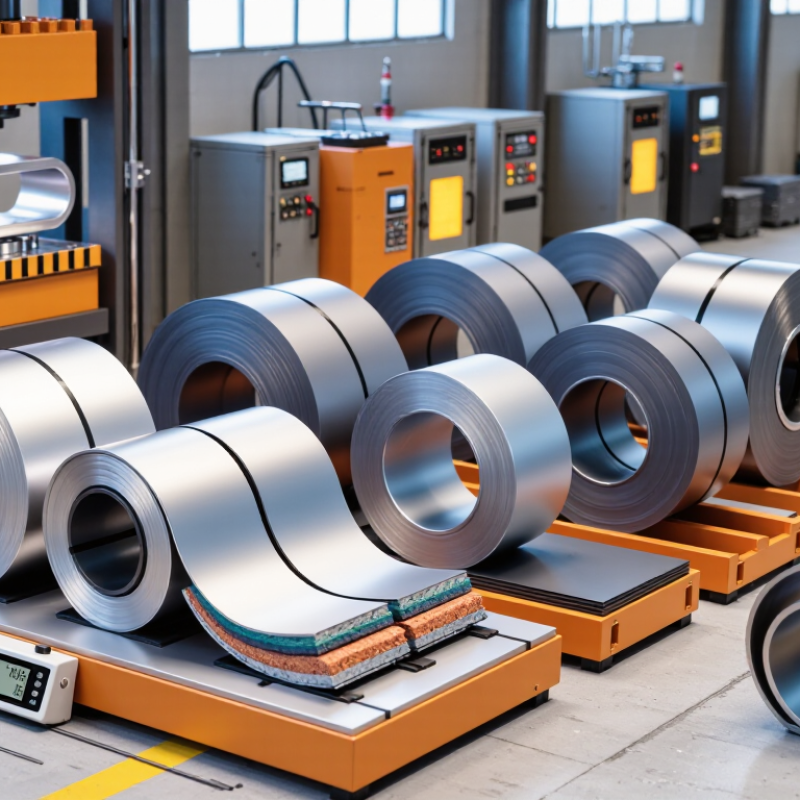
How to Choose Advanced High Strength Steel for Your Needs?
What Is Advanced High-Strength Steel and Why Does It Matter?
Advanced high-strength steel (AHSS) is engineered to carry greater loads with less material. Its strength usually comes from controlled alloying, heat treatment, and carefully designed microstructures. Common grades include dual-phase, transformation-induced plasticity, and press-hardened steels. Their tensile strengths can range from about 600 MPa to more than 1,500 MPa.
This matters most in vehicles, construction equipment, and safety structures. Lower mass can improve energy efficiency without reducing crash protection. The U.S. Department of Energy reports that a 10% vehicle weight reduction may improve fuel economy by 6% to 8%. WorldAutoSteel’s FutureSteelVehicle study also demonstrated potential body-structure mass reductions of roughly 35% through advanced steel design. These figures are useful benchmarks, not guaranteed results.
Material selection should match the forming process, joining method, corrosion environment, and required deformation behavior. A 1,000 MPa grade may look attractive, but it can demand stricter tooling control. Springback can increase. Welding windows may become narrower. In production trials, small variations in blank thickness can affect fit and fatigue performance. That detail is easy to underestimate.
Start with the load path, not the headline strength. Review tensile strength, elongation, hole-expansion performance, and forming-limit data. Ask for independent test reports and traceable certificates. Cost per kilogram is only part of the decision. Scrap, tooling changes, inspection time, and repair risk can alter the real cost. The best grade is often a compromise. Industry data helps, but plant-specific validation remains essential.
Choosing an AHSS grade starts with the performance target, not the highest strength number. Vehicle designers often balance crash energy absorption, stiffness, forming depth, and corrosion protection.
Dual-phase steel suits structural parts needing strength and predictable forming. A 980 MPa grade can support thinner sections, but it may demand tighter control of springback. Transformation-induced plasticity steel offers high elongation and energy absorption. It can fit complex crash components, although its forming behavior depends strongly on strain paths. Martensitic steel delivers very high tensile strength, often above 1,400 MPa, but its limited elongation restricts deep drawing. WorldAutoSteel’s AHSS Guidelines identify these trade-offs across dual-phase, TRIP, complex-phase, and martensitic grades.
Look beyond tensile strength. The U.S. Department of Energy reports that reducing vehicle mass by 10% can improve fuel economy by roughly 6–8%. That benefit only matters if the selected grade survives stamping, welding, fatigue, and crash validation. For example, choose dual-phase steel for a door reinforcement requiring moderate forming and strong intrusion resistance. Consider martensitic steel for a compact anti-intrusion beam with limited deformation. Use TRIP steel where deformation must absorb energy progressively. These choices are practical, not absolute. In production, a theoretically ideal grade may fail because of tooling wear, edge cracking, or inconsistent lubrication. Testing should include actual blanks, radii, weld schedules, and crash-relevant loading. Higher strength is not automatically better. Sometimes the less ambitious grade performs more reliably.
Select an AHSS grade by balancing tensile strength with formability. Dual-phase and TRIP steels provide a practical combination of strength and elongation, while martensitic steel offers very high strength with lower formability for reinforcement and crash-management parts.
Values are representative engineering targets for commonly used AHSS families. Actual strength and elongation depend on the applicable material specification, sheet thickness, processing route, and test direction.
How to Choose Advanced High Strength Steel for Your Needs?
How to Compare Strength, Formability, Weldability, and Corrosion Resistance
Choosing advanced high-strength steel requires more than checking the highest tensile strength. Yield strength matters when parts must resist permanent deformation. Tensile strength matters during extreme loading. However, a stronger grade may reduce elongation and increase forming cracks. In press-shop trials, sharp corners and small radii often reveal this weakness. Design details matter.
Formability should be assessed through elongation, bend performance, and hole expansion. A steel can form well in one operation and fail in another. Deep drawing, stretch forming, and flanging create different demands. Try representative blanks, not only laboratory samples. Small changes in lubrication, tool radius, or blank-holder pressure can alter results. This is where early testing earns its cost.
Weldability depends on chemistry, thickness, heat input, and joint design. Confirm the recommended welding window with production trials. Excessive heat may soften the heat-affected zone. Insufficient heat can create weak joints. Corrosion resistance also needs practical evaluation. Consider coating type, cut edges, trapped moisture, and exposure conditions. Salt-spray data can help, but it cannot reproduce every service environment. I would not select a grade from one chart alone. That shortcut is convenient, but sometimes wrong. Test the complete part.
| Steel Grade | Typical Yield Strength (MPa) | Typical Tensile Strength (MPa) | Typical Total Elongation (%) | Formability | Resistance Spot Weldability | Corrosion Resistance | Typical Applications |
|---|---|---|---|---|---|---|---|
| DP600 | 330–450 | 600–700 | 20–28 | High Good balance of strength and ductility; suitable for moderate-to-complex forming. | High Generally the easiest grade in this group to weld, provided current and electrode force are controlled. | Medium Comparable to other uncoated carbon steels; coating and paint system determine practical durability. | Body structures, reinforcement members, cross members, seat components, and suspension parts. |
| DP800 | 450–600 | 780–900 | 14–20 | Medium–High Good strength-to-ductility ratio, but springback and forming loads increase versus DP600. | Medium Weldable with a narrower process window and greater attention to electrode wear and heat input. | Medium Requires suitable metallic coating, pretreatment, and paint protection for long-term exposure. | Side-impact beams, pillars, rails, reinforcements, and weight-saving structural components. |
| DP1000 | 600–750 | 980–1,100 | 10–16 | Medium Good for controlled geometries; higher springback and edge-splitting risk require optimized tooling. | Medium Welding remains feasible, but higher resistance and hardening sensitivity require validated parameters. | Medium Corrosion performance depends primarily on the selected coating and complete paint coverage. | Crash-management parts, ultra-high-strength reinforcements, rails, and safety cages. |
| TRIP800 | 500–650 | 780–900 | 22–30 | High Excellent work hardening and uniform elongation support complex energy-absorbing shapes. | Medium Weldable, but retained austenite transformation and local hardening should be considered in the heat-affected zone. | Medium Needs the same effective coating and paint protection normally specified for automotive sheet steel. | Energy absorbers, crash zones, structural members, and components requiring high deformation capacity. |
| CP800 | 600–750 | 780–900 | 10–16 | Medium Good resistance to local deformation; less suitable for severe stretching than TRIP or DP grades. | Medium Requires controlled welding parameters because of high strength and a relatively narrow process window. | Medium Coatings are normally required where exposure to moisture, salts, or de-icing chemicals is expected. | Door reinforcements, bumpers, chassis parts, pillars, and components exposed to concentrated loads. |
| Martensitic 1200 | 900–1,100 | 1,200–1,400 | 4–8 | Low Excellent strength but limited elongation; commonly formed by bending or roll forming rather than deep drawing. | Low–Medium Resistance welding is possible, but high hardness, expulsion risk, and delayed cracking require strict control. | Medium Intrinsic corrosion behavior is similar to other carbon steels; galvanized or coated systems are commonly used. | Door beams, bumper beams, anti-intrusion bars, and highly loaded safety components. |
| Press-Hardened Steel 1500 | 950–1,200 | 1,400–1,600 | 5–8 | Low Before Hardening Hot forming enables complex shapes, but post-hardening machining and joining must be carefully planned. | Low–Medium Welding requires validated parameters, suitable electrodes, and attention to hardened heat-affected zones. | Medium Aluminum-silicon or other protective coatings may be specified for scale and corrosion control during hot forming. | Safety cages, roof rails, pillars, door rings, and other components requiring maximum crash strength. |
Choosing advanced high strength steel depends heavily on how your factory will process it. A grade that performs well in a datasheet may behave poorly during stamping, welding, or machining. Define the manufacturing route before comparing tensile strength. The sequence matters.
For cold stamping, study forming limits, elongation, and springback. Dual-phase steel can support complex shapes, but its strength may increase after forming. That change can affect trimming and dimensional control. Use suitable die radii and monitor tool wear closely. Small radius changes matter. Lubrication also influences surface quality and forming stability. For roll forming, consistent thickness and predictable bending behavior may matter more than maximum strength. Press settings should be confirmed through trials, not assumptions.
Welding introduces another decision point. Heat can soften selected regions or reduce joint performance. Review the heat-affected zone, welding speed, electrode force, and cooling conditions. Higher strength does not automatically create a stronger assembly. For laser cutting, edge quality and heat input deserve attention, especially near tight bends. Coating compatibility should be checked before production begins. In real shop trials, engineers sometimes find that a slightly lower-strength grade gives better throughput and fewer rejects. That can feel like a compromise. It may be the more reliable choice. Test representative parts, including bends, holes, welds, and fatigue-loaded areas, before approving the steel for full-scale manufacturing.
Choosing advanced high strength steel begins with evidence, not a strength label. Define load paths, forming depth, joining method, and service temperature before requesting samples.
A practical validation plan combines tensile, bend, hole expansion, fatigue, and crash-related tests. Test parts, not only laboratory coupons. Small details matter. Tool radius, lubrication, and cutting clearance can change results significantly.
During production trials, measure springback, edge cracking, weld quality, and dimensional stability. Record press force, die wear, scrap rate, and cycle time beside mechanical data.
A steel that passes strength targets may still increase tooling adjustments or reject rates. Cost must include coating, transport, joining, inspection, and future maintenance. Early reviews sometimes focus too heavily on price per tonne. That assumption is incomplete.
Compliance requires traceable certificates, verified chemical limits, and documented test methods. Check applicable material, vehicle, workplace, and environmental requirements for each sales region.
Ask whether heat numbers follow every batch from receipt through final assembly. Independent laboratory testing can challenge supplier data and expose inconsistent results.
Keep acceptance criteria measurable, such as minimum elongation or maximum dimensional deviation. If results conflict, investigate sampling, equipment calibration, and process variation before approval.
A cautious decision may choose a costlier grade when it reduces production uncertainty. But not always.
We use cookies on our website to give you an improved browser experience. View our Privacy Policy for more information. Please make your selection to opt in or out of ALL cookies here: Accept or Decline
Do you consent to the use of ALL cookies?
901 2nd Court West
Birmingham, AL 35204
Sales: 866.481.4036
Logistics/Ops: 866.481.4036
2101 Dralle Road
University Park, IL 60466
Sales: 708.813.9070
Logistics/Ops: 708.235.4200
400 E. 13th Street
Little Rock, AR 72114
Sales: 866.760.5344
Logistics/Ops: 866.760.5344
225 Collins Road
Elkhart, IN 46515
Sales: 574.295.0214
Logistics/Ops: 574.607.4611
601 Berryman Pike
Tipton, IN 46072
Sales: 800.897.7591
Logistics/Ops: 800.897.7591
3900 Uvalda Street
Denver, CO 80239
Sales: 303.706.8000
Ops/Logistics: 303.576.8398
510 3rd Street E
Milan, IL 61264
Sales: 800.322.1052
Logistics/Ops: 800.322.1052
1660 E. Aurora
Des Moines, IA 50313
Sales: 800.671.1660
Logistics: 800.671.1660
86554 Gene Lasserre Blvd.
Yulee, FL 32097
Sales: 904.253.3060
Logistics/Ops: 904.225.3000
694 S.E. County Road 245
Lake City, FL 32025
Sales: 800.727.6706
Logistics/Ops: 386.752.7412
210 Neptune Road
Auburndale, FL 33823
Sales: 863.967.1131
Logistics/Ops: 863.777.9814
4601 McCoy Drive
Pensacola, FL 32503
Sales: 850.308.7030
Logistics/Ops: 850.434.5502
815 South 56th Street
Tampa, FL 33619
Sales: 813.302.1940
Logistics/Ops: 813.621.1352
200 Hosea Road
Lawrenceville, GA 30046
Sales: 770.953.7575
Logistics/Ops: 770.513.6000
Branch Product Guide
Branch Line Card
Moulding Offering
Cedar Offering
Column Offering
8173 Hwy. 165 North
Monroe, LA 71211
Sales: 800.256.4165
Logistics/Ops: 800.256.4165
508 Warren Avenue
Portland, ME 04103
Sales: 207.888.2331
Logistics/Ops: 207.797.6565
4300 Georgia Pacific Blvd.
Frederick, MD 21704
Sales: 301.798.7474
Logistics/Ops: 301.874.8000
419 Maple Street
Bellingham, MA 02019
Sales: 508.449.0535
Logistics/Ops: 508.966.5500
825 Buchanan Ave SW
Grand Rapids, MI 49507
Sales: 877.800.1180
Logistics/Ops: 616.278.0909
995 Pacific St. NW
Aitkin, MN 56431
Sales: 800.432.3727
Logistics/Ops: 218.212.7770
1102 Port Terminal Drive
Duluth, MN 55802
Sales: 800.951.9899
Logistics/Ops: 800.851.9899
9110 83rd Ave. North
Brooklyn Park, MN 55445
Sales: 763.425.0204
Logistics/Ops: 763.425.0204
910 E. Railroad Street
Long Beach, MS 39560
Sales: 866.535.4135
Logistics/Ops: 228.205.2400
1727 Warren Street
North Kansas City, MO 64116
Sales: 800.621.2611
Logistics/Ops: 800.621.2611
2123 North Golden
Springfield, MO 65803
Sales: 800.375.7891
Logistics/Ops: 800.375.7891
13860 Corp. Woods Trail
Bridgeton, MO 63044
Sales: 314.209.0800
Logistics/Ops: 314.209.0800
1109 South 19th Street
Omaha, NE 68108
Sales: 800.489.6637
Logistics/Ops: 800.489.6637
1 Luger Road
Denville, NJ 07834
Sales: 973-339-3539
Logistics/Ops: 973.625.1461
3720 Jeffrey Blvd.
Blasdell, NY 14219
Sales: 716.235.5989
Logistics/Ops: 716.825.6557
319 Yaphank Ave.
Yaphank, NY 11980
Sales: 631.358.5714
Logistics/Ops: 631.924.7401
3300 Parkside Drive
Charlotte, NC 28208
Sales: 800.839.2588
Logistics/Ops: 704.394.3172
1712 East D Street
Butner, NC 27509
Sales: 984.389.8200
Logistics/Ops: 919.575.3700
128 Foothills Drive
Statesville, NC 28687
Sales: 800.222.1414
Logistics/Ops: 704.394.3172
550 Munroe Falls Rd.
Tallmadge, OH 44278
Sales: 330.357.4506
Logistics/Ops: 330.794.1141
10347 Toebben Dr.
Independence, KY 41051
Sales: 859.298.3926
Logistics/Ops: 859.746.2250
450 N. MacArthur
Oklahoma City, OK 73127
Sales: 800.375.6025
Logistics/Ops: 800.375.6025
1680 North Aspen
Broken Arrow, OK 74012
Sales: 918.272.2212
Logistics/Ops: 918.272.2212
522 Bridge Street
Hunker, PA 15639
Sales: 878.217.2001
Logistics/Ops: 724.925.7285
4290 Atlanta Street
Charleston, SC 29418
Sales: 843.371.1420
Logistics/Ops: 843.554.8192
1040 S. Industrial Dr.
Erwin, TN 37650
Sales: 423.641.1005
Logistics/Ops: 423.742.5911
4287 Pilot Drive
Memphis, TN 38118
Sales: 901.365.2101
Logistics/Ops: 901.365.2101
700 Myatt Drive
Madison, TN 37115
Sales: 615.327.9547
Logistics/Ops: 629.777.4949
4747 Mark IV Parkway
Fort Worth, TX 76106
Sales: 866.323.5117
Logistics/Ops: 817.625.9091
6990 Market Avenue
El Paso, TX 79915
Sales: 915.778.6356
Logistics/Ops: 915.265.7200
2502 Wilson Road
Harlingen, TX 78552
Sales: 800.580.6711
Logistics/Ops: 800.580.6711
10,000 North Loop East
Houston, TX 77029
Sales: 713.921.1977
Logistics/Ops: 713.675.3544
702 East 44th St.
Lubbock, TX 79404
Sales: 866.454.6010
Logistics/Ops: 866.454.6010
535 N. WW White Road
San Antonio, TX 78219
Sales: 800.284.0488
Logistics/Ops: 210.333.8112
142 Pine Haven Shores Rd.
Shelburne, VT 05482
Sales: 802.800.2540
Logistics/Ops: 802.985.2512
4700 Bethlehem Road,
Richmond, VA 23230
Sales: 804.201.2400
Logistics/Ops: 804.342.1161
4516 N Barker Road
Spokane Valley, WA 99027
Phone: 509.892.9420
Toll free: 800.728.6157
8365 N. 76th Street
Milwaukee, WI 53223
Sales: 800.356.9245
Logistics/Ops: 800.356.9245
312 S. Chester Street
Sparta, WI 54656
Sales: 800.362.5864
Logistics/Ops: 800.362.5864
899 Grossman Drive
Schofield, WI 54476
Sales: 800.472.0017
Logistics/Ops: 800.472.0017
