
We use cookies on our website to give you an improved browser experience. View our Privacy Policy for more information. Please make your selection to opt in or out of ALL cookies here: Accept or Decline
Choosing Chicken Farm Equipment in 2026 requires more than comparing prices and product photographs. Equipment affects flock health, labor demands, energy use, and daily operating consistency. USDA Economic Research Service publications identify feed as a major poultry expense, often near 60% of production costs. That makes accurate feeding equipment especially important. Small errors can become expensive across thousands of birds.
Recent poultry market analyses from Rabobank and the FAO also show continuing pressure on producers to improve efficiency, resilience, and resource use. Automated feeders, nipple drinkers, tunnel ventilation, cooling pads, lighting controls, and manure systems can support these goals. However, technology alone does not guarantee better results. Dr. Michael Czarick, a respected poultry-housing specialist at the University of Georgia, has emphasized, “The best ventilation system in the world will not work if it is not managed properly.” That warning remains practical in 2026.
A good selection process begins inside the house. Check air movement near the bird level. Watch whether feed pans empty evenly. Measure water pressure, temperature, humidity, and electricity use. Compare these observations with manufacturer specifications and independent extension guidance. The right Chicken Farm Equipment must match flock size, house design, local climate, maintenance skills, and expansion plans.
The numbers are not always perfect. Published reports use different farm sizes, regions, and measurement methods. A cheaper system may also demand more labor or repairs. Therefore, this guide examines performance, installation quality, after-sales support, hygiene, energy consumption, and total ownership cost before recommending any equipment.
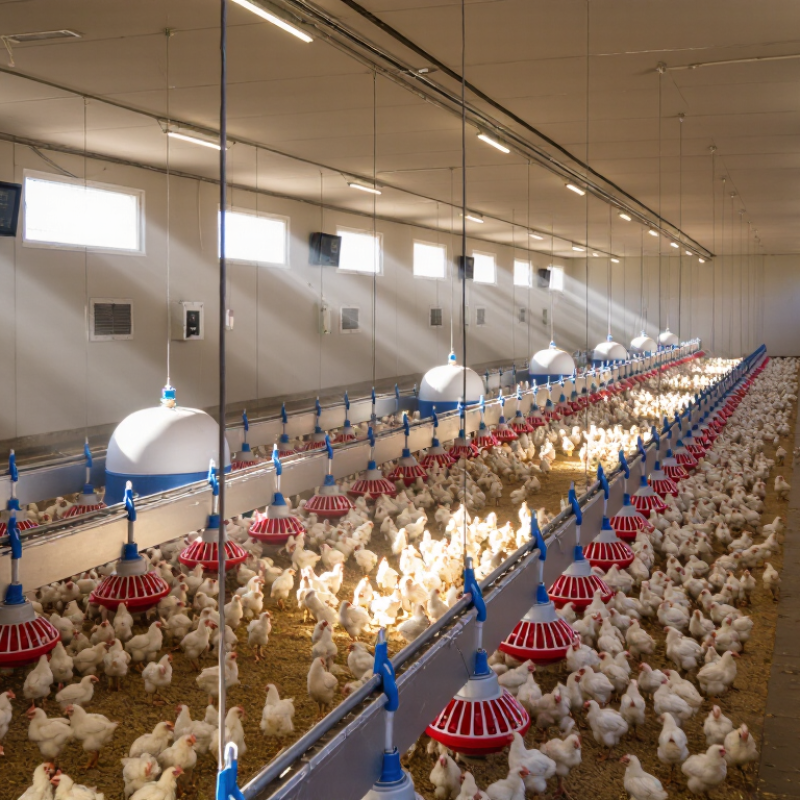
Farm scale should begin with usable floor area, not building size. For broilers, a practical planning ceiling is 30 kg/m², based on European welfare requirements and farm assurance practices. At a 2 kg market weight, this equals about 15 birds per square metre. A 10,000-bird house therefore needs roughly 667 m² of usable space, before excluding service corridors and fixed equipment.
The European Commission’s broiler welfare framework allows higher densities under strict conditions, but 30 kg/m² remains a more cautious equipment benchmark. It leaves less room for error.
Do not confuse this figure with 750 cm² per hen. Under EU laying-hen rules, 750 cm² refers to space in enriched cage systems, not broiler floor density. That area equals 0.075 m² per hen. EFSA’s 2023 welfare opinion also stresses movement, litter quality, climate, and stocking pressure. Space alone is not welfare. Still, these figures help size feeders, drinker lines, ventilation capacity, litter handling, and backup power.
For a 30 kg/m² broiler plan, select equipment around peak bird weight, not chick placement. Check airflow at the hottest local temperature, then test ammonia near floor level.
FAO production data shows poultry systems are expanding globally, yet climate and labor conditions vary sharply. A standard layout may fail on a humid farm.
I would also leave spare capacity. It costs more now, but overcrowded equipment is harder to correct later. The 750 cm² figure may look precise, but real performance remains imperfect and deserves review after each flock.
How to Choose Chicken Farm Equipment in 2026?
Sizing drinkers for 10–12 birds per nipple is a practical starting point. A house with 1,200 birds therefore needs about 100–120 nipples. I would add a small reserve, because injured or blocked nipples create uneven access. FAO’s Poultry Development Review links reliable water access with feed intake, growth, and flock performance. That connection is easy to underestimate.
Feeder capacity needs equal attention. Provide enough trough space for simultaneous feeding, especially during the first and last daily feeding periods. Many commercial management guides suggest roughly 5–10 centimeters of linear feeder space per growing bird, depending on feeder design and body weight. USDA Economic Research Service cost analyses place feed above 60 percent of typical poultry production costs. Waste from poor adjustment becomes expensive quickly. Keep the lip near the birds’ back height, and check for spilled feed beneath it.
Nipple flow must match age. Young birds need gentle access, while older birds require stronger delivery. A common working range is about 20–40 milliliters per minute, but local water pressure changes results. Measure it with a cup, not by guesswork. I once trusted a layout chart too much. That was a mistake. Walk the house twice daily, inspect wet litter, and record water use. The 10–12-bird rule is useful, but it is not a magic number. Temperature, breed size, and line height still demand adjustment.
Feeder and drinker planning guide for 10–12 birds per nipple.
Planning assumptions: provide one nipple drinker for every 10–12 birds and at least 10 cm of feeder access per bird. Nipple quantities are rounded up to the next whole unit, while feeder length represents total linear access for the flock.
When choosing chicken farm equipment in 2026, treat ventilation as a welfare control system, not merely a cooling tool. Keep ammonia below the 20 ppm welfare limit, including during cold nights. Measure it near feeders, drinker lines, and litter corners. Do not rely on one wall sensor. Use calibrated monitors at bird height, then compare readings across house zones. Fresh air must reach the floor without creating chilling drafts. That balance is easy to miss.
Select variable-speed exhaust fans, adjustable air inlets, and controllers that respond to temperature, humidity, and ammonia readings. Fan capacity should match house volume, stocking density, and local weather exposure. Inlets need enough opening pressure to move air across the ceiling before it descends. Check airflow with smoke or light ribbon tests. Watch the birds, too. Huddling suggests drafts; panting suggests inadequate heat removal. Keep minimum ventilation running in winter. Test it daily.
Equipment cannot repair wet litter alone. Inspect drinker height, leaks, litter depth, and manure accumulation every day. Clean sensors and fans on a written schedule, because dust quietly reduces performance. Record ammonia, humidity, fan speed, and alarm events. Ask a poultry veterinarian or ventilation engineer to review unusual patterns. A common mistake is trusting automatic settings without checking the house. I would leave room for correction. Weather changes, bird age, and litter condition can defeat yesterday’s settings. A useful system depends on measured airflow and timely human judgment.
Choosing chicken farm equipment in 2026 should begin with the feed bill, not the catalog. Feed often represents 60–70% of operating costs, so small inaccuracies become expensive every day. Select systems that meter portions consistently, match bird age, and reduce spillage around pans. In a practical farm trial, weigh feed delivered and feed remaining for several days. This simple check reveals losses that software may hide. Equipment should also allow quick height adjustments as birds grow. If workers need tools for every adjustment, settings may be ignored during busy shifts. That is a weakness worth admitting.
Tips: Compare equipment by feed conversion results, cleaning time, and calibration stability. Ask for documented test data, service procedures, and replacement-part availability. Check whether sensors remain accurate after dust exposure. Install a small test line before expanding across the house. Observe birds at feeding time: crowded pans, untouched feed, or uneven body weights signal poor distribution. Keep a daily log of feed issued, flock weight, mortality, and leftovers. Numbers do not explain everything, but they expose patterns.
Precision feeding requires more than automatic dispensers. Augers, hoppers, weighing sensors, controllers, and backup power must work together. Choose sealed components where dust and moisture are common, but ensure staff can open them safely for inspection. A reliable alarm should identify an empty hopper or blocked line before birds miss a feeding cycle. Do not accept claimed savings without comparing results across similar flock sizes and seasons. One farm may report excellent performance, while another struggles because feed texture differs. I would also budget for calibration, training, and occasional human error. Perfect operation is unlikely. Better equipment makes mistakes visible sooner.
Verify Automation, Biosecurity, and Energy Performance Before Purchase
A practical audit starts with the chicken house, not the sales brochure. Check whether sensors measure temperature, humidity, carbon dioxide, water flow, and feed use continuously. Each alarm should reach a named person within minutes. Automation without reliable alerts is expensive decoration. The OECD-FAO Agricultural Outlook 2024–2033 projects global poultry meat production to grow by about 14% by 2033. That growth increases pressure to manage larger flocks with fewer manual errors. Ask suppliers for uptime records, calibration procedures, and repair response times. Do not accept vague claims.
Biosecurity needs physical details. Inspect the clean-to-dirty route, boot-change area, handwashing point, vehicle access, and washable surfaces. USDA APHIS recorded about 58.8 million birds affected by highly pathogenic avian influenza in the United States during 2022. Equipment cannot prevent every outbreak, but poor layout can spread contamination quickly.
Energy performance also requires measured evidence. Request electricity use in kWh per bird placed, fan efficiency curves, heater consumption, and winter ventilation settings. The European Commission’s BAT guidance for intensive poultry production emphasizes monitoring ventilation, heating, water, and energy use. Compare figures from similar climates. A perfect dashboard may still hide poor maintenance. I would test one house first, review three production cycles, and revise the purchase plan when the data disagrees.
We use cookies on our website to give you an improved browser experience. View our Privacy Policy for more information. Please make your selection to opt in or out of ALL cookies here: Accept or Decline
Do you consent to the use of ALL cookies?
901 2nd Court West
Birmingham, AL 35204
Sales: 866.481.4036
Logistics/Ops: 866.481.4036
2101 Dralle Road
University Park, IL 60466
Sales: 708.813.9070
Logistics/Ops: 708.235.4200
400 E. 13th Street
Little Rock, AR 72114
Sales: 866.760.5344
Logistics/Ops: 866.760.5344
225 Collins Road
Elkhart, IN 46515
Sales: 574.295.0214
Logistics/Ops: 574.607.4611
601 Berryman Pike
Tipton, IN 46072
Sales: 800.897.7591
Logistics/Ops: 800.897.7591
3900 Uvalda Street
Denver, CO 80239
Sales: 303.706.8000
Ops/Logistics: 303.576.8398
510 3rd Street E
Milan, IL 61264
Sales: 800.322.1052
Logistics/Ops: 800.322.1052
1660 E. Aurora
Des Moines, IA 50313
Sales: 800.671.1660
Logistics: 800.671.1660
86554 Gene Lasserre Blvd.
Yulee, FL 32097
Sales: 904.253.3060
Logistics/Ops: 904.225.3000
694 S.E. County Road 245
Lake City, FL 32025
Sales: 800.727.6706
Logistics/Ops: 386.752.7412
210 Neptune Road
Auburndale, FL 33823
Sales: 863.967.1131
Logistics/Ops: 863.777.9814
4601 McCoy Drive
Pensacola, FL 32503
Sales: 850.308.7030
Logistics/Ops: 850.434.5502
815 South 56th Street
Tampa, FL 33619
Sales: 813.302.1940
Logistics/Ops: 813.621.1352
200 Hosea Road
Lawrenceville, GA 30046
Sales: 770.953.7575
Logistics/Ops: 770.513.6000
Branch Product Guide
Branch Line Card
Moulding Offering
Cedar Offering
Column Offering
8173 Hwy. 165 North
Monroe, LA 71211
Sales: 800.256.4165
Logistics/Ops: 800.256.4165
508 Warren Avenue
Portland, ME 04103
Sales: 207.888.2331
Logistics/Ops: 207.797.6565
4300 Georgia Pacific Blvd.
Frederick, MD 21704
Sales: 301.798.7474
Logistics/Ops: 301.874.8000
419 Maple Street
Bellingham, MA 02019
Sales: 508.449.0535
Logistics/Ops: 508.966.5500
825 Buchanan Ave SW
Grand Rapids, MI 49507
Sales: 877.800.1180
Logistics/Ops: 616.278.0909
995 Pacific St. NW
Aitkin, MN 56431
Sales: 800.432.3727
Logistics/Ops: 218.212.7770
1102 Port Terminal Drive
Duluth, MN 55802
Sales: 800.951.9899
Logistics/Ops: 800.851.9899
9110 83rd Ave. North
Brooklyn Park, MN 55445
Sales: 763.425.0204
Logistics/Ops: 763.425.0204
910 E. Railroad Street
Long Beach, MS 39560
Sales: 866.535.4135
Logistics/Ops: 228.205.2400
1727 Warren Street
North Kansas City, MO 64116
Sales: 800.621.2611
Logistics/Ops: 800.621.2611
2123 North Golden
Springfield, MO 65803
Sales: 800.375.7891
Logistics/Ops: 800.375.7891
13860 Corp. Woods Trail
Bridgeton, MO 63044
Sales: 314.209.0800
Logistics/Ops: 314.209.0800
1109 South 19th Street
Omaha, NE 68108
Sales: 800.489.6637
Logistics/Ops: 800.489.6637
1 Luger Road
Denville, NJ 07834
Sales: 973-339-3539
Logistics/Ops: 973.625.1461
3720 Jeffrey Blvd.
Blasdell, NY 14219
Sales: 716.235.5989
Logistics/Ops: 716.825.6557
319 Yaphank Ave.
Yaphank, NY 11980
Sales: 631.358.5714
Logistics/Ops: 631.924.7401
3300 Parkside Drive
Charlotte, NC 28208
Sales: 800.839.2588
Logistics/Ops: 704.394.3172
1712 East D Street
Butner, NC 27509
Sales: 984.389.8200
Logistics/Ops: 919.575.3700
128 Foothills Drive
Statesville, NC 28687
Sales: 800.222.1414
Logistics/Ops: 704.394.3172
550 Munroe Falls Rd.
Tallmadge, OH 44278
Sales: 330.357.4506
Logistics/Ops: 330.794.1141
10347 Toebben Dr.
Independence, KY 41051
Sales: 859.298.3926
Logistics/Ops: 859.746.2250
450 N. MacArthur
Oklahoma City, OK 73127
Sales: 800.375.6025
Logistics/Ops: 800.375.6025
1680 North Aspen
Broken Arrow, OK 74012
Sales: 918.272.2212
Logistics/Ops: 918.272.2212
522 Bridge Street
Hunker, PA 15639
Sales: 878.217.2001
Logistics/Ops: 724.925.7285
4290 Atlanta Street
Charleston, SC 29418
Sales: 843.371.1420
Logistics/Ops: 843.554.8192
1040 S. Industrial Dr.
Erwin, TN 37650
Sales: 423.641.1005
Logistics/Ops: 423.742.5911
4287 Pilot Drive
Memphis, TN 38118
Sales: 901.365.2101
Logistics/Ops: 901.365.2101
700 Myatt Drive
Madison, TN 37115
Sales: 615.327.9547
Logistics/Ops: 629.777.4949
4747 Mark IV Parkway
Fort Worth, TX 76106
Sales: 866.323.5117
Logistics/Ops: 817.625.9091
6990 Market Avenue
El Paso, TX 79915
Sales: 915.778.6356
Logistics/Ops: 915.265.7200
2502 Wilson Road
Harlingen, TX 78552
Sales: 800.580.6711
Logistics/Ops: 800.580.6711
10,000 North Loop East
Houston, TX 77029
Sales: 713.921.1977
Logistics/Ops: 713.675.3544
702 East 44th St.
Lubbock, TX 79404
Sales: 866.454.6010
Logistics/Ops: 866.454.6010
535 N. WW White Road
San Antonio, TX 78219
Sales: 800.284.0488
Logistics/Ops: 210.333.8112
142 Pine Haven Shores Rd.
Shelburne, VT 05482
Sales: 802.800.2540
Logistics/Ops: 802.985.2512
4700 Bethlehem Road,
Richmond, VA 23230
Sales: 804.201.2400
Logistics/Ops: 804.342.1161
4516 N Barker Road
Spokane Valley, WA 99027
Phone: 509.892.9420
Toll free: 800.728.6157
8365 N. 76th Street
Milwaukee, WI 53223
Sales: 800.356.9245
Logistics/Ops: 800.356.9245
312 S. Chester Street
Sparta, WI 54656
Sales: 800.362.5864
Logistics/Ops: 800.362.5864
899 Grossman Drive
Schofield, WI 54476
Sales: 800.472.0017
Logistics/Ops: 800.472.0017
