
We use cookies on our website to give you an improved browser experience. View our Privacy Policy for more information. Please make your selection to opt in or out of ALL cookies here: Accept or Decline
Choosing Fiberglass Front Doors in 2026 means weighing more than color and curb appeal. A door can feel solid in a showroom yet perform poorly if its frame, weather seals, glazing, or installation are wrong. Look for independently rated thermal performance, a durable finish, and clear warranty terms. Then check the rough-opening measurements and the direction the door swings. Small details matter.
The 2024 Remodeling Cost vs. Value report estimated a 188.1% cost recoup for steel entry-door replacement. That figure is a resale-value benchmark, not a fiberglass-door result or a promise of return. For product comparisons, consult the National Fenestration Rating Council label, which reports metrics such as U-factor and solar heat-gain coefficient. These numbers help compare tested products; they do not tell you how well a specific door will be installed.
Building scientist Joseph Lstiburek is often associated with the reminder, “There is no such thing as a perfect wall.” Applied cautiously, that idea matters here: even a well-made door depends on sound flashing, drainage, and a careful fit. A low U-factor cannot fix a leaking sill. And a premium finish may still need maintenance. This guide will help you compare core construction, glass options, security hardware, climate suitability, and installation quality. One honest caveat: published performance data can be difficult to compare across brands. Check the actual ratings, not just polished claims.
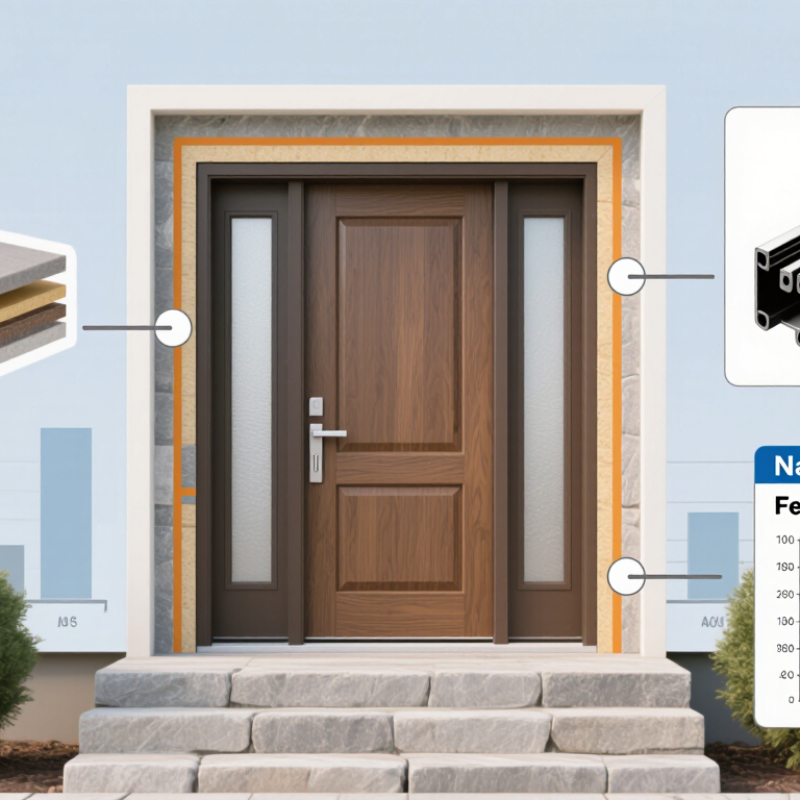
Start with the opening, not the finish. Measure its width, height, depth, and squareness at several points; older frames can shift. Note the swing direction, threshold height, nearby steps, and whether furniture blocks the arc. Then consider exposure: a shaded porch, strong afternoon sun, coastal moisture, and freezing winters create different demands. The U.S. Energy Information Administration’s 2020 Residential Energy Consumption Survey reports that space heating used about 42% of household energy. That figure is not door-specific, but it makes drafts and a poor frame fit worth checking.
Match the door to daily use. A busy entry may need a durable finish and an easy-clean surface; a dim hallway may benefit from glazing, balanced against privacy and heat gain. Ask for the complete door assembly’s NFRC-rated U-factor and, where relevant, solar heat gain coefficient—not just the slab’s advertised value. Check the frame, weatherstripping, sill, and installation details too. A well-rated slab can still disappoint if air slips around its edges. I’ve seen measurements taken only once; that shortcut can miss a tapered opening.
Tips: Photograph the existing hinges, lockset, and sill before shopping. Write down the rough-opening measurements and bring them to the supplier. Compare ratings for the climate where the home sits. And be honest about priorities: the “best” door may not be the one with the most glass or the lowest number.
How to Choose Fiberglass Front Doors in 2026?
Fiberglass doors can look similar in a showroom but perform differently at home. Many use molded fiberglass skins over a foam core, with wood or composite rails around the edges. The foam helps limit heat transfer, while the frame supports hinges and locks. Construction details vary, so check the product specifications rather than relying on appearance alone.
Compare the full assembly, not just the door slab. A tight weather seal and well-fitted frame can reduce drafts more effectively than a thick-looking panel. Ask how the door handles moisture, direct sun, and temperature swings in your climate. Fiberglass will not rust, but hard impacts can crack its skin, and dark finishes may absorb more heat. A minor flaw in the installation can still undermine good materials. That part is easy to overlook.
Tips: Check the core, edge construction, weatherstripping, and glazing options before choosing. Confirm that the frame suits your rough opening, and ask about finish care. If possible, inspect a sample in daylight. A useful comparison is the door’s tested insulation rating, but ratings do not capture every installation detail. Don’t assume the most elaborate design performs best.
| Construction or feature | Typical build | Insulation and energy performance | Moisture resistance | Durability and upkeep | Best suited for |
|---|---|---|---|---|---|
| Polyurethane-foam-core fiberglass | Molded fiberglass skins bonded to a rigid polyurethane foam core, usually with reinforced edges and hardware locations. | Foam-filled construction provides insulation. Performance depends on the complete door assembly, including its thickness, glazing, seals, and installation. | Fiberglass skins resist moisture-related swelling and corrosion. Unprotected edges, joints, or damaged finishes can still allow water intrusion. | Generally needs less routine upkeep than a wood exterior; inspect the finish, weatherstripping, and threshold periodically. | Homeowners prioritizing insulation and a low-maintenance entry door. |
| Polystyrene-foam-core fiberglass | Molded fiberglass skins surrounding a polystyrene foam core; edge and frame materials vary by product. | Provides insulation, but polystyrene cores commonly offer less insulating value than polyurethane cores of comparable thickness. Check the specific product’s documented performance. | The fiberglass skin is moisture resistant; protection at edges, joints, and glazing details remains important. | Routine care is similar to other fiberglass doors. Overall durability depends on the skin, edge reinforcement, finish, and hardware. | Projects where the selected model’s documented cost and performance suit the climate and budget. |
| Wood-edge or wood-stile construction | Fiberglass skins with wood components at the perimeter or around the lockset and hinges; exact reinforcement varies. | Insulation is determined mainly by the core and door assembly, not by the presence of wood edges alone. | Fiberglass faces resist moisture, but exposed or persistently wet wood components can swell or deteriorate. | Check exposed edges and finish condition, and keep seals and drainage details in good order. | Applications where the specified wood reinforcement and hardware layout meet the project requirements. |
| Composite-edge construction | Fiberglass skins with engineered composite reinforcement at some or all edges; core and reinforcement details vary. | Thermal performance still depends on the core, glazing, seals, and full door assembly. | Composite edge materials are generally less susceptible to moisture-related rot than untreated wood, but joints and installation still need protection. | Confirm the manufacturer’s requirements for finishing, hardware attachment, and maintenance. | Entries exposed to rain or humidity where reduced reliance on wood edges is preferred. |
| Glazing and decorative glass | May include insulated glass, clear or decorative glass, or sidelights as part of the entry system. | Glass changes the door’s overall thermal performance. Compare whole-unit documentation and glazing details rather than judging the opaque panel alone. | Water resistance depends on glazing seals, frame joints, flashing, and correct installation. | Inspect glazing seals and clean glass with products suitable for its finish. | Entries where daylight or visibility is important; consider privacy and energy needs together. |
| Weatherstripping and threshold | Perimeter weatherstripping and a threshold form part of the installed entry system. | Well-fitted seals help limit air leakage. A poorly adjusted door or worn seals can reduce the benefit of an insulated slab. | A properly installed threshold and effective seals help manage drafts and water at the opening; site drainage and installation matter. | Check for compressed, damaged, or loose seals and adjust or replace components when needed. | Every exterior entry door, particularly openings exposed to wind-driven rain. |
Selection note: Performance varies by model and installation. Compare documented whole-door energy ratings, available glazing and hardware options, warranty terms, and local code requirements. A door’s stated performance does not replace correct flashing, sealing, and installation.
How to Choose Fiberglass Front Doors in 2026?
Choose a Style, Glass Option, and Finish
Start with the shape of your entryway and the character of your home. A flat-panel door can suit a simple façade, while shallow grooves add texture without demanding attention. Measure the opening, including trim clearance, before settling on a design. A door that looks balanced in a showroom may feel crowded beside narrow sidelights. Small details matter.
Choose glass for both privacy and daylight. Clear glass brightens a dim hall, but patterned or textured glass can soften views from the street. Check how the glass looks from both sides, and ask about its insulation performance. For finishes, compare samples outdoors; warm wood tones can shift noticeably in direct sun. Fiberglass generally needs less upkeep than many painted wood doors, but the finish and hardware still need sensible care. No option is perfect. Sometimes a slightly less striking style fits the house better.
Tips: Match the door’s undertone to nearby trim, not just your interior paint. Ask how the finish should be cleaned, and confirm the glass configuration before ordering. Keep a sample. View it in morning and afternoon light.
A fiberglass front door should be judged by its full assembly, not its surface alone. Check the NFRC label for whole-unit U-factor; a lower value generally means less heat passes through. The U.S. Department of Energy advises checking weatherstripping and the threshold, too, since small gaps can undermine comfort. ENERGY STAR’s door criteria vary by climate zone, so compare the applicable rating rather than relying on a broad “energy efficient” claim.
Security starts at the frame. Ask whether the lock area is reinforced, whether the deadbolt extends securely into the strike plate, and how the jamb is anchored. A heavy-looking slab is not proof of a strong entry system. Small detail, big consequence. Request test documentation for the complete door assembly, and check that the supplied hardware matches the tested configuration.
Read the exclusions. The 2024 Cost vs. Value report estimated a national average cost of $11,036 for fiberglass entry-door replacement, with $5,318 in resale value, or 48.2% cost recouped. That is a useful investment benchmark, not a promise of performance. Compare written warranties for the slab, finish, glass seals, hardware, labor, and transferability. Note required maintenance and exclusions for moisture or improper installation. A long warranty can still leave key parts uncovered. A sample warranty and a clear installation record make comparison easier.
When comparing fiberglass front doors, price the complete project—not just the door slab. Request an itemized quote covering the frame, sill, lockset, delivery, removal, disposal, trim, and finishing. Ask whether hidden rot or opening repairs are excluded. Small details add up.
The Journal of Light Construction’s 2024 Cost vs. Value report put a steel entry-door replacement at a national average of $2,355, with an estimated $4,430 in resale value. That is a useful benchmark, not a fiberglass-door quote; materials, configuration, and local labor differ. Treat resale figures cautiously. Your actual costs may look quite different.
Professional installation should include checking that the rough opening is square, the sill is level, and the frame is plumb. Proper flashing and sealing help manage water around the doorway. Ask who handles any discovered damage, and get that work priced before installation begins. A low bid may omit it. Compare written scopes, warranty terms, and cleanup plans—not just totals. I would also keep a modest contingency; older framing can hide surprises, and estimates rarely predict every one.
We use cookies on our website to give you an improved browser experience. View our Privacy Policy for more information. Please make your selection to opt in or out of ALL cookies here: Accept or Decline
Do you consent to the use of ALL cookies?
901 2nd Court West
Birmingham, AL 35204
Sales: 866.481.4036
Logistics/Ops: 866.481.4036
2101 Dralle Road
University Park, IL 60466
Sales: 708.813.9070
Logistics/Ops: 708.235.4200
400 E. 13th Street
Little Rock, AR 72114
Sales: 866.760.5344
Logistics/Ops: 866.760.5344
225 Collins Road
Elkhart, IN 46515
Sales: 574.295.0214
Logistics/Ops: 574.607.4611
601 Berryman Pike
Tipton, IN 46072
Sales: 800.897.7591
Logistics/Ops: 800.897.7591
3900 Uvalda Street
Denver, CO 80239
Sales: 303.706.8000
Ops/Logistics: 303.576.8398
510 3rd Street E
Milan, IL 61264
Sales: 800.322.1052
Logistics/Ops: 800.322.1052
1660 E. Aurora
Des Moines, IA 50313
Sales: 800.671.1660
Logistics: 800.671.1660
86554 Gene Lasserre Blvd.
Yulee, FL 32097
Sales: 904.253.3060
Logistics/Ops: 904.225.3000
694 S.E. County Road 245
Lake City, FL 32025
Sales: 800.727.6706
Logistics/Ops: 386.752.7412
210 Neptune Road
Auburndale, FL 33823
Sales: 863.967.1131
Logistics/Ops: 863.777.9814
4601 McCoy Drive
Pensacola, FL 32503
Sales: 850.308.7030
Logistics/Ops: 850.434.5502
815 South 56th Street
Tampa, FL 33619
Sales: 813.302.1940
Logistics/Ops: 813.621.1352
200 Hosea Road
Lawrenceville, GA 30046
Sales: 770.953.7575
Logistics/Ops: 770.513.6000
Branch Product Guide
Branch Line Card
Moulding Offering
Cedar Offering
Column Offering
8173 Hwy. 165 North
Monroe, LA 71211
Sales: 800.256.4165
Logistics/Ops: 800.256.4165
508 Warren Avenue
Portland, ME 04103
Sales: 207.888.2331
Logistics/Ops: 207.797.6565
4300 Georgia Pacific Blvd.
Frederick, MD 21704
Sales: 301.798.7474
Logistics/Ops: 301.874.8000
419 Maple Street
Bellingham, MA 02019
Sales: 508.449.0535
Logistics/Ops: 508.966.5500
825 Buchanan Ave SW
Grand Rapids, MI 49507
Sales: 877.800.1180
Logistics/Ops: 616.278.0909
995 Pacific St. NW
Aitkin, MN 56431
Sales: 800.432.3727
Logistics/Ops: 218.212.7770
1102 Port Terminal Drive
Duluth, MN 55802
Sales: 800.951.9899
Logistics/Ops: 800.851.9899
9110 83rd Ave. North
Brooklyn Park, MN 55445
Sales: 763.425.0204
Logistics/Ops: 763.425.0204
910 E. Railroad Street
Long Beach, MS 39560
Sales: 866.535.4135
Logistics/Ops: 228.205.2400
1727 Warren Street
North Kansas City, MO 64116
Sales: 800.621.2611
Logistics/Ops: 800.621.2611
2123 North Golden
Springfield, MO 65803
Sales: 800.375.7891
Logistics/Ops: 800.375.7891
13860 Corp. Woods Trail
Bridgeton, MO 63044
Sales: 314.209.0800
Logistics/Ops: 314.209.0800
1109 South 19th Street
Omaha, NE 68108
Sales: 800.489.6637
Logistics/Ops: 800.489.6637
1 Luger Road
Denville, NJ 07834
Sales: 973-339-3539
Logistics/Ops: 973.625.1461
3720 Jeffrey Blvd.
Blasdell, NY 14219
Sales: 716.235.5989
Logistics/Ops: 716.825.6557
319 Yaphank Ave.
Yaphank, NY 11980
Sales: 631.358.5714
Logistics/Ops: 631.924.7401
3300 Parkside Drive
Charlotte, NC 28208
Sales: 800.839.2588
Logistics/Ops: 704.394.3172
1712 East D Street
Butner, NC 27509
Sales: 984.389.8200
Logistics/Ops: 919.575.3700
128 Foothills Drive
Statesville, NC 28687
Sales: 800.222.1414
Logistics/Ops: 704.394.3172
550 Munroe Falls Rd.
Tallmadge, OH 44278
Sales: 330.357.4506
Logistics/Ops: 330.794.1141
10347 Toebben Dr.
Independence, KY 41051
Sales: 859.298.3926
Logistics/Ops: 859.746.2250
450 N. MacArthur
Oklahoma City, OK 73127
Sales: 800.375.6025
Logistics/Ops: 800.375.6025
1680 North Aspen
Broken Arrow, OK 74012
Sales: 918.272.2212
Logistics/Ops: 918.272.2212
522 Bridge Street
Hunker, PA 15639
Sales: 878.217.2001
Logistics/Ops: 724.925.7285
4290 Atlanta Street
Charleston, SC 29418
Sales: 843.371.1420
Logistics/Ops: 843.554.8192
1040 S. Industrial Dr.
Erwin, TN 37650
Sales: 423.641.1005
Logistics/Ops: 423.742.5911
4287 Pilot Drive
Memphis, TN 38118
Sales: 901.365.2101
Logistics/Ops: 901.365.2101
700 Myatt Drive
Madison, TN 37115
Sales: 615.327.9547
Logistics/Ops: 629.777.4949
4747 Mark IV Parkway
Fort Worth, TX 76106
Sales: 866.323.5117
Logistics/Ops: 817.625.9091
6990 Market Avenue
El Paso, TX 79915
Sales: 915.778.6356
Logistics/Ops: 915.265.7200
2502 Wilson Road
Harlingen, TX 78552
Sales: 800.580.6711
Logistics/Ops: 800.580.6711
10,000 North Loop East
Houston, TX 77029
Sales: 713.921.1977
Logistics/Ops: 713.675.3544
702 East 44th St.
Lubbock, TX 79404
Sales: 866.454.6010
Logistics/Ops: 866.454.6010
535 N. WW White Road
San Antonio, TX 78219
Sales: 800.284.0488
Logistics/Ops: 210.333.8112
142 Pine Haven Shores Rd.
Shelburne, VT 05482
Sales: 802.800.2540
Logistics/Ops: 802.985.2512
4700 Bethlehem Road,
Richmond, VA 23230
Sales: 804.201.2400
Logistics/Ops: 804.342.1161
4516 N Barker Road
Spokane Valley, WA 99027
Phone: 509.892.9420
Toll free: 800.728.6157
8365 N. 76th Street
Milwaukee, WI 53223
Sales: 800.356.9245
Logistics/Ops: 800.356.9245
312 S. Chester Street
Sparta, WI 54656
Sales: 800.362.5864
Logistics/Ops: 800.362.5864
899 Grossman Drive
Schofield, WI 54476
Sales: 800.472.0017
Logistics/Ops: 800.472.0017
