
We use cookies on our website to give you an improved browser experience. View our Privacy Policy for more information. Please make your selection to opt in or out of ALL cookies here: Accept or Decline
Choosing Glass Roof Patio Covers in 2026 requires more than admiring bright, rain-washed outdoor spaces. The right system must balance daylight, heat control, drainage, structure, and long-term maintenance. It should feel open without turning your patio into a greenhouse.
The U.S. Department of Energy reports that windows can account for 25–30% of residential heating and cooling energy use. That figure makes glazing performance important. Look for low-emissivity glass, suitable U-factor ratings, and a solar heat-gain coefficient matched to your climate. In hot regions, tinted or spectrally selective glass can reduce glare on pale stone floors. In colder areas, insulated glazing helps limit interior heat loss. Small specification errors matter.
The NAHB’s latest homebuyer research continues to identify outdoor living areas as highly desirable residential features. Yet popularity should not replace technical judgment. Building scientist Joseph Lstiburek, founder of Building Science Corporation, offers a useful warning: “Water is patient.” His words apply directly to glass patio roofs. Poor flashing, blocked gutters, and weak roof pitches can create stains, leaks, and hidden structural damage.
No roof performs perfectly. Even premium glass needs cleaning and inspection. A thoughtful selection considers frame strength, drainage paths, ventilation, shading, safety glazing, and repair access. This guide examines those details, compares practical roof designs, and explains where homeowners often make expensive assumptions. The brightest option may not be the wisest one. Look beyond the first impression.
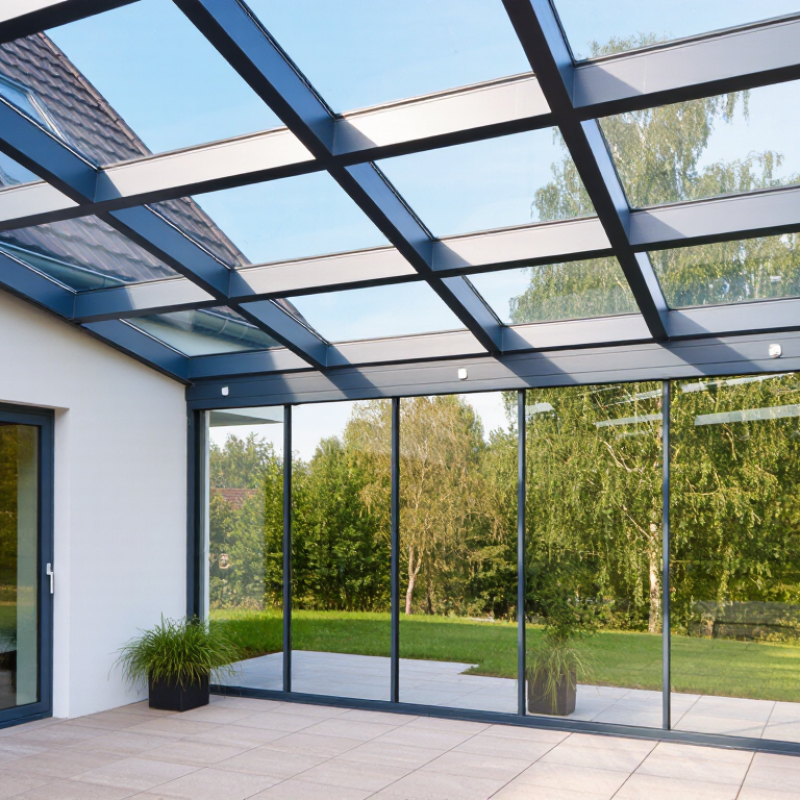
Start with how you will use the patio. Will it host morning coffee, family meals, or evening gatherings? Track sunlight across the area for several days. A south-facing roof may need solar-control glass, exterior shading, or adjustable louvers. Clear glass feels open, but it can increase heat and glare. Tinted or low-emissivity glass may improve comfort while preserving daylight.
Think about local weather, too. Heavy rain requires reliable drainage and carefully sealed joints. Windy locations need structural checks from a qualified professional. Ask about laminated safety glass, ventilation, roof pitch, and maintenance access. Local building requirements may also affect the design. Do not rely on attractive drawings alone.
Tips:
Place a chair beneath the proposed roof area. Notice heat, reflections, and falling leaves. Measure the patio during different seasons. Keep a small budget for drainage changes or shading. These details are easy to overlook.
A practical design should balance appearance, comfort, and long-term care. Glass may need regular cleaning, especially near trees or coastal air. A roof that looks perfect in spring could feel too hot in midsummer. That is worth reconsidering. Request written specifications, warranty terms, and installation experience from each contractor. If the advice sounds vague, pause before committing.
Choosing a glass roof patio cover starts with climate, not appearance. I have seen clear roofs brighten a small patio, yet they can create intense summer heat.
Low-e laminated glass reduces glare and helps maintain indoor comfort. Tempered glass is often more affordable, but it breaks into smaller fragments after severe impact. For homes near trees, laminated glass offers a more reassuring barrier because its inner layer can hold shards together.
Roof design changes daily use. A fixed flat roof looks clean, but drainage must be carefully engineered. Even a slight slope helps rain move toward gutters.
A pitched roof sheds leaves faster and can improve ventilation near the upper edge. Retractable sections provide flexible shade, though their seals and tracks need regular cleaning.
They are convenient. They are not maintenance-free.
The frame also deserves close comparison. Powder-coated aluminum resists rust and keeps the structure relatively light. Steel provides greater stiffness for wide spans, but it needs durable corrosion protection and stronger foundations.
Timber feels warmer and suits traditional homes, although moisture checks cannot be skipped. Ask an installer for wind, snow, drainage, and load calculations, not only glossy drawings. Local conditions vary, and a design that worked on my sheltered terrace may fail beside an exposed coast.
My own mistake was choosing maximum transparency before testing afternoon heat. A small sample panel would have revealed that problem earlier.
How to Choose Glass Roof Patio Covers in 2026?
A glass roof should match your local climate, not only your garden design. Check tested wind resistance, snow-load capacity, and drainage details before comparing appearance. In coastal areas, salt exposure can damage poorly protected frames and fasteners. In colder regions, ask about thermal breaks and condensation control. A roof that looks clear may still create icy water inside the patio.
Safety depends on the glass specification and the supporting structure. Laminated safety glass helps retain fragments after breakage, while tempered glass offers stronger impact resistance. Both have different failure behaviors. Ask for documented test results, structural calculations, and installation instructions. Local building requirements also matter. One common mistake is trusting a contractor’s verbal assurance without reviewing the paperwork. I have learned that missing details often appear during heavy rain, not during installation.
Tips: Choose low-emissivity glass for better insulation, but check its solar heat gain coefficient. Strong sunlight can turn a patio into a greenhouse. Consider adjustable shading, roof vents, and sensors for overheating. Inspect seals, gutters, and fixings every year. Small leaks become expensive quickly. Energy performance also depends on wall insulation and ventilation, not glass alone. A careful installer should explain these limits clearly, even when the explanation weakens the sales pitch.
How to Choose Glass Roof Patio Covers in 2026?
Installation starts with the structure, not the glass. Confirm local permits, zoning limits, and attachment rules before ordering materials. The 2024 International Residential Code addresses patio-cover loads, drainage, glazing safety, and structural connections. Local amendments may be stricter. A licensed professional should check snow, wind, seismic, and water loads for your property. ASCE 7-22 provides the broader load criteria used in structural design.
Glass performance matters after installation, too. The International Energy Agency’s 2024 Global Status Report states that buildings consume about 30% of global final energy. Low-emissivity glazing, correct orientation, and exterior shading can reduce unwanted heat gain. Still, glass is not automatically energy efficient. Ask for verified U-factor, solar heat gain coefficient, and visible transmittance data. NFRC-rated products offer a more reliable comparison than vague “all-season” claims. Inspect flashing, seals, gutters, and drainage channels at least twice yearly. Small leaks become expensive surprises.
Tips: Request stamped drawings and a written permit scope. Choose tempered or laminated safety glazing where required. Leave service access around gutters. After heavy rain, check the floor beneath every joint. The details are easy to overlook. A checklist helps, but it cannot replace an on-site inspection.-vesm
Use this comparison table as a planning guide. Final requirements depend on the project location, site conditions, structural design, and the authority having jurisdiction.
| Decision Area | What to Check | Typical Requirement or Planning Range | Why It Matters | Recommended Action |
|---|---|---|---|---|
| Local permits | Building, structural, planning, and electrical permits | Often required when the cover is attached to a building, adds structural load, changes drainage, or includes lighting and motorized systems. | Unpermitted work can create safety, resale, insurance, and inspection problems. | Contact the local building department before ordering materials or starting construction. |
| Structural design | Posts, beams, rafters, wall connections, foundations, and anchorage | Design must account for the glass dead load plus local snow, wind, rain, seismic, and maintenance loads. | Glass panels are heavy, and roof movement can cause cracking, leakage, or failed connections. | Use site-specific calculations from a qualified structural professional where required. |
| Glass safety | Glass type, thickness, size, edge support, and overhead glazing classification | Overhead glazing commonly requires safety glazing, such as laminated or tempered glass, subject to local code and the design. | Safety glazing helps reduce injury risk if the glass breaks; laminated glass can retain broken fragments. | Select glass through a qualified fabricator and request documentation for the specified assembly. |
| Roof pitch and drainage | Slope, gutters, downspouts, flashing, and discharge location | A positive slope is needed to move water toward gutters or a designed drainage edge; the exact slope depends on the system and local rainfall. | Poor drainage increases ponding, staining, leakage, ice buildup, and premature seal failure. | Confirm the manufacturer’s minimum slope and connect drainage away from foundations and walkways. |
| Wind exposure | Basic wind speed, exposure category, corner zones, uplift, and attachment method | Wind design values vary by location and should be taken from the applicable building code and site conditions. | Roof edges and corners can experience higher uplift than the center of the roof. | Do not rely on generic anchoring; verify fasteners, posts, footings, and wall connections for the site. |
| Snow and ice | Ground snow load, roof snow load, drifting, sliding snow, and ice accumulation | Snow loads are location-specific; a glass roof should not be selected from appearance or span alone. | Snow and drifting can significantly increase load on rafters, beams, connections, and foundations. | Obtain the applicable design load and arrange safe snow removal access where necessary. |
| Thermal performance | Glazing U-factor, solar heat gain coefficient, visible light, shading, and ventilation | Lower U-factor generally reduces heat transfer; lower solar heat gain can reduce unwanted summer heat, depending on climate and orientation. | Uncontrolled solar gain can make a patio uncomfortable and may increase cooling demand. | Match the glass and shading strategy to the climate, orientation, and intended seasonal use. |
| Energy and weather sealing | Flashing, gaskets, sealants, thermal movement, condensation, and wall interface | The roof-to-wall connection should use a coordinated flashing and drainage design, not sealant alone. | Water intrusion often occurs at joints, transitions, fasteners, and poorly detailed wall connections. | Request installation details showing how water is diverted and how materials accommodate movement. |
| Fire and separation | Property lines, fire separation distance, exterior wall rating, and local wildfire rules | Requirements vary by jurisdiction, occupancy, location, and proximity to neighboring structures. | An attached patio roof may affect wall openings, egress, fire spread, or property-line compliance. | Ask the authority having jurisdiction whether additional fire-resistant construction is required. |
| Daylight and glare | Orientation, nearby trees, interior reflections, tint, coatings, and shading devices | The best glazing specification depends on sun path, surrounding buildings, and whether the space is used in the morning or afternoon. | Excessive glare and direct solar radiation can reduce comfort despite good daylight. | Evaluate a sample or mock-up and include exterior shading where practical. |
| Cleaning access | Roof height, panel access, safe walking areas, and drainage clearance | Plan cleaning access without standing on glass; overhead panels should be treated as non-walkable unless specifically designed otherwise. | Unsafe access can lead to falls, broken glazing, damaged seals, and difficult maintenance. | Provide safe access from the ground or use trained professionals with suitable fall protection. |
| Routine cleaning | Dust, leaves, bird deposits, pollen, hard-water deposits, and nearby vegetation | Inspect at least twice a year and clean more frequently in areas with heavy dust, trees, birds, or salt exposure. | Deposits can block drainage, reduce daylight, stain surfaces, and conceal defects. | Use clean water, a soft non-abrasive tool, and a compatible mild cleaner; avoid harsh chemicals. |
| Seal and gasket inspection | Cracking, shrinkage, gaps, discoloration, loose gaskets, and water marks | Inspect seasonally and after severe storms; repair timing depends on the sealant and assembly condition. | Small failures can allow water into framing or adjacent building materials. | Use compatible replacement materials and follow the original system’s repair details. |
| Gutters and drainage | Leaves, sediment, downspouts, outlets, overflow paths, and foundation discharge | Check during spring and fall, and after major storms or when nearby trees shed heavily. | Blocked drainage can cause overflow, staining, erosion, and foundation-related moisture issues. | Keep outlets clear and direct water to an approved discharge point. |
| Glass damage monitoring | Chips, cracks, edge damage, spontaneous breakage, scratches, and impact marks | Any crack or significant edge damage requires prompt professional assessment, especially in overhead glazing. | Damage can reduce the safety margin and allow water or stress to reach the framing system. | Keep people below the affected area clear and arrange replacement or repair evaluation. |
| Service life planning | Replacement access, compatible parts, warranties, and long-term inspection costs | Glass may remain serviceable while seals, gaskets, coatings, drainage components, or finishes need earlier attention. | Whole-life cost is influenced by access, climate, cleaning frequency, and repairability. | Keep drawings, product specifications, installation records, and maintenance instructions for future repairs. |
Choosing a glass roof patio cover in 2026 starts with a realistic budget, not a beautiful picture. Measure the patio, wall height, drainage path, and nearby doors. A rough sketch helps contractors price the project accurately.
Include more than the roof panels. Your budget may need to cover structural framing, shading screens, gutters, lighting, delivery, installation, and future glass cleaning. Ask for itemized quotes. My first estimate was too optimistic because I ignored drainage work. That mistake changed the entire plan.
Select the cover according to your climate and daily use. Insulated glass can improve comfort, while laminated safety glass may offer better protection after accidental impact. Check wind, snow, heat, and rain requirements with a qualified local professional. Small details matter. A low roof pitch can hold leaves and create dirty water marks. A steeper pitch may improve drainage but affect the building connection. Compare fixed roofs with retractable systems if summer ventilation matters. Ask how seals, panels, and moving parts will be inspected later. The cheapest option can become expensive when replacement access is poor. Leave room in the budget for unknowns, because real patios rarely match perfect drawings.
We use cookies on our website to give you an improved browser experience. View our Privacy Policy for more information. Please make your selection to opt in or out of ALL cookies here: Accept or Decline
Do you consent to the use of ALL cookies?
901 2nd Court West
Birmingham, AL 35204
Sales: 866.481.4036
Logistics/Ops: 866.481.4036
2101 Dralle Road
University Park, IL 60466
Sales: 708.813.9070
Logistics/Ops: 708.235.4200
400 E. 13th Street
Little Rock, AR 72114
Sales: 866.760.5344
Logistics/Ops: 866.760.5344
225 Collins Road
Elkhart, IN 46515
Sales: 574.295.0214
Logistics/Ops: 574.607.4611
601 Berryman Pike
Tipton, IN 46072
Sales: 800.897.7591
Logistics/Ops: 800.897.7591
3900 Uvalda Street
Denver, CO 80239
Sales: 303.706.8000
Ops/Logistics: 303.576.8398
510 3rd Street E
Milan, IL 61264
Sales: 800.322.1052
Logistics/Ops: 800.322.1052
1660 E. Aurora
Des Moines, IA 50313
Sales: 800.671.1660
Logistics: 800.671.1660
86554 Gene Lasserre Blvd.
Yulee, FL 32097
Sales: 904.253.3060
Logistics/Ops: 904.225.3000
694 S.E. County Road 245
Lake City, FL 32025
Sales: 800.727.6706
Logistics/Ops: 386.752.7412
210 Neptune Road
Auburndale, FL 33823
Sales: 863.967.1131
Logistics/Ops: 863.777.9814
4601 McCoy Drive
Pensacola, FL 32503
Sales: 850.308.7030
Logistics/Ops: 850.434.5502
815 South 56th Street
Tampa, FL 33619
Sales: 813.302.1940
Logistics/Ops: 813.621.1352
200 Hosea Road
Lawrenceville, GA 30046
Sales: 770.953.7575
Logistics/Ops: 770.513.6000
Branch Product Guide
Branch Line Card
Moulding Offering
Cedar Offering
Column Offering
8173 Hwy. 165 North
Monroe, LA 71211
Sales: 800.256.4165
Logistics/Ops: 800.256.4165
508 Warren Avenue
Portland, ME 04103
Sales: 207.888.2331
Logistics/Ops: 207.797.6565
4300 Georgia Pacific Blvd.
Frederick, MD 21704
Sales: 301.798.7474
Logistics/Ops: 301.874.8000
419 Maple Street
Bellingham, MA 02019
Sales: 508.449.0535
Logistics/Ops: 508.966.5500
825 Buchanan Ave SW
Grand Rapids, MI 49507
Sales: 877.800.1180
Logistics/Ops: 616.278.0909
995 Pacific St. NW
Aitkin, MN 56431
Sales: 800.432.3727
Logistics/Ops: 218.212.7770
1102 Port Terminal Drive
Duluth, MN 55802
Sales: 800.951.9899
Logistics/Ops: 800.851.9899
9110 83rd Ave. North
Brooklyn Park, MN 55445
Sales: 763.425.0204
Logistics/Ops: 763.425.0204
910 E. Railroad Street
Long Beach, MS 39560
Sales: 866.535.4135
Logistics/Ops: 228.205.2400
1727 Warren Street
North Kansas City, MO 64116
Sales: 800.621.2611
Logistics/Ops: 800.621.2611
2123 North Golden
Springfield, MO 65803
Sales: 800.375.7891
Logistics/Ops: 800.375.7891
13860 Corp. Woods Trail
Bridgeton, MO 63044
Sales: 314.209.0800
Logistics/Ops: 314.209.0800
1109 South 19th Street
Omaha, NE 68108
Sales: 800.489.6637
Logistics/Ops: 800.489.6637
1 Luger Road
Denville, NJ 07834
Sales: 973-339-3539
Logistics/Ops: 973.625.1461
3720 Jeffrey Blvd.
Blasdell, NY 14219
Sales: 716.235.5989
Logistics/Ops: 716.825.6557
319 Yaphank Ave.
Yaphank, NY 11980
Sales: 631.358.5714
Logistics/Ops: 631.924.7401
3300 Parkside Drive
Charlotte, NC 28208
Sales: 800.839.2588
Logistics/Ops: 704.394.3172
1712 East D Street
Butner, NC 27509
Sales: 984.389.8200
Logistics/Ops: 919.575.3700
128 Foothills Drive
Statesville, NC 28687
Sales: 800.222.1414
Logistics/Ops: 704.394.3172
550 Munroe Falls Rd.
Tallmadge, OH 44278
Sales: 330.357.4506
Logistics/Ops: 330.794.1141
10347 Toebben Dr.
Independence, KY 41051
Sales: 859.298.3926
Logistics/Ops: 859.746.2250
450 N. MacArthur
Oklahoma City, OK 73127
Sales: 800.375.6025
Logistics/Ops: 800.375.6025
1680 North Aspen
Broken Arrow, OK 74012
Sales: 918.272.2212
Logistics/Ops: 918.272.2212
522 Bridge Street
Hunker, PA 15639
Sales: 878.217.2001
Logistics/Ops: 724.925.7285
4290 Atlanta Street
Charleston, SC 29418
Sales: 843.371.1420
Logistics/Ops: 843.554.8192
1040 S. Industrial Dr.
Erwin, TN 37650
Sales: 423.641.1005
Logistics/Ops: 423.742.5911
4287 Pilot Drive
Memphis, TN 38118
Sales: 901.365.2101
Logistics/Ops: 901.365.2101
700 Myatt Drive
Madison, TN 37115
Sales: 615.327.9547
Logistics/Ops: 629.777.4949
4747 Mark IV Parkway
Fort Worth, TX 76106
Sales: 866.323.5117
Logistics/Ops: 817.625.9091
6990 Market Avenue
El Paso, TX 79915
Sales: 915.778.6356
Logistics/Ops: 915.265.7200
2502 Wilson Road
Harlingen, TX 78552
Sales: 800.580.6711
Logistics/Ops: 800.580.6711
10,000 North Loop East
Houston, TX 77029
Sales: 713.921.1977
Logistics/Ops: 713.675.3544
702 East 44th St.
Lubbock, TX 79404
Sales: 866.454.6010
Logistics/Ops: 866.454.6010
535 N. WW White Road
San Antonio, TX 78219
Sales: 800.284.0488
Logistics/Ops: 210.333.8112
142 Pine Haven Shores Rd.
Shelburne, VT 05482
Sales: 802.800.2540
Logistics/Ops: 802.985.2512
4700 Bethlehem Road,
Richmond, VA 23230
Sales: 804.201.2400
Logistics/Ops: 804.342.1161
4516 N Barker Road
Spokane Valley, WA 99027
Phone: 509.892.9420
Toll free: 800.728.6157
8365 N. 76th Street
Milwaukee, WI 53223
Sales: 800.356.9245
Logistics/Ops: 800.356.9245
312 S. Chester Street
Sparta, WI 54656
Sales: 800.362.5864
Logistics/Ops: 800.362.5864
899 Grossman Drive
Schofield, WI 54476
Sales: 800.472.0017
Logistics/Ops: 800.472.0017
