
We use cookies on our website to give you an improved browser experience. View our Privacy Policy for more information. Please make your selection to opt in or out of ALL cookies here: Accept or Decline
Choosing Leather Office Chairs in 2026 requires more than matching a desk or selecting the darkest color. A chair may look impressive online, yet feel stiff after two hours of daily work. The right choice combines verified materials, supportive design, practical maintenance, and honest comfort testing. Full-grain leather can develop a rich patina, while corrected-grain leather often offers a more consistent finish. Bonded leather may cost less, but its surface can wear faster under heavy use.
Comfort remains personal. A tall user may need a deeper seat and higher backrest. A shorter user may struggle if their feet cannot rest flat. Adjustable lumbar support, seat height, armrests, and tilt tension deserve careful attention. Try every adjustment. Small details matter. A smooth recline mechanism, firm padding, and quiet casters can change an entire workday. Independent product testing, clear warranty terms, and transparent material descriptions also signal a reliable manufacturer. Marketing claims alone are not enough.
Some decisions remain imperfect. Soft leather may feel luxurious but show marks quickly. Firm cushioning may support long sessions but require a break-in period. Even an expensive chair cannot correct a poorly arranged workstation. This guide will examine material quality, ergonomic evidence, durability, sustainability claims, and real-world value. It will also question popular assumptions, because the most attractive chair is not always the healthiest or longest-lasting option. Careful comparison can help buyers choose with confidence, without confusing premium appearance with genuine performance.
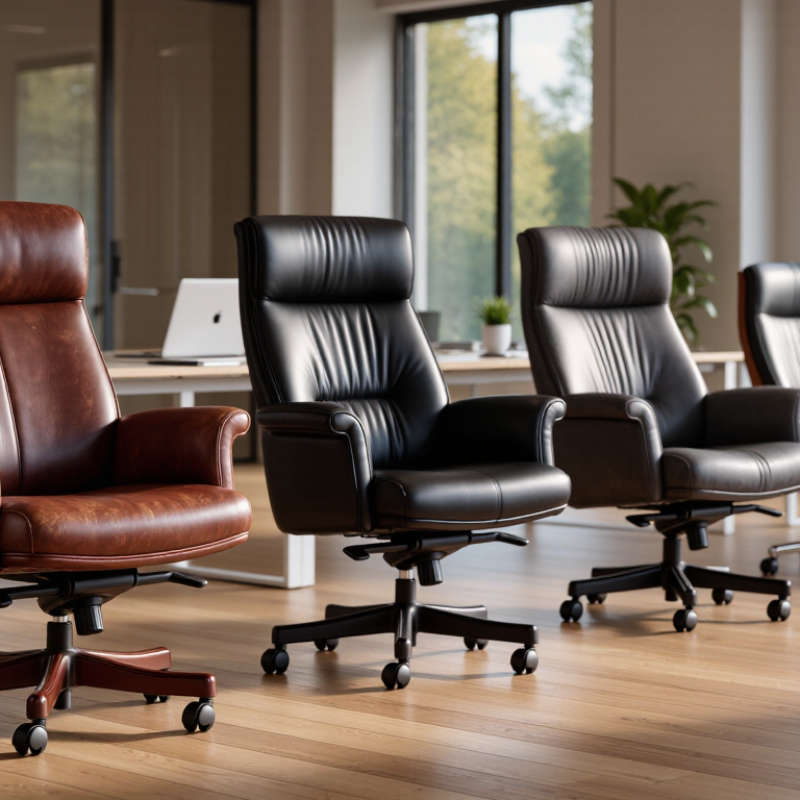
Leather type strongly affects comfort, durability, and maintenance. Full-grain leather keeps the hide’s natural surface, including small marks and varied texture. It develops a deeper patina with use. I prefer it for private offices, meeting rooms, and chairs used for long daily sessions. It feels substantial, but it can show scratches easily.
Top-grain leather has a lightly corrected surface. It offers a smoother appearance and usually provides better stain resistance. This makes it practical for shared offices and reception areas. Corrected-grain leather receives more surface treatment. It can deliver consistent color and easier cleaning, although it may feel less natural. Split leather costs less, but its coating may crack sooner under heavy use.
Check the chair, not only the material label. A genuine leather seat may still have synthetic panels on the sides or back. Ask where each material is used. Also inspect the stitching, foam recovery, tilt mechanism, and ventilation. Leather can feel warm in a poorly ventilated room. A breathable perforated panel may improve comfort. I once chose an attractive chair with excellent leather but weak lumbar adjustment. It looked impressive and supported me badly. That mistake still matters. Consider your working hours, room temperature, cleaning habits, and expected traffic before choosing.
When choosing a leather office chair in 2026, assess movement before appearance. The World Health Organization reports that lower back pain affected 619 million people worldwide in 2020. Poor seating is not the only cause, but long static postures can increase discomfort.
Look for adjustable seat height, seat depth, armrests, and lumbar support. Your feet should rest flat, with knees near hip level. The backrest should support your natural curve without forcing it forward. BIFMA ergonomic guidance recommends adjustability for different body sizes and working positions. That matters because a chair fitting one person may feel restrictive to another. Leather can feel supportive, but thick padding may trap heat. I learned this after long writing sessions. Comfort is not always visible.
Tips: Test the chair for at least ten minutes. Change posture several times. Check whether the lumbar support stays steady when you recline. Keep two fingers of space behind your knees. Adjust armrests so your shoulders remain relaxed. The U.S. Bureau of Labor Statistics continues to identify musculoskeletal disorders among significant workplace injury categories involving days away from work. That data supports prevention, though it does not prove that one chair prevents injury. Personal fit still matters. A chair can meet a standard and feel wrong.
Ergonomic adjustment ranges to check before buying
A suitable leather office chair should provide enough adjustment to keep your feet supported, your knees near a right angle, your elbows relaxed, and your lower back supported. The ranges shown are practical ergonomic selection targets for adult computer workstations; actual comfort depends on the user's height, desk, posture, and the chair's seat cushioning.
Choosing a leather office chair in 2026 starts with fit, not color. The U.S. Occupational Safety and Health Administration recommends adjustable seat height, lumbar support, and stable five-point bases. These features help your feet rest flat and keep your spine supported. Measure your desk before shopping. A chair that is 50 centimeters wide may overwhelm a compact workspace.
Seat depth matters more than many buyers expect. The BIFMA G1 ergonomic guideline recommends supporting the thighs without pressing behind the knees. Leave roughly two to four fingers of space. Too deep feels luxurious at first. Later, it can force you to lean forward. Leather also changes comfort: smooth upholstery may feel warm during long sessions, while perforated surfaces can improve airflow. Small detail. It matters.
Workspace compatibility includes movement, not only dimensions. The U.S. Bureau of Labor Statistics reported 27.2 musculoskeletal disorder cases per 10,000 full-time workers in 2023, showing why posture deserves serious attention. Check whether the armrests slide under your desk and whether the casters suit wood, carpet, or tile. A headrest is not automatically helpful. I once preferred one, then noticed it pushed my head forward. Test the chair for at least ten minutes, and remain open to changing your first impression.
| Chair Profile | Recommended User Height | Seat Height Range | Seat Width / Depth | Support Features to Check | Best Workspace Match | Key Consideration |
|---|---|---|---|---|---|---|
| Compact Task Chair | 150–175 cm 4 ft 11 in–5 ft 9 in | 40–50 cm 15.7–19.7 in | 45–50 cm wide 43–48 cm deep | Look for: Adjustable lumbar support, seat-depth adjustment, height-adjustable armrests, and a breathable leather or leather-look back panel. | Small home office Desks under 140 cm wide | Compact proportions reduce arm and leg overreach. Confirm that the seat depth allows a small gap behind the knees. |
| Standard Ergonomic Leather Chair | 160–185 cm 5 ft 3 in–6 ft 1 in | 42–54 cm 16.5–21.3 in | 48–52 cm wide 45–50 cm deep | Look for: Adjustable lumbar tension, synchronized recline, seat slider, 3D or 4D armrests, and a backrest that supports the upper back. | Everyday workstation Desks 140–180 cm wide | A versatile choice for long computer sessions when several adjustments can be tuned to the user. |
| High-Back Executive Chair | 170–195 cm 5 ft 7 in–6 ft 5 in | 45–57 cm 17.7–22.4 in | 50–56 cm wide 47–53 cm deep | Look for: Adjustable headrest, reinforced lumbar area, firm seat foam, a recline lock, and a stable five-star base. | Large private office Desks 160 cm wide or larger | Allow extra clearance behind the chair and under the desk. A tall back may visually dominate a compact room. |
| Petite Leather Chair | 145–165 cm 4 ft 9 in–5 ft 5 in | 38–47 cm 15.0–18.5 in | 43–48 cm wide 40–45 cm deep | Look for: Low minimum seat height, short seat depth, narrow arm spacing, and lumbar support that meets the lower back. | Small desk or shared office Limited legroom | Feet should rest flat on the floor or on a footrest while the elbows remain close to the body. |
| Heavy-Duty Leather Chair | 165–200 cm 5 ft 5 in–6 ft 7 in | 45–58 cm 17.7–22.8 in | 52–60 cm wide 48–55 cm deep | Look for: A clearly stated weight rating, reinforced frame, wider seat pan, durable casters, and adjustable lumbar support. | Spacious workstation Deep desks with generous legroom | Check the actual chair width, turning radius, and desk clearance before purchase; larger chairs need more floor space. |
| Conference and Short-Session Chair | 155–190 cm 5 ft 1 in–6 ft 3 in | 43–50 cm 16.9–19.7 in | 46–52 cm wide 43–48 cm deep | Look for: Supportive waterfall seat edge, moderate cushioning, a stable base, and a backrest that encourages an upright posture. | Meeting rooms Training areas and guest seating | Prioritize easy movement and cleanability over extensive adjustment when sitting periods are brief. |
Selection note: Dimensions are practical comparison ranges for common office-chair designs, not a substitute for measuring the individual user and workspace. For extended computer work, prioritize a seat height that keeps feet supported, knees near hip level, elbows close to the torso, and the monitor at a comfortable viewing height.
A leather office chair in 2026 should be judged beyond its appearance. Durability begins with the hide, stitching, frame, and weight rating. Full-grain or high-quality top-grain leather usually develops character with use, but quality varies between suppliers. Look for tight, even grain and reinforced seams. Press the seat and backrest. They should recover without staying deeply compressed. A sturdy base matters. Ask for repair options and clear warranty terms. Avoid trusting attractive photographs alone.
Maintenance affects both comfort and lifespan. Wipe dust weekly with a soft, slightly damp cloth. Use a leather conditioner sparingly, following the manufacturer’s care instructions. Excess moisture can stain the surface. Harsh cleaners may remove protective finishes. Check the chair near a window, too. Direct sunlight can fade leather and dry its surface over time. I once overlooked the armrests during inspection; they showed wear before the seat did. That mistake changed my checklist.
Environmental factors require careful questions. Ask how the leather was tanned, where materials were sourced, and whether wastewater is treated. Lower-impact tanning methods may reduce certain chemical concerns, but no process is impact-free. A certificate helps, yet it is not a complete environmental assessment. Prefer replaceable cushions, repairable mechanisms, and durable construction over disposable design. My own judgment is not flawless. Real evidence matters. A chair that lasts ten years may reduce replacement waste, but only if its materials can be maintained and responsibly handled at the end of use.
Choosing a leather office chair in 2026 means judging more than appearance. A rich surface can hide thin padding, weak stitching, or a noisy tilt mechanism. I inspect the leather grain, seam tension, foam resilience, and base stability before considering style. Full-grain leather usually develops character, while coated leather may offer easier cleaning at a lower price. The right choice depends on daily use. Look for adjustable seat depth, lumbar support, armrests, and reclining tension. Test each control slowly. A smooth adjustment feels safer and lasts longer.
A five-year warranty sounds impressive. Read the exclusions. Some policies cover the frame but exclude upholstery, casters, or labor costs. Others require buyers to pay return shipping or provide detailed maintenance records. Confirm whether repairs, replacement parts, and shipping are included. Photograph the chair when it arrives. Keep the receipt and care instructions. These small records can protect your claim later.
Warranty value depends on practical coverage, not the advertised number. A chair with fewer features may deliver better value if its mechanism is repairable. I once chose a cheaper chair with attractive leather and limited coverage. The surface stayed attractive, but the seat cushion flattened within months. That mistake changed my buying process. Add the purchase price, expected service life, maintenance supplies, and possible repair fees. If replacement becomes difficult, the low initial price may disappear quickly. Pay attention to comfort after an hour, not just during a showroom test.
We use cookies on our website to give you an improved browser experience. View our Privacy Policy for more information. Please make your selection to opt in or out of ALL cookies here: Accept or Decline
Do you consent to the use of ALL cookies?
901 2nd Court West
Birmingham, AL 35204
Sales: 866.481.4036
Logistics/Ops: 866.481.4036
2101 Dralle Road
University Park, IL 60466
Sales: 708.813.9070
Logistics/Ops: 708.235.4200
400 E. 13th Street
Little Rock, AR 72114
Sales: 866.760.5344
Logistics/Ops: 866.760.5344
225 Collins Road
Elkhart, IN 46515
Sales: 574.295.0214
Logistics/Ops: 574.607.4611
601 Berryman Pike
Tipton, IN 46072
Sales: 800.897.7591
Logistics/Ops: 800.897.7591
3900 Uvalda Street
Denver, CO 80239
Sales: 303.706.8000
Ops/Logistics: 303.576.8398
510 3rd Street E
Milan, IL 61264
Sales: 800.322.1052
Logistics/Ops: 800.322.1052
1660 E. Aurora
Des Moines, IA 50313
Sales: 800.671.1660
Logistics: 800.671.1660
86554 Gene Lasserre Blvd.
Yulee, FL 32097
Sales: 904.253.3060
Logistics/Ops: 904.225.3000
694 S.E. County Road 245
Lake City, FL 32025
Sales: 800.727.6706
Logistics/Ops: 386.752.7412
210 Neptune Road
Auburndale, FL 33823
Sales: 863.967.1131
Logistics/Ops: 863.777.9814
4601 McCoy Drive
Pensacola, FL 32503
Sales: 850.308.7030
Logistics/Ops: 850.434.5502
815 South 56th Street
Tampa, FL 33619
Sales: 813.302.1940
Logistics/Ops: 813.621.1352
200 Hosea Road
Lawrenceville, GA 30046
Sales: 770.953.7575
Logistics/Ops: 770.513.6000
Branch Product Guide
Branch Line Card
Moulding Offering
Cedar Offering
Column Offering
8173 Hwy. 165 North
Monroe, LA 71211
Sales: 800.256.4165
Logistics/Ops: 800.256.4165
508 Warren Avenue
Portland, ME 04103
Sales: 207.888.2331
Logistics/Ops: 207.797.6565
4300 Georgia Pacific Blvd.
Frederick, MD 21704
Sales: 301.798.7474
Logistics/Ops: 301.874.8000
419 Maple Street
Bellingham, MA 02019
Sales: 508.449.0535
Logistics/Ops: 508.966.5500
825 Buchanan Ave SW
Grand Rapids, MI 49507
Sales: 877.800.1180
Logistics/Ops: 616.278.0909
995 Pacific St. NW
Aitkin, MN 56431
Sales: 800.432.3727
Logistics/Ops: 218.212.7770
1102 Port Terminal Drive
Duluth, MN 55802
Sales: 800.951.9899
Logistics/Ops: 800.851.9899
9110 83rd Ave. North
Brooklyn Park, MN 55445
Sales: 763.425.0204
Logistics/Ops: 763.425.0204
910 E. Railroad Street
Long Beach, MS 39560
Sales: 866.535.4135
Logistics/Ops: 228.205.2400
1727 Warren Street
North Kansas City, MO 64116
Sales: 800.621.2611
Logistics/Ops: 800.621.2611
2123 North Golden
Springfield, MO 65803
Sales: 800.375.7891
Logistics/Ops: 800.375.7891
13860 Corp. Woods Trail
Bridgeton, MO 63044
Sales: 314.209.0800
Logistics/Ops: 314.209.0800
1109 South 19th Street
Omaha, NE 68108
Sales: 800.489.6637
Logistics/Ops: 800.489.6637
1 Luger Road
Denville, NJ 07834
Sales: 973-339-3539
Logistics/Ops: 973.625.1461
3720 Jeffrey Blvd.
Blasdell, NY 14219
Sales: 716.235.5989
Logistics/Ops: 716.825.6557
319 Yaphank Ave.
Yaphank, NY 11980
Sales: 631.358.5714
Logistics/Ops: 631.924.7401
3300 Parkside Drive
Charlotte, NC 28208
Sales: 800.839.2588
Logistics/Ops: 704.394.3172
1712 East D Street
Butner, NC 27509
Sales: 984.389.8200
Logistics/Ops: 919.575.3700
128 Foothills Drive
Statesville, NC 28687
Sales: 800.222.1414
Logistics/Ops: 704.394.3172
550 Munroe Falls Rd.
Tallmadge, OH 44278
Sales: 330.357.4506
Logistics/Ops: 330.794.1141
10347 Toebben Dr.
Independence, KY 41051
Sales: 859.298.3926
Logistics/Ops: 859.746.2250
450 N. MacArthur
Oklahoma City, OK 73127
Sales: 800.375.6025
Logistics/Ops: 800.375.6025
1680 North Aspen
Broken Arrow, OK 74012
Sales: 918.272.2212
Logistics/Ops: 918.272.2212
522 Bridge Street
Hunker, PA 15639
Sales: 878.217.2001
Logistics/Ops: 724.925.7285
4290 Atlanta Street
Charleston, SC 29418
Sales: 843.371.1420
Logistics/Ops: 843.554.8192
1040 S. Industrial Dr.
Erwin, TN 37650
Sales: 423.641.1005
Logistics/Ops: 423.742.5911
4287 Pilot Drive
Memphis, TN 38118
Sales: 901.365.2101
Logistics/Ops: 901.365.2101
700 Myatt Drive
Madison, TN 37115
Sales: 615.327.9547
Logistics/Ops: 629.777.4949
4747 Mark IV Parkway
Fort Worth, TX 76106
Sales: 866.323.5117
Logistics/Ops: 817.625.9091
6990 Market Avenue
El Paso, TX 79915
Sales: 915.778.6356
Logistics/Ops: 915.265.7200
2502 Wilson Road
Harlingen, TX 78552
Sales: 800.580.6711
Logistics/Ops: 800.580.6711
10,000 North Loop East
Houston, TX 77029
Sales: 713.921.1977
Logistics/Ops: 713.675.3544
702 East 44th St.
Lubbock, TX 79404
Sales: 866.454.6010
Logistics/Ops: 866.454.6010
535 N. WW White Road
San Antonio, TX 78219
Sales: 800.284.0488
Logistics/Ops: 210.333.8112
142 Pine Haven Shores Rd.
Shelburne, VT 05482
Sales: 802.800.2540
Logistics/Ops: 802.985.2512
4700 Bethlehem Road,
Richmond, VA 23230
Sales: 804.201.2400
Logistics/Ops: 804.342.1161
4516 N Barker Road
Spokane Valley, WA 99027
Phone: 509.892.9420
Toll free: 800.728.6157
8365 N. 76th Street
Milwaukee, WI 53223
Sales: 800.356.9245
Logistics/Ops: 800.356.9245
312 S. Chester Street
Sparta, WI 54656
Sales: 800.362.5864
Logistics/Ops: 800.362.5864
899 Grossman Drive
Schofield, WI 54476
Sales: 800.472.0017
Logistics/Ops: 800.472.0017
