
We use cookies on our website to give you an improved browser experience. View our Privacy Policy for more information. Please make your selection to opt in or out of ALL cookies here: Accept or Decline
A porch railing does more than outline the edge of a deck. It gives people something steady to hold, frames the home’s entrance, and affects how open the porch feels. Aluminum Porch Railing is a popular option because it is relatively light, resists rust, and comes in styles that suit both traditional and modern homes. Still, the right choice depends on more than appearance.
Start with the porch itself. Measure the railing runs, note any stairs or uneven surfaces, and check where posts can be secured. A sleek panel may look simple in a catalog but feel crowded beside a narrow doorway. Consider the finish, too. Powder-coated aluminum is available in many colors, while dark finishes can show dust or scratches more clearly in bright sunlight. Small details matter.
Safety deserves close attention. Review the manufacturer’s installation instructions and verify applicable local building requirements, especially for railing height, openings, and stair sections. Requirements can vary by location. Do not assume every system fits every porch. Check the product’s load information, post spacing, fasteners, and compatibility with the existing structure. In coastal areas, ask about finish durability and suitable hardware for exposure to salt and moisture.
There is no perfect railing for every home. A budget-friendly kit may save time, but unusual corners or older porch framing can complicate installation. That is easy to overlook. This guide explains how to compare materials, styles, safety features, maintenance needs, and costs, so you can choose an aluminum railing that feels secure and looks right for your space.
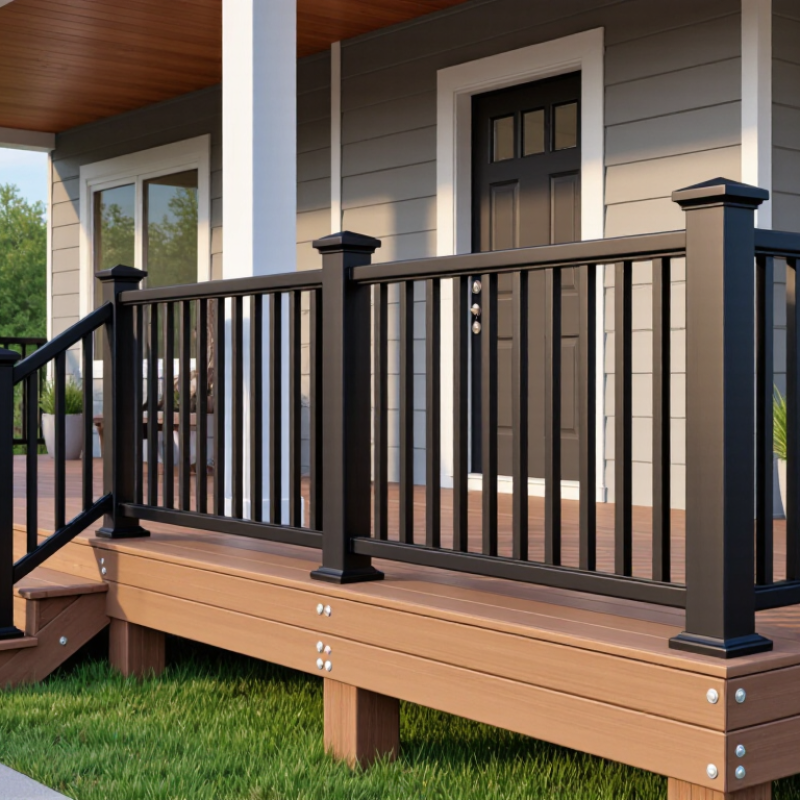
Before comparing aluminum porch railings, decide what the railing must do. Is it mainly a boundary, a steady handhold, or a way to keep children and pets away from an edge? The answer affects rail height, opening size, and where posts belong. If someone will use the rail for support, check that the top rail feels comfortable to grip and that the layout leaves a clear path. Measure twice. A few inches can change how a gate swings or how easily a chair passes.
Then study the porch itself. Measure each straight run, stair angle, and corner; older porches are not always square. Check what the posts will attach to, such as sound framing or a solid masonry surface. Loose boards, cracked concrete, and uneven steps can complicate installation. Small details matter. Note wind exposure, standing water, and salty air, since these conditions can affect finishes and maintenance needs. Take photos of the edges and connection points before planning the layout. A sketch helps, but it can miss a slope or an awkward doorway. Verify applicable local railing and stair requirements before ordering, and confirm the proposed mounting method suits the actual structure. Measurements are easy to rush; that is where I would pause and recheck.
Aluminum grade matters, but it does not tell the whole story. Alloy 6063 is widely used for railing because it extrudes into clean, detailed profiles and accepts finishes well. Alloy 6061 is generally stronger, though its strength alone cannot confirm that a railing is safe. Ask for the alloy specification and engineering details for the full assembly, including posts, fasteners, and connections. A grade number is not a load rating.
Profile shape and wall thickness affect stiffness. Compare rail height, post spacing, and how balusters attach, rather than judging a sample by appearance alone. A broad, hollow rail may feel sturdy yet flex if its walls are thin or supports are too far apart. Looks can mislead. Check the stated span limits and inspect corners and joints; these details often reveal more than a glossy showroom sample.
Protective finishes also deserve close attention. Powder coating provides color and a durable surface when preparation and application are done properly. Anodizing creates a protective oxide layer and a more metallic appearance. Near salt air or frequent moisture, ask about pretreatment, coating thickness, and compatible stainless-steel hardware. Pay attention to cut ends and scratches, where protection may be weaker. I would not choose by color alone; finish quality is difficult to judge from a small swatch, and some maintenance will still be needed.
Before choosing an aluminum porch railing, check the building requirements adopted by your local authority. Rules can differ by location and project, so do not rely on a generic online measurement. Ask the building department whether a permit or inspection is required, and confirm minimum railing height, opening limits, and load expectations. Small details matter. A gap that looks harmless may still be too wide for local rules.
Inspect how the railing attaches to the porch, not just how it looks. Posts should connect securely to sound framing or a suitable structural surface; loose trim is not a reliable anchor. Check that joints feel firm, fasteners resist corrosion, and the top rail offers a steady grip. Measure openings with a tape, especially near stairs, where requirements may differ. Measure twice. Aluminum can resist rust, but poor installation can still lead to movement or failure. It is easy to focus on color and finish; I would treat those as secondary until the safety checks are clear. If the porch is older or its framing is hidden, ask a qualified local professional to assess the attachment before ordering.
| Selection Check | What to Look For | Why It Matters | Code and Verification Notes |
|---|---|---|---|
| Guardrail requirement | Confirm whether the porch’s height above adjacent grade requires a guardrail. | A guard helps reduce the risk of a fall from an elevated porch. | The model IRC generally requires guards at open-sided walking surfaces more than 30 inches above the floor or grade below, measured within 36 inches horizontally. Confirm the locally adopted code and any exceptions. |
| Guard height | Check the proposed rail height against the rules for the porch and building type. | A rail that is too low may not provide the required fall protection. | The model IRC commonly specifies a minimum 36-inch guard height for many residential applications. Other building codes, locations, and situations may require different heights. |
| Opening size | Look for baluster spacing and other openings that meet the applicable opening limits. | Properly sized openings help reduce the risk of a child slipping through or becoming trapped. | The model IRC generally uses a 4-inch sphere test for guard openings, with separate provisions for certain stair openings. Verify the requirements for the specific installation. |
| Stair handrail | If the porch includes stairs, check whether a separate graspable handrail is needed and provided. | A handrail gives people support while ascending or descending stairs. | The model IRC generally places stair handrails 34 to 38 inches above stair nosings. Handrail requirements, measurement details, and exceptions depend on the adopted code. |
| Strength and attachments | Choose a complete railing system with documented structural performance and installation instructions for the intended surface. | Posts, brackets, fasteners, and the porch structure all contribute to the railing’s performance. | Loads and attachment details are governed by the locally adopted building code and site conditions. Check that the porch framing and specified fasteners are suitable; do not rely on appearance alone. |
| Infill and climbability | Review the layout of balusters, panels, and any horizontal members, especially where children may use the porch. | Infill design affects fall protection and may create footholds. | Opening limits and any restrictions on climbable designs vary by code and application. Ask the local building department or a qualified professional to review the layout. |
| Finish and corrosion resistance | Check the finish specification and care instructions for the local climate and exposure, including coastal or de-icing-salt conditions. | Aluminum does not rust like iron or steel, but its finish and connected metals can still be affected by exposure and maintenance. | Follow the system manufacturer’s published cleaning and installation instructions. Use compatible fasteners and fittings, particularly where dissimilar metals or corrosive conditions are present. |
| Stairs, landings, and transitions | Check rail continuity, post locations, stair connections, and changes in level. | Gaps or awkward transitions can make a railing harder to use and may leave areas inadequately protected. | Stair and landing rules can differ from porch guard rules. Confirm the applicable handrail, guard, and termination requirements for each section. |
| Permits and approval | Ask whether a permit, plan review, or inspection is required before work begins. | Early review can identify local requirements before materials are purchased or installed. | Permit rules and adopted code editions vary by jurisdiction. Check with the local building department and retain product specifications and installation records. |
Important: Code figures above are examples from model-code provisions, not a guarantee of local compliance. Requirements can change with the adopted code edition, amendments, building type, and site conditions. Confirm the current rules with your local building department before selecting or installing a railing.
Choose an aluminum porch railing by matching its style to your home and its layout to how you use the space. Slim vertical pickets suit traditional façades and keep the view open; broader panels create a more defined edge. For a narrow porch, a simple straight run can feel less crowded. Corners, steps, and gates need separate planning. Measure each section, including stair angles, before ordering.
Height is a safety decision, not just a design choice. The 2021 International Residential Code, published by the International Code Council, specifies guards at least 36 inches high for many residential walking surfaces more than 30 inches above grade. It also limits openings so a 4-inch sphere cannot pass through. Local adoption and conditions can vary, so confirm requirements with your building department. A tape measure can prevent an expensive mismatch.
Tips: Mark posts and stair transitions with chalk before settling on a configuration. Check that rails won’t block doors or outdoor furniture. Choose a finish suited to your climate, and ask how it should be cleaned. One overlooked corner can spoil an otherwise careful layout.
Typical U.S. code reference heights for porch guards
A 36-inch guard height is a common residential-code reference, while 42 inches is a common reference in other building-code contexts. Requirements vary by location, building type, and porch conditions, so confirm local code before choosing a railing height. Measure from the walking surface to the top of the railing.
A good aluminum porch railing starts with its anchors, not its finish. Surface-mounted posts fasten to the deck surface; fascia-mounted posts attach at the rim joist. Either method can fail if fasteners miss sound framing. Check the manufacturer’s installation details, post spacing, and local requirements before comparing quotes. Ask whether labor includes blocking, flashing, and repair of damaged trim. These details change the real price. A small gap can invite water.
For long-term cost, compare coating quality, hardware, and upkeep—not just the initial estimate. Wash away salt and dirt with mild soap, then inspect joints and fasteners each year. Replace corroded screws promptly; mixed metals can accelerate corrosion. The International Aluminium Institute reports that recycled aluminum uses about 95% less energy than primary aluminum production, a figure also cited by the Aluminum Association in Aluminum: The Element of Sustainability. That is an environmental measure, not a promise of lower household costs. Still, recyclable material and low routine upkeep can strengthen the lifecycle case. Ask for coating documentation and a written warranty, and check what it excludes. One caveat: a cheaper system may cost more if its mounting needs extra reinforcement.
We use cookies on our website to give you an improved browser experience. View our Privacy Policy for more information. Please make your selection to opt in or out of ALL cookies here: Accept or Decline
Do you consent to the use of ALL cookies?
901 2nd Court West
Birmingham, AL 35204
Sales: 866.481.4036
Logistics/Ops: 866.481.4036
2101 Dralle Road
University Park, IL 60466
Sales: 708.813.9070
Logistics/Ops: 708.235.4200
400 E. 13th Street
Little Rock, AR 72114
Sales: 866.760.5344
Logistics/Ops: 866.760.5344
225 Collins Road
Elkhart, IN 46515
Sales: 574.295.0214
Logistics/Ops: 574.607.4611
601 Berryman Pike
Tipton, IN 46072
Sales: 800.897.7591
Logistics/Ops: 800.897.7591
3900 Uvalda Street
Denver, CO 80239
Sales: 303.706.8000
Ops/Logistics: 303.576.8398
510 3rd Street E
Milan, IL 61264
Sales: 800.322.1052
Logistics/Ops: 800.322.1052
1660 E. Aurora
Des Moines, IA 50313
Sales: 800.671.1660
Logistics: 800.671.1660
86554 Gene Lasserre Blvd.
Yulee, FL 32097
Sales: 904.253.3060
Logistics/Ops: 904.225.3000
694 S.E. County Road 245
Lake City, FL 32025
Sales: 800.727.6706
Logistics/Ops: 386.752.7412
210 Neptune Road
Auburndale, FL 33823
Sales: 863.967.1131
Logistics/Ops: 863.777.9814
4601 McCoy Drive
Pensacola, FL 32503
Sales: 850.308.7030
Logistics/Ops: 850.434.5502
815 South 56th Street
Tampa, FL 33619
Sales: 813.302.1940
Logistics/Ops: 813.621.1352
200 Hosea Road
Lawrenceville, GA 30046
Sales: 770.953.7575
Logistics/Ops: 770.513.6000
Branch Product Guide
Branch Line Card
Moulding Offering
Cedar Offering
Column Offering
8173 Hwy. 165 North
Monroe, LA 71211
Sales: 800.256.4165
Logistics/Ops: 800.256.4165
508 Warren Avenue
Portland, ME 04103
Sales: 207.888.2331
Logistics/Ops: 207.797.6565
4300 Georgia Pacific Blvd.
Frederick, MD 21704
Sales: 301.798.7474
Logistics/Ops: 301.874.8000
419 Maple Street
Bellingham, MA 02019
Sales: 508.449.0535
Logistics/Ops: 508.966.5500
825 Buchanan Ave SW
Grand Rapids, MI 49507
Sales: 877.800.1180
Logistics/Ops: 616.278.0909
995 Pacific St. NW
Aitkin, MN 56431
Sales: 800.432.3727
Logistics/Ops: 218.212.7770
1102 Port Terminal Drive
Duluth, MN 55802
Sales: 800.951.9899
Logistics/Ops: 800.851.9899
9110 83rd Ave. North
Brooklyn Park, MN 55445
Sales: 763.425.0204
Logistics/Ops: 763.425.0204
910 E. Railroad Street
Long Beach, MS 39560
Sales: 866.535.4135
Logistics/Ops: 228.205.2400
1727 Warren Street
North Kansas City, MO 64116
Sales: 800.621.2611
Logistics/Ops: 800.621.2611
2123 North Golden
Springfield, MO 65803
Sales: 800.375.7891
Logistics/Ops: 800.375.7891
13860 Corp. Woods Trail
Bridgeton, MO 63044
Sales: 314.209.0800
Logistics/Ops: 314.209.0800
1109 South 19th Street
Omaha, NE 68108
Sales: 800.489.6637
Logistics/Ops: 800.489.6637
1 Luger Road
Denville, NJ 07834
Sales: 973-339-3539
Logistics/Ops: 973.625.1461
3720 Jeffrey Blvd.
Blasdell, NY 14219
Sales: 716.235.5989
Logistics/Ops: 716.825.6557
319 Yaphank Ave.
Yaphank, NY 11980
Sales: 631.358.5714
Logistics/Ops: 631.924.7401
3300 Parkside Drive
Charlotte, NC 28208
Sales: 800.839.2588
Logistics/Ops: 704.394.3172
1712 East D Street
Butner, NC 27509
Sales: 984.389.8200
Logistics/Ops: 919.575.3700
128 Foothills Drive
Statesville, NC 28687
Sales: 800.222.1414
Logistics/Ops: 704.394.3172
550 Munroe Falls Rd.
Tallmadge, OH 44278
Sales: 330.357.4506
Logistics/Ops: 330.794.1141
10347 Toebben Dr.
Independence, KY 41051
Sales: 859.298.3926
Logistics/Ops: 859.746.2250
450 N. MacArthur
Oklahoma City, OK 73127
Sales: 800.375.6025
Logistics/Ops: 800.375.6025
1680 North Aspen
Broken Arrow, OK 74012
Sales: 918.272.2212
Logistics/Ops: 918.272.2212
522 Bridge Street
Hunker, PA 15639
Sales: 878.217.2001
Logistics/Ops: 724.925.7285
4290 Atlanta Street
Charleston, SC 29418
Sales: 843.371.1420
Logistics/Ops: 843.554.8192
1040 S. Industrial Dr.
Erwin, TN 37650
Sales: 423.641.1005
Logistics/Ops: 423.742.5911
4287 Pilot Drive
Memphis, TN 38118
Sales: 901.365.2101
Logistics/Ops: 901.365.2101
700 Myatt Drive
Madison, TN 37115
Sales: 615.327.9547
Logistics/Ops: 629.777.4949
4747 Mark IV Parkway
Fort Worth, TX 76106
Sales: 866.323.5117
Logistics/Ops: 817.625.9091
6990 Market Avenue
El Paso, TX 79915
Sales: 915.778.6356
Logistics/Ops: 915.265.7200
2502 Wilson Road
Harlingen, TX 78552
Sales: 800.580.6711
Logistics/Ops: 800.580.6711
10,000 North Loop East
Houston, TX 77029
Sales: 713.921.1977
Logistics/Ops: 713.675.3544
702 East 44th St.
Lubbock, TX 79404
Sales: 866.454.6010
Logistics/Ops: 866.454.6010
535 N. WW White Road
San Antonio, TX 78219
Sales: 800.284.0488
Logistics/Ops: 210.333.8112
142 Pine Haven Shores Rd.
Shelburne, VT 05482
Sales: 802.800.2540
Logistics/Ops: 802.985.2512
4700 Bethlehem Road,
Richmond, VA 23230
Sales: 804.201.2400
Logistics/Ops: 804.342.1161
4516 N Barker Road
Spokane Valley, WA 99027
Phone: 509.892.9420
Toll free: 800.728.6157
8365 N. 76th Street
Milwaukee, WI 53223
Sales: 800.356.9245
Logistics/Ops: 800.356.9245
312 S. Chester Street
Sparta, WI 54656
Sales: 800.362.5864
Logistics/Ops: 800.362.5864
899 Grossman Drive
Schofield, WI 54476
Sales: 800.472.0017
Logistics/Ops: 800.472.0017
