
We use cookies on our website to give you an improved browser experience. View our Privacy Policy for more information. Please make your selection to opt in or out of ALL cookies here: Accept or Decline
Choosing carbon fiber is not a search for the “strongest” option. It is a match between material properties and the job. A lightweight drone arm, a bicycle frame, and a heated industrial panel face different loads and conditions. The right grade depends on stiffness, strength, weight, temperature, and how the fiber will be processed. Small details matter. A tight weave may look premium, but it does not automatically make a part stronger.
Composite-materials researcher Dr. Deborah D. Chung’s work offers a useful selection principle, paraphrased here: “Match the reinforcement to the load path, not the marketing label.” That means checking fiber grade, tow size, weave, resin compatibility, and the supplier’s technical data. For a real comparison, review the intended loads and manufacturing method, then verify performance with test results where possible. Ask how the material handles impact, moisture, and repeated stress. And compare total part cost, not just the price of a roll. There is no perfect choice. Even experienced buyers can overvalue a familiar specification or overlook a processing constraint. Start with the application, check the evidence, and leave room to revise your decision when prototype results disagree. Sometimes they will.
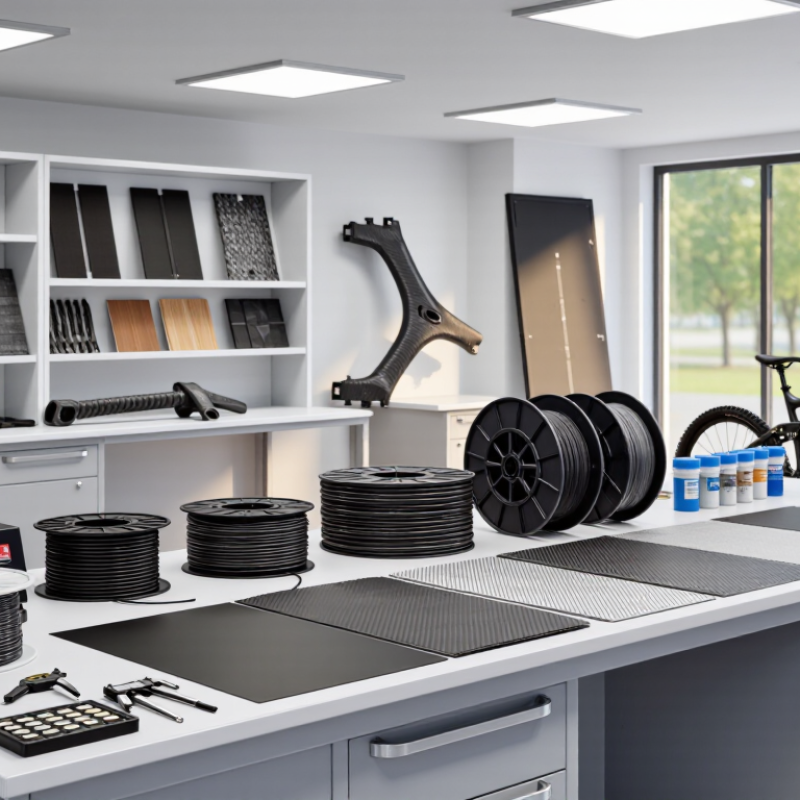
Carbon fiber is not one material with one performance level. Standard-modulus fibers suit many stiff, weight-sensitive parts; intermediate- and high-modulus grades resist bending more strongly but can be less tolerant of impact. Commercial technical data commonly show tensile strengths around 3–7 GPa and moduli from roughly 230 GPa to above 500 GPa, depending on grade. These are fiber-level figures, not guaranteed part performance. A useful distinction.
Oak Ridge National Laboratory materials assessments place carbon-fiber density near 1.8 g/cm³, compared with about 2.7 g/cm³ for aluminum. That helps explain its appeal in lightweight structures, but resin, fiber direction, and layup change the finished component’s behavior. A thin unidirectional strip feels stiff along its fibers and far less so across them. ASTM D4018 specifies testing for carbon-fiber tow properties; a tow result alone cannot predict a finished laminate. Check the actual datasheet for strength, modulus, strain, and test conditions, then match those values to the load and environment. I would also question any choice based on maximum stiffness alone: a dropped tool or a drilled hole can expose weaknesses that a headline modulus misses.
| Fiber family / grade | Typical tensile modulus | Typical tensile strength | Typical density | Key characteristics | Often considered for |
|---|---|---|---|---|---|
| Standard-modulus PAN-based | Approximately 230–250 GPa | Approximately 3.5–5.0 GPa | Approximately 1.75–1.82 g/cm³ | A widely used balance of stiffness, strength, damage tolerance, and cost. PAN refers to the polyacrylonitrile precursor commonly used to make structural carbon fiber. | General-purpose composite parts, sporting goods, automotive components, and structures where a balanced property set is preferred. |
| Intermediate-modulus PAN-based | Approximately 280–320 GPa | Approximately 4.0–6.0 GPa | Approximately 1.78–1.84 g/cm³ | Higher axial stiffness than standard-modulus fiber while retaining useful tensile strength. Actual strength and strain-to-failure vary by specific fiber grade and processing. | Stiff, lightweight structural components and applications where deflection control matters. |
| High-modulus PAN-based | Approximately 350–450 GPa | Approximately 3.0–5.0 GPa | Approximately 1.80–1.90 g/cm³ | High stiffness along the fiber direction. Greater modulus does not automatically mean greater tensile strength; these fibers can have lower strain-to-failure and require careful design. | Precision structures, aerospace components, and parts that need high stiffness with low mass. |
| High- or ultra-high-modulus pitch-based | Often approximately 400–900+ GPa, depending on grade | Highly grade-dependent; often approximately 2.0–4.0 GPa | Approximately 1.90–2.20 g/cm³ | Pitch-based fibers can achieve exceptionally high axial modulus and, in some grades, high thermal conductivity. They are generally more specialized and can be more brittle or less tolerant of handling damage. | High-stiffness components, thermal-management structures, and applications requiring high thermal conductivity along the fiber direction. |
| Woven carbon-fiber fabric | Depends on the fiber grade and weave; properties are lower at laminate level than straight-fiber values | Depends on fiber grade, weave, resin, and laminate design | Finished composite density depends on fiber, resin, and fiber volume fraction | Weave improves handling and provides fibers in multiple directions, but crimp in the yarns can reduce stiffness and strength compared with straight, aligned fibers. | Panels and shaped parts where handling, drape, and multidirectional reinforcement are useful. |
| Unidirectional carbon-fiber reinforcement | Depends on the fiber grade; highest laminate stiffness is generally along the aligned fiber direction | Depends on fiber grade, resin, fiber volume fraction, and loading direction | Finished composite density depends on the full laminate system | Fibers are aligned mainly in one direction, giving efficient directional strength and stiffness. Additional plies may be needed to support loads in other directions. | Engineered structures with known load paths, such as beams, spars, and selectively reinforced panels. |
Selection note: Values are indicative ranges for comparison, not guaranteed design allowables. Modulus-grade labels are not applied identically by every producer, and measured properties depend on fiber grade, test method, temperature, and processing. For a finished composite, check laminate-level data for the selected resin, fiber orientation, layup, and manufacturing process.
Start with the part’s real job, not a carbon-fiber grade on a chart. A bicycle frame tube needs stiffness under repeated pedaling loads. A camera support may need low weight and resistance to vibration. A panel near heat or moisture also needs a suitable resin system. Record the load direction, expected impacts, operating temperature, and available space. Small details matter.
Translate those conditions into measurable targets, such as maximum deflection, part weight, and service life. High stiffness may call for fibers aligned with the main load, while multidirectional loads may require a balanced layup. Impact resistance can depend on the fabric architecture, resin, and part thickness. Review technical data under relevant test conditions; numbers from different methods may not compare directly. More fiber is not automatically better.
Manufacturing limits belong in the decision too. A complex curve may be difficult to lay up without wrinkles, and those defects can weaken a part. Ask how the material will be formed, cured, inspected, and repaired. If possible, test small coupons made with the intended process. Then test a prototype under realistic loads. Lab data helps, but actual parts can behave differently. I would not treat one successful test as proof of long-term performance.
Choosing carbon fiber means comparing the finished part, not just the fiber label. Strength describes how much load it can تحمل before failure; stiffness describes how much it bends under load. A stiff panel may still crack under a sharp impact. Fiber direction matters: unidirectional layers resist loads along their length, while woven layers handle varied directions more evenly. Feel the difference.
Weight depends on the full construction. Resin content, layer count, and any foam or honeycomb core can change a part’s mass substantially. For a bicycle component, for example, a lighter layup may reduce weight but offer less resistance to knocks. Ask for the finished part’s weight and test data, not only a fiber specification. Numbers need context.
Durability also depends on use. Repeated flexing, edge impacts, heat, moisture, and sunlight can affect the resin and laminate over time. A protective coating may help with surface wear, but it cannot fix poor construction. Think about where the part will be used and how it will be inspected. Honestly, comparing products can feel messy when test methods differ; even a promising datasheet may not predict real-world damage. Request details on load direction, impact testing, and service conditions before choosing.
Compare representative tensile strength and stiffness. Values are illustrative of common fiber modulus classes, not guaranteed specifications; actual properties vary by grade and test method.
How to read this: Higher modulus means greater stiffness, while higher tensile strength means greater resistance to pulling loads. Fiber density is broadly similar across these classes (roughly 1.7–1.9 g/cm³), so choosing a higher-modulus fiber does not automatically reduce material weight. Composite durability also depends heavily on the resin, layup, impact protection, and exposure to moisture and UV.
Choosing carbon fiber means matching its form to the loads, shape, and production method—not just picking the stiffest grade. Unidirectional tape places most strength along one axis, making it useful for beams or panels with a clear load path. Woven fabric handles more complex shapes and resists splitting across directions, though its crimp can reduce stiffness slightly. Chopped fiber suits molded parts with curves and ribs, but usually offers less directional strength. Small details matter.
The manufacturing method changes what is practical. Prepreg provides controlled resin content and consistent results, but needs careful storage, temperature control, and suitable curing equipment. Resin infusion can form larger parts from dry fabric, though resin flow and trapped air need close attention. Pultrusion works well for long, constant-section profiles, not for every shape. A datasheet helps, but it cannot show how easily a fabric will drape around a tight corner or how a process will behave in your tooling. Make a small trial part and inspect its finish, thickness, and fit. I would not treat the first sample as proof; it may reveal questions the specification missed.
How to Choose the Best Carbon Fiber for Your Needs?
Check Quality, Compatibility, Availability, and Cost
Start with the job the part must do, then compare material data rather than relying on labels like “high strength.” Check the fiber grade, weave, resin system, and published test conditions. A datasheet should identify key properties and, where available, batch traceability. Consistent fiber alignment and resin distribution matter; visible wrinkles or dry patches can signal problems, though appearance alone cannot confirm quality. Ask how samples were tested. Details matter.
Compatibility is easy to overlook. Confirm that the resin and fiber suit your curing temperature, production method, and expected exposure to heat or moisture. If the part contacts metal, consider electrical conductivity and corrosion risks at the interface. A material that performs well in a test coupon may behave differently in a finished shape. Test representative parts when the consequences of failure are significant.
Availability and cost affect the real choice. Ask suppliers about lead times, stock formats, minimum orders, and whether future batches are likely to match. A low price per sheet can be misleading once cutting waste, tooling, inspection, and labor are included. Compare the total cost of usable parts, not just raw material. The cheapest option may still be right for a simple, low-load component. It is not always obvious.
We use cookies on our website to give you an improved browser experience. View our Privacy Policy for more information. Please make your selection to opt in or out of ALL cookies here: Accept or Decline
Do you consent to the use of ALL cookies?
901 2nd Court West
Birmingham, AL 35204
Sales: 866.481.4036
Logistics/Ops: 866.481.4036
2101 Dralle Road
University Park, IL 60466
Sales: 708.813.9070
Logistics/Ops: 708.235.4200
400 E. 13th Street
Little Rock, AR 72114
Sales: 866.760.5344
Logistics/Ops: 866.760.5344
225 Collins Road
Elkhart, IN 46515
Sales: 574.295.0214
Logistics/Ops: 574.607.4611
601 Berryman Pike
Tipton, IN 46072
Sales: 800.897.7591
Logistics/Ops: 800.897.7591
3900 Uvalda Street
Denver, CO 80239
Sales: 303.706.8000
Ops/Logistics: 303.576.8398
510 3rd Street E
Milan, IL 61264
Sales: 800.322.1052
Logistics/Ops: 800.322.1052
1660 E. Aurora
Des Moines, IA 50313
Sales: 800.671.1660
Logistics: 800.671.1660
86554 Gene Lasserre Blvd.
Yulee, FL 32097
Sales: 904.253.3060
Logistics/Ops: 904.225.3000
694 S.E. County Road 245
Lake City, FL 32025
Sales: 800.727.6706
Logistics/Ops: 386.752.7412
210 Neptune Road
Auburndale, FL 33823
Sales: 863.967.1131
Logistics/Ops: 863.777.9814
4601 McCoy Drive
Pensacola, FL 32503
Sales: 850.308.7030
Logistics/Ops: 850.434.5502
815 South 56th Street
Tampa, FL 33619
Sales: 813.302.1940
Logistics/Ops: 813.621.1352
200 Hosea Road
Lawrenceville, GA 30046
Sales: 770.953.7575
Logistics/Ops: 770.513.6000
Branch Product Guide
Branch Line Card
Moulding Offering
Cedar Offering
Column Offering
8173 Hwy. 165 North
Monroe, LA 71211
Sales: 800.256.4165
Logistics/Ops: 800.256.4165
508 Warren Avenue
Portland, ME 04103
Sales: 207.888.2331
Logistics/Ops: 207.797.6565
4300 Georgia Pacific Blvd.
Frederick, MD 21704
Sales: 301.798.7474
Logistics/Ops: 301.874.8000
419 Maple Street
Bellingham, MA 02019
Sales: 508.449.0535
Logistics/Ops: 508.966.5500
825 Buchanan Ave SW
Grand Rapids, MI 49507
Sales: 877.800.1180
Logistics/Ops: 616.278.0909
995 Pacific St. NW
Aitkin, MN 56431
Sales: 800.432.3727
Logistics/Ops: 218.212.7770
1102 Port Terminal Drive
Duluth, MN 55802
Sales: 800.951.9899
Logistics/Ops: 800.851.9899
9110 83rd Ave. North
Brooklyn Park, MN 55445
Sales: 763.425.0204
Logistics/Ops: 763.425.0204
910 E. Railroad Street
Long Beach, MS 39560
Sales: 866.535.4135
Logistics/Ops: 228.205.2400
1727 Warren Street
North Kansas City, MO 64116
Sales: 800.621.2611
Logistics/Ops: 800.621.2611
2123 North Golden
Springfield, MO 65803
Sales: 800.375.7891
Logistics/Ops: 800.375.7891
13860 Corp. Woods Trail
Bridgeton, MO 63044
Sales: 314.209.0800
Logistics/Ops: 314.209.0800
1109 South 19th Street
Omaha, NE 68108
Sales: 800.489.6637
Logistics/Ops: 800.489.6637
1 Luger Road
Denville, NJ 07834
Sales: 973-339-3539
Logistics/Ops: 973.625.1461
3720 Jeffrey Blvd.
Blasdell, NY 14219
Sales: 716.235.5989
Logistics/Ops: 716.825.6557
319 Yaphank Ave.
Yaphank, NY 11980
Sales: 631.358.5714
Logistics/Ops: 631.924.7401
3300 Parkside Drive
Charlotte, NC 28208
Sales: 800.839.2588
Logistics/Ops: 704.394.3172
1712 East D Street
Butner, NC 27509
Sales: 984.389.8200
Logistics/Ops: 919.575.3700
128 Foothills Drive
Statesville, NC 28687
Sales: 800.222.1414
Logistics/Ops: 704.394.3172
550 Munroe Falls Rd.
Tallmadge, OH 44278
Sales: 330.357.4506
Logistics/Ops: 330.794.1141
10347 Toebben Dr.
Independence, KY 41051
Sales: 859.298.3926
Logistics/Ops: 859.746.2250
450 N. MacArthur
Oklahoma City, OK 73127
Sales: 800.375.6025
Logistics/Ops: 800.375.6025
1680 North Aspen
Broken Arrow, OK 74012
Sales: 918.272.2212
Logistics/Ops: 918.272.2212
522 Bridge Street
Hunker, PA 15639
Sales: 878.217.2001
Logistics/Ops: 724.925.7285
4290 Atlanta Street
Charleston, SC 29418
Sales: 843.371.1420
Logistics/Ops: 843.554.8192
1040 S. Industrial Dr.
Erwin, TN 37650
Sales: 423.641.1005
Logistics/Ops: 423.742.5911
4287 Pilot Drive
Memphis, TN 38118
Sales: 901.365.2101
Logistics/Ops: 901.365.2101
700 Myatt Drive
Madison, TN 37115
Sales: 615.327.9547
Logistics/Ops: 629.777.4949
4747 Mark IV Parkway
Fort Worth, TX 76106
Sales: 866.323.5117
Logistics/Ops: 817.625.9091
6990 Market Avenue
El Paso, TX 79915
Sales: 915.778.6356
Logistics/Ops: 915.265.7200
2502 Wilson Road
Harlingen, TX 78552
Sales: 800.580.6711
Logistics/Ops: 800.580.6711
10,000 North Loop East
Houston, TX 77029
Sales: 713.921.1977
Logistics/Ops: 713.675.3544
702 East 44th St.
Lubbock, TX 79404
Sales: 866.454.6010
Logistics/Ops: 866.454.6010
535 N. WW White Road
San Antonio, TX 78219
Sales: 800.284.0488
Logistics/Ops: 210.333.8112
142 Pine Haven Shores Rd.
Shelburne, VT 05482
Sales: 802.800.2540
Logistics/Ops: 802.985.2512
4700 Bethlehem Road,
Richmond, VA 23230
Sales: 804.201.2400
Logistics/Ops: 804.342.1161
4516 N Barker Road
Spokane Valley, WA 99027
Phone: 509.892.9420
Toll free: 800.728.6157
8365 N. 76th Street
Milwaukee, WI 53223
Sales: 800.356.9245
Logistics/Ops: 800.356.9245
312 S. Chester Street
Sparta, WI 54656
Sales: 800.362.5864
Logistics/Ops: 800.362.5864
899 Grossman Drive
Schofield, WI 54476
Sales: 800.472.0017
Logistics/Ops: 800.472.0017
