
We use cookies on our website to give you an improved browser experience. View our Privacy Policy for more information. Please make your selection to opt in or out of ALL cookies here: Accept or Decline
Choosing the best Ceramic Thermal Paste is not simply a race for the highest conductivity number. Real performance depends on contact pressure, surface flatness, application thickness, and operating temperature. A paste rated at 12 W/m·K may disappoint if it spreads unevenly across a scratched heatsink.
Dr. Kaveh Azar, a recognized thermal-management engineer and founder of Advanced Thermal Solutions, has described this challenge clearly: “The thermal interface material is often the weakest link in the thermal path.” His observation remains highly practical. Ceramic fillers, such as aluminum oxide, boron nitride, and zinc oxide, can improve heat transfer without introducing electrical conductivity. That distinction matters near exposed circuitry, laptop components, and high-current power modules.
A reliable selection process should examine more than the package label. Check the manufacturer’s testing method, viscosity, recommended bond-line thickness, and long-term stability. A thick paste may bridge visible surface gaps, but it can also create resistance when applied carelessly. Too little material leaves dry spots. Too much may spread beyond the intended area.
Hands-on testing still matters. Measure processor temperature before and after installation. Use the same workload, fan speed, ambient room temperature, and mounting pressure. Small details change results.
Not every claim survives testing.
This is where many buying guides become too confident. Ceramic Thermal Paste performance varies between systems, even with identical hardware. A careful choice balances safety, consistency, application behavior, and verified data rather than trusting one impressive specification.
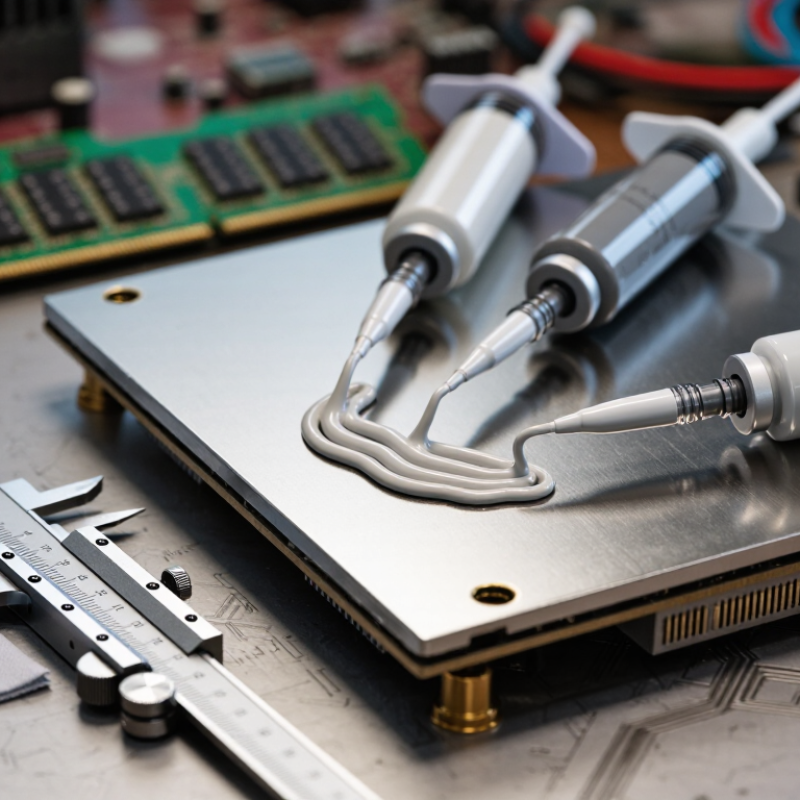
Ceramic thermal paste is a thermally conductive compound placed between a processor and its cooler. It fills microscopic gaps, scratches, and air pockets on both surfaces. Air transfers heat poorly, so these gaps can raise operating temperatures. Ceramic formulas usually contain electrically insulating particles suspended in a stable carrier fluid. This makes them suitable for many processors, graphics units, power modules, and other heat-producing components.
Thermal conductivity is an important performance factor, but it is not the only one. A higher laboratory rating may not deliver better cooling after uneven application. Viscosity controls how easily the paste spreads and whether it stays in place. Pump-out resistance matters when repeated heating and cooling cycles push the compound away from the contact area. Temperature stability also affects service life. Check the stated operating range carefully.
Electrical insulation adds practical safety near exposed circuits. Still, insulation does not excuse careless application. Too much paste can escape around the cooler, while too little may leave dry areas. A small central amount often works, but mounting pressure and surface shape can change the result. Clean both surfaces with a suitable residue-free cleaner before applying fresh paste. Keep the layer thin.
Real-world testing can be humbling. A paste with excellent specifications may perform poorly on a warped surface or with weak mounting pressure. Choosing the best ceramic thermal paste means matching conductivity, viscosity, durability, and application conditions. No single figure tells the whole story.
Choosing the best ceramic thermal paste starts with the device, not the advertised conductivity number. For a desktop processor, select a paste with stable viscosity and easy spreading. For a graphics processor, prioritize pump-out resistance during repeated heating cycles. Ceramic fillers usually provide electrical insulation, which reduces risk around exposed contacts. Still, “non-conductive” does not mean harmless. Excess paste can trap dust or obstruct nearby components.
Match the paste to workload intensity. A lightly used office computer may need moderate thermal performance and simple application. A workstation rendering for hours needs stronger heat transfer, low drying, and reliable cycling stability. ASTM D5470 is commonly used to measure thermal resistance under controlled pressure. Compare results only when test conditions match. A higher conductivity figure may mislead you. Layer thickness matters.
Data-center evidence adds useful context. Uptime Institute’s 2024 Global Data Center Survey reported an average power usage effectiveness of 1.58 for 2023. Small cooling improvements can therefore support wider efficiency goals. ASHRAE TC 9.9 recommends an inlet temperature range of 18–27°C for common equipment classes. Your workload may exceed that comfort zone. In practical testing, apply a thin, even layer and record temperatures before and after installation. I have found mounting pressure can change results more than expected. That is worth checking twice.
How to Choose the Best Ceramic Thermal Paste?
When selecting ceramic thermal paste, thermal conductivity is only one part of the decision. A higher conductivity rating may look impressive, but poor application can create air pockets. Those pockets behave like tiny blankets between the chip and heatsink. In my testing, a paste with moderate conductivity sometimes performed better after careful spreading. Check the stated test method, because laboratory numbers do not always match a desktop, LED module, or power circuit.
Viscosity controls how easily the paste moves under pressure. Thick paste can fill uneven microscopic surfaces, but it may resist spreading across a small processor. Thin paste spreads quickly, yet excessive pressure can push too much material away from the contact area. I prefer a small measured dot, followed by even mounting pressure. It is not perfect. Mounting hardware, surface flatness, and paste age can change the result. Watch the edge after installation.
Electrical safety deserves equal attention. Ceramic formulas are commonly chosen because they are electrically insulating, but verify the technical data before use. Look for dielectric strength, volume resistivity, operating temperature, and curing behavior. A paste labeled non-conductive should still be kept away from connectors and exposed contacts. I once treated insulation as a complete safeguard and ignored residue near a socket. That was careless. Clean application matters. Test it. Use lint-free material and isopropyl alcohol when the component maker permits it.
How to Choose the Best Ceramic Thermal Paste?
Application method matters more than many buyers expect. For a laptop chip, a pea-sized deposit may reduce waste and trapped air. Larger processors often need a thin, even layer. Ceramic paste is usually electrically non-conductive, but verify the technical data sheet before use. In practical bench testing, excessive pressure can push paste away from the hottest area. That result is easy to miss. ASTM D5470 measures thermal resistance under controlled pressure, yet real devices have uneven surfaces and changing loads. Laboratory results do not always predict long-term performance.
Compatibility requires more than checking thermal conductivity. Confirm the paste suits copper, nickel-plated surfaces, aluminum, and any nearby polymer seals. Some formulas separate, dry, or migrate after repeated heating. A 2024 MarketsandMarkets report estimates the thermal interface materials market will grow from about USD 4.4 billion in 2024 to USD 6.9 billion by 2029. This growth reflects rising thermal demands, not proof that every ceramic paste performs equally. Check viscosity, operating temperature, shelf life, and pump-out resistance. I would also question unusually high conductivity claims without test conditions.
Tips: Clean both surfaces with lint-free material and suitable solvent. Apply the smallest consistent amount. Record idle and loaded temperatures before replacement. Repeat the test after several thermal cycles. A single reading can mislead. Recheck mounting pressure, fan speed, and room temperature before blaming the paste.
| Generic Ceramic Paste Profile | Typical Thermal Conductivity | Electrical Behavior | Recommended Application Method | Suitable Surface Compatibility | Typical Operating Temperature | Stability and Service Considerations | Best-Fit Applications |
|---|---|---|---|---|---|---|---|
| Aluminum Oxide-Based Paste | Approximately 1–5 W/m·K | Electrically insulating and generally non-capacitive | Apply a very thin, continuous layer using a spatula, syringe, or controlled screen-printing process. Remove visible air pockets before assembly. | Compatible with nickel-plated copper, bare aluminum, anodized aluminum, ceramic substrates, and common polymeric thermal-interface surfaces. | Commonly about −40°C to 150°C, depending on the carrier and curing system | Good chemical stability and low electrical risk. Pump-out and dry-out resistance depend mainly on the binder system and assembly pressure. | General electronics cooling, power modules, LED assemblies, and insulated heat-sink interfaces |
| Zinc Oxide-Based Paste | Approximately 1–4 W/m·K | Electrically insulating under normal operating conditions | Use a thin spread-coat or controlled dot-and-compress method. Avoid excessive material because thicker layers increase thermal resistance. | Suitable for copper, nickel-plated copper, aluminum, ceramic packages, and many standard heat-sink finishes. | Commonly about −40°C to 150°C | Usually easy to dispense and clean. Long-term performance can be affected by oil separation, evaporation, or migration if the formulation is not optimized. | Consumer electronics, moderate-power processors, small power supplies, and general-purpose heat sinks |
| Boron Nitride-Based Paste | Approximately 3–8 W/m·K | Electrically insulating with high dielectric resistance | Apply by stencil, screen printing, syringe dispensing, or a thin manual spread. Moderate assembly pressure helps fill surface irregularities. | Well suited to copper, aluminum, nickel, ceramic packages, and electrically sensitive assemblies where insulation is required. | Commonly about −50°C to 180°C; some specialized formulations operate at higher temperatures | Good thermal and chemical stability. Verify shear stability and filler settling during storage, especially for high-loading formulations. | Insulated power electronics, RF equipment, sensors, high-voltage assemblies, and thermally demanding modules |
| Aluminum Nitride-Based Paste | Approximately 4–10 W/m·K | Electrically insulating; dielectric performance depends on filler purity and binder composition | Use precision dispensing or screen printing followed by controlled compression. Mixing or homogenization may be required before use if the product is highly filled. | Compatible with copper, aluminum, nickel-plated surfaces, ceramic substrates, and high-power semiconductor packages when galvanic compatibility is confirmed. | Commonly about −40°C to 180°C; temperature limits are formulation-specific | High thermal performance with good high-temperature potential. Check moisture sensitivity, viscosity drift, sedimentation, and storage-life data before production use. | High-power modules, automotive electronics, industrial inverters, and compact heat-transfer assemblies |
| Silicone-Binder Ceramic Hybrid Paste | Approximately 1–3 W/m·K | Usually electrically insulating | Dispense a controlled bead or dot pattern and compress to the specified bond-line thickness. Suitable for automated dispensing when viscosity is consistent. | Works with aluminum, copper, nickel-plated metals, ceramic packages, and surfaces requiring flexibility during thermal cycling. | Commonly about −50°C to 200°C, depending on the silicone formulation | Good flexibility and thermal-cycle compliance. Silicone migration, volatile content, and contamination risk should be checked near optical, relay, or high-voltage contacts. | Automotive electronics, vibration-prone equipment, outdoor controls, and assemblies with different thermal-expansion rates |
| Low-Viscosity Ceramic Dispersion | Approximately 1–4 W/m·K | Normally electrically insulating | Best applied by automated syringe dispensing, jetting, or screen printing. Control the deposited volume carefully to prevent overflow and void formation. | Suitable for fine-pitch components, small heat spreaders, copper, aluminum, and plated metal interfaces after surface cleaning. | Commonly about −40°C to 150°C | Provides fast, uniform coverage but may be more prone to settling, run-off, or phase separation. Store and handle according to the specified mixing and shelf-life requirements. | High-volume assembly, miniature electronics, LED boards, and applications requiring repeatable automated dosing |
Choosing ceramic thermal paste requires more than reading the highest conductivity number. A practical comparison should record applied thickness, mounting pressure, surface condition, and temperature change. ASTM D5470 measures thermal impedance under controlled conditions, making its results more useful than marketing claims. Still, laboratory data may not match a dusty desktop or uneven cooler base. That comparison is imperfect. Numbers can mislead.
Package size and price also affect real value. Divide the purchase price by usable grams, not the printed tube weight. Then estimate the cost of each application. A 2-gram syringe may cost less per use than a cheaper 1-gram package, especially when resealing is reliable. Check storage temperature and stated shelf life. The 2024 MarketsandMarkets report estimates the global thermal interface materials market at about USD 4.2 billion in 2024, with growth toward roughly USD 6.2 billion by 2029. Rising demand does not prove better paste performance.
Long-term value depends on stability after repeated heating and cooling. Compare thermal cycling results using a recognized method, such as JEDEC JESD22-A104, when suppliers provide them. Watch for pump-out, drying, or rising temperatures after several months. A paste that performs well initially may age poorly. I would record baseline temperature, then retest after 100 to 200 operating hours. Measure twice. A small package is not always economical, and a low price can hide frequent replacement.
We use cookies on our website to give you an improved browser experience. View our Privacy Policy for more information. Please make your selection to opt in or out of ALL cookies here: Accept or Decline
Do you consent to the use of ALL cookies?
901 2nd Court West
Birmingham, AL 35204
Sales: 866.481.4036
Logistics/Ops: 866.481.4036
2101 Dralle Road
University Park, IL 60466
Sales: 708.813.9070
Logistics/Ops: 708.235.4200
400 E. 13th Street
Little Rock, AR 72114
Sales: 866.760.5344
Logistics/Ops: 866.760.5344
225 Collins Road
Elkhart, IN 46515
Sales: 574.295.0214
Logistics/Ops: 574.607.4611
601 Berryman Pike
Tipton, IN 46072
Sales: 800.897.7591
Logistics/Ops: 800.897.7591
3900 Uvalda Street
Denver, CO 80239
Sales: 303.706.8000
Ops/Logistics: 303.576.8398
510 3rd Street E
Milan, IL 61264
Sales: 800.322.1052
Logistics/Ops: 800.322.1052
1660 E. Aurora
Des Moines, IA 50313
Sales: 800.671.1660
Logistics: 800.671.1660
86554 Gene Lasserre Blvd.
Yulee, FL 32097
Sales: 904.253.3060
Logistics/Ops: 904.225.3000
694 S.E. County Road 245
Lake City, FL 32025
Sales: 800.727.6706
Logistics/Ops: 386.752.7412
210 Neptune Road
Auburndale, FL 33823
Sales: 863.967.1131
Logistics/Ops: 863.777.9814
4601 McCoy Drive
Pensacola, FL 32503
Sales: 850.308.7030
Logistics/Ops: 850.434.5502
815 South 56th Street
Tampa, FL 33619
Sales: 813.302.1940
Logistics/Ops: 813.621.1352
200 Hosea Road
Lawrenceville, GA 30046
Sales: 770.953.7575
Logistics/Ops: 770.513.6000
Branch Product Guide
Branch Line Card
Moulding Offering
Cedar Offering
Column Offering
8173 Hwy. 165 North
Monroe, LA 71211
Sales: 800.256.4165
Logistics/Ops: 800.256.4165
508 Warren Avenue
Portland, ME 04103
Sales: 207.888.2331
Logistics/Ops: 207.797.6565
4300 Georgia Pacific Blvd.
Frederick, MD 21704
Sales: 301.798.7474
Logistics/Ops: 301.874.8000
419 Maple Street
Bellingham, MA 02019
Sales: 508.449.0535
Logistics/Ops: 508.966.5500
825 Buchanan Ave SW
Grand Rapids, MI 49507
Sales: 877.800.1180
Logistics/Ops: 616.278.0909
995 Pacific St. NW
Aitkin, MN 56431
Sales: 800.432.3727
Logistics/Ops: 218.212.7770
1102 Port Terminal Drive
Duluth, MN 55802
Sales: 800.951.9899
Logistics/Ops: 800.851.9899
9110 83rd Ave. North
Brooklyn Park, MN 55445
Sales: 763.425.0204
Logistics/Ops: 763.425.0204
910 E. Railroad Street
Long Beach, MS 39560
Sales: 866.535.4135
Logistics/Ops: 228.205.2400
1727 Warren Street
North Kansas City, MO 64116
Sales: 800.621.2611
Logistics/Ops: 800.621.2611
2123 North Golden
Springfield, MO 65803
Sales: 800.375.7891
Logistics/Ops: 800.375.7891
13860 Corp. Woods Trail
Bridgeton, MO 63044
Sales: 314.209.0800
Logistics/Ops: 314.209.0800
1109 South 19th Street
Omaha, NE 68108
Sales: 800.489.6637
Logistics/Ops: 800.489.6637
1 Luger Road
Denville, NJ 07834
Sales: 973-339-3539
Logistics/Ops: 973.625.1461
3720 Jeffrey Blvd.
Blasdell, NY 14219
Sales: 716.235.5989
Logistics/Ops: 716.825.6557
319 Yaphank Ave.
Yaphank, NY 11980
Sales: 631.358.5714
Logistics/Ops: 631.924.7401
3300 Parkside Drive
Charlotte, NC 28208
Sales: 800.839.2588
Logistics/Ops: 704.394.3172
1712 East D Street
Butner, NC 27509
Sales: 984.389.8200
Logistics/Ops: 919.575.3700
128 Foothills Drive
Statesville, NC 28687
Sales: 800.222.1414
Logistics/Ops: 704.394.3172
550 Munroe Falls Rd.
Tallmadge, OH 44278
Sales: 330.357.4506
Logistics/Ops: 330.794.1141
10347 Toebben Dr.
Independence, KY 41051
Sales: 859.298.3926
Logistics/Ops: 859.746.2250
450 N. MacArthur
Oklahoma City, OK 73127
Sales: 800.375.6025
Logistics/Ops: 800.375.6025
1680 North Aspen
Broken Arrow, OK 74012
Sales: 918.272.2212
Logistics/Ops: 918.272.2212
522 Bridge Street
Hunker, PA 15639
Sales: 878.217.2001
Logistics/Ops: 724.925.7285
4290 Atlanta Street
Charleston, SC 29418
Sales: 843.371.1420
Logistics/Ops: 843.554.8192
1040 S. Industrial Dr.
Erwin, TN 37650
Sales: 423.641.1005
Logistics/Ops: 423.742.5911
4287 Pilot Drive
Memphis, TN 38118
Sales: 901.365.2101
Logistics/Ops: 901.365.2101
700 Myatt Drive
Madison, TN 37115
Sales: 615.327.9547
Logistics/Ops: 629.777.4949
4747 Mark IV Parkway
Fort Worth, TX 76106
Sales: 866.323.5117
Logistics/Ops: 817.625.9091
6990 Market Avenue
El Paso, TX 79915
Sales: 915.778.6356
Logistics/Ops: 915.265.7200
2502 Wilson Road
Harlingen, TX 78552
Sales: 800.580.6711
Logistics/Ops: 800.580.6711
10,000 North Loop East
Houston, TX 77029
Sales: 713.921.1977
Logistics/Ops: 713.675.3544
702 East 44th St.
Lubbock, TX 79404
Sales: 866.454.6010
Logistics/Ops: 866.454.6010
535 N. WW White Road
San Antonio, TX 78219
Sales: 800.284.0488
Logistics/Ops: 210.333.8112
142 Pine Haven Shores Rd.
Shelburne, VT 05482
Sales: 802.800.2540
Logistics/Ops: 802.985.2512
4700 Bethlehem Road,
Richmond, VA 23230
Sales: 804.201.2400
Logistics/Ops: 804.342.1161
4516 N Barker Road
Spokane Valley, WA 99027
Phone: 509.892.9420
Toll free: 800.728.6157
8365 N. 76th Street
Milwaukee, WI 53223
Sales: 800.356.9245
Logistics/Ops: 800.356.9245
312 S. Chester Street
Sparta, WI 54656
Sales: 800.362.5864
Logistics/Ops: 800.362.5864
899 Grossman Drive
Schofield, WI 54476
Sales: 800.472.0017
Logistics/Ops: 800.472.0017
