
We use cookies on our website to give you an improved browser experience. View our Privacy Policy for more information. Please make your selection to opt in or out of ALL cookies here: Accept or Decline
Choosing the best DTF Transfer Film Rolls (DTF Film) requires more than comparing prices. Print shops need consistent coating, stable release, accurate sizing, and dependable performance during pressing.
Industry forecasts show why this decision matters. Grand View Research identifies digital textile printing as a growing market, supported by customized apparel and shorter production runs. Smithers also reports continued expansion in digital textile applications, especially where speed and design flexibility matter. MarketsandMarkets similarly links direct-to-film printing growth with on-demand manufacturing and personalized clothing. These reports study broader markets, not every film roll. That distinction matters.
In practical production, film quality appears in small details. A roll should feed smoothly without telescoping at the edges. Its surface should hold powder evenly, without cloudy patches or excessive static. During pressing, the transfer should release cleanly and leave sharp lettering on cotton, polyester, and blended fabrics. Strong color density helps, but so does predictable peeling. A dramatic sample can still fail after twenty garments.
There is no universal “best” roll. Film thickness, coating chemistry, printer settings, adhesive powder, ink load, and curing temperature all interact. Sometimes a cheaper roll performs better in one workflow. Sometimes it creates costly reprints. Careful testing remains essential. Record peel timing, wash results, humidity, and fabric type before purchasing in bulk. Reported market growth is encouraging, but supplier claims still require verification. The most reliable choice is the roll that delivers repeatable results under your actual production conditions.
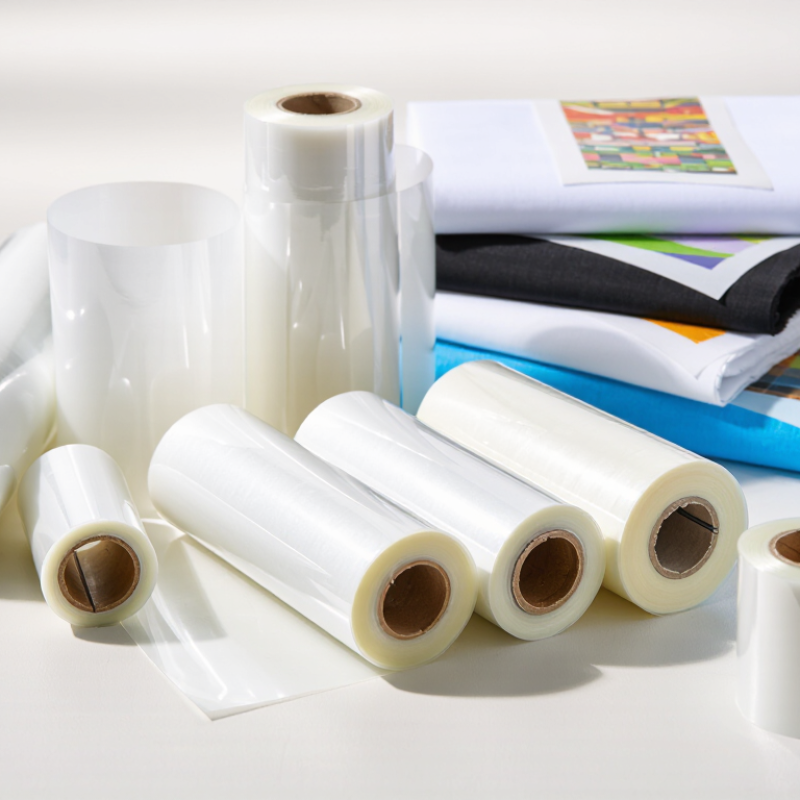
DTF transfer film rolls are coated PET sheets used to move printed designs onto fabric. The roll feeds through a printer, where the image is printed in reverse. White ink usually forms the base layer. The wet print then receives hot-melt adhesive powder. Heat cures the powder into a flexible glue layer. During heat pressing, that layer bonds the design to cotton, polyester, blends, and similar textiles. The film is peeled hot or cold, depending on its coating.
The best roll depends on the production process, not only the lowest price. Check the film’s width, thickness, coating uniformity, and release behavior. A stable surface helps prevent ink spreading around small letters. A smooth coating can also improve fine details, such as thin lines and soft gradients. Matte film reduces glare during alignment. Glossy film may make printed colors appear brighter before pressing. Rolls with consistent tension feed more evenly and create fewer wrinkles.
Practical testing still matters. Print a small color chart and press it onto both light and dark fabric. Check edge lifting after washing, especially around dense black areas. Humidity can affect powder adhesion and film handling. Static may attract dust. I would not trust a roll after one successful sample; that is an easy mistake. Test several sections from the same roll, because coating quality can change across its length. Keep unused film sealed, dry, and away from direct heat. Small storage details often decide whether a transfer looks professional or merely acceptable.
What Are the Best DTF Transfer Film Rolls?
Which Film Specifications Matter for DTF Printing?
The best DTF transfer film depends on coating quality, thickness, width, and release behavior. A well-coated PET film helps ink sit evenly instead of forming tiny pools. Film thickness often ranges from about 75 to 100 microns. Thinner film can feel flexible, while thicker film may handle feeding more steadily. The correct choice depends on your printer, curing method, and garment surface.
Release performance matters greatly. The printed layer should transfer cleanly after pressing, without leaving cloudy patches or broken edges. A matte surface can reduce glare during printing, but it may behave differently under heat. Check whether the film supports hot peel, warm peel, or cold peel. I once treated peel timing as a minor detail. It was not. A few seconds changed the finish noticeably. Roll width and length also matter because uneven feeding creates wasted material and misaligned designs.
Tips: Test a small roll first. Print fine text, solid color blocks, and a large black area. Watch for ink spreading, powder bonding, curling, and difficult peeling. Store rolls sealed, dry, and away from direct heat. Humidity can affect coating performance, even when the film looks normal. Keep notes on temperature, pressure, and peel timing. Results may still vary between production days. That is worth checking, not ignoring.
| Specification | Typical Options or Range | Why It Matters | Practical Selection Guidance |
|---|---|---|---|
| Base Material | PET film, commonly used for DTF transfer applications | PET provides dimensional stability, a smooth printing surface, and controlled release during heat pressing. | Choose a film specifically engineered for DTF ink, adhesive powder, and heat-press transfer. |
| Film Thickness | Approximately 75–100 microns | Thickness affects handling, stiffness, heat transfer behavior, and resistance to wrinkling. | Around 75–85 microns is often easier to handle; thicker film can offer greater rigidity but may require process adjustment. |
| Surface Finish | Matte, semi-matte, or glossy | Surface finish influences glare, image appearance, film handling, and the visual finish of the transferred design. | Matte film is useful for reduced glare and easier visual inspection; glossy film can provide a brighter appearance. |
| Release Type | Cold peel, warm peel, or hot peel | The release window affects production speed, image quality, and the risk of lifting fine details. | Select the release type that matches the adhesive powder, curing process, and heat-press workflow. Do not mix peel methods without testing. |
| Coating Structure | Single-sided coated or double-sided coated | The printing side must accept water-based pigment ink evenly, while the reverse side should feed smoothly and resist sticking. | Use single-sided coated film for standard workflows; double-sided coated film may improve feeding and handling in some equipment. |
| Ink Compatibility | Water-based DTF pigment ink | Compatible coating helps control ink absorption, dot formation, color density, and drying. | Confirm compatibility with the specific ink system and perform a nozzle, color, drying, and adhesion test before bulk production. |
| White Ink Performance | Uniform coverage with controlled drying | Poor white-ink interaction can cause uneven opacity, pinholes, spreading, or powder adhesion problems. | Look for smooth white layers without excessive pooling or premature drying during printing. |
| Powder Adhesion | Even adhesion to wet printed areas with minimal background contamination | Consistent adhesion affects wash durability, edge definition, hand feel, and transfer completeness. | Test fine details, large solid areas, and transparent spaces. Excess powder on unprinted areas may indicate a film or process mismatch. |
| Available Roll Width | Common widths include approximately 30–60 cm | Width determines print layout, material utilization, nesting efficiency, and compatibility with the printer. | Choose a width that matches the printer's maximum media width while leaving enough margin for reliable feeding. |
| Roll Length | Often supplied in rolls of approximately 50–100 m, depending on width and intended use | Longer rolls reduce changeovers but require stable storage, accurate tension control, and consistent coating quality throughout the roll. | Use shorter rolls for sampling or low-volume work; use longer rolls after confirming reliable printer and powder-shaker performance. |
| Dimensional Stability | Low shrinkage and low stretching during printing and pressing | Stable film helps preserve registration, fine lines, repeated patterns, and accurate image dimensions. | Check for wrinkling, edge curl, and image distortion after curing and pressing. |
| Static Control | Low-static or antistatic handling characteristics | Static can attract dust, disturb powder distribution, and cause feeding or stacking issues. | Prefer film with stable feeding and minimal dust attraction, especially in dry production environments. |
| Heat Resistance | Must tolerate the curing and heat-press temperatures specified for the complete DTF system | Insufficient heat resistance can lead to deformation, sticking, image transfer defects, or difficult peeling. | Follow the film supplier's tested temperature and dwell-time window, then verify results on the target garment. |
| Storage Conditions | Cool, dry, clean environment; protected from moisture, direct sunlight, and pressure | Moisture and heat can affect coating performance, static behavior, curling, and powder adhesion. | Keep rolls sealed until use, allow them to acclimate to the production room, and store them flat or according to the supplier's instructions. |
| Quality-Control Checks | Print test, powder test, curing test, peel test, stretch test, and wash test | A film may print well but still fail during peeling, pressing, stretching, or laundering. | Approve a roll only after checking color appearance, fine detail, release behavior, adhesion, stretch recovery, and wash durability. |
Comparing DTF film rolls requires more than checking thickness or surface gloss. Print performance matters during every production stage. I test rolls with identical artwork, ink settings, powder, curing time, and garment fabric. This keeps the comparison fair. Small differences become visible quickly.
Start by checking ink spread and white ink density. Sharp edges should remain clean, especially around small letters and thin lines. A reliable coating holds ink without creating wet spots or cloudy areas. I also inspect the printed film under angled light. Uneven shine can reveal coating problems. Do not judge release by touch alone. A smooth film may still peel poorly after curing.
Peel behavior deserves careful testing. Compare the transfer at room temperature and after cooling, because some films release differently. The image should stay on the garment without lifting corners or leaving excessive residue. Then perform a stretch test and several wash cycles. Look for cracking, fading, and rough edges. Film curl also matters during busy production, since curled material can shift under the printer head. Humidity can change results more than expected. I once trusted a strong-looking roll that performed well on day one but released unevenly after storage. That mistake showed me the value of recording temperature, humidity, and curing details for every trial.
The best roll depends on the workflow, not only the printer. For short custom orders, choose 60 cm film with stable feeding and easy cold-peel release. A matte surface can reduce glare during alignment. It also helps operators inspect white ink coverage under workshop lighting.
High-volume production needs longer rolls, consistent thickness, and strong dimensional stability. A 100-meter roll can reduce changeovers, but only if its edges remain flat. Curling film creates wrinkles near the platen and wastes powder.
Smithers’ digital textile printing report valued the global market at about $2.9 billion in 2022, with continued growth expected through 2027. That expansion increases pressure for reliable, repeatable consumables.
For stretch garments, prioritize elastic film and controlled release strength. For cotton-heavy batches, balanced adhesion and accurate color reproduction matter more. Check coating uniformity across the roll, especially when printing large graphics.
Grand View Research has reported strong projected growth for direct-to-film printing, with double-digit annual expansion in some market forecasts. These figures support investment in workflow testing, not blind purchasing.
A perfect roll rarely exists. I would test three rolls from the same production lot, then record feeding, peeling, powder coverage, and wash results. Small differences matter. Humidity can change everything.
Choosing the best DTF transfer film roll starts with your production conditions, not its appearance. In my production tests, I compare film thickness, coating consistency, transparency, and static control. A smooth surface should hold ink evenly without creating pinholes or cloudy patches. Hold the roll under bright light. Check both edges and the center.
Test a small roll before purchasing in bulk. Print the same design with your usual ink, powder, temperature, and pressing time. Keep those settings unchanged. Record ink spread, powder coverage, peeling behavior, and color after pressing. Warm peel and cold peel can produce different results. Follow the film’s recommended process, but do not trust it blindly. Your printer, humidity, and fabric can change the outcome.
After pressing, inspect fine lettering and solid color blocks. Rub the surface gently after cooling. Then wash the garment several times using a consistent cycle. I once approved a film after one successful press, but repeated washing exposed weak adhesion around thin lines. That result changed my testing method. Repeat the test. Measure, rather than relying only on touch. Store unused rolls sealed, dry, and away from direct heat. A dependable film should deliver stable transfer quality across ordinary production variations, even when the first sample looks perfect.
We use cookies on our website to give you an improved browser experience. View our Privacy Policy for more information. Please make your selection to opt in or out of ALL cookies here: Accept or Decline
Do you consent to the use of ALL cookies?
901 2nd Court West
Birmingham, AL 35204
Sales: 866.481.4036
Logistics/Ops: 866.481.4036
2101 Dralle Road
University Park, IL 60466
Sales: 708.813.9070
Logistics/Ops: 708.235.4200
400 E. 13th Street
Little Rock, AR 72114
Sales: 866.760.5344
Logistics/Ops: 866.760.5344
225 Collins Road
Elkhart, IN 46515
Sales: 574.295.0214
Logistics/Ops: 574.607.4611
601 Berryman Pike
Tipton, IN 46072
Sales: 800.897.7591
Logistics/Ops: 800.897.7591
3900 Uvalda Street
Denver, CO 80239
Sales: 303.706.8000
Ops/Logistics: 303.576.8398
510 3rd Street E
Milan, IL 61264
Sales: 800.322.1052
Logistics/Ops: 800.322.1052
1660 E. Aurora
Des Moines, IA 50313
Sales: 800.671.1660
Logistics: 800.671.1660
86554 Gene Lasserre Blvd.
Yulee, FL 32097
Sales: 904.253.3060
Logistics/Ops: 904.225.3000
694 S.E. County Road 245
Lake City, FL 32025
Sales: 800.727.6706
Logistics/Ops: 386.752.7412
210 Neptune Road
Auburndale, FL 33823
Sales: 863.967.1131
Logistics/Ops: 863.777.9814
4601 McCoy Drive
Pensacola, FL 32503
Sales: 850.308.7030
Logistics/Ops: 850.434.5502
815 South 56th Street
Tampa, FL 33619
Sales: 813.302.1940
Logistics/Ops: 813.621.1352
200 Hosea Road
Lawrenceville, GA 30046
Sales: 770.953.7575
Logistics/Ops: 770.513.6000
Branch Product Guide
Branch Line Card
Moulding Offering
Cedar Offering
Column Offering
8173 Hwy. 165 North
Monroe, LA 71211
Sales: 800.256.4165
Logistics/Ops: 800.256.4165
508 Warren Avenue
Portland, ME 04103
Sales: 207.888.2331
Logistics/Ops: 207.797.6565
4300 Georgia Pacific Blvd.
Frederick, MD 21704
Sales: 301.798.7474
Logistics/Ops: 301.874.8000
419 Maple Street
Bellingham, MA 02019
Sales: 508.449.0535
Logistics/Ops: 508.966.5500
825 Buchanan Ave SW
Grand Rapids, MI 49507
Sales: 877.800.1180
Logistics/Ops: 616.278.0909
995 Pacific St. NW
Aitkin, MN 56431
Sales: 800.432.3727
Logistics/Ops: 218.212.7770
1102 Port Terminal Drive
Duluth, MN 55802
Sales: 800.951.9899
Logistics/Ops: 800.851.9899
9110 83rd Ave. North
Brooklyn Park, MN 55445
Sales: 763.425.0204
Logistics/Ops: 763.425.0204
910 E. Railroad Street
Long Beach, MS 39560
Sales: 866.535.4135
Logistics/Ops: 228.205.2400
1727 Warren Street
North Kansas City, MO 64116
Sales: 800.621.2611
Logistics/Ops: 800.621.2611
2123 North Golden
Springfield, MO 65803
Sales: 800.375.7891
Logistics/Ops: 800.375.7891
13860 Corp. Woods Trail
Bridgeton, MO 63044
Sales: 314.209.0800
Logistics/Ops: 314.209.0800
1109 South 19th Street
Omaha, NE 68108
Sales: 800.489.6637
Logistics/Ops: 800.489.6637
1 Luger Road
Denville, NJ 07834
Sales: 973-339-3539
Logistics/Ops: 973.625.1461
3720 Jeffrey Blvd.
Blasdell, NY 14219
Sales: 716.235.5989
Logistics/Ops: 716.825.6557
319 Yaphank Ave.
Yaphank, NY 11980
Sales: 631.358.5714
Logistics/Ops: 631.924.7401
3300 Parkside Drive
Charlotte, NC 28208
Sales: 800.839.2588
Logistics/Ops: 704.394.3172
1712 East D Street
Butner, NC 27509
Sales: 984.389.8200
Logistics/Ops: 919.575.3700
128 Foothills Drive
Statesville, NC 28687
Sales: 800.222.1414
Logistics/Ops: 704.394.3172
550 Munroe Falls Rd.
Tallmadge, OH 44278
Sales: 330.357.4506
Logistics/Ops: 330.794.1141
10347 Toebben Dr.
Independence, KY 41051
Sales: 859.298.3926
Logistics/Ops: 859.746.2250
450 N. MacArthur
Oklahoma City, OK 73127
Sales: 800.375.6025
Logistics/Ops: 800.375.6025
1680 North Aspen
Broken Arrow, OK 74012
Sales: 918.272.2212
Logistics/Ops: 918.272.2212
522 Bridge Street
Hunker, PA 15639
Sales: 878.217.2001
Logistics/Ops: 724.925.7285
4290 Atlanta Street
Charleston, SC 29418
Sales: 843.371.1420
Logistics/Ops: 843.554.8192
1040 S. Industrial Dr.
Erwin, TN 37650
Sales: 423.641.1005
Logistics/Ops: 423.742.5911
4287 Pilot Drive
Memphis, TN 38118
Sales: 901.365.2101
Logistics/Ops: 901.365.2101
700 Myatt Drive
Madison, TN 37115
Sales: 615.327.9547
Logistics/Ops: 629.777.4949
4747 Mark IV Parkway
Fort Worth, TX 76106
Sales: 866.323.5117
Logistics/Ops: 817.625.9091
6990 Market Avenue
El Paso, TX 79915
Sales: 915.778.6356
Logistics/Ops: 915.265.7200
2502 Wilson Road
Harlingen, TX 78552
Sales: 800.580.6711
Logistics/Ops: 800.580.6711
10,000 North Loop East
Houston, TX 77029
Sales: 713.921.1977
Logistics/Ops: 713.675.3544
702 East 44th St.
Lubbock, TX 79404
Sales: 866.454.6010
Logistics/Ops: 866.454.6010
535 N. WW White Road
San Antonio, TX 78219
Sales: 800.284.0488
Logistics/Ops: 210.333.8112
142 Pine Haven Shores Rd.
Shelburne, VT 05482
Sales: 802.800.2540
Logistics/Ops: 802.985.2512
4700 Bethlehem Road,
Richmond, VA 23230
Sales: 804.201.2400
Logistics/Ops: 804.342.1161
4516 N Barker Road
Spokane Valley, WA 99027
Phone: 509.892.9420
Toll free: 800.728.6157
8365 N. 76th Street
Milwaukee, WI 53223
Sales: 800.356.9245
Logistics/Ops: 800.356.9245
312 S. Chester Street
Sparta, WI 54656
Sales: 800.362.5864
Logistics/Ops: 800.362.5864
899 Grossman Drive
Schofield, WI 54476
Sales: 800.472.0017
Logistics/Ops: 800.472.0017
