
We use cookies on our website to give you an improved browser experience. View our Privacy Policy for more information. Please make your selection to opt in or out of ALL cookies here: Accept or Decline
Choosing the right Pvc Roofing Solutions requires more than comparing membrane prices. A roof must manage water, wind, heat, maintenance, and the building’s actual use. PVC membranes remain popular because heat-welded seams can create continuous, watertight joints. That advantage matters around drains, parapets, and rooftop equipment.
Market evidence supports careful evaluation. Grand View Research identifies roofing materials as a large and steadily expanding construction market, driven by renovation and energy-efficiency needs. The U.S. Department of Energy reports that cool roofs can reduce peak cooling demand by 10% to 30% in suitable climates. However, those savings depend on insulation, ventilation, roof orientation, and local weather. A white membrane alone cannot fix a poorly designed roof.
Mark Graham, former Vice President of Technical Services at the National Roofing Contractors Association, has stated, “A roof is a system, not just a membrane.” This principle should guide every Pvc Roofing Solutions decision. Review membrane thickness, reinforcement, chemical resistance, wind-uplift ratings, fire classifications, and manufacturer warranties. Ask whether the installer follows documented hot-air welding procedures. Request project references with similar roof size and exposure.
The cheapest option may not be the most economical. Sometimes, it fails early.
A practical assessment should also examine substrate moisture, drainage falls, fastener spacing, and future maintenance access. Independent testing, such as ASTM performance standards or FM Approvals, adds useful confidence. Still, certificates do not replace site experience. Every building behaves differently. That is where careful inspection, transparent advice, and honest reconsideration become essential.
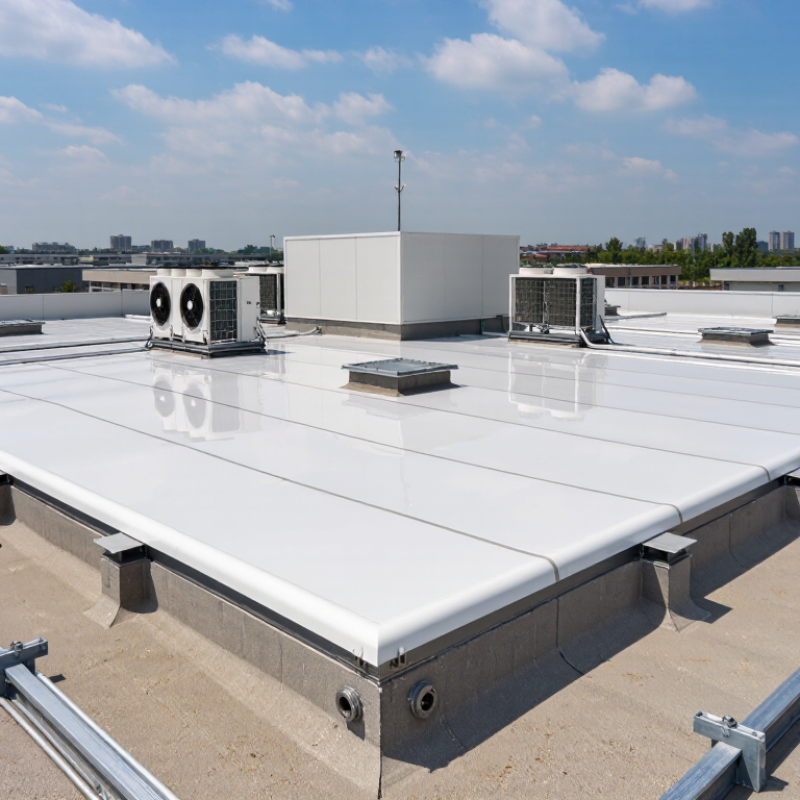
PVC roofing is a thermoplastic membrane system designed for low-slope and flat roofs. ASTM D4434 provides performance requirements for PVC sheet materials used in roofing applications. It addresses properties such as thickness, tensile strength, tear resistance, and weathering performance. However, compliance alone does not guarantee a successful roof.
Membrane selection matters. Reinforced PVC contains a polyester scrim that improves dimensional stability and puncture resistance. Non-reinforced sheets can offer flexibility but may need greater care during installation. Fleece-backed membranes can help protect the sheet over suitable substrates. Thickness, color, insulation, drainage, and expected foot traffic should guide the decision. A roof near coastal air, intense sunlight, or heavy snow needs a more careful specification.
Installation is equally important. Clean, consistently welded seams should be checked with probing tools and documented testing. Poor detailing around drains, vents, and edges can shorten the service life dramatically. In real projects, a properly installed PVC roof may perform for 20–30 years, but this range is not a promise. Maintenance, storm damage, ponding water, and chemical exposure can change the result. Even experienced crews sometimes overlook small punctures. Regular inspections catch those problems early. Review the current ASTM edition and local project requirements before approval.
| Evaluation Dimension | PVC Roofing Data | Why It Matters | Selection Guidance |
|---|---|---|---|
| Material Definition | PVC roofing is a thermoplastic single-ply membrane made primarily from polyvinyl chloride, plasticizers, stabilizers, pigments, and reinforcing materials where required. | The formulation and reinforcement affect flexibility, dimensional stability, weldability, and weathering performance. | Review the published product data sheet and confirm that the membrane is intended for the roof assembly and climate. |
| Applicable Standard | ASTM D4434 is the standard specification for poly(vinyl chloride) sheet roofing. It addresses material classifications and performance requirements for PVC roofing sheets. | A recognized standard provides a consistent basis for comparing membrane properties and specification compliance. | Ask for current, documented ASTM D4434 compliance; do not treat the ASTM reference alone as a complete roof-system approval. |
| Membrane Construction | Common constructions include non-reinforced, scrim-reinforced, and fleece-backed PVC membranes. | Reinforcement improves dimensional stability and resistance to tearing, while fleece backing can provide separation and additional protection over suitable substrates. | Use reinforced sheets for many mechanically attached or high-wind assemblies; select fleece backing when the approved assembly requires added substrate protection. |
| Typical Thickness Range | Commercial PVC roofing membranes are commonly available in approximately 45–90 mil thicknesses, with thicker options used where additional durability is desired. | Thickness can influence puncture resistance, handling, expected serviceability, and installed cost. | Choose thickness according to traffic, maintenance exposure, wind design, hail risk, substrate condition, and the approved assembly—not thickness alone. |
| Seam Technology | PVC seams are generally joined by hot-air welding, creating a fused membrane-to-membrane connection. | Properly welded seams can provide strong, watertight joints and allow seam quality to be checked during installation. | Require trained installers, suitable welding equipment, clean surfaces, correct welding temperatures, and documented seam testing. |
| Solar Reflectance and Heat Control | Light-colored PVC membranes can provide high solar reflectance and reduce roof-surface heat compared with dark roof coverings under similar conditions. | Reflective surfaces may reduce cooling demand and thermal stress, although actual energy savings depend on climate, insulation, HVAC efficiency, and roof design. | Compare independently documented solar reflectance, thermal emittance, and aged-performance data where energy performance is important. |
| Chemical Resistance | PVC membranes generally provide useful resistance to many water-based chemicals, oils, greases, and industrial contaminants, but performance varies by formulation and exposure. | Restaurants, manufacturing areas, waste facilities, and other specialized buildings may expose roofing to chemicals that can damage some membranes. | Obtain a chemical-compatibility review for recurring or concentrated exposure before final material selection. |
| Fire and Code Performance | Fire performance depends on the complete roof assembly, including the membrane, insulation, cover board, deck, attachment method, slope, and penetrations. | A membrane's individual properties do not establish the fire classification of the installed roof system. | Verify the required fire classification, wind uplift rating, and local code approvals for the complete assembly. |
| Wind and Attachment Options | PVC systems may be installed using mechanical attachment, adhered applications, or approved induction-welded attachment methods, depending on the system design. | Attachment method affects wind resistance, installation speed, substrate requirements, penetrations, and repair procedures. | Base the design on project-specific wind calculations and tested or approved assembly data. |
| Expected Service Life | A properly designed, installed, and maintained PVC roof is commonly discussed as providing approximately 20–30 years of service life; actual life may be shorter or longer. | Ultraviolet exposure, weather, ponding water, foot traffic, workmanship, drainage, maintenance, and membrane formulation all affect durability. | Use 20–30 years as a planning range rather than a guarantee, and evaluate project-specific service-life evidence. |
| Ponding Water and Drainage | PVC membranes can be used on low-slope roofs, but positive drainage and properly designed slopes remain important for long-term roof performance. | Persistent ponding can increase dirt accumulation, biological growth, seam stress, and exposure to contaminants. | Correct drainage defects, confirm drain and scupper capacity, and follow the membrane manufacturer's allowable ponding-water requirements. |
| Maintenance Requirements | Routine maintenance includes inspections, drain cleaning, removal of debris, checking flashings and seams, and prompt repair of punctures or damaged accessories. | Preventive maintenance helps identify small defects before they become leaks or widespread system damage. | Schedule inspections at least annually and after severe weather, with more frequent reviews for high-traffic or industrial roofs. |
| Best-Fit Building Applications | Common applications include warehouses, commercial buildings, institutional facilities, retail properties, and low-slope roof renovations. | PVC is especially useful where heat reflection, welded seams, chemical resistance, or lightweight single-ply construction is required. | Match the membrane to the roof deck, insulation, occupancy, climate, maintenance traffic, and expected exposure conditions. |
| Final Selection Checklist | Confirm ASTM D4434 compliance, membrane construction, thickness, reinforcement, seam method, wind uplift rating, fire classification, drainage design, accessory compatibility, installation requirements, and maintenance plan. | Roof performance depends on the complete system rather than on the membrane sheet alone. | Select the option with verified assembly data, qualified installation, suitable accessories, and a realistic 20–30-year lifecycle plan. |
Note: ASTM D4434 compliance, fire ratings, wind ratings, thickness ranges, and service-life expectations should be verified against current project specifications, applicable building codes, and the selected roof-system documentation.
How to Choose the Best PVC Roofing Solutions?
PVC roofing selection should begin with thickness, not price. Standard systems commonly range from 45 to 80 mil. A 45-mil membrane may suit light commercial roofs with limited traffic. For warehouses, kitchens, and maintenance-heavy buildings, 60–80 mil PVC usually provides better puncture resistance. Reinforcement matters as much as thickness. Polyester scrim helps control shrinking, tearing, and movement around fasteners. Inspectors should check scrim placement, seam quality, and corner detailing.
Chemical exposure changes the decision. Restaurant grease, industrial solvents, acids, and exhaust deposits can attack unsuitable membranes. Request documented resistance data for the actual chemicals, temperatures, and exposure times. ASTM D4434 testing supports PVC membrane evaluation, while FM Global Data Sheet 1-28 provides useful roof performance guidance. The U.S. Department of Energy reports that reflective roofs can remain up to 50°F cooler than conventional roofs, reducing heat transfer during hot weather. Source conditions still matter.
Do not assume thicker always means better. An 80-mil sheet can add weight, cost, and installation difficulty. Poorly welded seams can defeat a strong membrane. I have seen specifications focus heavily on mil thickness while ignoring drainage and rooftop traffic. That is a mistake. Verify slope, walkway protection, reinforcement, chemical compatibility, and installer workmanship. Small details decide long-term performance.
Choosing a PVC roofing solution starts with the roof’s climate burden, not its color alone. On low-slope roofs, an initial Solar Reflectance Index (SRI) of 82 signals strong solar control. It can keep the membrane cooler under intense sun. That matters above occupied rooms. Still, SRI is not a complete energy forecast. Roof insulation, ventilation, humidity, and indoor loads also influence results.
An aged SRI of 64 deserves equal attention. After years of dust, weathering, and maintenance traffic, the surface may reflect less sunlight. In a hot climate, that decline can raise membrane temperatures and increase cooling demand. I would request documented initial and aged values, test methods, and exposure assumptions before comparing PVC roofing solutions. ASTM E1980-based calculations can support consistent SRI interpretation, but field conditions remain messier. Nearby trees, ponding water, and poor drainage can change actual performance. Low-slope roofs need positive drainage, sound seams, and compatible insulation.
During an assessment, inspect rooftop details at midday. Look for exposed fasteners, blocked drains, dirt bands, and heat-sensitive equipment. A reflective membrane can help, yet it cannot correct trapped moisture or weak installation. I have found that a high initial rating sometimes attracts too much confidence. The aged rating often tells the more useful story. It is less impressive. But it is closer to ownership reality. Ask whether cleaning schedules, repair access, and local weather were considered in the specification.
Climate Efficiency for Low-Slope Roofs: Solar Reflectance Index (SRI) values indicate how effectively a roofing surface limits heat buildup. Higher values generally support cooler roof temperatures and reduced cooling demand. The initial SRI is 82, while the aged SRI is 64 after weathering.
Interpretation: The SRI decreases by 18 points, or approximately 22%, from its initial condition to its aged condition. When comparing PVC roofing solutions, consider both initial and aged performance, especially in hot, sunny climates.
A reliable PVC roof begins with verified installation, not a glossy product sheet. Hot-air welds should show a consistent bead without bubbles, scorching, or open edges. After cooling, a technician can run a probe along each seam. Any soft spot deserves investigation. Welding temperature, machine speed, and pressure should be recorded, because small adjustments can affect seam strength. Visual inspection alone is not enough.
Tips: Request documented test results for the membrane, including applicable ASTM D4434 performance data. Ask whether the assembly has been evaluated under ASTM E1592 or another accepted wind-uplift procedure. The rating must match the building’s height, location, edge zones, and structural design. A generic number may mislead. Check that installers use calibrated equipment and keep daily welding logs. Take photographs before insulation or cover boards hide the seams.
Do not accept a rating without checking its test conditions. Roof geometry, fastener spacing, substrate quality, and perimeter detailing can change performance. Field testing should include trial welds and, when appropriate, destructive seam samples. This step feels inconvenient. It can reveal weak settings early. I would also review the installer’s training records and previous project experience. Even experienced crews can miss a seam when wind, moisture, or rushed scheduling disrupts the work. A careful verification record protects the roof’s expected performance.
Choosing a PVC roof requires more than comparing bid prices. A 15-year warranty and a 30-year warranty do not automatically indicate different service lives. Warranty language may exclude ponding water, punctures, poor drainage, or unapproved repairs. During site reviews, I check seams, perimeter details, penetrations, and rooftop traffic zones. Small defects often become expensive when ignored.
Use the NIST Building Life-Cycle Cost program to compare installation, inspections, repairs, replacement, and discount rates. It treats future expenses as part of today’s decision. National Roofing Contractors Association guidance recommends inspections after severe weather and at regular intervals. That practice protects warranty evidence and reveals seam damage early. A maintenance allowance should cover drain cleaning, flashing repairs, and weld testing. It sounds ordinary. It matters.
Recycling deserves equal attention. The U.S. Environmental Protection Agency reported about 600 million tons of construction and demolition debris in 2018. Roofing membranes represent only a portion, but disposal impacts remain substantial. A 2024 European PVC recycling progress report recorded 810,775 metric tonnes recycled across PVC applications during 2023. That figure is not roofing-specific. Ask contractors to document membrane composition, collection routes, contamination limits, and chain of custody. I would not accept “recyclable” as a complete claim. Transport and clean separation decide whether recycling actually happens. Sometimes replacement is delayed too long, and the deck suffers.
We use cookies on our website to give you an improved browser experience. View our Privacy Policy for more information. Please make your selection to opt in or out of ALL cookies here: Accept or Decline
Do you consent to the use of ALL cookies?
901 2nd Court West
Birmingham, AL 35204
Sales: 866.481.4036
Logistics/Ops: 866.481.4036
2101 Dralle Road
University Park, IL 60466
Sales: 708.813.9070
Logistics/Ops: 708.235.4200
400 E. 13th Street
Little Rock, AR 72114
Sales: 866.760.5344
Logistics/Ops: 866.760.5344
225 Collins Road
Elkhart, IN 46515
Sales: 574.295.0214
Logistics/Ops: 574.607.4611
601 Berryman Pike
Tipton, IN 46072
Sales: 800.897.7591
Logistics/Ops: 800.897.7591
3900 Uvalda Street
Denver, CO 80239
Sales: 303.706.8000
Ops/Logistics: 303.576.8398
510 3rd Street E
Milan, IL 61264
Sales: 800.322.1052
Logistics/Ops: 800.322.1052
1660 E. Aurora
Des Moines, IA 50313
Sales: 800.671.1660
Logistics: 800.671.1660
86554 Gene Lasserre Blvd.
Yulee, FL 32097
Sales: 904.253.3060
Logistics/Ops: 904.225.3000
694 S.E. County Road 245
Lake City, FL 32025
Sales: 800.727.6706
Logistics/Ops: 386.752.7412
210 Neptune Road
Auburndale, FL 33823
Sales: 863.967.1131
Logistics/Ops: 863.777.9814
4601 McCoy Drive
Pensacola, FL 32503
Sales: 850.308.7030
Logistics/Ops: 850.434.5502
815 South 56th Street
Tampa, FL 33619
Sales: 813.302.1940
Logistics/Ops: 813.621.1352
200 Hosea Road
Lawrenceville, GA 30046
Sales: 770.953.7575
Logistics/Ops: 770.513.6000
Branch Product Guide
Branch Line Card
Moulding Offering
Cedar Offering
Column Offering
8173 Hwy. 165 North
Monroe, LA 71211
Sales: 800.256.4165
Logistics/Ops: 800.256.4165
508 Warren Avenue
Portland, ME 04103
Sales: 207.888.2331
Logistics/Ops: 207.797.6565
4300 Georgia Pacific Blvd.
Frederick, MD 21704
Sales: 301.798.7474
Logistics/Ops: 301.874.8000
419 Maple Street
Bellingham, MA 02019
Sales: 508.449.0535
Logistics/Ops: 508.966.5500
825 Buchanan Ave SW
Grand Rapids, MI 49507
Sales: 877.800.1180
Logistics/Ops: 616.278.0909
995 Pacific St. NW
Aitkin, MN 56431
Sales: 800.432.3727
Logistics/Ops: 218.212.7770
1102 Port Terminal Drive
Duluth, MN 55802
Sales: 800.951.9899
Logistics/Ops: 800.851.9899
9110 83rd Ave. North
Brooklyn Park, MN 55445
Sales: 763.425.0204
Logistics/Ops: 763.425.0204
910 E. Railroad Street
Long Beach, MS 39560
Sales: 866.535.4135
Logistics/Ops: 228.205.2400
1727 Warren Street
North Kansas City, MO 64116
Sales: 800.621.2611
Logistics/Ops: 800.621.2611
2123 North Golden
Springfield, MO 65803
Sales: 800.375.7891
Logistics/Ops: 800.375.7891
13860 Corp. Woods Trail
Bridgeton, MO 63044
Sales: 314.209.0800
Logistics/Ops: 314.209.0800
1109 South 19th Street
Omaha, NE 68108
Sales: 800.489.6637
Logistics/Ops: 800.489.6637
1 Luger Road
Denville, NJ 07834
Sales: 973-339-3539
Logistics/Ops: 973.625.1461
3720 Jeffrey Blvd.
Blasdell, NY 14219
Sales: 716.235.5989
Logistics/Ops: 716.825.6557
319 Yaphank Ave.
Yaphank, NY 11980
Sales: 631.358.5714
Logistics/Ops: 631.924.7401
3300 Parkside Drive
Charlotte, NC 28208
Sales: 800.839.2588
Logistics/Ops: 704.394.3172
1712 East D Street
Butner, NC 27509
Sales: 984.389.8200
Logistics/Ops: 919.575.3700
128 Foothills Drive
Statesville, NC 28687
Sales: 800.222.1414
Logistics/Ops: 704.394.3172
550 Munroe Falls Rd.
Tallmadge, OH 44278
Sales: 330.357.4506
Logistics/Ops: 330.794.1141
10347 Toebben Dr.
Independence, KY 41051
Sales: 859.298.3926
Logistics/Ops: 859.746.2250
450 N. MacArthur
Oklahoma City, OK 73127
Sales: 800.375.6025
Logistics/Ops: 800.375.6025
1680 North Aspen
Broken Arrow, OK 74012
Sales: 918.272.2212
Logistics/Ops: 918.272.2212
522 Bridge Street
Hunker, PA 15639
Sales: 878.217.2001
Logistics/Ops: 724.925.7285
4290 Atlanta Street
Charleston, SC 29418
Sales: 843.371.1420
Logistics/Ops: 843.554.8192
1040 S. Industrial Dr.
Erwin, TN 37650
Sales: 423.641.1005
Logistics/Ops: 423.742.5911
4287 Pilot Drive
Memphis, TN 38118
Sales: 901.365.2101
Logistics/Ops: 901.365.2101
700 Myatt Drive
Madison, TN 37115
Sales: 615.327.9547
Logistics/Ops: 629.777.4949
4747 Mark IV Parkway
Fort Worth, TX 76106
Sales: 866.323.5117
Logistics/Ops: 817.625.9091
6990 Market Avenue
El Paso, TX 79915
Sales: 915.778.6356
Logistics/Ops: 915.265.7200
2502 Wilson Road
Harlingen, TX 78552
Sales: 800.580.6711
Logistics/Ops: 800.580.6711
10,000 North Loop East
Houston, TX 77029
Sales: 713.921.1977
Logistics/Ops: 713.675.3544
702 East 44th St.
Lubbock, TX 79404
Sales: 866.454.6010
Logistics/Ops: 866.454.6010
535 N. WW White Road
San Antonio, TX 78219
Sales: 800.284.0488
Logistics/Ops: 210.333.8112
142 Pine Haven Shores Rd.
Shelburne, VT 05482
Sales: 802.800.2540
Logistics/Ops: 802.985.2512
4700 Bethlehem Road,
Richmond, VA 23230
Sales: 804.201.2400
Logistics/Ops: 804.342.1161
4516 N Barker Road
Spokane Valley, WA 99027
Phone: 509.892.9420
Toll free: 800.728.6157
8365 N. 76th Street
Milwaukee, WI 53223
Sales: 800.356.9245
Logistics/Ops: 800.356.9245
312 S. Chester Street
Sparta, WI 54656
Sales: 800.362.5864
Logistics/Ops: 800.362.5864
899 Grossman Drive
Schofield, WI 54476
Sales: 800.472.0017
Logistics/Ops: 800.472.0017
