
We use cookies on our website to give you an improved browser experience. View our Privacy Policy for more information. Please make your selection to opt in or out of ALL cookies here: Accept or Decline
Choosing Waterproof Decking is about more than keeping rain off the boards. The right system should handle standing water, wet shoes, summer heat, and years of foot traffic without becoming slippery or difficult to maintain. A deck can look flawless in a product photo. Real weather is less forgiving.
Start by checking what “waterproof” means for the product. Some boards resist moisture, while others rely on a fully sealed surface or drainage beneath the deck. Those differences affect installation, upkeep, and performance around doors, stairs, and railings. Ask for test data, warranty terms, and clear installation instructions. Look closely at seams and edges; water often finds the weak point there.
I can’t verify an industry expert’s name or quotation from the material provided, so I won’t invent one. A useful principle for this guide is: “Choose the system that manages water at the joints, edges, and structure—not just on the board surface.” Treat it as editorial guidance, not a sourced expert quote.
This guide compares common materials, drainage designs, slip resistance, maintenance needs, and total cost. It also explains which questions to ask an installer before work begins. Small details matter: a slight slope, a clean drainage channel, or a properly finished threshold can change how the whole deck performs. Product labels alone are not enough. Check the details, and be willing to question attractive claims when the evidence is thin.
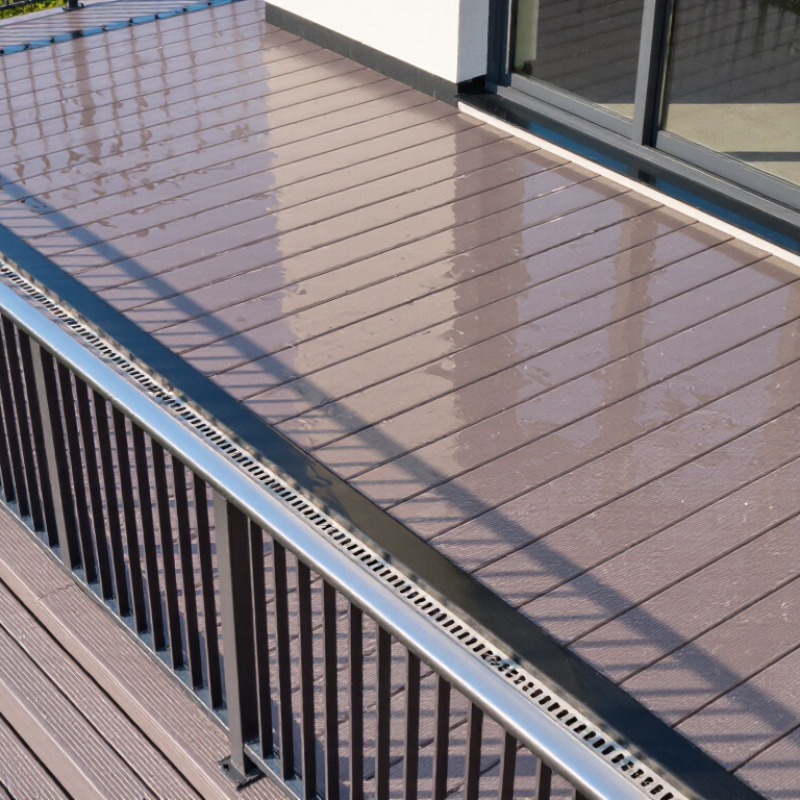
Waterproof decking is not one material. Cellular PVC contains no wood fibers, so it resists water absorption and suits damp, shaded areas. Capped composite combines wood fibers with a protective polymer shell; its cut edges and gaps still need careful detailing. Pressure-treated or naturally durable wood can work outdoors, but it needs regular sealing and maintenance. No deck is truly waterproof if water can pool beneath boards or enter poorly sealed joints.
Material movement matters. The USDA Forest Products Laboratory’s Wood Handbook reports typical total shrinkage of about 6–12% tangentially and 3–6% radially as wood dries from green to oven-dry conditions. These figures vary by species, but they show why tight board spacing can cause trouble. Check the manufacturer’s installation guidance for drainage gaps, fasteners, and temperature-related expansion. A smooth sample may look convincing indoors; outdoors, sun, standing water, and grit tell a different story.
Tips: Ask for a sample and inspect its cut edge. Confirm whether the system sheds water between boards or needs a separate waterproof membrane. Keep a small drainage gap. It may look less seamless, but trapped water is worse.
Start with exposure, not a product label.
A coastal deck faces salt spray, wind-driven rain, and persistent dampness. NOAA’s Climate Change Indicators report tracks very heavy precipitation. Across the contiguous United States, the amount rose 55% from 1958 to 2022. That national figure is a warning, not a local forecast.
Check local rainfall, freeze-thaw cycles, and whether water drains away from the house. Measure after rain. Puddles near posts or slow-drying corners can reveal trouble a showroom sample cannot.
Then match the surface to how people use it.
EPA’s Heat Island Effect guidance notes that sunlit urban surfaces can reach 50–90°F above air temperature; this is context, not a deck-specific measurement. Dark, exposed boards may feel harsh under bare feet. Shade, nearby trees, and afternoon sun matter.
For dining, allow room for chairs and consider grip when the surface is wet. For a poolside deck, prioritize drainage and a surface that stays comfortable underfoot.
I would not assume one rainy season tells the whole story; inspect the site through wet and dry spells, and weigh maintenance honestly.
A wet deck needs more than a water-resistant surface; drainage and the frame beneath it matter too. Compare materials by checking how they handle standing water, repeated wetting, and damp conditions around fasteners. Capped composite boards resist moisture at the surface, but cut ends and gaps still need proper installation. PVC boards absorb very little water, though they can feel different underfoot and may move with temperature changes. Pressure-treated wood can work in damp settings, but it needs regular sealing and careful inspection. Small details count. Look for clear guidance on drainage, ventilation, and suitable fasteners.
Durability depends on more than the board itself. Ask how the material performs through freeze-thaw cycles, heavy foot traffic, and years of sun exposure. A sample left in a puddle overnight can show surface effects, but it cannot predict long-term performance. Maintenance needs vary, too. Some surfaces need only occasional washing; wood may require cleaning, drying, and renewed protective coating. A quick rinse helps. Avoid assuming that “waterproof” means maintenance-free, especially where leaves collect between boards or water sits beside posts. I would compare the full upkeep schedule and the substructure requirements, not just the product label. That distinction is easy to miss.
| Decking Material | Water Resistance | Durability Considerations | Maintenance Needs | Best Suited For | Important Limitations |
|---|---|---|---|---|---|
| Cellular PVC | Does not absorb water like wood-based decking, so it resists swelling and rot from moisture. | Resists rot and insect damage. Surface scratching, heat-related movement, and fading can vary by product and exposure. | Wash periodically with water and a suitable cleaner; promptly remove dirt and spills. Follow the maker’s guidance for stains and repairs. | Wet climates, poolside areas, and homeowners prioritizing low moisture absorption. | Not every PVC board has the same construction or performance. It can become hot in direct sun, and the substructure and installation still need proper drainage. |
| Capped Composite | A protective polymer cap helps limit water absorption at the exposed surface. Cut ends, gaps, and damaged areas may be less protected. | Generally resists rot and splintering better than untreated wood. Surface stains, scratches, and mold or mildew on accumulated dirt remain possible. | Clean periodically with water and a product-approved cleaner; clear debris from gaps and keep the surface draining freely. | People seeking a wood-like appearance with less routine coating than wood usually requires. | The composite core is not necessarily waterproof. Performance depends on the cap, board design, installation, and care instructions. |
| Uncapped Composite | Can absorb more moisture than capped composite; absorption and dimensional changes depend on its composition and exposure. | Does not need protection from rot in the same way as wood, but moisture cycling, staining, and surface wear can affect appearance over time. | Regularly sweep and wash; remove leaves and standing debris. Check the product instructions before using cleaners or pressure washing. | Projects where composite decking is desired and the specific product’s water-absorption characteristics are acceptable. | It is not waterproof. Compare product-specific technical information rather than assuming all composite boards perform alike. |
| Pressure-Treated Wood | Preservative treatment helps protect against decay, but the wood can still absorb water and may swell, shrink, or crack as it dries. | Can provide long service with suitable installation and care. Splits, splinters, loose fasteners, and surface wear may develop. | Clean as needed; allow new wood to dry as directed, then apply a suitable water-repellent sealer or stain when appropriate. Inspect regularly. | Cost-conscious projects where natural wood is preferred and periodic upkeep is acceptable. | Treatment does not make the boards waterproof. Moisture retention, poor airflow, and neglected coatings can shorten service life. |
| Naturally Durable Hardwood | Some dense hardwood species resist moisture and decay well, but they still take up water and are not waterproof. | Durability varies by species and grade. Dense boards can be hard to cut and fasten; weathering and checking may occur. | Clean periodically. An exterior oil may help maintain color where recommended, but many species weather to a gray patina without it. | Those who prefer natural wood and are willing to select a suitable species and follow its installation guidance. | Species, sourcing, and installation matter. Natural weathering is normal; check fastener and substructure requirements before installation. |
Selection tip: “Water-resistant” does not mean the entire deck assembly is waterproof. Compare product-specific technical data, and plan for drainage, ventilation, correct gaps, and suitable framing.
Before choosing waterproof decking, inspect the frame beneath it. Look for soft spots, loose fasteners, and signs of trapped moisture. The surface cannot solve structural problems. Check the system’s required joist spacing, slope, and ventilation; these vary by design. A small level can reveal flat areas where water may collect. That detail matters.
Installation rules affect both performance and labor costs. Some systems need sealed seams, edge flashing, or careful treatment around posts and stairs. Ask for these tasks in the written quote, not as vague “finishing work.” Confirm how installers handle door thresholds and drainage outlets. Those spots are easy to overlook. Keep the instructions for future repairs, too. I would not assume one waterproofing layer suits every deck; exposure, framing, and climate change the details.
Compare the full cost, not just the price per square foot. Include demolition, frame repairs, underlayment, trim, fasteners, and disposal. A low quote may leave out difficult corners or water management. Request a maintenance schedule and ask what cleaning products are safe. Regular checks may catch lifted edges before water reaches the frame. Long-term costs are hard to predict exactly, and that uncertainty deserves attention. Even a well-installed deck needs periodic inspection.
PVC and aluminum decking are highly water-resistant, while composite boards resist moisture but still depend on proper drainage and installation. Pressure-treated wood is not waterproof and needs regular sealing. The chart shows broad U.S. installed-cost estimates per square foot; actual prices vary by location, deck design, labor, and whether framing or drainage work is required. Compare expected service life, maintenance, and installation needs—not just upfront cost.
Choosing waterproof decking starts with the product specification sheet, not the color sample. Check whether the system sheds water across the walking surface or relies on a separate membrane beneath the boards. Confirm required slope, drainage gaps, flashing details, and compatible fasteners. A small mismatch at a wall or stair can let water reach the framing.
Look for test methods, not vague claims. ASTM D7032 sets performance-rating procedures for plastic and wood-plastic composite deck boards, stairs, guards, and handrails; it is not, by itself, proof that an entire deck assembly is waterproof. Ask for wet-slip test results, UV and freeze-thaw data, and the limits of any warranty. The USDA Forest Products Laboratory’s Wood Handbook treats wood moisture above roughly 20 percent as a warning condition for decay. That makes substrate ventilation and drainage worth checking, even with waterproof surface boards.
Fit the product to the site. A shaded, rain-prone balcony needs different drainage planning than a sunny, dry patio. Compare tested span limits with joist spacing, and confirm the chosen board permits the planned installation. A spec sheet can still leave gaps. Request written details for edges, penetrations, and transitions before ordering; those awkward corners often decide whether the system stays dry.
We use cookies on our website to give you an improved browser experience. View our Privacy Policy for more information. Please make your selection to opt in or out of ALL cookies here: Accept or Decline
Do you consent to the use of ALL cookies?
901 2nd Court West
Birmingham, AL 35204
Sales: 866.481.4036
Logistics/Ops: 866.481.4036
2101 Dralle Road
University Park, IL 60466
Sales: 708.813.9070
Logistics/Ops: 708.235.4200
400 E. 13th Street
Little Rock, AR 72114
Sales: 866.760.5344
Logistics/Ops: 866.760.5344
225 Collins Road
Elkhart, IN 46515
Sales: 574.295.0214
Logistics/Ops: 574.607.4611
601 Berryman Pike
Tipton, IN 46072
Sales: 800.897.7591
Logistics/Ops: 800.897.7591
3900 Uvalda Street
Denver, CO 80239
Sales: 303.706.8000
Ops/Logistics: 303.576.8398
510 3rd Street E
Milan, IL 61264
Sales: 800.322.1052
Logistics/Ops: 800.322.1052
1660 E. Aurora
Des Moines, IA 50313
Sales: 800.671.1660
Logistics: 800.671.1660
86554 Gene Lasserre Blvd.
Yulee, FL 32097
Sales: 904.253.3060
Logistics/Ops: 904.225.3000
694 S.E. County Road 245
Lake City, FL 32025
Sales: 800.727.6706
Logistics/Ops: 386.752.7412
210 Neptune Road
Auburndale, FL 33823
Sales: 863.967.1131
Logistics/Ops: 863.777.9814
4601 McCoy Drive
Pensacola, FL 32503
Sales: 850.308.7030
Logistics/Ops: 850.434.5502
815 South 56th Street
Tampa, FL 33619
Sales: 813.302.1940
Logistics/Ops: 813.621.1352
200 Hosea Road
Lawrenceville, GA 30046
Sales: 770.953.7575
Logistics/Ops: 770.513.6000
Branch Product Guide
Branch Line Card
Moulding Offering
Cedar Offering
Column Offering
8173 Hwy. 165 North
Monroe, LA 71211
Sales: 800.256.4165
Logistics/Ops: 800.256.4165
508 Warren Avenue
Portland, ME 04103
Sales: 207.888.2331
Logistics/Ops: 207.797.6565
4300 Georgia Pacific Blvd.
Frederick, MD 21704
Sales: 301.798.7474
Logistics/Ops: 301.874.8000
419 Maple Street
Bellingham, MA 02019
Sales: 508.449.0535
Logistics/Ops: 508.966.5500
825 Buchanan Ave SW
Grand Rapids, MI 49507
Sales: 877.800.1180
Logistics/Ops: 616.278.0909
995 Pacific St. NW
Aitkin, MN 56431
Sales: 800.432.3727
Logistics/Ops: 218.212.7770
1102 Port Terminal Drive
Duluth, MN 55802
Sales: 800.951.9899
Logistics/Ops: 800.851.9899
9110 83rd Ave. North
Brooklyn Park, MN 55445
Sales: 763.425.0204
Logistics/Ops: 763.425.0204
910 E. Railroad Street
Long Beach, MS 39560
Sales: 866.535.4135
Logistics/Ops: 228.205.2400
1727 Warren Street
North Kansas City, MO 64116
Sales: 800.621.2611
Logistics/Ops: 800.621.2611
2123 North Golden
Springfield, MO 65803
Sales: 800.375.7891
Logistics/Ops: 800.375.7891
13860 Corp. Woods Trail
Bridgeton, MO 63044
Sales: 314.209.0800
Logistics/Ops: 314.209.0800
1109 South 19th Street
Omaha, NE 68108
Sales: 800.489.6637
Logistics/Ops: 800.489.6637
1 Luger Road
Denville, NJ 07834
Sales: 973-339-3539
Logistics/Ops: 973.625.1461
3720 Jeffrey Blvd.
Blasdell, NY 14219
Sales: 716.235.5989
Logistics/Ops: 716.825.6557
319 Yaphank Ave.
Yaphank, NY 11980
Sales: 631.358.5714
Logistics/Ops: 631.924.7401
3300 Parkside Drive
Charlotte, NC 28208
Sales: 800.839.2588
Logistics/Ops: 704.394.3172
1712 East D Street
Butner, NC 27509
Sales: 984.389.8200
Logistics/Ops: 919.575.3700
128 Foothills Drive
Statesville, NC 28687
Sales: 800.222.1414
Logistics/Ops: 704.394.3172
550 Munroe Falls Rd.
Tallmadge, OH 44278
Sales: 330.357.4506
Logistics/Ops: 330.794.1141
10347 Toebben Dr.
Independence, KY 41051
Sales: 859.298.3926
Logistics/Ops: 859.746.2250
450 N. MacArthur
Oklahoma City, OK 73127
Sales: 800.375.6025
Logistics/Ops: 800.375.6025
1680 North Aspen
Broken Arrow, OK 74012
Sales: 918.272.2212
Logistics/Ops: 918.272.2212
522 Bridge Street
Hunker, PA 15639
Sales: 878.217.2001
Logistics/Ops: 724.925.7285
4290 Atlanta Street
Charleston, SC 29418
Sales: 843.371.1420
Logistics/Ops: 843.554.8192
1040 S. Industrial Dr.
Erwin, TN 37650
Sales: 423.641.1005
Logistics/Ops: 423.742.5911
4287 Pilot Drive
Memphis, TN 38118
Sales: 901.365.2101
Logistics/Ops: 901.365.2101
700 Myatt Drive
Madison, TN 37115
Sales: 615.327.9547
Logistics/Ops: 629.777.4949
4747 Mark IV Parkway
Fort Worth, TX 76106
Sales: 866.323.5117
Logistics/Ops: 817.625.9091
6990 Market Avenue
El Paso, TX 79915
Sales: 915.778.6356
Logistics/Ops: 915.265.7200
2502 Wilson Road
Harlingen, TX 78552
Sales: 800.580.6711
Logistics/Ops: 800.580.6711
10,000 North Loop East
Houston, TX 77029
Sales: 713.921.1977
Logistics/Ops: 713.675.3544
702 East 44th St.
Lubbock, TX 79404
Sales: 866.454.6010
Logistics/Ops: 866.454.6010
535 N. WW White Road
San Antonio, TX 78219
Sales: 800.284.0488
Logistics/Ops: 210.333.8112
142 Pine Haven Shores Rd.
Shelburne, VT 05482
Sales: 802.800.2540
Logistics/Ops: 802.985.2512
4700 Bethlehem Road,
Richmond, VA 23230
Sales: 804.201.2400
Logistics/Ops: 804.342.1161
4516 N Barker Road
Spokane Valley, WA 99027
Phone: 509.892.9420
Toll free: 800.728.6157
8365 N. 76th Street
Milwaukee, WI 53223
Sales: 800.356.9245
Logistics/Ops: 800.356.9245
312 S. Chester Street
Sparta, WI 54656
Sales: 800.362.5864
Logistics/Ops: 800.362.5864
899 Grossman Drive
Schofield, WI 54476
Sales: 800.472.0017
Logistics/Ops: 800.472.0017
