We use cookies on our website to give you an improved browser experience. View our Privacy Policy for more information. Please make your selection to opt in or out of ALL cookies here: Accept or Decline
Choosing a rotary pouch packing machine is not simply a matter of comparing speeds. It is a production decision involving product behavior, pouch material, filling accuracy, labor, maintenance, and future demand. A machine may look impressive in a showroom, yet struggle with sticky powder or irregular granules on a busy factory floor.
PMMI market-development expert Jorge Izquierdo has emphasized, “The most important thing is to understand the process and the product.” That principle remains practical. Before reviewing machine models, manufacturers should test the product’s flow, density, moisture, and particle size. They should also examine pouch width, seal structure, filling range, and target output. Small details matter. A weak seal can waste an entire production shift.
A reliable rotary pouch packing machine should offer stable indexing, accurate dosing, accessible changeover parts, and clear operator controls. Hygienic design also deserves close attention, especially around product-contact areas and dust collection points. Experienced teams should request sample runs using their own materials, not only factory demonstrations. Ask for measured results, including seal strength, giveaway, downtime, and rejected pouch rates.
No checklist is perfect. A machine that suits one plant may disappoint another. Budget pressure can also hide long-term costs. Energy use, spare parts, training, and service response should be considered honestly. This guide explains how to compare these factors, identify avoidable risks, and select equipment that supports dependable production rather than impressive promises.
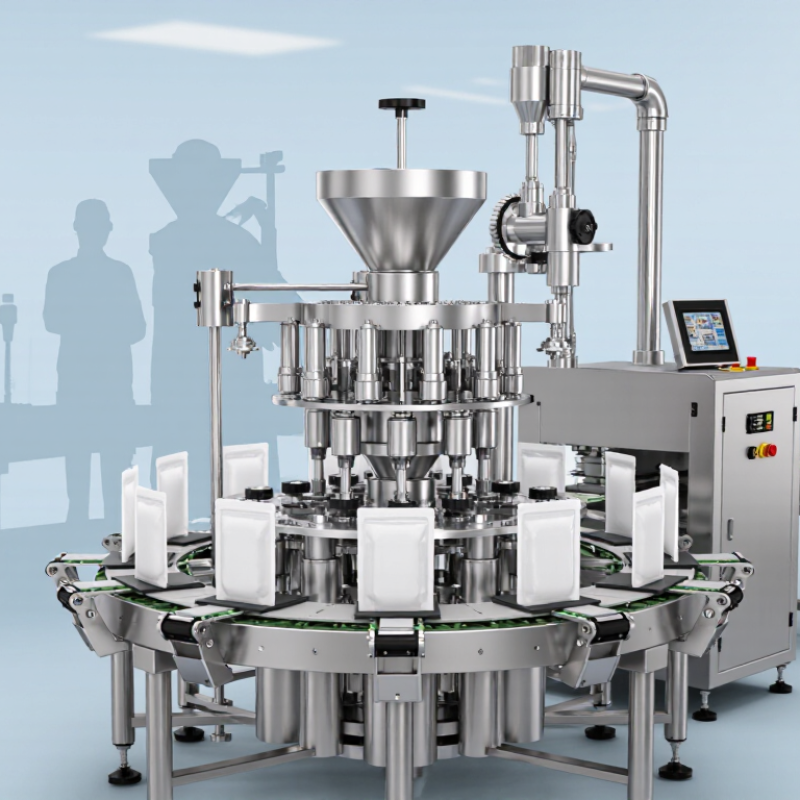
How to Choose a Rotary Pouch Packing Machine?
Define Your Product and Packaging Requirements
Your product should determine the machine, not the other way around. Start with its shape, density, moisture, temperature, and flow behavior. Powdered ingredients may bridge inside the hopper, while oily snacks can contaminate sealing jaws. Granules may require a multihead weigher for stable dosing.
Measure the target fill weight and acceptable variation. Then define pouch width, height, zipper needs, seal style, and film structure. A 2024 report from the Flexible Packaging Association valued the U.S. flexible packaging market at approximately $40 billion in 2023. This scale reflects strong demand, but every product still needs individual testing. Flexible film is not automatically suitable for every barrier requirement.
Consider oxygen, moisture, light, and aroma protection. A food product may need high-barrier laminate, while a dry household product may need a simpler structure. Review the sealing temperature range and friction of the film. Small differences can create wrinkles, weak seals, or leaking corners.
Ask for trials using your actual product and film. Watch the feed path closely. Does powder settle on the seal? Do irregular pieces damage the pouch? These observations matter more than a brochure’s maximum speed. PMMI’s 2024 State of the Industry report recorded U.S. packaging machinery shipments of about $10.2 billion in 2023, showing a mature equipment market. Yet advertised speed can mislead. Real output falls during film changes, cleaning, and adjustments. Build your specification around dependable production, not perfect test conditions.
Choosing a rotary pouch packing machine requires more than comparing speed figures. The pouch material, product texture, and required seal quality matter equally. A practical evaluation should begin with daily production volume and pouch dimensions.
Intermittent-motion rotary machines suit products needing accurate dosing and careful sealing. They pause during filling and sealing, which can improve control for powders, granules, and irregular pieces. Continuous-motion models run faster and reduce stopping time. However, they may require more precise product flow and timing. Check whether the machine supports premade pouches, zipper pouches, spouted pouches, or flat sachets. Flexibility sounds useful, but unused options can increase maintenance work.
Operating features deserve close attention. Servo-driven dosing improves repeatability, while load cells can verify fill weight during production. Adjustable sealing temperature and pressure help protect delicate films. A clear touchscreen, recipe storage, and fault history can shorten operator training. Automatic film tracking is valuable when film edges shift slightly. It still needs regular inspection. Sensors should detect empty pouches, open seals, and product trapped in the sealing area. Washdown design, tool-free access, and stainless-steel contact parts support cleaner changeovers. In production reviews, changeover time is often underestimated. Measure the full process, including cleaning, adjustment, and test packs. A faster machine may become less productive when operators struggle with access or frequent adjustments. Reliability also depends on spare-part availability, service response, and documented operating procedures.
Compare typical throughput and operating features of common rotary pouch machine configurations.
A flexible choice for standard premade pouches, powders, granules, and irregular products. It generally offers easier changeovers and moderate speed.
Designed for higher output with reduced stopping between stations. It is suitable for stable products and production lines that prioritize speed.
Removes air before sealing and is commonly selected for meat, seafood, cheese, and other products where reduced oxygen exposure is important.
Replaces pouch air with a controlled gas mixture before sealing. It supports products that require a modified atmosphere and careful seal integrity.
The chart shows representative midpoints of common industry operating ranges: approximately 30–60, 60–100, 20–50, and 20–40 pouches per minute respectively. Actual output depends on pouch size, filling volume, product characteristics, sealing time, and the number of machine stations.
Capacity, accuracy, and pouch size compatibility should guide your machine selection. A machine rated for 60 pouches per minute may slow down with heavy products, wide pouches, or delicate materials. Check the practical output, not only the advertised speed. Ask for trial data using your actual product, pouch film, and target weight.
Accuracy depends on the filling system, product flow, and weighing method. Granules may require a different filler from powders or irregular pieces. During testing, record ten or more consecutive weights. Small variations can become expensive over a long production shift.
I have seen teams focus on speed and overlook seal consistency. That mistake is easy to make. Inspect the seal width, temperature stability, and rejected pouch rate.
Pouch compatibility also needs careful checking. Confirm the minimum and maximum pouch width, height, thickness, zipper position, and spout location. A machine may handle several formats, but frequent size changes can reduce output. Changeover time matters.
Tips: Bring real pouches to the factory trial. Test the smallest and largest sizes. Leave room for future products, but do not pay for unused capacity. Write down every setting, result, and adjustment. My own preference is to repeat difficult tests, because one successful run can create false confidence.
Choosing a rotary pouch packing machine begins with the material, not the advertised speed. Film thickness, sealability, pouch size, powder flow, and product moisture all affect performance. A machine that handles dry granules may struggle with sticky products. Test your actual material before purchase. Small trials reveal problems that brochures often hide.
Automation should match your operators and production volume. Servo-driven filling, automatic film tracking, weight feedback, and recipe storage can improve consistency. Sensors should detect empty pockets, sealing faults, and film misalignment. I once underestimated changeover time; cleaning and format adjustments reduced daily output more than expected. Simple controls may be better than excessive automation.
Sanitation requires practical access. Choose smooth stainless-steel surfaces, removable contact parts, protected wiring, and designs that prevent product buildup. Check whether tools are needed for routine cleaning. Shorter cleaning routes matter. Safety cannot be treated as an optional feature. Confirm guarding, door interlocks, emergency stops, overload protection, and clear lockout procedures. Ask for risk-assessment documents and evidence of conformity with applicable local and industry standards. Do not accept vague claims. Review manuals, inspection records, and operator training requirements. A machine may meet a standard on paper, yet still create awkward cleaning or maintenance risks on the factory floor.

Installation deserves more attention than catalog speed. Measure ceiling height, floor loading, electrical capacity, compressed-air quality, and feeding distances before purchase. A machine that fits the room may still obstruct maintenance access. Request a documented commissioning plan, operator training, and format-change tests using your actual pouch film. PMMI’s State of the Industry reporting placed U.S. packaging machinery shipments at about $10.2 billion in 2022, showing a mature market where integration quality strongly affects investment value.
Maintenance should be judged through evidence, not promises. Ask for lubrication charts, fault-history exports, accessible sensors, and a critical-spares list. The U.S. Department of Energy’s Operations & Maintenance Best Practices guide reports that predictive maintenance can reduce maintenance costs by 25–30% and downtime by 35–45%. Those figures are useful, but not automatic. Poor data collection can make predictive maintenance expensive theater. Check whether technicians can diagnose sealing temperature drift before rejected pouches accumulate.
Cost includes labor, utilities, film waste, training, and lost production. Build a three-year total-cost model, then challenge every assumption. Supplier support matters here. Confirm response times, remote-access procedures, local service coverage, software-update policies, and spare-part availability. Ask for references from facilities with similar pouch sizes and changeover frequency. A low purchase price can become costly after one unavailable servo drive. I would also test the supplier’s honesty: request known limitations, not only performance claims. That conversation often reveals more than a polished demonstration.
We use cookies on our website to give you an improved browser experience. View our Privacy Policy for more information. Please make your selection to opt in or out of ALL cookies here: Accept or Decline
Do you consent to the use of ALL cookies?
901 2nd Court West
Birmingham, AL 35204
Sales: 866.481.4036
Logistics/Ops: 866.481.4036
2101 Dralle Road
University Park, IL 60466
Sales: 708.813.9070
Logistics/Ops: 708.235.4200
400 E. 13th Street
Little Rock, AR 72114
Sales: 866.760.5344
Logistics/Ops: 866.760.5344
225 Collins Road
Elkhart, IN 46515
Sales: 574.295.0214
Logistics/Ops: 574.607.4611
601 Berryman Pike
Tipton, IN 46072
Sales: 800.897.7591
Logistics/Ops: 800.897.7591
3900 Uvalda Street
Denver, CO 80239
Sales: 303.706.8000
Ops/Logistics: 303.576.8398
510 3rd Street E
Milan, IL 61264
Sales: 800.322.1052
Logistics/Ops: 800.322.1052
1660 E. Aurora
Des Moines, IA 50313
Sales: 800.671.1660
Logistics: 800.671.1660
86554 Gene Lasserre Blvd.
Yulee, FL 32097
Sales: 904.253.3060
Logistics/Ops: 904.225.3000
694 S.E. County Road 245
Lake City, FL 32025
Sales: 800.727.6706
Logistics/Ops: 386.752.7412
210 Neptune Road
Auburndale, FL 33823
Sales: 863.967.1131
Logistics/Ops: 863.777.9814
4601 McCoy Drive
Pensacola, FL 32503
Sales: 850.308.7030
Logistics/Ops: 850.434.5502
815 South 56th Street
Tampa, FL 33619
Sales: 813.302.1940
Logistics/Ops: 813.621.1352
200 Hosea Road
Lawrenceville, GA 30046
Sales: 770.953.7575
Logistics/Ops: 770.513.6000
Branch Product Guide
Branch Line Card
Moulding Offering
Cedar Offering
Column Offering
8173 Hwy. 165 North
Monroe, LA 71211
Sales: 800.256.4165
Logistics/Ops: 800.256.4165
508 Warren Avenue
Portland, ME 04103
Sales: 207.888.2331
Logistics/Ops: 207.797.6565
4300 Georgia Pacific Blvd.
Frederick, MD 21704
Sales: 301.798.7474
Logistics/Ops: 301.874.8000
419 Maple Street
Bellingham, MA 02019
Sales: 508.449.0535
Logistics/Ops: 508.966.5500
825 Buchanan Ave SW
Grand Rapids, MI 49507
Sales: 877.800.1180
Logistics/Ops: 616.278.0909
995 Pacific St. NW
Aitkin, MN 56431
Sales: 800.432.3727
Logistics/Ops: 218.212.7770
1102 Port Terminal Drive
Duluth, MN 55802
Sales: 800.951.9899
Logistics/Ops: 800.851.9899
9110 83rd Ave. North
Brooklyn Park, MN 55445
Sales: 763.425.0204
Logistics/Ops: 763.425.0204
910 E. Railroad Street
Long Beach, MS 39560
Sales: 866.535.4135
Logistics/Ops: 228.205.2400
1727 Warren Street
North Kansas City, MO 64116
Sales: 800.621.2611
Logistics/Ops: 800.621.2611
2123 North Golden
Springfield, MO 65803
Sales: 800.375.7891
Logistics/Ops: 800.375.7891
13860 Corp. Woods Trail
Bridgeton, MO 63044
Sales: 314.209.0800
Logistics/Ops: 314.209.0800
1109 South 19th Street
Omaha, NE 68108
Sales: 800.489.6637
Logistics/Ops: 800.489.6637
1 Luger Road
Denville, NJ 07834
Sales: 973-339-3539
Logistics/Ops: 973.625.1461
3720 Jeffrey Blvd.
Blasdell, NY 14219
Sales: 716.235.5989
Logistics/Ops: 716.825.6557
319 Yaphank Ave.
Yaphank, NY 11980
Sales: 631.358.5714
Logistics/Ops: 631.924.7401
3300 Parkside Drive
Charlotte, NC 28208
Sales: 800.839.2588
Logistics/Ops: 704.394.3172
1712 East D Street
Butner, NC 27509
Sales: 984.389.8200
Logistics/Ops: 919.575.3700
128 Foothills Drive
Statesville, NC 28687
Sales: 800.222.1414
Logistics/Ops: 704.394.3172
550 Munroe Falls Rd.
Tallmadge, OH 44278
Sales: 330.357.4506
Logistics/Ops: 330.794.1141
10347 Toebben Dr.
Independence, KY 41051
Sales: 859.298.3926
Logistics/Ops: 859.746.2250
450 N. MacArthur
Oklahoma City, OK 73127
Sales: 800.375.6025
Logistics/Ops: 800.375.6025
1680 North Aspen
Broken Arrow, OK 74012
Sales: 918.272.2212
Logistics/Ops: 918.272.2212
522 Bridge Street
Hunker, PA 15639
Sales: 878.217.2001
Logistics/Ops: 724.925.7285
4290 Atlanta Street
Charleston, SC 29418
Sales: 843.371.1420
Logistics/Ops: 843.554.8192
1040 S. Industrial Dr.
Erwin, TN 37650
Sales: 423.641.1005
Logistics/Ops: 423.742.5911
4287 Pilot Drive
Memphis, TN 38118
Sales: 901.365.2101
Logistics/Ops: 901.365.2101
700 Myatt Drive
Madison, TN 37115
Sales: 615.327.9547
Logistics/Ops: 629.777.4949
4747 Mark IV Parkway
Fort Worth, TX 76106
Sales: 866.323.5117
Logistics/Ops: 817.625.9091
6990 Market Avenue
El Paso, TX 79915
Sales: 915.778.6356
Logistics/Ops: 915.265.7200
2502 Wilson Road
Harlingen, TX 78552
Sales: 800.580.6711
Logistics/Ops: 800.580.6711
10,000 North Loop East
Houston, TX 77029
Sales: 713.921.1977
Logistics/Ops: 713.675.3544
702 East 44th St.
Lubbock, TX 79404
Sales: 866.454.6010
Logistics/Ops: 866.454.6010
535 N. WW White Road
San Antonio, TX 78219
Sales: 800.284.0488
Logistics/Ops: 210.333.8112
142 Pine Haven Shores Rd.
Shelburne, VT 05482
Sales: 802.800.2540
Logistics/Ops: 802.985.2512
4700 Bethlehem Road,
Richmond, VA 23230
Sales: 804.201.2400
Logistics/Ops: 804.342.1161
4516 N Barker Road
Spokane Valley, WA 99027
Phone: 509.892.9420
Toll free: 800.728.6157
8365 N. 76th Street
Milwaukee, WI 53223
Sales: 800.356.9245
Logistics/Ops: 800.356.9245
312 S. Chester Street
Sparta, WI 54656
Sales: 800.362.5864
Logistics/Ops: 800.362.5864
899 Grossman Drive
Schofield, WI 54476
Sales: 800.472.0017
Logistics/Ops: 800.472.0017
