
We use cookies on our website to give you an improved browser experience. View our Privacy Policy for more information. Please make your selection to opt in or out of ALL cookies here: Accept or Decline
Selecting cigar display cases is not a simple matter of matching wood, glass, and price. Global buyers must protect product quality, support responsible retailing, and meet different regional requirements. The World Health Organization’s WHO Report on the Global Tobacco Epidemic 2023 emphasizes the importance of regulated tobacco environments and clear consumer information. That context matters when a display case is placed in a store, lounge, or specialty retailer.
Market research from Grand View Research and Future Market Insights describes continued interest in premium cigars and cigarillos, especially through specialty retail channels. Yet market growth does not guarantee a successful display strategy. A case may look luxurious but fail to control humidity. Another may protect cigars while hiding their labels and finishes. Small details matter.
Think about a cedar-lined cabinet in a bright showroom. Heat from nearby lighting, frequent door opening, and unstable room humidity can affect storage conditions. Buyers should examine construction, sealing, ventilation, visibility, capacity, security, and maintenance before choosing cigar display cases. These decisions also influence staff efficiency and the customer’s first impression.
The best choice is rarely the most expensive model. It is the case that fits the product, location, and operating routine. Retail teams should also verify local rules for tobacco presentation, age-restricted sales, warning notices, and advertising. Requirements differ widely across countries and may change.
Some recommendations remain imperfect. No case solves poor inventory control or careless handling. That is worth remembering. The following seven tips combine practical retail experience, manufacturer specifications, and findings from recognized industry reports to support a more reliable global purchasing decision.
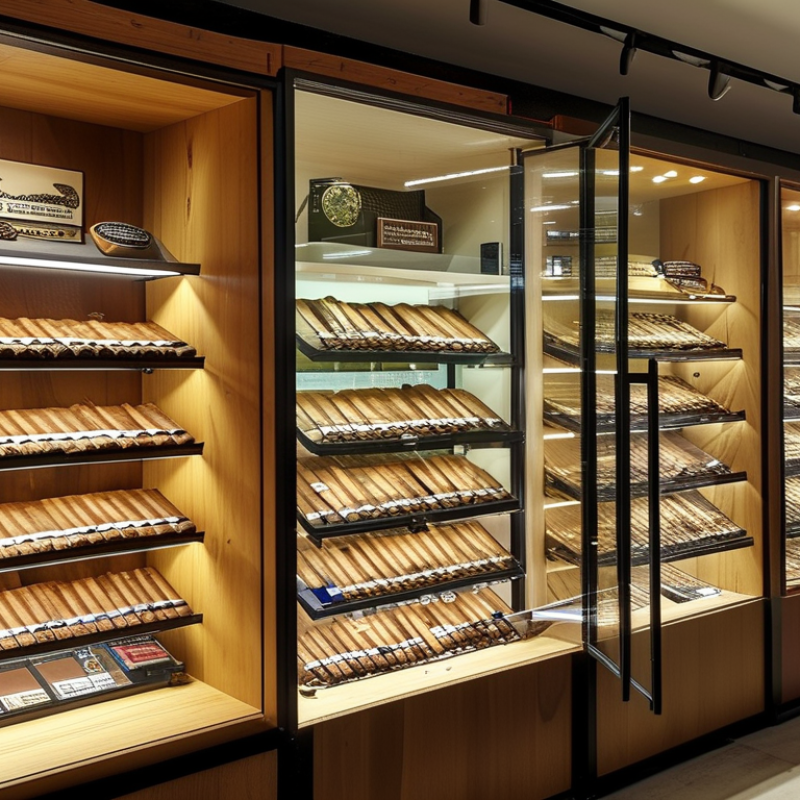
Choosing a cigar display case starts with a measurable storage target, not its wood finish. For most premium cigars, aim for 65–70% relative humidity and 65–70°F (18–21°C). This range supports stable texture, aroma, and burn behavior during normal storage. Small swings matter. Cases placed near windows, heaters, or air-conditioning vents can drift outside the target within hours. Global buyers should consider seasonal humidity before selecting capacity or location.
A reliable case needs an accurate hygrometer, a tight seal, and controlled moisture management. Digital readings are convenient, but calibration with a trusted reference remains worthwhile. Check it daily. During setup, season the interior gradually and allow the wood to reach equilibrium before loading cigars. Rushing this step can create false readings and uneven moisture. Use distilled water or an approved humidification medium, and keep liquids away from cigar wrappers. That detail is easy to overlook.
When inspecting display cases, I look for uniform seals, smooth hinges, stable shelves, and unobstructed airflow. A glass top improves presentation, yet direct sunlight can heat the interior and damage aroma. An attractive case is not automatically a stable case. Record temperature and RH for several days, especially after delivery or relocation. If readings repeatedly miss 65–70% RH or 65–70°F, adjust the environment before adding more cigars. Humidity packs alone cannot correct a poorly sealed case or a hot room. Recheck the setup.
| Selection Dimension | Recommended Target or Specification | Why It Matters for Cigar Stability | Buyer Checkpoint |
|---|---|---|---|
| 1. Relative Humidity Control | Maintain approximately 65–70% RH for most stored cigars. | Stable humidity helps reduce excessive drying, cracking, swelling, and uneven combustion. | Choose a case with an effective seal and a humidification system sized for its internal volume. |
| 2. Temperature Range | Keep the storage environment near 65–70°F (18–21°C), away from heat and direct sunlight. | Lower, steady temperatures help preserve tobacco condition and reduce the risk of rapid humidity changes. | For international shipping, confirm the case will not be placed in hot vehicles, unconditioned warehouses, or freezing areas. |
| 3. Hygrometer Accuracy | Prefer a digital hygrometer with stated accuracy of approximately ±2–3% RH and ±1°F. | A reliable reading makes it easier to identify humidity drift before cigars are affected. | Verify whether the sensor is replaceable or recalibratable and check the display unit before use. |
| 4. Interior Material | Use untreated Spanish cedar or another cigar-safe, low-odor interior material. | A suitable wood lining can buffer short-term humidity changes and support a stable storage environment. | Confirm that coatings, adhesives, and finishes are fully cured and do not produce strong odors. |
| 5. Seal and Construction | Select a rigid case with a close-fitting lid, continuous gasket, and minimal air gaps. | A dependable seal slows moisture exchange and improves the efficiency of the humidification source. | Inspect the gasket, hinges, corners, and latch; avoid warped panels or visible gaps. |
| 6. Capacity and Internal Layout | Allow approximately 10–20% unused space and provide dividers or trays where needed. | Overcrowding restricts airflow and makes it harder to maintain uniform humidity around each cigar. | Compare usable internal dimensions rather than advertised capacity; measure cigars by length and ring gauge. |
| 7. Portability and Climate Protection | For travel, choose impact-resistant construction, a secure latch, and protection from rapid temperature changes. | International transport can expose cigars to vibration, dry cabin air, heat, and sudden humidity fluctuations. | Check empty weight, external dimensions, carry-on suitability, replacement parts, and maintenance requirements. |
Choosing a cigar display case starts with the box, not the advertised capacity. Standard 25-count and 50-count boxes can vary in length, width, and height. Measure the actual box before ordering. Record all three dimensions.
A 25-count box usually suits a compact case with one display level. Leave at least 2–3 centimeters around the box for easy removal. That space also prevents corners from scraping the case. A 50-count box needs deeper shelves and stronger support. Check the shelf load rating, especially when using glass, hardwood, or metal construction. Heavy cases are not always better.
Think about access, too. A sliding tray may work well for a 25-count format. A hinged front can provide better visibility for a larger 50-count box. The door should open without touching nearby shelves. Small detail, but important. I have seen attractive cases become awkward because the internal height ignored the box lid.
Humidity control requires careful planning. A tightly packed case may limit airflow and create uneven conditions. Leave room for a calibrated hygrometer and a suitable humidification unit, if storage conditions require them. Keep measurements in both millimeters and inches when buying internationally. Conversion mistakes happen. I once approved a case with enough width but insufficient depth; the specification sheet was correct, yet the box still failed to fit. Always request an internal-dimension drawing before production.
Match Case Capacity to Standard 25- and 50-Count Cigar Boxes
Standard cigar boxes commonly contain 25 or 50 cigars. Select a display case with capacity that matches the number of boxes you plan to present: 25 cigars per box for smaller assortments and 50 cigars per box for larger assortments. The chart shows the exact cigar capacity required for one, two, or three boxes.
Aroma, humidity control, durability, and maintenance should guide the decision. Spanish cedar is often preferred because it supports a stable storage environment and adds a gentle woody scent. Its porous surface can help manage excess moisture, but it needs correct seasoning and regular inspection. Neglect it, and the wood may warp.
It lets buyers check wrappers, labels, and moisture conditions without opening the case. Thick, tempered panels resist daily handling better than thin glass. However, glass itself does not regulate humidity. A reliable seal, calibrated hygrometer, and suitable humidification system are essential. Fingerprints also appear quickly. That is a small issue, but customers notice it.
Powder-coated or stainless surfaces resist dents, stains, and changing temperatures better than untreated materials. Yet metal can transfer heat rapidly, so placement away from windows and heaters matters. Consider the case size, door seal, shelf adjustability, cleaning access, and replacement parts before buying. I have seen attractive cases fail because the hinges were weak or the interior was difficult to clean. A mixed design can work well: cedar inside, glass for viewing, and metal for structural support. Still, every material has limits. Test humidity stability for several days before loading valuable contents.
Humidity control is the most important test for a cigar display case. A case can look elegant while storing products in unstable air. Target 65–70% relative humidity, depending on the product and storage policy. Keep the range consistent.
Use a calibrated hygrometer, not an unverified dial gauge. ASTM E104-20 describes saturated salt solutions for controlled humidity checks. NIST Special Publication 250-39 also emphasizes traceable humidity calibration and measurement uncertainty. A sensor with a ±2% RH error can display 65% when the real level is 63–67%. That difference matters during long storage.
Place two hygrometers inside the case during testing. Keep one near the door and one at the rear shelf. Record readings morning and evening for seven days. Watch for sudden changes after opening. Small cases often recover slowly. That is easy to overlook. Recalibrate instruments at scheduled intervals, especially after shipping across climates. I would also question any case promising “automatic” stability without test records. Real rooms vary, seals age, and displays face warm lights. A verified reading is stronger evidence than a polished specification sheet.
Choosing a cigar display case for international use requires more than attractive wood and clear glass. Compliance can affect delivery, resale, and customer trust.
Start by identifying the destination market and its current import rules. Requirements vary by country. Ask a licensed customs broker to confirm the correct HS code. Check the declared value, origin statement, and product description. Verify FSC certification for wooden parts, including a valid chain-of-custody document. A logo alone proves little. Confirm whether wood packaging follows ISPM 15 rules. Some buyers overlook this detail.
Inspect the wood species, coatings, adhesives, and moisture resistance. Imported wood may require extra declarations. If the case includes lights, sensors, fans, or controls, request RoHS documentation. Test reports should match the actual components, not an older model. Check local electrical safety rules, voltage, frequency, plug type, and battery requirements. Keep technical files available. Customs officers may ask questions later.
Review packaging carefully. Use protective corner guards and moisture barriers during long sea transport. Confirm that the shipping carton carries accurate handling marks. Keep invoices, packing lists, certificates, and test records together. They save time during inspection. Still, paperwork is not enough. A supplier may provide incomplete or outdated evidence. I have seen attractive cases delayed because one certificate used a different product name. That mistake is easy to prevent, but often ignored. Recheck every document before shipment, and revisit the rules when the destination changes.
We use cookies on our website to give you an improved browser experience. View our Privacy Policy for more information. Please make your selection to opt in or out of ALL cookies here: Accept or Decline
Do you consent to the use of ALL cookies?
901 2nd Court West
Birmingham, AL 35204
Sales: 866.481.4036
Logistics/Ops: 866.481.4036
2101 Dralle Road
University Park, IL 60466
Sales: 708.813.9070
Logistics/Ops: 708.235.4200
400 E. 13th Street
Little Rock, AR 72114
Sales: 866.760.5344
Logistics/Ops: 866.760.5344
225 Collins Road
Elkhart, IN 46515
Sales: 574.295.0214
Logistics/Ops: 574.607.4611
601 Berryman Pike
Tipton, IN 46072
Sales: 800.897.7591
Logistics/Ops: 800.897.7591
3900 Uvalda Street
Denver, CO 80239
Sales: 303.706.8000
Ops/Logistics: 303.576.8398
510 3rd Street E
Milan, IL 61264
Sales: 800.322.1052
Logistics/Ops: 800.322.1052
1660 E. Aurora
Des Moines, IA 50313
Sales: 800.671.1660
Logistics: 800.671.1660
86554 Gene Lasserre Blvd.
Yulee, FL 32097
Sales: 904.253.3060
Logistics/Ops: 904.225.3000
694 S.E. County Road 245
Lake City, FL 32025
Sales: 800.727.6706
Logistics/Ops: 386.752.7412
210 Neptune Road
Auburndale, FL 33823
Sales: 863.967.1131
Logistics/Ops: 863.777.9814
4601 McCoy Drive
Pensacola, FL 32503
Sales: 850.308.7030
Logistics/Ops: 850.434.5502
815 South 56th Street
Tampa, FL 33619
Sales: 813.302.1940
Logistics/Ops: 813.621.1352
200 Hosea Road
Lawrenceville, GA 30046
Sales: 770.953.7575
Logistics/Ops: 770.513.6000
Branch Product Guide
Branch Line Card
Moulding Offering
Cedar Offering
Column Offering
8173 Hwy. 165 North
Monroe, LA 71211
Sales: 800.256.4165
Logistics/Ops: 800.256.4165
508 Warren Avenue
Portland, ME 04103
Sales: 207.888.2331
Logistics/Ops: 207.797.6565
4300 Georgia Pacific Blvd.
Frederick, MD 21704
Sales: 301.798.7474
Logistics/Ops: 301.874.8000
419 Maple Street
Bellingham, MA 02019
Sales: 508.449.0535
Logistics/Ops: 508.966.5500
825 Buchanan Ave SW
Grand Rapids, MI 49507
Sales: 877.800.1180
Logistics/Ops: 616.278.0909
995 Pacific St. NW
Aitkin, MN 56431
Sales: 800.432.3727
Logistics/Ops: 218.212.7770
1102 Port Terminal Drive
Duluth, MN 55802
Sales: 800.951.9899
Logistics/Ops: 800.851.9899
9110 83rd Ave. North
Brooklyn Park, MN 55445
Sales: 763.425.0204
Logistics/Ops: 763.425.0204
910 E. Railroad Street
Long Beach, MS 39560
Sales: 866.535.4135
Logistics/Ops: 228.205.2400
1727 Warren Street
North Kansas City, MO 64116
Sales: 800.621.2611
Logistics/Ops: 800.621.2611
2123 North Golden
Springfield, MO 65803
Sales: 800.375.7891
Logistics/Ops: 800.375.7891
13860 Corp. Woods Trail
Bridgeton, MO 63044
Sales: 314.209.0800
Logistics/Ops: 314.209.0800
1109 South 19th Street
Omaha, NE 68108
Sales: 800.489.6637
Logistics/Ops: 800.489.6637
1 Luger Road
Denville, NJ 07834
Sales: 973-339-3539
Logistics/Ops: 973.625.1461
3720 Jeffrey Blvd.
Blasdell, NY 14219
Sales: 716.235.5989
Logistics/Ops: 716.825.6557
319 Yaphank Ave.
Yaphank, NY 11980
Sales: 631.358.5714
Logistics/Ops: 631.924.7401
3300 Parkside Drive
Charlotte, NC 28208
Sales: 800.839.2588
Logistics/Ops: 704.394.3172
1712 East D Street
Butner, NC 27509
Sales: 984.389.8200
Logistics/Ops: 919.575.3700
128 Foothills Drive
Statesville, NC 28687
Sales: 800.222.1414
Logistics/Ops: 704.394.3172
550 Munroe Falls Rd.
Tallmadge, OH 44278
Sales: 330.357.4506
Logistics/Ops: 330.794.1141
10347 Toebben Dr.
Independence, KY 41051
Sales: 859.298.3926
Logistics/Ops: 859.746.2250
450 N. MacArthur
Oklahoma City, OK 73127
Sales: 800.375.6025
Logistics/Ops: 800.375.6025
1680 North Aspen
Broken Arrow, OK 74012
Sales: 918.272.2212
Logistics/Ops: 918.272.2212
522 Bridge Street
Hunker, PA 15639
Sales: 878.217.2001
Logistics/Ops: 724.925.7285
4290 Atlanta Street
Charleston, SC 29418
Sales: 843.371.1420
Logistics/Ops: 843.554.8192
1040 S. Industrial Dr.
Erwin, TN 37650
Sales: 423.641.1005
Logistics/Ops: 423.742.5911
4287 Pilot Drive
Memphis, TN 38118
Sales: 901.365.2101
Logistics/Ops: 901.365.2101
700 Myatt Drive
Madison, TN 37115
Sales: 615.327.9547
Logistics/Ops: 629.777.4949
4747 Mark IV Parkway
Fort Worth, TX 76106
Sales: 866.323.5117
Logistics/Ops: 817.625.9091
6990 Market Avenue
El Paso, TX 79915
Sales: 915.778.6356
Logistics/Ops: 915.265.7200
2502 Wilson Road
Harlingen, TX 78552
Sales: 800.580.6711
Logistics/Ops: 800.580.6711
10,000 North Loop East
Houston, TX 77029
Sales: 713.921.1977
Logistics/Ops: 713.675.3544
702 East 44th St.
Lubbock, TX 79404
Sales: 866.454.6010
Logistics/Ops: 866.454.6010
535 N. WW White Road
San Antonio, TX 78219
Sales: 800.284.0488
Logistics/Ops: 210.333.8112
142 Pine Haven Shores Rd.
Shelburne, VT 05482
Sales: 802.800.2540
Logistics/Ops: 802.985.2512
4700 Bethlehem Road,
Richmond, VA 23230
Sales: 804.201.2400
Logistics/Ops: 804.342.1161
4516 N Barker Road
Spokane Valley, WA 99027
Phone: 509.892.9420
Toll free: 800.728.6157
8365 N. 76th Street
Milwaukee, WI 53223
Sales: 800.356.9245
Logistics/Ops: 800.356.9245
312 S. Chester Street
Sparta, WI 54656
Sales: 800.362.5864
Logistics/Ops: 800.362.5864
899 Grossman Drive
Schofield, WI 54476
Sales: 800.472.0017
Logistics/Ops: 800.472.0017
