We use cookies on our website to give you an improved browser experience. View our Privacy Policy for more information. Please make your selection to opt in or out of ALL cookies here: Accept or Decline
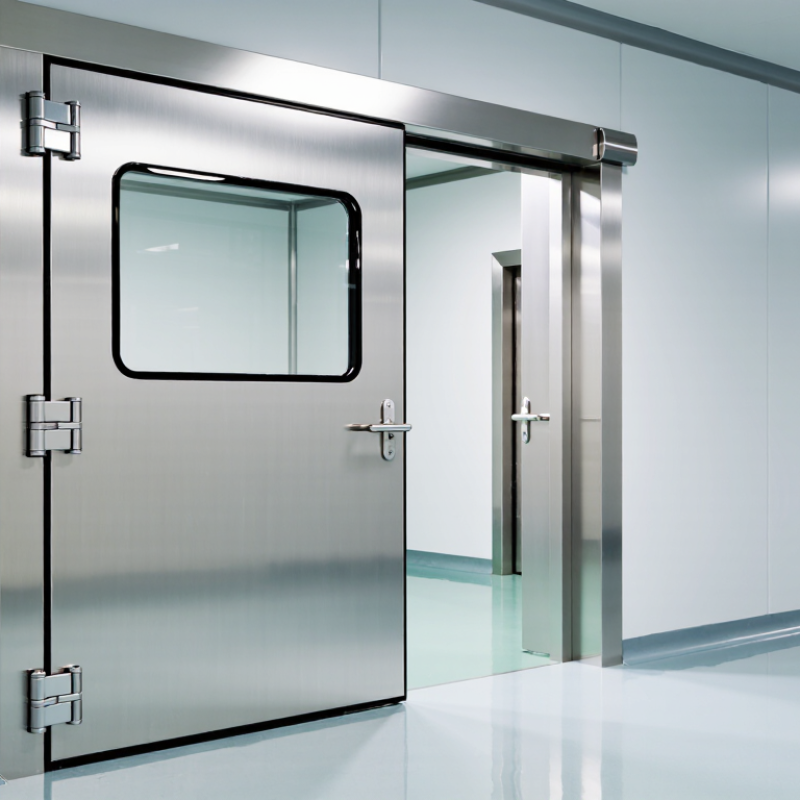
Cleanroom Swing Doors are designed to protect controlled environments from dust, microbes, pressure loss, and unnecessary air movement. They commonly use stainless steel, smooth laminates, or other cleanable surfaces. Their rounded edges reduce dirt traps. Sealed frames help limit leakage around the opening.
The operating principle is simple, but the details matter. When someone pushes the door open, hinges guide its movement and usually return it to a closed position. A gasket can compress against the frame, creating a tighter barrier. Some systems include vision panels, interlocks, or automatic closers. These features help staff observe nearby areas and reduce accidental door conflicts.
Cleanroom performance depends on more than the door itself. Pressure differentials, airflow patterns, installation quality, and maintenance all influence results. A well-sealed door cannot correct poor room design. That point is easy to overlook. Facility engineers often inspect hinges, seals, handles, and closing speed during routine qualification work. They may also check whether the door opens against the intended pressure direction.
There is no universal swing-door specification. A pharmaceutical suite may require different materials and controls than an electronics assembly room. The correct choice should match the room classification, cleaning chemicals, traffic volume, and safety requirements. Designers should review applicable standards and manufacturer data before installation. Even then, real-world use can reveal problems, such as slow closing or damaged seals. Continuous observation remains essential.
Cleanroom swing doors are hinged doors designed to control movement between spaces with different cleanliness levels. They commonly use smooth, non-shedding surfaces that tolerate repeated cleaning. Their frames fit tightly against wall panels, while gaskets reduce uncontrolled air leakage around the edges. Some models include flush vision panels, allowing staff to check the next room before opening.
The operation is simple but carefully controlled. A user pushes or pulls the door through its swing path, and hinges guide it back toward the closed position. A closer may complete this movement slowly, preventing sudden pressure changes and accidental impacts.
In higher-control areas, an interlock prevents two connected doors from opening together. This helps protect room pressure and reduces unnecessary air exchange.
Cleanroom swing doors are not magic barriers. Their performance depends on correct installation, seal condition, cleaning methods, and user behavior. Even a small gap under the door can weaken the room’s pressure balance. In practice, operators should inspect hinges, latches, gaskets, and viewing panels regularly. Door traffic also matters. Frequent opening can carry particles into a controlled area, even when the door itself is well designed. The details are easy to overlook. That is where many problems begin.
Cleanroom swing doors are built to control movement, air leakage, and contamination between controlled areas. Their construction usually starts with a rigid metal skin surrounding an insulated, low-shedding core. Stainless steel or coated steel provides a smooth surface that tolerates frequent cleaning. Welded or sealed joints reduce dirt traps around the frame. The details matter. Flush faces are easier to wipe than decorative profiles. A small, poorly sealed gap can still disturb room pressure.
Key components include hinges, a door closer, a latch, perimeter gaskets, and a vision panel. Hinges must support repeated cycles without creating excessive movement. The closer returns the leaf to its sealed position, while the latch keeps compression consistent. Flexible gaskets fill the contact line between door and frame. Many designs include a narrow, impact-resistant window for safer visibility. Some doors also use kick plates, automatic operators, or access controls, depending on the room’s workflow.
In operation, a user pushes or pulls the door through its swing path. The closer then guides it back against the frame, compressing the gasket. This action helps maintain pressure differences and limits uncontrolled airflow. However, a cleanroom door is not a complete contamination solution. Poor installation, damaged seals, or careless traffic can weaken performance. In practice, door selection should reflect trolley size, cleaning chemicals, opening frequency, and maintenance skill. A technically strong door may still fail when the surrounding frame is uneven. That is worth checking.
Cleanroom swing doors control movement between areas with different cleanliness levels. They usually have a rigid, smooth panel, sealed edges, and corrosion-resistant hardware. The door opens when a person pushes the handle or activates an approved access control device. Hinges then guide the panel through a controlled arc. A closer returns it to the frame without requiring another touch.
The sealing action matters more than the swing itself. As the panel closes, its edges meet compression gaskets around the frame. These gaskets limit uncontrolled air leakage and reduce the entry of particles. Many cleanrooms also use interlocks. One door must close before another can open. This simple sequence protects pressure differences and discourages rushed traffic. Airflow still depends on room design, filtration, and pressure control.
Operators should move slowly and check the door after every passage. A partly open door can disrupt airflow within seconds. In daily inspections, technicians look for damaged seals, loose hinges, and delayed closing. Small gaps are easy to overlook. That is where practice can fail. A door may appear clean but still leak around its lower edge. Regular cleaning, functional testing, and documented maintenance provide stronger evidence than appearance alone.
Cleanroom swing doors support airflow control by limiting uncontrolled air exchange between adjacent spaces. They usually include a rigid door leaf, perimeter seals, hinges, and a self-closing mechanism. Some systems also use interlocking controls, preventing two connected doors from opening together. This creates a practical airlock effect. Small gaps matter.
In practice, the door works with the room’s pressure cascade, not alone. EU GMP Annex 1 identifies 10 Pa as a guidance value between adjacent rooms of different grades. When the door opens, pressure temporarily equalizes and air turbulence can carry particles across the threshold. Operators should therefore minimize opening time and avoid blocking the closing path. A poor seal can quietly defeat an otherwise well-designed ventilation system.
ISO 14644-1:2015 sets a maximum concentration of 3,520 particles per cubic meter at 0.5 micrometers for an ISO Class 5 environment. The limit rises to 352,000 particles for ISO Class 7. These figures show why door movement and cleaning routines require control. Door surfaces, handles, hinges, and floor-level edges need documented inspection. A self-closing door is helpful, but it is not contamination-proof. That assumption deserves review. Performance testing should include leakage checks, pressure monitoring, and airflow visualization under realistic traffic conditions.
| Data Dimension | Typical Specification or Characteristic | How It Works | Contamination-Control Relevance |
|---|---|---|---|
| Door Definition | A hinged personnel or material door designed for controlled environments. | The door leaf rotates around vertical hinges and closes against a frame fitted with seals or gaskets. | A controlled closing interface limits uncontrolled air exchange and helps maintain the room’s cleanliness conditions. |
| Common Door Configuration | Single-leaf or double-leaf swing construction; single-leaf doors are common for personnel access. | Double-leaf doors can provide a wider clear opening for carts, equipment, or larger loads. | The configuration should match traffic volume, equipment size, and the required cleanroom zoning strategy. |
| Typical Construction Materials | Powder-coated or stainless steel surfaces, insulated cores, flush panels, and corrosion-resistant hardware. | Smooth, non-shedding surfaces are formed to reduce exposed joints, ledges, and areas where particles can accumulate. | Non-porous and cleanable materials support routine disinfection and reduce particle retention. |
| Surface Design | Flush door faces, radiused edges where practical, sealed joints, and minimal projecting hardware. | The door is designed to eliminate or reduce recesses that are difficult to wipe or disinfect. | Simplified geometry lowers the risk of residue buildup and makes cleaning more repeatable. |
| Sealing System | Perimeter gaskets or compression seals are commonly installed around the frame and door leaf. | When the door closes, the gasket compresses against the mating surface and reduces leakage paths. | Effective sealing helps prevent uncontrolled infiltration from adjacent areas, although it does not make the door completely airtight. |
| Airflow Function | The door supports airflow control but does not independently regulate room airflow. | Room pressure, supply air, return air, and exhaust systems establish the pressure and airflow pattern; the closed door helps preserve that condition. | Correct door installation complements the HVAC design and helps maintain the intended pressure cascade. |
| Pressure Cascade | Many facilities use a positive-pressure cascade from cleaner spaces toward less-clean spaces; some containment areas use negative pressure. | Air moves through intentional transfer paths from higher pressure to lower pressure when the door is closed or opened. | The pressure direction should be selected according to whether the primary objective is product protection or containment of hazardous materials. |
| Typical Pressure Differential | Project values are commonly specified in the low-Pascal range, often approximately 5–15 Pa between adjacent zones. | The building-management or HVAC system maintains the differential; door leakage and opening events temporarily disturb it. | The exact value must be established by the facility’s validated design, risk assessment, and applicable regulations. |
| Door Opening Direction | Opening direction is selected according to pressure relationships, life-safety rules, workflow, and containment requirements. | Pressure forces can make a door easier or harder to open depending on the direction of the pressure differential and the door area. | Correct planning reduces accidental pressure loss and supports safe, unidirectional movement of personnel and materials. |
| Self-Closing Mechanism | Hydraulic, pneumatic, or mechanical closers are commonly used. | The closer returns the door to the closed position after passage without requiring manual handling. | Fast and reliable closure reduces the time that contaminated or unfiltered air can migrate between zones. |
| Vision Panel | Flush, sealed glazing may be incorporated for visibility between adjacent areas. | Personnel can check the opposite side before opening, reducing unnecessary door cycles and collision risks. | Fewer unnecessary openings help stabilize pressure and reduce particle transfer caused by traffic. |
| Interlocking Option | Doors serving airlocks or change rooms may be connected to an access-control interlock system. | One door remains locked or unavailable while the other door is open, subject to the control sequence. | Interlocking prevents direct simultaneous openings that could cause a rapid pressure disturbance between zones. |
| Airlock Application | Two or more doors can form a personnel, material, or pass-through airlock. | The airlock creates a buffer space between areas with different cleanliness or pressure requirements. | Airlocks reduce direct cross-contamination and help separate gowning, production, storage, and exit activities. |
| Traffic Control | Access is typically limited to trained personnel and authorized material movements. | Procedures control who opens the door, how long it remains open, and the sequence of entry and exit. | Operational discipline is essential because frequent or prolonged openings can defeat the benefits of the door design. |
| Cleanroom Classification | Suitability is evaluated against the required cleanliness classification, such as ISO classifications defined by ISO 14644-1. | The door forms part of the room envelope and is assessed together with HVAC, filtration, finishes, and operating procedures. | A door alone cannot establish an ISO cleanroom classification; the complete facility must meet the required airborne-particle limits. |
| Cleaning Compatibility | Materials and sealants should tolerate the facility’s approved detergents, disinfectants, and cleaning frequency. | Compatible surfaces maintain their integrity when repeatedly wiped or chemically disinfected. | Material compatibility prevents flaking, corrosion, swelling, and degradation that could generate particles or harbor microorganisms. |
| Threshold Design | Flush or low-profile thresholds may be used where permitted by the room layout and safety requirements. | A reduced threshold profile improves cleanability and allows carts or equipment to pass with less vibration. | Thresholds should not create inaccessible dirt traps or interfere with the required seal and pressure-control strategy. |
| Leakage Consideration | Leakage depends on gasket compression, frame installation, door alignment, hardware condition, and pressure difference. | Any gap around the closed door becomes a potential path for unintended air movement. | Periodic inspection and adjustment help preserve the designed airflow direction and reduce contamination migration. |
| Maintenance Checks | Routine checks typically include hinges, closer speed, latch engagement, gasket condition, alignment, and surface damage. | Maintenance keeps the door closing fully and ensures that seals remain continuous and resilient. | Preventive maintenance reduces particle generation, door-drift events, pressure instability, and unplanned downtime. |
| Validation and Testing | Testing may include visual inspection, pressure-difference verification, airflow visualization, particle monitoring, and door-operation checks. | Testing confirms that the installed door operates as part of the complete environmental-control system. | Performance should be verified during commissioning and periodically according to the facility’s quality program and risk assessment. |
| Main Limitation | A swing door is not a substitute for filtration, ventilation, pressure control, or proper personnel procedures. | Its contribution is primarily mechanical containment, controlled access, and reduction of uncontrolled air exchange. | Effective contamination prevention requires the door, HVAC system, cleaning program, gowning practices, and user behavior to work together. |

Cleanroom swing doors control movement while protecting pressure, airflow, and particle limits. Common types include single-leaf, double-leaf, manual, and automatic models. Flush, sealed surfaces reduce dust traps. Vision panels improve safety without opening the door. In pharmaceutical areas, interlocked doors help prevent two openings at once. ISO 14644-1:2015 classifies ISO 5 environments at no more than 3,520 particles per cubic metre at 0.5 micrometres. A poorly sealed door can compromise that target quickly.
Their uses vary across pharmaceutical, medical-device, food, and laboratory facilities. Doors should support the room’s pressure cascade, not replace filtration or cleaning controls. EU GMP Annex 1, published in 2022, gives 10 pascals as a guidance value between rooms of different grades. In field inspections, the hinge side often fails before the panel. Inspectors should check gaskets, closers, latches, sweeps, and frame joints. A clean appearance is not proof of tightness. That assumption deserves more doubt.
Tips: Wipe doors with approved, low-lint materials. Do not spray liquid directly into hinges or sensors. Check closing speed and latch engagement weekly. Record damaged seals immediately. Use calibrated pressure and particle instruments during qualification. Maintenance intervals should follow traffic volume, room classification, and risk assessment. High-use doors may need monthly hardware checks, although fixed schedules can miss real operating problems. Observe the door during busy shifts, not only during inspections.
We use cookies on our website to give you an improved browser experience. View our Privacy Policy for more information. Please make your selection to opt in or out of ALL cookies here: Accept or Decline
Do you consent to the use of ALL cookies?
901 2nd Court West
Birmingham, AL 35204
Sales: 866.481.4036
Logistics/Ops: 866.481.4036
2101 Dralle Road
University Park, IL 60466
Sales: 708.813.9070
Logistics/Ops: 708.235.4200
400 E. 13th Street
Little Rock, AR 72114
Sales: 866.760.5344
Logistics/Ops: 866.760.5344
225 Collins Road
Elkhart, IN 46515
Sales: 574.295.0214
Logistics/Ops: 574.607.4611
601 Berryman Pike
Tipton, IN 46072
Sales: 800.897.7591
Logistics/Ops: 800.897.7591
3900 Uvalda Street
Denver, CO 80239
Sales: 303.706.8000
Ops/Logistics: 303.576.8398
510 3rd Street E
Milan, IL 61264
Sales: 800.322.1052
Logistics/Ops: 800.322.1052
1660 E. Aurora
Des Moines, IA 50313
Sales: 800.671.1660
Logistics: 800.671.1660
86554 Gene Lasserre Blvd.
Yulee, FL 32097
Sales: 904.253.3060
Logistics/Ops: 904.225.3000
694 S.E. County Road 245
Lake City, FL 32025
Sales: 800.727.6706
Logistics/Ops: 386.752.7412
210 Neptune Road
Auburndale, FL 33823
Sales: 863.967.1131
Logistics/Ops: 863.777.9814
4601 McCoy Drive
Pensacola, FL 32503
Sales: 850.308.7030
Logistics/Ops: 850.434.5502
815 South 56th Street
Tampa, FL 33619
Sales: 813.302.1940
Logistics/Ops: 813.621.1352
200 Hosea Road
Lawrenceville, GA 30046
Sales: 770.953.7575
Logistics/Ops: 770.513.6000
Branch Product Guide
Branch Line Card
Moulding Offering
Cedar Offering
Column Offering
8173 Hwy. 165 North
Monroe, LA 71211
Sales: 800.256.4165
Logistics/Ops: 800.256.4165
508 Warren Avenue
Portland, ME 04103
Sales: 207.888.2331
Logistics/Ops: 207.797.6565
4300 Georgia Pacific Blvd.
Frederick, MD 21704
Sales: 301.798.7474
Logistics/Ops: 301.874.8000
419 Maple Street
Bellingham, MA 02019
Sales: 508.449.0535
Logistics/Ops: 508.966.5500
825 Buchanan Ave SW
Grand Rapids, MI 49507
Sales: 877.800.1180
Logistics/Ops: 616.278.0909
995 Pacific St. NW
Aitkin, MN 56431
Sales: 800.432.3727
Logistics/Ops: 218.212.7770
1102 Port Terminal Drive
Duluth, MN 55802
Sales: 800.951.9899
Logistics/Ops: 800.851.9899
9110 83rd Ave. North
Brooklyn Park, MN 55445
Sales: 763.425.0204
Logistics/Ops: 763.425.0204
910 E. Railroad Street
Long Beach, MS 39560
Sales: 866.535.4135
Logistics/Ops: 228.205.2400
1727 Warren Street
North Kansas City, MO 64116
Sales: 800.621.2611
Logistics/Ops: 800.621.2611
2123 North Golden
Springfield, MO 65803
Sales: 800.375.7891
Logistics/Ops: 800.375.7891
13860 Corp. Woods Trail
Bridgeton, MO 63044
Sales: 314.209.0800
Logistics/Ops: 314.209.0800
1109 South 19th Street
Omaha, NE 68108
Sales: 800.489.6637
Logistics/Ops: 800.489.6637
1 Luger Road
Denville, NJ 07834
Sales: 973-339-3539
Logistics/Ops: 973.625.1461
3720 Jeffrey Blvd.
Blasdell, NY 14219
Sales: 716.235.5989
Logistics/Ops: 716.825.6557
319 Yaphank Ave.
Yaphank, NY 11980
Sales: 631.358.5714
Logistics/Ops: 631.924.7401
3300 Parkside Drive
Charlotte, NC 28208
Sales: 800.839.2588
Logistics/Ops: 704.394.3172
1712 East D Street
Butner, NC 27509
Sales: 984.389.8200
Logistics/Ops: 919.575.3700
128 Foothills Drive
Statesville, NC 28687
Sales: 800.222.1414
Logistics/Ops: 704.394.3172
550 Munroe Falls Rd.
Tallmadge, OH 44278
Sales: 330.357.4506
Logistics/Ops: 330.794.1141
10347 Toebben Dr.
Independence, KY 41051
Sales: 859.298.3926
Logistics/Ops: 859.746.2250
450 N. MacArthur
Oklahoma City, OK 73127
Sales: 800.375.6025
Logistics/Ops: 800.375.6025
1680 North Aspen
Broken Arrow, OK 74012
Sales: 918.272.2212
Logistics/Ops: 918.272.2212
522 Bridge Street
Hunker, PA 15639
Sales: 878.217.2001
Logistics/Ops: 724.925.7285
4290 Atlanta Street
Charleston, SC 29418
Sales: 843.371.1420
Logistics/Ops: 843.554.8192
1040 S. Industrial Dr.
Erwin, TN 37650
Sales: 423.641.1005
Logistics/Ops: 423.742.5911
4287 Pilot Drive
Memphis, TN 38118
Sales: 901.365.2101
Logistics/Ops: 901.365.2101
700 Myatt Drive
Madison, TN 37115
Sales: 615.327.9547
Logistics/Ops: 629.777.4949
4747 Mark IV Parkway
Fort Worth, TX 76106
Sales: 866.323.5117
Logistics/Ops: 817.625.9091
6990 Market Avenue
El Paso, TX 79915
Sales: 915.778.6356
Logistics/Ops: 915.265.7200
2502 Wilson Road
Harlingen, TX 78552
Sales: 800.580.6711
Logistics/Ops: 800.580.6711
10,000 North Loop East
Houston, TX 77029
Sales: 713.921.1977
Logistics/Ops: 713.675.3544
702 East 44th St.
Lubbock, TX 79404
Sales: 866.454.6010
Logistics/Ops: 866.454.6010
535 N. WW White Road
San Antonio, TX 78219
Sales: 800.284.0488
Logistics/Ops: 210.333.8112
142 Pine Haven Shores Rd.
Shelburne, VT 05482
Sales: 802.800.2540
Logistics/Ops: 802.985.2512
4700 Bethlehem Road,
Richmond, VA 23230
Sales: 804.201.2400
Logistics/Ops: 804.342.1161
4516 N Barker Road
Spokane Valley, WA 99027
Phone: 509.892.9420
Toll free: 800.728.6157
8365 N. 76th Street
Milwaukee, WI 53223
Sales: 800.356.9245
Logistics/Ops: 800.356.9245
312 S. Chester Street
Sparta, WI 54656
Sales: 800.362.5864
Logistics/Ops: 800.362.5864
899 Grossman Drive
Schofield, WI 54476
Sales: 800.472.0017
Logistics/Ops: 800.472.0017