
We use cookies on our website to give you an improved browser experience. View our Privacy Policy for more information. Please make your selection to opt in or out of ALL cookies here: Accept or Decline
Dichroic Beamsplitters are essential optical devices in various applications, from telecommunications to medical imaging. According to a recent market analysis by Global Industry Analysts, the dichroic beamsplitter industry is projected to grow by 6% annually, reflecting its increasing importance in high-tech solutions. These devices utilize selective wavelength transmission, allowing specific light wavelengths to pass while reflecting others. Their precision and efficiency are critical in modern optical systems.
Dr. Emily Carter, a renowned expert in optical engineering, stated, “The dichroic beamsplitter is a cornerstone technology that enhances the performance of many optical systems.” This highlights the device's significance in improving image quality and system reliability. Despite their advantages, users must navigate challenges such as alignment issues and varying performance across wavelengths. Different designs exist, each with unique attributes and applications, making it crucial for professionals to choose the right type for their needs.
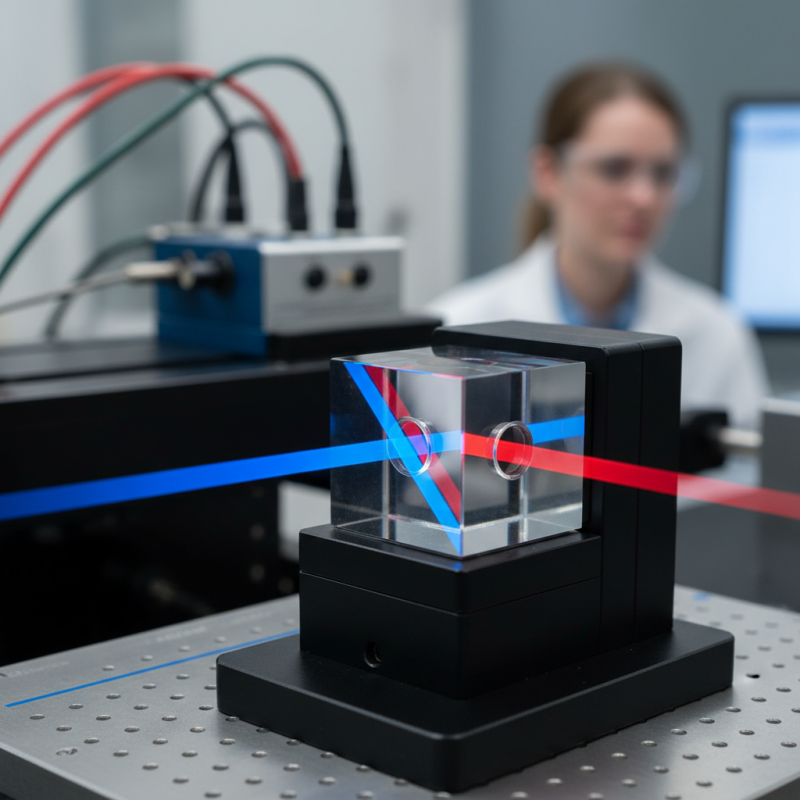
A dichroic beamsplitter is an optical device that selectively transmits certain wavelengths of light while reflecting others. This unique functionality makes it a crucial component in various applications, including microscopy, imaging, and laser systems. The beamsplitter uses thin film coatings to achieve its selective filtering. This coating is engineered to allow specific wavelengths to pass through while reflecting others at precise angles.
When light strikes a dichroic beamsplitter, it interacts with the coated surface. Depending on the wavelength, some light is transmitted, and some is reflected. This characteristic allows users to separate and manipulate colors efficiently. In a laboratory setting, for instance, dichroic beamsplitters help scientists analyze complex samples. They can identify specific fluorescence signals from a composite image.
However, using a dichroic beamsplitter isn’t without challenges. The performance can vary based on angle and polarization, which requires careful calibration. It’s important to note that the integrated coatings might degrade over time, impacting reliability. Regular maintenance and assessments are vital to ensure peak performance. Adapting to these factors is essential for obtaining accurate results in optical systems. Understanding these intricacies makes the dichroic beamsplitter a fascinating tool in modern optics.
Dichroic beamsplitters are optical devices designed to separate light into two distinct paths based on wavelength. The principle of operation relies on thin-film interference. This technology uses multiple layers of materials to create specific optical characteristics. These films are precisely engineered to reflect certain wavelengths of light while allowing others to pass through. The result is a highly efficient separation of colors.
When light encounters a dichroic beamsplitter, it reflects the designated wavelengths while transmitting others. For instance, blue light may be reflected, while red light passes through. This is particularly useful in applications such as fluorescence microscopy and projection systems. However, achieving the perfect balance between reflection and transmission can be challenging. Each layer must be carefully controlled to ensure optimal performance.
The construction of these beamsplitters often involves complex manufacturing processes. Small variations in layer thickness can lead to substantial differences in performance. This aspect requires continual refinement and meticulous attention to detail. However, even minor imperfections can influence the overall effectiveness of the device. Users must evaluate the spectral performance to make informed decisions. This balance of science and art reflects the ongoing drive for advancements in optical technology.
Dichroic beamsplitters play a crucial role in optical systems across various applications. These devices are designed to selectively transmit certain wavelengths of light while reflecting others. In medical imaging techniques such as fluorescence microscopy, dichroic beamsplitters are essential. They allow for the separation of excitation and emission wavelengths, enhancing image clarity and resolution.
In commercial applications, dichroic beamsplitters are vital for color separation in projectors. They contribute to the high-quality color reproduction found in modern displays. According to a report by MarketsandMarkets, the optical components market, including beamsplitters, is expected to reach a value of $55 billion by 2024. This growth indicates the increasing reliance on these technologies in various fields including telecommunications and entertainment.
However, selecting the right dichroic beamsplitter can be challenging. Users must consider factors such as wavelength range, angle of incidence, and surface quality. Poor choices may lead to reduced performance and color distortion. Continuous advances in materials science are necessary to improve the efficiency and reliability of these devices, ensuring that optical systems can meet evolving demands.
| Property | Description |
|---|---|
| Definition | A dichroic beamsplitter is an optical device that reflects one wavelength of light while allowing another to pass through. |
| Working Principle | It utilizes optical coatings that are designed to selectively reflect and transmit specific wavelengths based on the angle of incidence. |
| Common Applications | Used in fluorescence microscopy, multi-wavelength imaging systems, and in laser systems to separate pump and signal beams. |
| Advantages | High efficiency, minimized losses in light intensity, and tailored wavelength transmission/reflection for specific applications. |
| Limitations | Performance can be affected by angle of incidence, and they may require precise alignment in optical setups. |
| Material Used | Typically made from glass substrates with specialized coatings to achieve desired optical properties. |
Dichroic beamsplitters are specialized optical devices that separate light into different wavelengths. Their unique properties make them vastly different from traditional beamsplitters. A dichroic beamsplitter reflects one wavelength while transmitting others. This property allows for efficient separation of spectral components in applications like fluorescence and spectroscopy.
Traditional beamsplitters, on the other hand, typically reflect and transmit light based on a fixed ratio. They do not distinguish between different wavelengths. This limitation can result in reduced performance in analytical setups. Industry reports indicate that dichroic beamsplitters can enhance signal strength by over 50% in certain applications due to their selective transmission. Their efficiency is crucial in high-precision experiments.
Tip: When selecting a beamsplitter, consider your specific application. Review the spectral range you'll be working with. This can significantly influence your results.
Another point of reflection lies in polarization. Traditional beamsplitters often introduce unwanted polarization effects. Dichroic beamsplitters can mitigate these effects in certain configurations, providing cleaner signals. However, achieving optimal results requires careful alignment and understanding of the light source characteristics. Ensure you assess both aspects in your optical setup.
Tip: Regular calibration is vital. It ensures that your beamsplitters perform at their best. This practice can save time and resources in the long run.
Dichroic beamsplitters are critical components in optical systems. They separate light into two different paths based on wavelength. Several factors can significantly affect their performance.
One key factor is the angle of incidence. A beamsplitter's effectiveness can vary with how light hits its surface. Optimal angles help achieve better separation and reduce reflections. Variations in these angles, even slight ones, can impact the quality of the output. Users must pay attention to this detail to ensure efficiency.
Coating quality is another major consideration. The layer of optical coating on a beamsplitter directly influences its transmission and reflection properties. Imperfections in the coating can lead to unwanted losses. Manufacturers often optimize these coatings, but even small defects can become problematic. Continuous assessment of the performance is necessary, as environmental factors can degrade the coating over time. Understanding these nuances allows users to make informed choices about their optical setups.
We use cookies on our website to give you an improved browser experience. View our Privacy Policy for more information. Please make your selection to opt in or out of ALL cookies here: Accept or Decline
Do you consent to the use of ALL cookies?
901 2nd Court West
Birmingham, AL 35204
Sales: 866.481.4036
Logistics/Ops: 866.481.4036
2101 Dralle Road
University Park, IL 60466
Sales: 708.813.9070
Logistics/Ops: 708.235.4200
400 E. 13th Street
Little Rock, AR 72114
Sales: 866.760.5344
Logistics/Ops: 866.760.5344
225 Collins Road
Elkhart, IN 46515
Sales: 574.295.0214
Logistics/Ops: 574.607.4611
601 Berryman Pike
Tipton, IN 46072
Sales: 800.897.7591
Logistics/Ops: 800.897.7591
3900 Uvalda Street
Denver, CO 80239
Sales: 303.706.8000
Ops/Logistics: 303.576.8398
510 3rd Street E
Milan, IL 61264
Sales: 800.322.1052
Logistics/Ops: 800.322.1052
1660 E. Aurora
Des Moines, IA 50313
Sales: 800.671.1660
Logistics: 800.671.1660
86554 Gene Lasserre Blvd.
Yulee, FL 32097
Sales: 904.253.3060
Logistics/Ops: 904.225.3000
694 S.E. County Road 245
Lake City, FL 32025
Sales: 800.727.6706
Logistics/Ops: 386.752.7412
210 Neptune Road
Auburndale, FL 33823
Sales: 863.967.1131
Logistics/Ops: 863.777.9814
4601 McCoy Drive
Pensacola, FL 32503
Sales: 850.308.7030
Logistics/Ops: 850.434.5502
815 South 56th Street
Tampa, FL 33619
Sales: 813.302.1940
Logistics/Ops: 813.621.1352
200 Hosea Road
Lawrenceville, GA 30046
Sales: 770.953.7575
Logistics/Ops: 770.513.6000
Branch Product Guide
Branch Line Card
Moulding Offering
Cedar Offering
Column Offering
8173 Hwy. 165 North
Monroe, LA 71211
Sales: 800.256.4165
Logistics/Ops: 800.256.4165
508 Warren Avenue
Portland, ME 04103
Sales: 207.888.2331
Logistics/Ops: 207.797.6565
4300 Georgia Pacific Blvd.
Frederick, MD 21704
Sales: 301.798.7474
Logistics/Ops: 301.874.8000
419 Maple Street
Bellingham, MA 02019
Sales: 508.449.0535
Logistics/Ops: 508.966.5500
825 Buchanan Ave SW
Grand Rapids, MI 49507
Sales: 877.800.1180
Logistics/Ops: 616.278.0909
995 Pacific St. NW
Aitkin, MN 56431
Sales: 800.432.3727
Logistics/Ops: 218.212.7770
1102 Port Terminal Drive
Duluth, MN 55802
Sales: 800.951.9899
Logistics/Ops: 800.851.9899
9110 83rd Ave. North
Brooklyn Park, MN 55445
Sales: 763.425.0204
Logistics/Ops: 763.425.0204
910 E. Railroad Street
Long Beach, MS 39560
Sales: 866.535.4135
Logistics/Ops: 228.205.2400
1727 Warren Street
North Kansas City, MO 64116
Sales: 800.621.2611
Logistics/Ops: 800.621.2611
2123 North Golden
Springfield, MO 65803
Sales: 800.375.7891
Logistics/Ops: 800.375.7891
13860 Corp. Woods Trail
Bridgeton, MO 63044
Sales: 314.209.0800
Logistics/Ops: 314.209.0800
1109 South 19th Street
Omaha, NE 68108
Sales: 800.489.6637
Logistics/Ops: 800.489.6637
1 Luger Road
Denville, NJ 07834
Sales: 973-339-3539
Logistics/Ops: 973.625.1461
3720 Jeffrey Blvd.
Blasdell, NY 14219
Sales: 716.235.5989
Logistics/Ops: 716.825.6557
319 Yaphank Ave.
Yaphank, NY 11980
Sales: 631.358.5714
Logistics/Ops: 631.924.7401
3300 Parkside Drive
Charlotte, NC 28208
Sales: 800.839.2588
Logistics/Ops: 704.394.3172
1712 East D Street
Butner, NC 27509
Sales: 984.389.8200
Logistics/Ops: 919.575.3700
128 Foothills Drive
Statesville, NC 28687
Sales: 800.222.1414
Logistics/Ops: 704.394.3172
550 Munroe Falls Rd.
Tallmadge, OH 44278
Sales: 330.357.4506
Logistics/Ops: 330.794.1141
10347 Toebben Dr.
Independence, KY 41051
Sales: 859.298.3926
Logistics/Ops: 859.746.2250
450 N. MacArthur
Oklahoma City, OK 73127
Sales: 800.375.6025
Logistics/Ops: 800.375.6025
1680 North Aspen
Broken Arrow, OK 74012
Sales: 918.272.2212
Logistics/Ops: 918.272.2212
522 Bridge Street
Hunker, PA 15639
Sales: 878.217.2001
Logistics/Ops: 724.925.7285
4290 Atlanta Street
Charleston, SC 29418
Sales: 843.371.1420
Logistics/Ops: 843.554.8192
1040 S. Industrial Dr.
Erwin, TN 37650
Sales: 423.641.1005
Logistics/Ops: 423.742.5911
4287 Pilot Drive
Memphis, TN 38118
Sales: 901.365.2101
Logistics/Ops: 901.365.2101
700 Myatt Drive
Madison, TN 37115
Sales: 615.327.9547
Logistics/Ops: 629.777.4949
4747 Mark IV Parkway
Fort Worth, TX 76106
Sales: 866.323.5117
Logistics/Ops: 817.625.9091
6990 Market Avenue
El Paso, TX 79915
Sales: 915.778.6356
Logistics/Ops: 915.265.7200
2502 Wilson Road
Harlingen, TX 78552
Sales: 800.580.6711
Logistics/Ops: 800.580.6711
10,000 North Loop East
Houston, TX 77029
Sales: 713.921.1977
Logistics/Ops: 713.675.3544
702 East 44th St.
Lubbock, TX 79404
Sales: 866.454.6010
Logistics/Ops: 866.454.6010
535 N. WW White Road
San Antonio, TX 78219
Sales: 800.284.0488
Logistics/Ops: 210.333.8112
142 Pine Haven Shores Rd.
Shelburne, VT 05482
Sales: 802.800.2540
Logistics/Ops: 802.985.2512
4700 Bethlehem Road,
Richmond, VA 23230
Sales: 804.201.2400
Logistics/Ops: 804.342.1161
4516 N Barker Road
Spokane Valley, WA 99027
Phone: 509.892.9420
Toll free: 800.728.6157
8365 N. 76th Street
Milwaukee, WI 53223
Sales: 800.356.9245
Logistics/Ops: 800.356.9245
312 S. Chester Street
Sparta, WI 54656
Sales: 800.362.5864
Logistics/Ops: 800.362.5864
899 Grossman Drive
Schofield, WI 54476
Sales: 800.472.0017
Logistics/Ops: 800.472.0017
