
We use cookies on our website to give you an improved browser experience. View our Privacy Policy for more information. Please make your selection to opt in or out of ALL cookies here: Accept or Decline
A golf umbrella is larger, stronger, and more versatile than a typical rain umbrella. Its wide canopy can protect two people, a golf bag, or a stroller from sudden showers. The name comes from the course, where players need reliable coverage across open, windy ground. However, many people now use golf umbrellas for commuting, travel, sports, and outdoor events.
Choosing among golf umbrellas requires more than measuring the canopy. During practical testing, I look at frame strength, handle comfort, opening speed, and how easily the umbrella fits into a car or hallway. A canopy near 60 inches offers generous coverage, but it may feel awkward in crowded streets. Fiberglass ribs usually bend more safely than rigid metal ribs during gusts. A vented canopy can also release trapped wind instead of turning inside out.
Small details matter. A rubberized handle feels secure with wet hands, while a basic wrist strap helps during brief stops. Water-resistant fabric is useful, but no umbrella should be treated as completely waterproof forever. Coatings wear down, stitching can loosen, and even a sturdy frame may fail in severe weather. I once chose maximum size over portability and regretted it on a packed train. That experience changed my priorities.
The best option balances coverage, durability, weight, and daily convenience. Price can suggest quality, but it does not prove it. Look for clear specifications, dependable materials, and realistic customer feedback. A thoughtful choice protects more than clothing. It makes bad weather easier to manage.
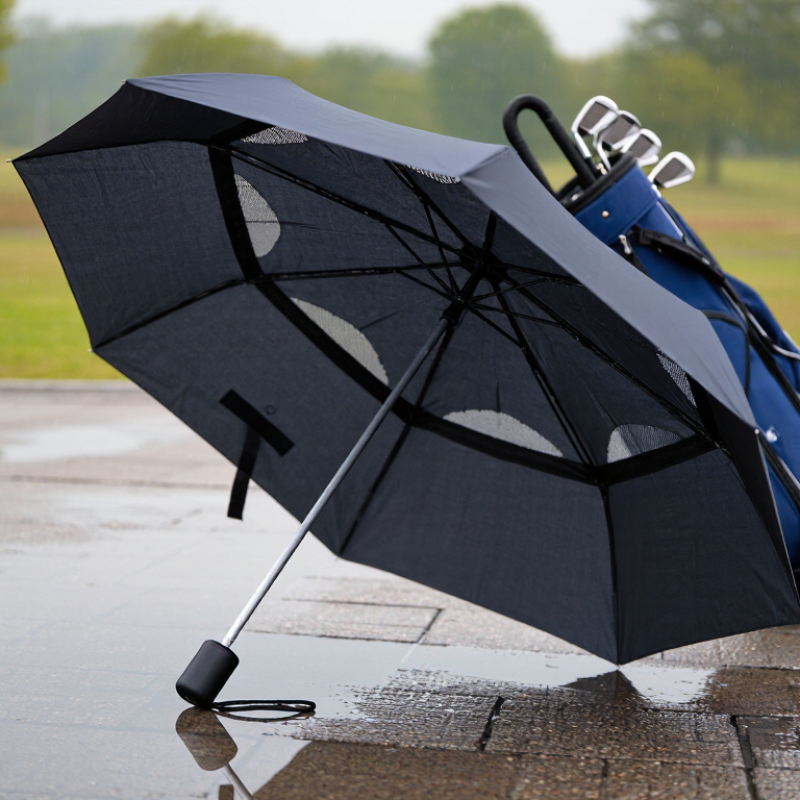
A golf umbrella is a large rain umbrella designed to protect golfers, equipment, and sometimes another person. Its canopy commonly measures between 60 and 68 inches across. That size creates useful coverage beside a golf bag or push cart. It is also wider than most everyday umbrellas.
Golf umbrellas usually have a long shaft, a broad canopy, and a comfortable handle. Many include a vent near the top. This opening lets strong air pass through, reducing pressure on the fabric. Fiberglass ribs can provide flexibility during gusts, while a water-resistant canopy helps rain slide away. The umbrella should open smoothly and remain stable without feeling dangerously heavy.
Size matters. Too small, and your shoulders or clubs stay wet. Too large, and crowded paths become awkward. Check the canopy diameter, closed length, weight, and handle shape before buying. A straight handle may suit a golf cart, while a curved handle can feel easier to carry. Look for reinforced joints and tightly stitched panels. No umbrella is truly windproof. A careless opening in a sudden gust can still damage it. The trade-off is easy to miss: maximum coverage often means less portability. A golf umbrella can serve commuters and spectators, but its bulk may become annoying on buses or narrow sidewalks.
A golf umbrella has a much larger canopy than a standard umbrella. Its open width often measures 60 to 68 inches, covering two people comfortably. Standard umbrellas usually prioritize portability, while golf umbrellas prioritize coverage and stability. This difference matters on an exposed course, where rain and wind can arrive together.
Golf umbrellas commonly use a longer shaft and a straight handle. The design offers more reach, especially when protecting a golf bag, trolley, or another person. Many models include a vented canopy. Small openings allow wind to pass through and may reduce inside-out flipping. Strong ribs and flexible materials also improve performance during sudden gusts. Still, “windproof” should not be treated as an absolute promise.
When choosing one, I check the canopy diameter, shaft length, handle grip, and packed weight. A large canopy is useful, but it can feel awkward beside crowded seating or narrow paths. I once selected maximum coverage and underestimated the carrying strain. That choice was not entirely practical. A balanced umbrella should feel stable without tiring your wrist. Consider fiberglass ribs, a water-resistant canopy, and an easy-opening mechanism. Avoid relying only on appearance. Open and close the umbrella several times, if possible, and inspect the stitching around the ribs. For occasional use, moderate weight may be wiser than extreme size. For regular outdoor use, stronger construction usually offers better long-term value.
A golf umbrella is a large canopy designed to protect one or two people. Its wider arc covers shoulders, clubs, and a small trolley. The most useful size is usually 60 to 68 inches. Bigger is not always better. It can feel awkward on narrow paths and become difficult during sudden gusts.
Materials deserve close attention. Fiberglass ribs flex better than brittle metal ribs, while a fiberglass shaft can reduce electrical conductivity concerns. Polyester is common because it dries quickly and resists stretching. Nylon feels lighter, but prolonged sunlight may weaken it. Look for tightly stitched panels, reinforced stress points, and a vented canopy. No umbrella is truly windproof. A double-canopy design may release pressure, but it can still turn inside out.
Sun protection also matters. The WHO Global Solar UV Index guide recommends protection when the index reaches 3 or higher. The CDC notes that clouds do not block all ultraviolet radiation. A dark, tightly woven canopy may reduce glare, but fabric claims should include tested UPF data. Handles should remain comfortable with wet hands, and the open mechanism should work without excessive force. Small details often decide real-world durability.
Tips: Hold the umbrella at shoulder height and check rib flexibility before buying. Test the canopy with one hand. If it feels heavy indoors, it may become tiring after eighteen holes. Check the warranty terms, too; they can reveal whether the construction is trusted.
A golf umbrella is larger than a standard rain umbrella, often measuring 60 to 68 inches across. This wider canopy can protect two players, golf bags, and a scorecard. However, extra size also creates more wind resistance. Bigger is not always better.
The 2024 National Golf Foundation Participation Report recorded 28.1 million on-course golfers in the United States during 2023. That figure reflects many hours spent outdoors, where weather can change quickly. Choose a canopy with strong ribs, a reinforced shaft, and a comfortable handle. Fiberglass components usually offer better flexibility than rigid metal during gusty conditions. A vented canopy may release trapped air, although it can still turn inside out in severe wind.
Check the closed length before buying. A compact model fits beside clubs more easily, while a longer shaft may open faster and feel stronger. Look for a water-resistant fabric with taped or tightly stitched seams. The World Meteorological Organization’s climate reports show increasing weather variability, but local forecasts still matter most for each round. Test the grip with one hand. Wet gloves can make a smooth handle surprisingly difficult to control. I once focused too much on canopy width and ignored weight. That mistake became obvious after eighteen holes. Choose protection you can carry comfortably, not just a shelter that looks impressive.
Typical open-canopy diameters by umbrella type
A golf umbrella is designed with a wider canopy than a compact umbrella, providing greater coverage for golfers, bags, and equipment. For general outdoor use, a 60–68 inch canopy offers strong coverage, while a smaller 42–48 inch option is easier to carry and store. When choosing one, also consider wind resistance, frame durability, handle comfort, and overall weight.
A golf umbrella is wider than a standard rain umbrella, often measuring 60 inches or more. It shelters a golfer, bag, and nearby equipment. The R&A’s Global Golf Participation Report recorded more than 66 million golfers worldwide. That scale makes practical umbrella care increasingly important.
Open the umbrella fully before entering strong wind. Never force the ribs against a gust. A golf umbrella is not a storm shield. Move away from exposed ground during lightning. After use, shake off loose water and leave the canopy open in a ventilated place. Drying matters because trapped moisture can encourage mildew and weaken fabric coatings. Check the shaft, runner, and ribs before the next round. I sometimes forget the handle area, yet it collects surprising moisture.
Tips: Keep the umbrella in a cool, dry place. Do not store it tightly folded when damp. Wipe mud from the tip and handle with clean water. Test the automatic opening mechanism away from people. Replace the umbrella if ribs bend repeatedly or the canopy tears. The World Meteorological Organization reported that 2023 was the warmest year on record, showing how quickly outdoor conditions can change. Still, weather data cannot replace judgment. An umbrella may keep rain off your shoulders, but it cannot make unsafe play safe.
| Data Dimension | Typical Specification or Fact | How to Choose | How to Use and Maintain It |
|---|---|---|---|
| Definition | A golf umbrella is a large umbrella designed to cover one or more people and golf equipment. | Choose it when broad coverage is more important than compact size. | Use it for golf, walking, spectator activities, commuting, or other situations requiring extended coverage. |
| Canopy Diameter | Common golf-umbrella canopies measure approximately 60–68 inches (152–173 cm) when open. | A 60–62 inch canopy is easier to handle; a 64–68 inch canopy provides more coverage but may be heavier and less convenient in crowded areas. | Open the canopy away from people, vehicles, and fragile objects because its wide span requires additional clearance. |
| Coverage | Depending on design and wind conditions, a large canopy can provide coverage for one or two adults and some equipment. | Prioritize canopy size if you regularly carry a golf bag or need shelter for two people. | Keep the canopy centered over the covered area and avoid forcing it into spaces narrower than its open diameter. |
| Closed Length | Many full-size golf umbrellas are approximately 36–42 inches (91–107 cm) long when closed. | Check the closed length before purchasing if you need to store the umbrella in a vehicle, locker, or entryway. | Use a protective sleeve or strap when storing it to prevent the canopy from snagging on nearby objects. |
| Opening Style | Manual-open and automatic-open mechanisms are both common; automatic models usually open with a spring-assisted button. | Select manual opening for a simple mechanism or automatic opening for faster one-handed deployment. | Keep fingers, faces, and nearby objects clear of the runner and ribs while opening or closing. |
| Frame Construction | A frame normally includes a shaft, ribs, stretchers, runner, and canopy-support points. Materials may include steel, aluminum, fiberglass, or combinations of these. | Fiberglass components are flexible and resistant to corrosion; aluminum is lightweight; steel can provide stiffness but may add weight. | Do not use the umbrella as a walking stick or lever, as excessive force can bend the shaft or damage the ribs. |
| Wind Performance | Wind resistance varies by frame design, canopy venting, construction quality, and wind direction. No umbrella is completely windproof. | Look for flexible ribs, reinforced joints, and a vented canopy when use in exposed areas is expected. Treat marketing wind-speed ratings cautiously unless testing details are provided. | Close the umbrella before strong gusts become difficult to control. Never force the canopy against the wind or use it during thunderstorms. |
| Vented Canopy | A vented canopy has an additional opening or overlapping panel that allows some air to escape. | Choose a vented design for open spaces where gusts are common, while recognizing that ventilation does not eliminate wind-related damage. | Check that vent panels are not blocked, torn, or stuck together after storage. |
| Canopy Material | Common canopy fabrics include polyester and nylon, which are lightweight, quick-drying, and water-resistant when properly finished. | Compare fabric density, stitching, seam quality, and the clarity of the manufacturer’s water-repellent claims. | Do not scrub aggressively or apply household solvents, as they may weaken the coating or discolor the fabric. |
| Handle and Grip | Handles may be straight, curved, molded, or ergonomic, with materials such as plastic, rubber, foam, or wood. | Choose a grip that feels secure with wet hands and is comfortable during extended carrying. | Wipe the handle clean and dry it if moisture or dirt causes the grip to become slippery. |
| Weight | Large golf umbrellas commonly weigh about 1–2 pounds (0.45–0.9 kg), depending on size and frame materials. | Choose a lighter model for walking or carrying over long distances; choose additional structure only when its handling remains comfortable. | Carry the umbrella by its handle rather than by the ribs or canopy, which can place stress on the frame. |
| UV Protection | Some canopies are made with fabrics or coatings intended to reduce ultraviolet exposure, but protection levels differ between products. | If sun protection matters, look for a clearly stated ultraviolet protection rating or test method instead of relying only on canopy color. | Inspect the fabric periodically for fading, peeling, or coating damage that may reduce performance. |
| Water Management | Umbrella fabric is water-resistant rather than permanently waterproof; performance can decline through wear and contamination. | Choose tightly stitched panels and a canopy with a smooth, intact surface and well-finished seams. | Shake off excess water, wipe away dirt, and allow the umbrella to dry fully while open before storing it closed. |
| Cleaning | Most fabric canopies can be cleaned with lukewarm water and mild soap. | Avoid products that require harsh chemicals or complicated maintenance if the umbrella will be used frequently. | Use a soft cloth or sponge, rinse thoroughly, and air-dry completely. Do not machine-wash or machine-dry the umbrella. |
| Storage | Long-term damp storage can encourage mildew, odor, corrosion, and fabric deterioration. | Choose a model that includes a sleeve or closure strap if organized storage is important. | Store it in a dry, ventilated place away from prolonged heat, direct sunlight, and heavy objects that could bend the frame. |
| Inspection Interval | There is no universal replacement schedule; condition depends on frequency of use, weather exposure, and handling. | Replace the umbrella when essential ribs, joints, shaft sections, or the canopy are damaged beyond safe use. | Before use, check the shaft, ribs, stretchers, runner, handle, seams, and opening mechanism for looseness, cracks, or sharp exposed parts. |
| Safety in Lightning | An umbrella does not protect a person from lightning and may increase the person’s height in an exposed area. | Do not select or use any umbrella as a substitute for proper shelter during a thunderstorm. | Stop using the umbrella and move into a substantial enclosed building or a hard-topped vehicle when thunder or lightning is present. |
Specifications are typical ranges and may vary by construction, canopy size, materials, and intended use.
We use cookies on our website to give you an improved browser experience. View our Privacy Policy for more information. Please make your selection to opt in or out of ALL cookies here: Accept or Decline
Do you consent to the use of ALL cookies?
901 2nd Court West
Birmingham, AL 35204
Sales: 866.481.4036
Logistics/Ops: 866.481.4036
2101 Dralle Road
University Park, IL 60466
Sales: 708.813.9070
Logistics/Ops: 708.235.4200
400 E. 13th Street
Little Rock, AR 72114
Sales: 866.760.5344
Logistics/Ops: 866.760.5344
225 Collins Road
Elkhart, IN 46515
Sales: 574.295.0214
Logistics/Ops: 574.607.4611
601 Berryman Pike
Tipton, IN 46072
Sales: 800.897.7591
Logistics/Ops: 800.897.7591
3900 Uvalda Street
Denver, CO 80239
Sales: 303.706.8000
Ops/Logistics: 303.576.8398
510 3rd Street E
Milan, IL 61264
Sales: 800.322.1052
Logistics/Ops: 800.322.1052
1660 E. Aurora
Des Moines, IA 50313
Sales: 800.671.1660
Logistics: 800.671.1660
86554 Gene Lasserre Blvd.
Yulee, FL 32097
Sales: 904.253.3060
Logistics/Ops: 904.225.3000
694 S.E. County Road 245
Lake City, FL 32025
Sales: 800.727.6706
Logistics/Ops: 386.752.7412
210 Neptune Road
Auburndale, FL 33823
Sales: 863.967.1131
Logistics/Ops: 863.777.9814
4601 McCoy Drive
Pensacola, FL 32503
Sales: 850.308.7030
Logistics/Ops: 850.434.5502
815 South 56th Street
Tampa, FL 33619
Sales: 813.302.1940
Logistics/Ops: 813.621.1352
200 Hosea Road
Lawrenceville, GA 30046
Sales: 770.953.7575
Logistics/Ops: 770.513.6000
Branch Product Guide
Branch Line Card
Moulding Offering
Cedar Offering
Column Offering
8173 Hwy. 165 North
Monroe, LA 71211
Sales: 800.256.4165
Logistics/Ops: 800.256.4165
508 Warren Avenue
Portland, ME 04103
Sales: 207.888.2331
Logistics/Ops: 207.797.6565
4300 Georgia Pacific Blvd.
Frederick, MD 21704
Sales: 301.798.7474
Logistics/Ops: 301.874.8000
419 Maple Street
Bellingham, MA 02019
Sales: 508.449.0535
Logistics/Ops: 508.966.5500
825 Buchanan Ave SW
Grand Rapids, MI 49507
Sales: 877.800.1180
Logistics/Ops: 616.278.0909
995 Pacific St. NW
Aitkin, MN 56431
Sales: 800.432.3727
Logistics/Ops: 218.212.7770
1102 Port Terminal Drive
Duluth, MN 55802
Sales: 800.951.9899
Logistics/Ops: 800.851.9899
9110 83rd Ave. North
Brooklyn Park, MN 55445
Sales: 763.425.0204
Logistics/Ops: 763.425.0204
910 E. Railroad Street
Long Beach, MS 39560
Sales: 866.535.4135
Logistics/Ops: 228.205.2400
1727 Warren Street
North Kansas City, MO 64116
Sales: 800.621.2611
Logistics/Ops: 800.621.2611
2123 North Golden
Springfield, MO 65803
Sales: 800.375.7891
Logistics/Ops: 800.375.7891
13860 Corp. Woods Trail
Bridgeton, MO 63044
Sales: 314.209.0800
Logistics/Ops: 314.209.0800
1109 South 19th Street
Omaha, NE 68108
Sales: 800.489.6637
Logistics/Ops: 800.489.6637
1 Luger Road
Denville, NJ 07834
Sales: 973-339-3539
Logistics/Ops: 973.625.1461
3720 Jeffrey Blvd.
Blasdell, NY 14219
Sales: 716.235.5989
Logistics/Ops: 716.825.6557
319 Yaphank Ave.
Yaphank, NY 11980
Sales: 631.358.5714
Logistics/Ops: 631.924.7401
3300 Parkside Drive
Charlotte, NC 28208
Sales: 800.839.2588
Logistics/Ops: 704.394.3172
1712 East D Street
Butner, NC 27509
Sales: 984.389.8200
Logistics/Ops: 919.575.3700
128 Foothills Drive
Statesville, NC 28687
Sales: 800.222.1414
Logistics/Ops: 704.394.3172
550 Munroe Falls Rd.
Tallmadge, OH 44278
Sales: 330.357.4506
Logistics/Ops: 330.794.1141
10347 Toebben Dr.
Independence, KY 41051
Sales: 859.298.3926
Logistics/Ops: 859.746.2250
450 N. MacArthur
Oklahoma City, OK 73127
Sales: 800.375.6025
Logistics/Ops: 800.375.6025
1680 North Aspen
Broken Arrow, OK 74012
Sales: 918.272.2212
Logistics/Ops: 918.272.2212
522 Bridge Street
Hunker, PA 15639
Sales: 878.217.2001
Logistics/Ops: 724.925.7285
4290 Atlanta Street
Charleston, SC 29418
Sales: 843.371.1420
Logistics/Ops: 843.554.8192
1040 S. Industrial Dr.
Erwin, TN 37650
Sales: 423.641.1005
Logistics/Ops: 423.742.5911
4287 Pilot Drive
Memphis, TN 38118
Sales: 901.365.2101
Logistics/Ops: 901.365.2101
700 Myatt Drive
Madison, TN 37115
Sales: 615.327.9547
Logistics/Ops: 629.777.4949
4747 Mark IV Parkway
Fort Worth, TX 76106
Sales: 866.323.5117
Logistics/Ops: 817.625.9091
6990 Market Avenue
El Paso, TX 79915
Sales: 915.778.6356
Logistics/Ops: 915.265.7200
2502 Wilson Road
Harlingen, TX 78552
Sales: 800.580.6711
Logistics/Ops: 800.580.6711
10,000 North Loop East
Houston, TX 77029
Sales: 713.921.1977
Logistics/Ops: 713.675.3544
702 East 44th St.
Lubbock, TX 79404
Sales: 866.454.6010
Logistics/Ops: 866.454.6010
535 N. WW White Road
San Antonio, TX 78219
Sales: 800.284.0488
Logistics/Ops: 210.333.8112
142 Pine Haven Shores Rd.
Shelburne, VT 05482
Sales: 802.800.2540
Logistics/Ops: 802.985.2512
4700 Bethlehem Road,
Richmond, VA 23230
Sales: 804.201.2400
Logistics/Ops: 804.342.1161
4516 N Barker Road
Spokane Valley, WA 99027
Phone: 509.892.9420
Toll free: 800.728.6157
8365 N. 76th Street
Milwaukee, WI 53223
Sales: 800.356.9245
Logistics/Ops: 800.356.9245
312 S. Chester Street
Sparta, WI 54656
Sales: 800.362.5864
Logistics/Ops: 800.362.5864
899 Grossman Drive
Schofield, WI 54476
Sales: 800.472.0017
Logistics/Ops: 800.472.0017
