
We use cookies on our website to give you an improved browser experience. View our Privacy Policy for more information. Please make your selection to opt in or out of ALL cookies here: Accept or Decline
Choosing an S83 Pneumatic Air Leg Rock Drill begins with the rock, not the catalogue photograph. The machine must match your working conditions, drilling pattern, and operator experience. In a narrow underground heading, every kilogram matters. So does the position of the air leg.
Evert Hoek, a widely respected rock-mechanics authority, has said, “The rock mass, not the machine, controls the excavation response.” That principle deserves attention here. A powerful drill cannot correct poor ground assessment, weak air delivery, or an unsuitable bit. It may only create faster problems. This is where many buying decisions become less certain.
Check the S83’s air consumption against the compressor and pipeline length. Measure pressure at the drill, not only at the compressor gauge. Inspect hose couplings, water control, leg extension, and lubrication arrangements. Small leaks can reduce impact performance and increase operator fatigue. They are easy to overlook.
Then examine the rock texture. Hard, abrasive stone may demand different bits and sharper maintenance routines. Fractured ground may require slower feed pressure and closer alignment. A shorter air leg can improve control, while a longer leg may increase reach. Neither choice is automatically correct.
A responsible selection also includes spare-part access, training, noise exposure, and service support. Ask for test records and operating references. Do not trust impressive claims without field evidence. The best S83 Pneumatic Air Leg Rock Drill is not simply the strongest model. It is the one that produces consistent holes, manageable vibration, and predictable maintenance at your actual site. Even experienced teams should review the choice after the first drilling cycle.
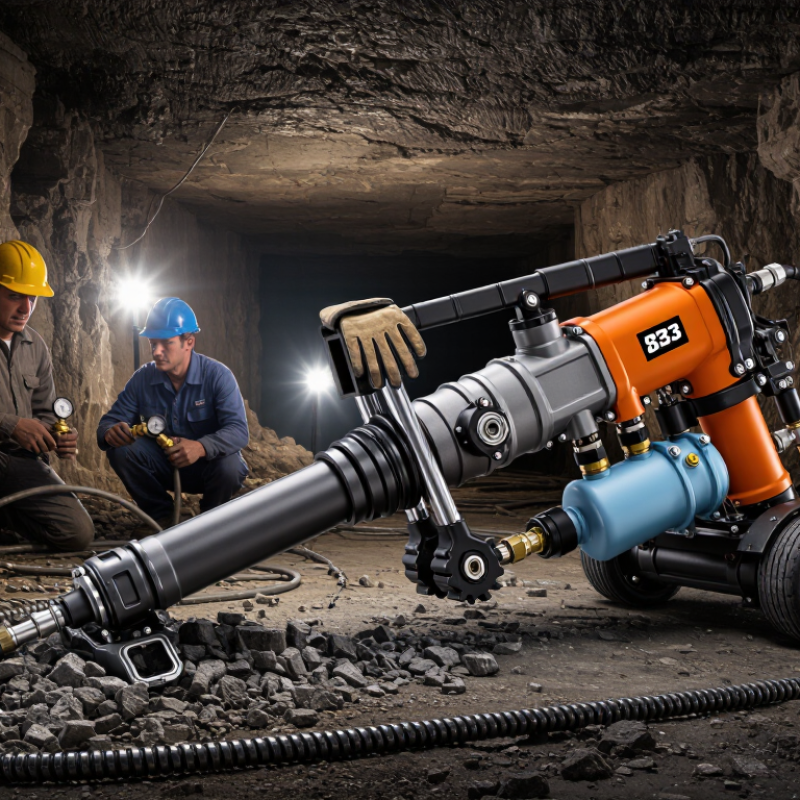
An S83 pneumatic air leg rock drill uses compressed air to power a piston inside the cylinder. The piston strikes the drill steel, while a rotating mechanism turns the bit between impacts. This combined action breaks hard material efficiently. Its air leg supports the drill and controls forward pressure. Operators can adjust the leg angle for lower, vertical, or inclined drilling.
The design is mechanical, but small details matter. Clean air protects valves, seals, and the impact chamber. Excess water may cause corrosion and unstable performance. Before choosing a unit, check its air consumption, working pressure, weight, rotation speed, and compatible drill steel. A heavier drill may feel steadier, yet it can increase fatigue during long shifts. That trade-off is easy to underestimate. Also inspect the handle layout and lubrication system. Controls should remain reachable while wearing gloves.
Tips: Use a moisture separator and the recommended pneumatic oil. Check hose connections before every shift. Listen for irregular impact sounds. They often reveal wear early. Keep the air leg stable against the rock surface. Too little feed pressure causes bouncing, while excessive pressure slows rotation. I would also record drilling depth, air pressure, and maintenance dates. Those simple notes expose repeated problems, although they do not replace a qualified inspection. Perform repairs only after isolating and releasing compressed air.
How to Choose an S83 Pneumatic Air Leg Rock Drill
Assessing rock conditions starts before the drill reaches the face. Record uniaxial compressive strength, joint spacing, bedding direction, abrasivity, and water presence. ISRM rock classification methods commonly place strong rock above 100 MPa in compressive strength. Such formations demand stable feed pressure and durable drill steels. Softer, fractured rock may need gentler thrust to prevent bit jamming and hole deviation. The rock rarely behaves perfectly.
An S83 pneumatic air leg rock drill should match the planned hole diameter, depth, and drilling angle. Check the site’s actual air pressure at the machine, not only the compressor rating. A pressure drop through long hoses can reduce impact energy and flushing performance. Field measurements matter. For dusty faces, NIOSH research identifies respirable crystalline silica as a serious mining hazard, so water flushing or effective dust controls should be planned. Wet fractures also require reliable drainage and careful hose protection.
Drilling records provide useful evidence. Track penetration time, air consumption, bit wear, vibration, and rejected holes over several shifts. The International Society for Rock Mechanics recommends documenting rock mass properties rather than relying on visual judgment alone. If penetration slows sharply after a bedding change, the selected feed setting may be wrong. I would not choose a drill from catalogue power alone. A short trial in representative ground can reveal more than a polished specification sheet.
Comparing S83 specifications starts with the drilling task, not the catalogue headline. Typical S83 data lists 34–42 mm hole diameters, about 5 m drilling depth, and 0.5–0.63 MPa working pressure. Impact rates commonly exceed 2,000 blows per minute, while air consumption may approach 65 L/s. These figures affect compressor sizing, penetration speed, and operating cost.
Check the air-leg extension, feed stability, and control response underground. A stable leg keeps the bit aligned against hard rock and reduces wasted impact energy. A lighter unit, often near 45 kg, improves repositioning but may transmit more vibration. European vibration guidance uses 2.5 m/s² A(8) as an exposure action value and 5.0 m/s² as a limit value. Actual drill vibration still depends on rock, bit wear, pressure, and operator posture. It is not only a machine specification.
Noise, flushing performance, and lubrication deserve equal attention. NIOSH mining research identifies noise, vibration, dust, and awkward posture as recurring equipment risks. Compare measured data, not optimistic claims. A practical mistake is choosing the highest impact rate without checking compressor recovery. The drill may sound powerful, yet stall during continuous drilling. Inspect hose diameter, water flushing, coupling quality, and spare-part access before purchase. Catalogue numbers can be incomplete. That deserves reflection.
Choosing an S83 pneumatic air leg rock drill starts with the air leg, not the drill body. The leg must match the drill’s mounting point, thrust range, and working angle. Check the required air pressure and consumption against the compressor’s real output, not its advertised peak. In underground headings, pressure often drops when several tools share one line. A small mismatch can cause slow feed, unstable drilling, or excessive vibration. Measure the hose length, inner diameter, and couplings before ordering. These details are easy to overlook.
Select an air leg with enough stroke for the planned hole depth and enough thrust for the rock condition. Softer rock may need controlled feed, while hard, fractured rock demands steadier support. An adjustable leg helps, but too much extension can reduce rigidity. Keep the setup practical. Operators should test the drill at the actual face, with the leg fully supported and aligned with the hole. A paper calculation cannot reveal every movement.
Auxiliary equipment deserves equal attention. Use a clean air filter, pressure regulator, lubricator, and water separator where site conditions require them. Moisture can wash lubricant from moving parts and accelerate corrosion. Fit a suitable hose restraint, secure the air line away from sharp edges, and inspect couplings for leakage. A muffler may reduce noise, but it cannot correct poor airflow. I have found that a quieter setup can still lose power through a restricted fitting. Recheck the connections after the first shift. The initial selection may be imperfect. Field feedback should change it.
| Category | Selection Parameter | Typical S83 Reference Data | Compatibility and Selection Guidance |
|---|---|---|---|
| Rock Drill | Drilling application | Hand-held or air-leg-mounted percussion drilling | Select an S83 configuration for quarrying, mining, tunneling, construction, and secondary rock breaking where compressed-air operation is available. |
| Rock Drill | Typical bore diameter | Approximately 34–42 mm | Use the lower end for faster drilling in softer rock and the upper end for larger blast-hole or anchor-hole requirements. Actual diameter depends on the bit and rock formation. |
| Rock Drill | Typical drilling depth per rod | Approximately 1.0–2.0 m | Choose drill-rod length according to the air-leg stroke, required hole depth, working clearance, and the need to remove rods safely. |
| Rock Drill | Rated working air pressure | About 0.63 MPa (6.3 bar) | The compressor and air network should maintain the required pressure at the drill inlet while the machine is operating. Avoid exceeding the drill manufacturer’s rated pressure. |
| Rock Drill | Typical free-air consumption | Approximately 55–70 L/s at rated pressure | Size the compressor using the drill’s actual air-consumption rating plus a reserve of approximately 20–30% for hose losses, leakage, simultaneous tools, and changing rock conditions. |
| Rock Drill | Impact frequency | Approximately 2,000–2,500 blows/min | A higher impact rate may improve penetration in suitable rock, but excessive feed force, dull bits, or inadequate air volume can reduce performance and increase wear. |
| Rock Drill | Air-leg mounting | Front and rear mounting points with a pivoting support arrangement | Confirm that the air-leg brackets, pins, mounting holes, and drill centerline match. The leg must support the drill without binding throughout its full extension. |
| Air Leg | Recommended leg type | Telescopic pneumatic air leg for rock-drill feed control | Use a leg designed for the S83 mounting pattern and operating pressure. A general-purpose pneumatic cylinder is not automatically suitable for drilling vibration or feed loads. |
| Air Leg | Typical usable extension | Approximately 1.2–1.8 m, depending on leg model | Select the stroke according to roof height, bench height, hole angle, and operator access. Keep sufficient retraction length for transport and positioning. |
| Air Leg | Feed-force requirement | Adjustable, generally sufficient to maintain steady bit contact without stalling | The leg should provide controlled thrust rather than maximum force only. Excessive feed force can jam the bit, bend rods, overload the chuck, and accelerate wear. |
| Air Leg | Control arrangement | Separate or integrated valves for extension, retraction, and feed adjustment | Prefer controls that allow slow positioning and smooth feed adjustment. A shut-off valve should isolate the leg before maintenance or relocation. |
| Compressed Air | Recommended compressor capacity | At least 70–90 L/s free-air delivery for one drill, subject to actual consumption | Use the compressor’s delivered-air rating at the working pressure, not only its motor power or theoretical displacement. Add capacity when other pneumatic tools operate simultaneously. |
| Compressed Air | Air hose internal diameter | Commonly 19–25 mm for the main hose | Use a larger diameter for long runs or high air demand. Minimize sharp bends, unnecessary reducers, and excessive hose length to limit pressure drop. |
| Compressed Air | Hose working-pressure rating | At least 1.5 times the maximum operating pressure | Select hose, couplings, and whip checks with compatible pressure ratings. Inspect for cuts, abrasion, loose fittings, and damaged safety cables before use. |
| Air Treatment | Moisture control | Water separator or aftercooler with regular draining | Remove condensate before it reaches the drill. Water in the air line can cause corrosion, valve sticking, lubricant washout, and freezing in cold conditions. |
| Air Treatment | Air-line lubrication | In-line pneumatic oiler installed near the drill | Use the lubricant specified for pneumatic percussion equipment and adjust the feed rate according to the maintenance manual. Do not mix incompatible oils. |
| Drilling Tools | Drill-rod shank compatibility | Common short-hole shank sizes include approximately 22 × 108 mm; verify the exact S83 chuck specification | The shank diameter, length, collar geometry, and flushing passage must match the chuck and retaining mechanism. Never force an incompatible rod into the drill. |
| Drilling Tools | Bit selection | Threaded or integral button bit selected for the rod system and target hole diameter | Match bit diameter and carbide design to rock hardness, abrasiveness, fracturing, and flushing conditions. Replace bits when penetration rate falls or excessive wear appears. |
| Flushing | Cuttings removal | Compressed-air flushing; water-assisted flushing where site conditions permit | Maintain sufficient flushing flow to clear cuttings without creating unsafe dust or water hazards. Use dust suppression or wet drilling controls when required by the site. |
| Safety | Required operator protection | Safety helmet, eye protection, hearing protection, gloves, protective footwear, and respiratory protection where required | Follow the site risk assessment and applicable occupational-safety requirements. Keep personnel clear of the rotating rod, exhaust, hose connections, and unstable rock. |
| Inspection | Pre-operation checks | Inspect mounting pins, hoses, couplings, valves, lubrication, drill rods, bits, and air pressure | Do not operate with damaged hoses, loose fasteners, cracked brackets, leaking valves, worn retainers, or a misaligned air leg. Verify the drill is securely supported before starting. |
| Final Selection | Best-fit configuration | S83 drill + matched telescopic air leg + adequately sized compressor + treated air supply + compatible rod and bit system | Before purchase, compare the nameplate data, mounting dimensions, air consumption, pressure, shank specification, leg stroke, hose connection size, and local service requirements. |
Note: The reference values shown are typical engineering ranges for S83-class pneumatic rock-drill configurations. Always confirm the exact specifications, mounting dimensions, and operating limits on the equipment nameplate and technical manual before installation.
Choosing an S83 Pneumatic Air Leg Rock Drill requires more than comparing purchase prices. Safety and maintenance shape its real value underground or on a construction site. Before each shift, inspect the air hose, couplings, trigger, leg, and drill steel for damage. Small leaks matter. A loose coupling can whip violently under pressure.
Wear hearing protection, eye protection, gloves, safety footwear, and suitable respiratory protection. Control dust with approved water systems or local ventilation when conditions require it. Keep hands away from moving joints, and never adjust the drill while air pressure remains connected. I have seen operators focus on drilling speed and overlook vibration, which often signals worn parts or poor alignment. That mistake was costly.
Maintenance should follow the equipment manual and actual working conditions. Clean the air inlet, lubricate with the specified oil, and drain moisture from the air system regularly. Record hose changes, lubrication times, repairs, and unusual noise. These notes help reveal repeated failures. They also support safer decisions between shifts.
Calculate total operating costs over the planned service life. Include compressor electricity, air treatment, drill steel, bits, lubricant, labor, transport, and downtime. A cheaper drill may consume more air or require frequent seal replacement. A reliable unit can still become expensive if operators misuse it or maintenance is postponed. I once underestimated compressor demand, and the extra energy cost changed the project estimate. Check actual air consumption, expected drilling hours, spare-part availability, and service access before approving the purchase. Allow room for uncertainty. Site conditions rarely match the brochure.
We use cookies on our website to give you an improved browser experience. View our Privacy Policy for more information. Please make your selection to opt in or out of ALL cookies here: Accept or Decline
Do you consent to the use of ALL cookies?
901 2nd Court West
Birmingham, AL 35204
Sales: 866.481.4036
Logistics/Ops: 866.481.4036
2101 Dralle Road
University Park, IL 60466
Sales: 708.813.9070
Logistics/Ops: 708.235.4200
400 E. 13th Street
Little Rock, AR 72114
Sales: 866.760.5344
Logistics/Ops: 866.760.5344
225 Collins Road
Elkhart, IN 46515
Sales: 574.295.0214
Logistics/Ops: 574.607.4611
601 Berryman Pike
Tipton, IN 46072
Sales: 800.897.7591
Logistics/Ops: 800.897.7591
3900 Uvalda Street
Denver, CO 80239
Sales: 303.706.8000
Ops/Logistics: 303.576.8398
510 3rd Street E
Milan, IL 61264
Sales: 800.322.1052
Logistics/Ops: 800.322.1052
1660 E. Aurora
Des Moines, IA 50313
Sales: 800.671.1660
Logistics: 800.671.1660
86554 Gene Lasserre Blvd.
Yulee, FL 32097
Sales: 904.253.3060
Logistics/Ops: 904.225.3000
694 S.E. County Road 245
Lake City, FL 32025
Sales: 800.727.6706
Logistics/Ops: 386.752.7412
210 Neptune Road
Auburndale, FL 33823
Sales: 863.967.1131
Logistics/Ops: 863.777.9814
4601 McCoy Drive
Pensacola, FL 32503
Sales: 850.308.7030
Logistics/Ops: 850.434.5502
815 South 56th Street
Tampa, FL 33619
Sales: 813.302.1940
Logistics/Ops: 813.621.1352
200 Hosea Road
Lawrenceville, GA 30046
Sales: 770.953.7575
Logistics/Ops: 770.513.6000
Branch Product Guide
Branch Line Card
Moulding Offering
Cedar Offering
Column Offering
8173 Hwy. 165 North
Monroe, LA 71211
Sales: 800.256.4165
Logistics/Ops: 800.256.4165
508 Warren Avenue
Portland, ME 04103
Sales: 207.888.2331
Logistics/Ops: 207.797.6565
4300 Georgia Pacific Blvd.
Frederick, MD 21704
Sales: 301.798.7474
Logistics/Ops: 301.874.8000
419 Maple Street
Bellingham, MA 02019
Sales: 508.449.0535
Logistics/Ops: 508.966.5500
825 Buchanan Ave SW
Grand Rapids, MI 49507
Sales: 877.800.1180
Logistics/Ops: 616.278.0909
995 Pacific St. NW
Aitkin, MN 56431
Sales: 800.432.3727
Logistics/Ops: 218.212.7770
1102 Port Terminal Drive
Duluth, MN 55802
Sales: 800.951.9899
Logistics/Ops: 800.851.9899
9110 83rd Ave. North
Brooklyn Park, MN 55445
Sales: 763.425.0204
Logistics/Ops: 763.425.0204
910 E. Railroad Street
Long Beach, MS 39560
Sales: 866.535.4135
Logistics/Ops: 228.205.2400
1727 Warren Street
North Kansas City, MO 64116
Sales: 800.621.2611
Logistics/Ops: 800.621.2611
2123 North Golden
Springfield, MO 65803
Sales: 800.375.7891
Logistics/Ops: 800.375.7891
13860 Corp. Woods Trail
Bridgeton, MO 63044
Sales: 314.209.0800
Logistics/Ops: 314.209.0800
1109 South 19th Street
Omaha, NE 68108
Sales: 800.489.6637
Logistics/Ops: 800.489.6637
1 Luger Road
Denville, NJ 07834
Sales: 973-339-3539
Logistics/Ops: 973.625.1461
3720 Jeffrey Blvd.
Blasdell, NY 14219
Sales: 716.235.5989
Logistics/Ops: 716.825.6557
319 Yaphank Ave.
Yaphank, NY 11980
Sales: 631.358.5714
Logistics/Ops: 631.924.7401
3300 Parkside Drive
Charlotte, NC 28208
Sales: 800.839.2588
Logistics/Ops: 704.394.3172
1712 East D Street
Butner, NC 27509
Sales: 984.389.8200
Logistics/Ops: 919.575.3700
128 Foothills Drive
Statesville, NC 28687
Sales: 800.222.1414
Logistics/Ops: 704.394.3172
550 Munroe Falls Rd.
Tallmadge, OH 44278
Sales: 330.357.4506
Logistics/Ops: 330.794.1141
10347 Toebben Dr.
Independence, KY 41051
Sales: 859.298.3926
Logistics/Ops: 859.746.2250
450 N. MacArthur
Oklahoma City, OK 73127
Sales: 800.375.6025
Logistics/Ops: 800.375.6025
1680 North Aspen
Broken Arrow, OK 74012
Sales: 918.272.2212
Logistics/Ops: 918.272.2212
522 Bridge Street
Hunker, PA 15639
Sales: 878.217.2001
Logistics/Ops: 724.925.7285
4290 Atlanta Street
Charleston, SC 29418
Sales: 843.371.1420
Logistics/Ops: 843.554.8192
1040 S. Industrial Dr.
Erwin, TN 37650
Sales: 423.641.1005
Logistics/Ops: 423.742.5911
4287 Pilot Drive
Memphis, TN 38118
Sales: 901.365.2101
Logistics/Ops: 901.365.2101
700 Myatt Drive
Madison, TN 37115
Sales: 615.327.9547
Logistics/Ops: 629.777.4949
4747 Mark IV Parkway
Fort Worth, TX 76106
Sales: 866.323.5117
Logistics/Ops: 817.625.9091
6990 Market Avenue
El Paso, TX 79915
Sales: 915.778.6356
Logistics/Ops: 915.265.7200
2502 Wilson Road
Harlingen, TX 78552
Sales: 800.580.6711
Logistics/Ops: 800.580.6711
10,000 North Loop East
Houston, TX 77029
Sales: 713.921.1977
Logistics/Ops: 713.675.3544
702 East 44th St.
Lubbock, TX 79404
Sales: 866.454.6010
Logistics/Ops: 866.454.6010
535 N. WW White Road
San Antonio, TX 78219
Sales: 800.284.0488
Logistics/Ops: 210.333.8112
142 Pine Haven Shores Rd.
Shelburne, VT 05482
Sales: 802.800.2540
Logistics/Ops: 802.985.2512
4700 Bethlehem Road,
Richmond, VA 23230
Sales: 804.201.2400
Logistics/Ops: 804.342.1161
4516 N Barker Road
Spokane Valley, WA 99027
Phone: 509.892.9420
Toll free: 800.728.6157
8365 N. 76th Street
Milwaukee, WI 53223
Sales: 800.356.9245
Logistics/Ops: 800.356.9245
312 S. Chester Street
Sparta, WI 54656
Sales: 800.362.5864
Logistics/Ops: 800.362.5864
899 Grossman Drive
Schofield, WI 54476
Sales: 800.472.0017
Logistics/Ops: 800.472.0017
