
We use cookies on our website to give you an improved browser experience. View our Privacy Policy for more information. Please make your selection to opt in or out of ALL cookies here: Accept or Decline
Choosing the right aluminium melting pot from China requires more than comparing online prices. The vessel must match your alloy, furnace, batch size, heating method, and production rhythm. A pot that looks robust in photographs may fail after repeated thermal cycling. Small details matter, including wall thickness, pouring lip design, handle balance, and internal surface condition.
Industry data shows why this decision deserves care. The United States Geological Survey estimated global primary aluminum production at approximately 70 million metric tons in 2023. China contributed about 41 million metric tons, making it the dominant production region. These figures describe aluminum output, not melting equipment. However, they explain China’s broad manufacturing experience and supplier range. The International Aluminium Institute also reports continuing growth in aluminum demand, driven by transport, construction, packaging, and energy applications.
A dependable aluminium melting pot should have documented material specifications, consistent dimensions, and traceable quality checks. Ask whether the manufacturer identifies the metal grade, maximum operating temperature, usable capacity, and recommended heating limits. Request inspection records, dimensional tolerances, and photographs from actual production batches. ISO 9001 certification can support process confidence, but it does not guarantee perfect pot performance. That distinction is easy to miss.
The cheapest option may not be economical. A cracked rim, uneven base, or contaminated lining can interrupt production and waste valuable metal. I would avoid relying on promises alone. Supplier history, sample testing, and clear technical communication deserve equal attention. Sometimes, the best choice is not the largest pot. It is the one that fits your process accurately and performs predictably.
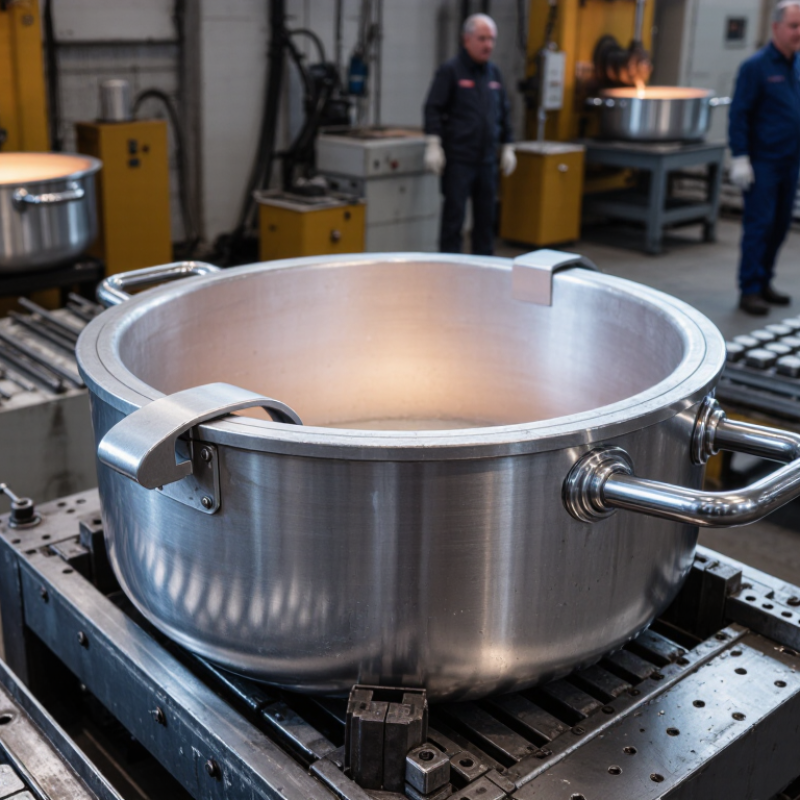
Before choosing an aluminium melting pot from China, measure your actual production needs. Record the batch size, alloy types, melting frequency, and target temperature. A small workshop may need 30 kilograms per batch, while a casting line may require several hundred kilograms. Do not size the pot by its advertised maximum capacity. Leave working space for safe stirring and controlled pouring.
Fuel choice also matters. Electric heating offers clean temperature control and easy adjustment. Gas heating may suit larger operations, but ventilation and combustion control require careful planning. Check the melting range of each alloy, then compare it with the pot’s rated temperature. Ask for details about the crucible material, refractory lining, heating elements, insulation, and temperature sensor. These parts affect service life more than a polished outer shell.
Think about daily handling, not only technical figures. Will an operator lift the crucible manually? Is a tilting mechanism necessary? Can the controls be read beside bright furnace light? Confirm voltage, frequency, dimensions, spare parts, and inspection documents with the supplier. Request test records using a similar aluminium load. A practical review should include heat-up time, temperature stability, energy use, and pouring safety. I would not rely on catalog capacity alone; real output can change with alloy, charge shape, and ambient conditions. Sometimes, a simpler pot is the more reliable choice.
How to Choose the Best Aluminium Melting Pot from China?
Pot material directly affects service life, heat transfer, and casting safety. Aluminium pots are unsuitable for melting aluminium because their melting point is too close to the working temperature. Steel offers strength and reasonable cost, while cast iron holds heat well but may crack after thermal shock. Graphite provides excellent heat resistance and clean metal contact, but it is more fragile during transport.
Thickness needs careful comparison. A thin wall heats quickly, yet it can deform under repeated heating. A thicker wall improves rigidity and heat retention, but it adds weight and slows temperature changes. For regular workshop use, check whether the stated thickness remains consistent around the base, rim, and sidewall. A small variation can create hot spots. I have seen specifications look impressive until the actual rim felt noticeably lighter. Measurements matter.
Heat resistance is more than a maximum temperature number. Ask for continuous working temperature, thermal-cycle test results, and resistance to oxidation. The pot should tolerate heating near aluminium’s melting range without softening or scaling. Handles, seams, and lifting points also need inspection. Request photographs of internal surfaces and independent material certificates when possible. Some suppliers provide excellent documents, but production quality may still vary between batches. That uncomfortable gap deserves attention. Test a sample before ordering heavily.
How to Choose the Best Aluminium Melting Pot from China?
Evaluate Capacity, Furnace Compatibility, and Pouring Design
Choosing an aluminium melting pot starts with the real batch size, not the advertised maximum. A pot rated for 50 kilograms may safely hold less during regular operation. Aluminium expands when heated, and generous headspace helps prevent splashing. Measure your normal charge, peak load, and available lifting capacity. Then leave practical room for tools and temperature movement. Small details matter.
Check whether the pot matches your furnace opening, heat source, and operating temperature. A fuel-fired furnace may need different wall thickness than an electric unit. Induction heating also requires suitable material properties and clearance. Compare the pot’s outside diameter, height, base shape, and total weight when full. Ask for dimensional drawings and material certificates. Do not rely on a catalogue photograph.
Pouring design affects control, worker fatigue, and metal loss. A well-formed lip should create a steady stream without sudden drips. Handles need enough clearance from the furnace and a balanced grip near the loaded centre. For larger pots, lifting eyes or mechanical attachments deserve careful review. I would test the empty pot first, then use a controlled trial load. It may feel excessive, but awkward balance often appears only during pouring. Check surface quality, welds, and lining condition before every cycle. A lower purchase price means little if the design slows production or increases handling risk.
| Pot Type | Typical Aluminium Capacity | Common Material | Suitable Furnace Compatibility | Typical Working Temperature | Pouring Design | Best Application | Key Evaluation Points |
|---|---|---|---|---|---|---|---|
| Small Crucible Pot For small batches | 2–10 kg of aluminium | Graphite, silicon carbide, or clay-graphite | Propane, natural gas, electric resistance, and small induction furnaces | Approximately 700–900°C in normal aluminium melting service | Manual lifting; compact rim or small pouring lip | Laboratory work, repair shops, prototypes, and hobby casting | Check external diameter, wall thickness, empty weight, and safe lifting clearance. |
| Medium Crucible Pot General-purpose choice | 10–30 kg of aluminium | Silicon carbide or clay-graphite | Gas-fired, electric resistance, and medium induction furnaces | Approximately 700–900°C in normal aluminium melting service | Reinforced rim, pouring lip, or compatible lifting tongs | Job shops, maintenance casting, and small production runs | Match the crucible outside diameter and height with the furnace chamber and lid opening. |
| Large Crucible Pot For production batches | 30–100 kg of aluminium | Silicon carbide, clay-graphite, or high-alumina ceramic | Gas-fired furnaces, power-assisted tilting furnaces, and large induction systems | Approximately 700–900°C in normal aluminium melting service | Pouring spout, lifting lugs, or mechanical pouring support | Foundries and repeated batch production | Verify lifting capacity, thermal-shock resistance, furnace loading method, and handling space. |
| Electric-Furnace-Compatible Pot | 5–50 kg of aluminium | Silicon carbide, clay-graphite, or alumina-based ceramic | Electric resistance furnaces with controlled chamber dimensions | Approximately 700–900°C; confirm the furnace control range | Standard rim, lip, or removable pouring handle | Indoor workshops requiring clean and controllable heating | Confirm heating-element clearance, electrical insulation requirements, and chamber size. |
| Induction-Compatible Pot For rapid heating | 5–100 kg of aluminium, depending on furnace power | Graphite, silicon carbide, or other manufacturer-approved conductive-compatible material | Induction furnaces only when the crucible material and coil system are approved together | Approximately 700–900°C in aluminium service | Manual, tong-assisted, or tilting-furnace pouring | Fast-melting operations and frequent batch changes | Do not select by capacity alone; confirm magnetic behavior, coil clearance, wall thickness, and power rating. |
| Gas-Fired Furnace Pot | 10–100 kg of aluminium | Silicon carbide or clay-graphite | Propane or natural-gas furnaces with direct or indirect flame heating | Approximately 700–900°C; avoid excessive flame impingement | Pouring lip, lifting tongs, or mechanical tilting arrangement | Outdoor foundries and applications with high batch flexibility | Check burner position, flame circulation, pot support, thermal expansion allowance, and ventilation. |
| Tilting-Pot Design For controlled pouring | 20–200 kg of aluminium | Silicon carbide, clay-graphite, or high-strength ceramic | Tilting furnaces and fixed furnaces equipped with a mechanical pouring frame | Approximately 700–900°C in normal operation | Controlled rotation with a defined pouring lip or spout | Production casting where repeatable stream control is important | Evaluate pivot position, pouring angle, handle or gearbox access, center of gravity, and locking mechanism. |
| Fixed Pot with Ladle Transfer | 30–500 kg of aluminium, depending on furnace design | Refractory-lined steel shell or large ceramic crucible | Stationary holding, melting, or reverberatory furnace systems | Approximately 700–850°C for holding and transfer operations | Skimming access and separate ladle transfer; no direct pot pouring | High-volume operations with dedicated transfer equipment | Assess refractory lining, metal-access height, skimming clearance, drain design, and maintenance access. |
| Anti-Slag Pouring Design | 10–100 kg of aluminium | Silicon carbide or clay-graphite with a shaped lip or internal pouring geometry | Gas-fired, electric, and selected induction furnaces | Approximately 700–900°C in normal aluminium melting service | Offset pouring lip or designed outlet intended to reduce slag carryover | Castings requiring cleaner metal transfer | Review lip geometry, residual-metal volume, cleaning access, and compatibility with the receiving mold or ladle. |
| High-Thermal-Shock Pot For frequent cycling | 5–100 kg of aluminium | Silicon carbide or selected composite refractory material | Furnaces with frequent heat-up and cool-down cycles | Approximately 700–900°C; follow the specified preheating schedule | Reinforced rim, pouring lip, and secure lifting support | Multi-shift casting and repeated batch changes | Check heating-rate limits, preheating instructions, visible crack criteria, and resistance to thermal cycling. |
Selection note: Aluminium melts at approximately 660°C, but the crucible and furnace are normally operated above the melting point to allow practical melting, temperature control, and metal transfer. Actual capacity depends on crucible geometry, alloy density, fill level, safety clearance, and the furnace manufacturer's operating limits.
Choosing an aluminium melting pot from China starts with the supplier, not the catalogue photo. Ask for alloy composition, wall-thickness records, and recent inspection reports. A reliable factory should explain its casting process clearly. It should also show batch traceability from raw material to finished pot. Request samples before placing a large order. Check the rim, pouring lip, handles, and inner surface for cracks or rough casting marks. Small defects can become serious during repeated heating.
Certifications need careful checking. ISO 9001 can indicate a controlled quality system, but it does not automatically certify every melting pot. Ask for the certificate scope, issuing body, and validity date. Material test reports should match the supplied alloy and production batch. Independent inspection can verify dimensions, weight, surface quality, and thermal performance. Do not accept attractive documents without verification. A polished certificate can still hide inconsistent production.
Customization should be discussed in measurable terms. Confirm capacity, maximum working temperature, wall thickness, handle position, spout design, and surface treatment. Ask whether the pot is made for manual pouring or furnace handling. Packaging also matters, especially when edges can be damaged during transport. One practical mistake is requesting a custom shape before testing the standard sample. It may look efficient, but it can increase tooling costs and reveal problems late. Leave room for adjustment. Supplier communication is part of quality. Clear drawings, inspection points, and written acceptance criteria reduce avoidable disputes.
How to Choose the Best Aluminium Melting Pot from China?
The lowest quotation rarely shows the real cost. Compare the pot, furnace compatibility, freight, import charges, installation, energy use, and maintenance. Ask for a line-by-line quotation. Confirm whether insulation, thermocouples, covers, and spare parts are included. A cheaper pot may consume more energy or need earlier replacement.
Safety deserves practical verification. Check the aluminium alloy, wall thickness, weld quality, handle strength, and maximum operating temperature. Request material certificates, dimensional drawings, inspection records, and safe operating instructions. Ask how the supplier tests leakage and thermal stress. A factory video helps, but it cannot replace independent inspection. I once treated polished surfaces as proof of quality. That was a weak assumption. Internal construction matters more.
Delivery details can prevent costly delays. Confirm production time, packaging method, port, shipping terms, and damage claims before payment. Wooden cases should protect the pot from impact and moisture. After-sales support must be specific. Seek a written warranty, response time, troubleshooting process, and access to replaceable parts. Ask for installation guidance and clear responsibilities if performance differs from the agreed specification. Supplier references from similar melting operations add useful evidence. Still, no reference removes the need for a pre-shipment inspection. unerquicklich
The weighted score combines landed cost, safety documentation, delivery reliability, and after-sales support. Safety and after-sales performance receive higher priority because they directly affect operational risk and long-term ownership cost.
We use cookies on our website to give you an improved browser experience. View our Privacy Policy for more information. Please make your selection to opt in or out of ALL cookies here: Accept or Decline
Do you consent to the use of ALL cookies?
901 2nd Court West
Birmingham, AL 35204
Sales: 866.481.4036
Logistics/Ops: 866.481.4036
2101 Dralle Road
University Park, IL 60466
Sales: 708.813.9070
Logistics/Ops: 708.235.4200
400 E. 13th Street
Little Rock, AR 72114
Sales: 866.760.5344
Logistics/Ops: 866.760.5344
225 Collins Road
Elkhart, IN 46515
Sales: 574.295.0214
Logistics/Ops: 574.607.4611
601 Berryman Pike
Tipton, IN 46072
Sales: 800.897.7591
Logistics/Ops: 800.897.7591
3900 Uvalda Street
Denver, CO 80239
Sales: 303.706.8000
Ops/Logistics: 303.576.8398
510 3rd Street E
Milan, IL 61264
Sales: 800.322.1052
Logistics/Ops: 800.322.1052
1660 E. Aurora
Des Moines, IA 50313
Sales: 800.671.1660
Logistics: 800.671.1660
86554 Gene Lasserre Blvd.
Yulee, FL 32097
Sales: 904.253.3060
Logistics/Ops: 904.225.3000
694 S.E. County Road 245
Lake City, FL 32025
Sales: 800.727.6706
Logistics/Ops: 386.752.7412
210 Neptune Road
Auburndale, FL 33823
Sales: 863.967.1131
Logistics/Ops: 863.777.9814
4601 McCoy Drive
Pensacola, FL 32503
Sales: 850.308.7030
Logistics/Ops: 850.434.5502
815 South 56th Street
Tampa, FL 33619
Sales: 813.302.1940
Logistics/Ops: 813.621.1352
200 Hosea Road
Lawrenceville, GA 30046
Sales: 770.953.7575
Logistics/Ops: 770.513.6000
Branch Product Guide
Branch Line Card
Moulding Offering
Cedar Offering
Column Offering
8173 Hwy. 165 North
Monroe, LA 71211
Sales: 800.256.4165
Logistics/Ops: 800.256.4165
508 Warren Avenue
Portland, ME 04103
Sales: 207.888.2331
Logistics/Ops: 207.797.6565
4300 Georgia Pacific Blvd.
Frederick, MD 21704
Sales: 301.798.7474
Logistics/Ops: 301.874.8000
419 Maple Street
Bellingham, MA 02019
Sales: 508.449.0535
Logistics/Ops: 508.966.5500
825 Buchanan Ave SW
Grand Rapids, MI 49507
Sales: 877.800.1180
Logistics/Ops: 616.278.0909
995 Pacific St. NW
Aitkin, MN 56431
Sales: 800.432.3727
Logistics/Ops: 218.212.7770
1102 Port Terminal Drive
Duluth, MN 55802
Sales: 800.951.9899
Logistics/Ops: 800.851.9899
9110 83rd Ave. North
Brooklyn Park, MN 55445
Sales: 763.425.0204
Logistics/Ops: 763.425.0204
910 E. Railroad Street
Long Beach, MS 39560
Sales: 866.535.4135
Logistics/Ops: 228.205.2400
1727 Warren Street
North Kansas City, MO 64116
Sales: 800.621.2611
Logistics/Ops: 800.621.2611
2123 North Golden
Springfield, MO 65803
Sales: 800.375.7891
Logistics/Ops: 800.375.7891
13860 Corp. Woods Trail
Bridgeton, MO 63044
Sales: 314.209.0800
Logistics/Ops: 314.209.0800
1109 South 19th Street
Omaha, NE 68108
Sales: 800.489.6637
Logistics/Ops: 800.489.6637
1 Luger Road
Denville, NJ 07834
Sales: 973-339-3539
Logistics/Ops: 973.625.1461
3720 Jeffrey Blvd.
Blasdell, NY 14219
Sales: 716.235.5989
Logistics/Ops: 716.825.6557
319 Yaphank Ave.
Yaphank, NY 11980
Sales: 631.358.5714
Logistics/Ops: 631.924.7401
3300 Parkside Drive
Charlotte, NC 28208
Sales: 800.839.2588
Logistics/Ops: 704.394.3172
1712 East D Street
Butner, NC 27509
Sales: 984.389.8200
Logistics/Ops: 919.575.3700
128 Foothills Drive
Statesville, NC 28687
Sales: 800.222.1414
Logistics/Ops: 704.394.3172
550 Munroe Falls Rd.
Tallmadge, OH 44278
Sales: 330.357.4506
Logistics/Ops: 330.794.1141
10347 Toebben Dr.
Independence, KY 41051
Sales: 859.298.3926
Logistics/Ops: 859.746.2250
450 N. MacArthur
Oklahoma City, OK 73127
Sales: 800.375.6025
Logistics/Ops: 800.375.6025
1680 North Aspen
Broken Arrow, OK 74012
Sales: 918.272.2212
Logistics/Ops: 918.272.2212
522 Bridge Street
Hunker, PA 15639
Sales: 878.217.2001
Logistics/Ops: 724.925.7285
4290 Atlanta Street
Charleston, SC 29418
Sales: 843.371.1420
Logistics/Ops: 843.554.8192
1040 S. Industrial Dr.
Erwin, TN 37650
Sales: 423.641.1005
Logistics/Ops: 423.742.5911
4287 Pilot Drive
Memphis, TN 38118
Sales: 901.365.2101
Logistics/Ops: 901.365.2101
700 Myatt Drive
Madison, TN 37115
Sales: 615.327.9547
Logistics/Ops: 629.777.4949
4747 Mark IV Parkway
Fort Worth, TX 76106
Sales: 866.323.5117
Logistics/Ops: 817.625.9091
6990 Market Avenue
El Paso, TX 79915
Sales: 915.778.6356
Logistics/Ops: 915.265.7200
2502 Wilson Road
Harlingen, TX 78552
Sales: 800.580.6711
Logistics/Ops: 800.580.6711
10,000 North Loop East
Houston, TX 77029
Sales: 713.921.1977
Logistics/Ops: 713.675.3544
702 East 44th St.
Lubbock, TX 79404
Sales: 866.454.6010
Logistics/Ops: 866.454.6010
535 N. WW White Road
San Antonio, TX 78219
Sales: 800.284.0488
Logistics/Ops: 210.333.8112
142 Pine Haven Shores Rd.
Shelburne, VT 05482
Sales: 802.800.2540
Logistics/Ops: 802.985.2512
4700 Bethlehem Road,
Richmond, VA 23230
Sales: 804.201.2400
Logistics/Ops: 804.342.1161
4516 N Barker Road
Spokane Valley, WA 99027
Phone: 509.892.9420
Toll free: 800.728.6157
8365 N. 76th Street
Milwaukee, WI 53223
Sales: 800.356.9245
Logistics/Ops: 800.356.9245
312 S. Chester Street
Sparta, WI 54656
Sales: 800.362.5864
Logistics/Ops: 800.362.5864
899 Grossman Drive
Schofield, WI 54476
Sales: 800.472.0017
Logistics/Ops: 800.472.0017
