
We use cookies on our website to give you an improved browser experience. View our Privacy Policy for more information. Please make your selection to opt in or out of ALL cookies here: Accept or Decline
Choosing the right Industrial Fans can affect production efficiency, worker comfort, equipment life, and operating costs. A fan may look powerful on paper, yet perform poorly in a dusty workshop or enclosed warehouse. Real conditions matter.
The selection process should begin with measurable requirements. Check airflow volume, static pressure, temperature, humidity, available space, and operating hours. A packaging facility may need steady ventilation, while a metalworking plant may require fans that resist heat, oil mist, and airborne particles. Noise also deserves attention, especially near workstations. An experienced engineer should review system resistance and duct design before recommending a model. Small calculation errors can create expensive problems.
Energy efficiency is important, but it should not replace reliability. Compare motor efficiency, control options, maintenance access, and expected service life. Examine the manufacturer’s technical documentation, testing data, warranty terms, and safety certifications. Trusted suppliers should explain performance limits clearly instead of promising unrealistic savings. Local operating conditions may change the final decision. A fan designed for a clean facility might struggle in a corrosive environment. No selection method is perfect. Real-world testing is valuable. Start with verified data, then confirm performance after installation. Careful evaluation helps businesses choose Industrial Fans that deliver consistent airflow without creating unnecessary noise, downtime, or energy waste.
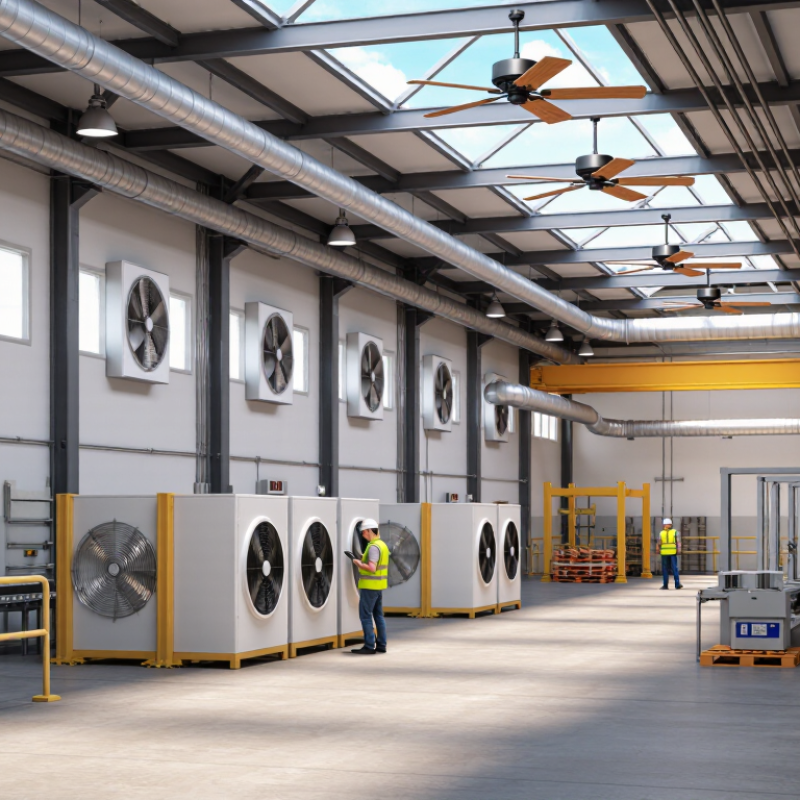
Before choosing an industrial fan, define the conditions inside your facility. Measure the room’s length, width, ceiling height, and air volume. Record heat sources, dust levels, moisture, and nearby equipment. A welding area needs different airflow from a dry storage room.
Identify the main purpose. Are you removing heat, controlling fumes, improving comfort, or supporting process ventilation? Calculate the required airflow with a qualified engineer or ventilation specialist. Check cubic feet per minute, static pressure, operating temperature, noise limits, and available power. I have seen projects fail because airflow was estimated by room size alone. That shortcut can create dead zones, excessive noise, or wasted energy. It is worth checking measurements twice.
Tips: Map airflow with smoke testing or temporary sensors before installation. Ask workers where heat and odors collect. Leave access for cleaning and maintenance. Review local safety requirements, electrical conditions, and emergency controls with competent professionals. A fan that looks powerful may perform poorly against filters, ducts, or narrow openings. Also consider future changes, such as added machinery or expanded storage. Your first requirement list may be incomplete. That is normal, but ignoring the gaps can become expensive.
Choosing the best industrial fan starts with airflow, not the catalogue label. Axial fans move large air volumes at low to moderate pressure. Centrifugal fans handle higher resistance from filters, ducts, and process equipment. The U.S. Department of Energy reports that motor-driven systems consume a major share of industrial electricity, making fan selection an operational decision, not a minor purchase.
Airflow technology changes operating costs. A fixed-speed fan may waste energy when demand falls. Variable-speed control can reduce speed during cooler shifts or lower production. AMCA engineering guidance follows the fan laws: airflow changes with speed, pressure changes with speed squared, and power changes with speed cubed. A 20% speed reduction can therefore cut theoretical power demand by about 49%. Real savings will be smaller when controls, leakage, or poor maintenance interfere.
Measure the system first. Record airflow, static pressure, temperature, dust levels, and noise near workers. That evidence prevents oversizing. Oversized fans often create turbulence, drafts, and unnecessary electricity use. I have seen a fan selected by room volume alone; it moved air, but failed near a hot process line. That method needs reconsideration. The International Energy Agency also identifies industrial motor systems as a substantial portion of global electricity use, reinforcing the value of efficient controls. Check filter loading and belt condition regularly. Small losses accumulate. Always compare measured performance with the duty point, not the advertised maximum.
Compare Industrial Fan Types and Airflow Technologies
Axial fans typically provide the highest airflow at low static pressure, making them suitable for general ventilation and air movement. Centrifugal fans generate higher pressure for ducted systems, filters, and process ventilation. Mixed-flow fans offer a practical balance between airflow and pressure. The values shown are representative operating points; actual performance depends on fan size, speed, system resistance, and operating conditions.
How to Choose the Best Industrial Fans for Your Business
Evaluate Performance, Energy Use, and Operating Costs
Choosing an industrial fan starts with the actual airflow requirement, not the largest available motor. Measure the room volume, heat sources, dust levels, and required air changes. Then compare airflow and static pressure on the fan curve. A fan may move impressive air in an open test, yet perform poorly against filters, ducts, or louvers.
Look beyond the purchase price. Check motor efficiency, control compatibility, duty cycle, and expected annual operating hours. A variable-speed control can reduce energy use when full airflow is unnecessary. However, savings depend on correct sizing and stable control settings. Ask for certified performance data and calculate kilowatt use at the operating point, not at maximum speed. Small errors matter.
Maintenance also shapes operating cost. Inspect bearings, belts, guards, and electrical connections according to the service schedule. Dust buildup can reduce airflow while increasing motor load. I once focused too heavily on initial cost and underestimated cleaning time. That decision looked sensible on paper, but the labor budget changed quickly. Include replacement parts, downtime, installation access, and noise control in the calculation. Compare several operating scenarios, because real facilities rarely run at one fixed load. A simple spreadsheet can reveal whether a higher-efficiency fan earns back its added cost. Not every upgrade will.
Installation conditions should guide your fan selection. Measure the room, airflow path, temperature, humidity, and available mounting space. A fan near welding areas may need stronger corrosion and heat resistance. Check ceiling strength before installing heavy equipment. I have seen poor mounting create vibration, noise, and loose fasteners within weeks. Airflow must also match the work area, not just the fan’s advertised capacity.
Safety deserves practical attention. Confirm that guards cover moving blades and that electrical connections suit the site conditions. Keep emergency access clear around the fan and control switches. Lockout procedures should be available before cleaning or repairs. A small clearance mistake can turn routine maintenance into a serious hazard. Do not assume a quiet fan is automatically safe.
Tips: Create a simple inspection sheet. Record unusual noise, vibration, dust buildup, and motor temperature. Clean intake screens before airflow drops noticeably. Tighten accessible fasteners during scheduled shutdowns. Inspect cables for cracks or exposed sections. Replace damaged guards immediately. Maintenance records help technicians identify gradual changes, although they are easy to neglect during busy production periods. That weakness should be acknowledged and corrected with clear ownership.
Choosing an industrial fan starts with the supplier, not the catalogue. The U.S. Department of Energy’s 2021 Motor System Market Assessment reports that motor-driven equipment uses about 68% of electricity in U.S. manufacturing. A poorly matched fan can therefore create a large operating cost. Ask suppliers for tested airflow, pressure, efficiency, noise, and power data. These values should follow recognized methods, such as AMCA 210 or ISO 5801. Marketing claims alone are not enough.
Inspect the supplier’s technical process. Request a performance curve for your actual duct resistance, not a generic maximum-airflow figure. Check motor protection, impeller balancing, bearing access, corrosion resistance, and control compatibility. A reliable supplier should provide drawings, manuals, test records, warranty terms, and realistic spare-part lead times. Visit the factory when possible. Look for clean assembly areas and traceable quality checks. Small details matter.
Service response matters more than a polished quotation.
The U.S. Department of Energy’s fan-system guidance recommends evaluating the entire system, including ducts, filters, dampers, and controls. Compare lifecycle cost over several years, not only the purchase price. Ask for customer references from facilities with similar dust, temperature, and duty cycles. I would also request a written commissioning plan. This step is easy to overlook. My own caution is simple: even a strong supplier can miss site conditions when the specification is vague. Finalize the choice only after airflow requirements, acceptance tests, maintenance access, and delivery responsibilities are written clearly.
| Evaluation Dimension | What to Check | Practical Data or Selection Guide | Why It Matters |
|---|---|---|---|
| Fan Type | Match the fan design to the airflow direction and system resistance. | Axial fans are commonly used for high airflow at relatively low pressure. Centrifugal fans are generally better suited to ducted systems and higher static pressure. | Using the wrong fan type can cause inadequate ventilation, excessive noise, or unnecessary energy consumption. |
| Required Airflow | Determine the required cubic feet per minute (CFM) or cubic metres per hour (m³/h). | Airflow requirement depends on room volume, air-change rate, heat load, process emissions, and occupancy. The conversion is 1 m³/h ≈ 0.589 CFM. | A fan must move enough air to meet the ventilation or cooling target under actual operating conditions. |
| Static Pressure | Include resistance from ducts, filters, louvers, dampers, grilles, and process equipment. | Review the fan curve at the required operating point, expressed in Pa or in. w.g. Do not select a fan using free-air airflow alone. | Actual airflow can fall substantially when system resistance is higher than the fan’s rated test condition. |
| Operating Point | Compare the required airflow and pressure with the published performance curve. | Select a duty point that is not at the extreme end of the fan curve and verify stable operation across expected load conditions. | Operating near an unstable or inefficient region may increase vibration, noise, and maintenance requirements. |
| Motor Power and Efficiency | Check motor rating, service factor, efficiency class, and power consumption at the duty point. | Verify voltage, phase, frequency, full-load current, and compatibility with the intended electrical supply. Consider an efficient motor and speed control where the load varies. | Motor efficiency affects operating cost, heat generation, and the required electrical infrastructure. |
| Speed Control | Determine whether the fan needs variable-speed operation. | Common control options include variable-frequency drives for compatible motors, electronically commutated motors, or staged switching. | Reducing speed can lower airflow and energy use when full capacity is not required, subject to system and motor limits. |
| Noise Level | Review sound-power or sound-pressure data and the test conditions used. | Noise is commonly reported in dB or dB(A). Compare products measured at equivalent airflow, pressure, distance, and installation conditions. | Sound performance depends on both the fan and the installation, including ducts, vibration, and room acoustics. |
| Temperature Capability | Confirm the maximum continuous air temperature and motor ambient-temperature rating. | For hot-air applications, verify bearings, insulation, seals, wiring, and cooling arrangements in addition to the stated temperature limit. | Exceeding temperature limits can shorten insulation life, damage bearings, and create unsafe operating conditions. |
| Environment and Enclosure | Assess dust, moisture, corrosive gases, washdown exposure, and outdoor installation. | Select suitable enclosure protection using the applicable IP rating and specify corrosion-resistant materials or coatings where required. | Environmental protection reduces the risk of electrical faults, corrosion, contamination, and premature failure. |
| Air Cleanliness and Hazardous Areas | Identify combustible dust, flammable vapour, corrosive chemicals, grease, or abrasive particles. | For hazardous locations, require equipment certified for the specific area classification and gas or dust group. For contaminated air, check impeller material and cleanability. | Special environments require appropriate construction and certification to control ignition, corrosion, and reliability risks. |
| Construction Materials | Review housing, impeller, shaft, fasteners, coatings, and protective guards. | Use materials appropriate for humidity, chemicals, temperature, impact, and cleaning methods. Confirm guard spacing and mechanical protection. | Correct materials improve service life and help protect personnel from rotating components. |
| Installation Requirements | Check mounting orientation, available space, duct size, access, electrical connection, and lifting requirements. | Allow access for inspection and cleaning, provide suitable supports, and follow the manufacturer’s clearance and alignment instructions. | Poor installation can reduce airflow, increase vibration, and make routine maintenance difficult. |
| Maintenance Requirements | Evaluate bearing type, lubrication needs, filter access, inspection points, and replacement parts. | Prefer documented maintenance intervals, accessible components, vibration checks, and clearly identified spare parts. | Easy maintenance can reduce downtime and support more predictable operating costs. |
| Testing and Documentation | Request performance curves, dimensional drawings, wiring diagrams, manuals, test reports, and certificates where applicable. | Documentation should state test standards, operating conditions, tolerances, electrical data, sound data, and allowable limits. | Complete documentation supports engineering approval, installation, commissioning, and future troubleshooting. |
| Supplier Reliability | Assess technical support, manufacturing capability, quality controls, lead time, warranty, and after-sales service. | Ask for verifiable references, quality certificates, service procedures, spare-parts availability, and written warranty terms. | A dependable supplier helps reduce procurement risk and provides support throughout the equipment life cycle. |
| Total Cost of Ownership | Compare purchase price with energy, installation, maintenance, spare parts, downtime, and disposal costs. | Use the expected operating hours, electricity tariff, motor input power, maintenance schedule, and service life for the calculation. | The lowest initial price may not provide the lowest long-term cost. |
| Final Selection Check | Confirm that the selected model meets airflow, pressure, electrical, environmental, safety, installation, and budget requirements. | Record the final duty point, fan speed, motor data, noise level, dimensions, certifications, delivery terms, warranty, and approved accessories. | A documented final check prevents specification gaps and makes supplier quotations easier to compare. |
We use cookies on our website to give you an improved browser experience. View our Privacy Policy for more information. Please make your selection to opt in or out of ALL cookies here: Accept or Decline
Do you consent to the use of ALL cookies?
901 2nd Court West
Birmingham, AL 35204
Sales: 866.481.4036
Logistics/Ops: 866.481.4036
2101 Dralle Road
University Park, IL 60466
Sales: 708.813.9070
Logistics/Ops: 708.235.4200
400 E. 13th Street
Little Rock, AR 72114
Sales: 866.760.5344
Logistics/Ops: 866.760.5344
225 Collins Road
Elkhart, IN 46515
Sales: 574.295.0214
Logistics/Ops: 574.607.4611
601 Berryman Pike
Tipton, IN 46072
Sales: 800.897.7591
Logistics/Ops: 800.897.7591
3900 Uvalda Street
Denver, CO 80239
Sales: 303.706.8000
Ops/Logistics: 303.576.8398
510 3rd Street E
Milan, IL 61264
Sales: 800.322.1052
Logistics/Ops: 800.322.1052
1660 E. Aurora
Des Moines, IA 50313
Sales: 800.671.1660
Logistics: 800.671.1660
86554 Gene Lasserre Blvd.
Yulee, FL 32097
Sales: 904.253.3060
Logistics/Ops: 904.225.3000
694 S.E. County Road 245
Lake City, FL 32025
Sales: 800.727.6706
Logistics/Ops: 386.752.7412
210 Neptune Road
Auburndale, FL 33823
Sales: 863.967.1131
Logistics/Ops: 863.777.9814
4601 McCoy Drive
Pensacola, FL 32503
Sales: 850.308.7030
Logistics/Ops: 850.434.5502
815 South 56th Street
Tampa, FL 33619
Sales: 813.302.1940
Logistics/Ops: 813.621.1352
200 Hosea Road
Lawrenceville, GA 30046
Sales: 770.953.7575
Logistics/Ops: 770.513.6000
Branch Product Guide
Branch Line Card
Moulding Offering
Cedar Offering
Column Offering
8173 Hwy. 165 North
Monroe, LA 71211
Sales: 800.256.4165
Logistics/Ops: 800.256.4165
508 Warren Avenue
Portland, ME 04103
Sales: 207.888.2331
Logistics/Ops: 207.797.6565
4300 Georgia Pacific Blvd.
Frederick, MD 21704
Sales: 301.798.7474
Logistics/Ops: 301.874.8000
419 Maple Street
Bellingham, MA 02019
Sales: 508.449.0535
Logistics/Ops: 508.966.5500
825 Buchanan Ave SW
Grand Rapids, MI 49507
Sales: 877.800.1180
Logistics/Ops: 616.278.0909
995 Pacific St. NW
Aitkin, MN 56431
Sales: 800.432.3727
Logistics/Ops: 218.212.7770
1102 Port Terminal Drive
Duluth, MN 55802
Sales: 800.951.9899
Logistics/Ops: 800.851.9899
9110 83rd Ave. North
Brooklyn Park, MN 55445
Sales: 763.425.0204
Logistics/Ops: 763.425.0204
910 E. Railroad Street
Long Beach, MS 39560
Sales: 866.535.4135
Logistics/Ops: 228.205.2400
1727 Warren Street
North Kansas City, MO 64116
Sales: 800.621.2611
Logistics/Ops: 800.621.2611
2123 North Golden
Springfield, MO 65803
Sales: 800.375.7891
Logistics/Ops: 800.375.7891
13860 Corp. Woods Trail
Bridgeton, MO 63044
Sales: 314.209.0800
Logistics/Ops: 314.209.0800
1109 South 19th Street
Omaha, NE 68108
Sales: 800.489.6637
Logistics/Ops: 800.489.6637
1 Luger Road
Denville, NJ 07834
Sales: 973-339-3539
Logistics/Ops: 973.625.1461
3720 Jeffrey Blvd.
Blasdell, NY 14219
Sales: 716.235.5989
Logistics/Ops: 716.825.6557
319 Yaphank Ave.
Yaphank, NY 11980
Sales: 631.358.5714
Logistics/Ops: 631.924.7401
3300 Parkside Drive
Charlotte, NC 28208
Sales: 800.839.2588
Logistics/Ops: 704.394.3172
1712 East D Street
Butner, NC 27509
Sales: 984.389.8200
Logistics/Ops: 919.575.3700
128 Foothills Drive
Statesville, NC 28687
Sales: 800.222.1414
Logistics/Ops: 704.394.3172
550 Munroe Falls Rd.
Tallmadge, OH 44278
Sales: 330.357.4506
Logistics/Ops: 330.794.1141
10347 Toebben Dr.
Independence, KY 41051
Sales: 859.298.3926
Logistics/Ops: 859.746.2250
450 N. MacArthur
Oklahoma City, OK 73127
Sales: 800.375.6025
Logistics/Ops: 800.375.6025
1680 North Aspen
Broken Arrow, OK 74012
Sales: 918.272.2212
Logistics/Ops: 918.272.2212
522 Bridge Street
Hunker, PA 15639
Sales: 878.217.2001
Logistics/Ops: 724.925.7285
4290 Atlanta Street
Charleston, SC 29418
Sales: 843.371.1420
Logistics/Ops: 843.554.8192
1040 S. Industrial Dr.
Erwin, TN 37650
Sales: 423.641.1005
Logistics/Ops: 423.742.5911
4287 Pilot Drive
Memphis, TN 38118
Sales: 901.365.2101
Logistics/Ops: 901.365.2101
700 Myatt Drive
Madison, TN 37115
Sales: 615.327.9547
Logistics/Ops: 629.777.4949
4747 Mark IV Parkway
Fort Worth, TX 76106
Sales: 866.323.5117
Logistics/Ops: 817.625.9091
6990 Market Avenue
El Paso, TX 79915
Sales: 915.778.6356
Logistics/Ops: 915.265.7200
2502 Wilson Road
Harlingen, TX 78552
Sales: 800.580.6711
Logistics/Ops: 800.580.6711
10,000 North Loop East
Houston, TX 77029
Sales: 713.921.1977
Logistics/Ops: 713.675.3544
702 East 44th St.
Lubbock, TX 79404
Sales: 866.454.6010
Logistics/Ops: 866.454.6010
535 N. WW White Road
San Antonio, TX 78219
Sales: 800.284.0488
Logistics/Ops: 210.333.8112
142 Pine Haven Shores Rd.
Shelburne, VT 05482
Sales: 802.800.2540
Logistics/Ops: 802.985.2512
4700 Bethlehem Road,
Richmond, VA 23230
Sales: 804.201.2400
Logistics/Ops: 804.342.1161
4516 N Barker Road
Spokane Valley, WA 99027
Phone: 509.892.9420
Toll free: 800.728.6157
8365 N. 76th Street
Milwaukee, WI 53223
Sales: 800.356.9245
Logistics/Ops: 800.356.9245
312 S. Chester Street
Sparta, WI 54656
Sales: 800.362.5864
Logistics/Ops: 800.362.5864
899 Grossman Drive
Schofield, WI 54476
Sales: 800.472.0017
Logistics/Ops: 800.472.0017
