
We use cookies on our website to give you an improved browser experience. View our Privacy Policy for more information. Please make your selection to opt in or out of ALL cookies here: Accept or Decline
Choosing Maple Engineered Flooring is not simply a matter of selecting the palest board or the lowest price. Maple can bring a clean, bright character to a room, yet its subtle grain may reveal scratches, dust, and uneven lighting. The right choice depends on construction, finish, board width, installation conditions, and daily use. A hallway with muddy shoes needs different performance from a quiet guest room.
Brett Miller, a respected wood-flooring educator and technical expert with the National Wood Flooring Association, has said, “Wood flooring is a natural product, and no two floors are alike.” That principle matters when comparing maple samples. Natural variation is not a defect. It is part of the material’s identity. Still, buyers should examine more than appearance. Check the wear-layer thickness, core stability, finish quality, formaldehyde compliance, warranty language, and moisture requirements. A beautiful sample can mislead.
Room conditions matter greatly.
Before ordering, place sample boards near windows and under evening lights. Notice how the maple tone changes. Consider whether the floor will be installed over concrete, radiant heating, or a timber subfloor. Engineered construction can improve dimensional stability, but it does not cancel poor preparation. This is where many careful buyers make an expensive mistake.
A reliable decision balances beauty, performance, and maintenance. Choose a proven supplier, request technical documents, and confirm installation instructions with a qualified professional. Maple Engineered Flooring can be durable and refined, but only when its specifications match the room. The perfect floor may not be the most fashionable one. It may be the one that still looks convincing after years of ordinary living.
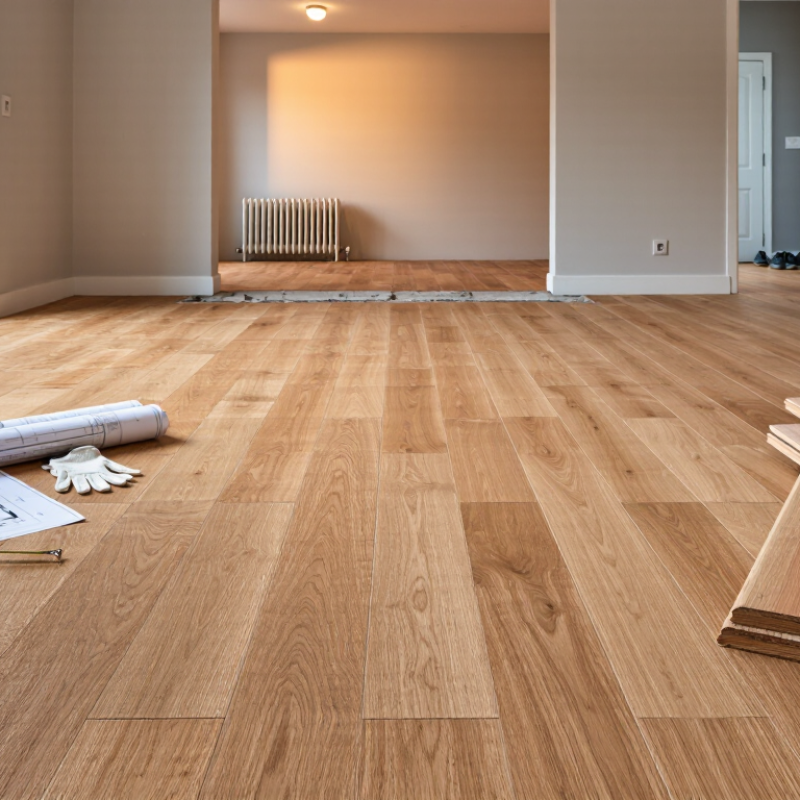
Maple engineered flooring combines a genuine maple surface with a layered structural core. Unlike solid planks, its cross-layer construction can reduce movement when indoor humidity changes. The maple wear layer provides natural grain, pale color, and a smooth, refined appearance. Depending on the cut, boards may show quiet cathedral lines or straighter patterns. This variation matters. A clear finish usually highlights maple’s creamy tone, while a tinted finish can deepen it. Maple is relatively hard, so it handles daily foot traffic well. Still, hard does not mean scratch-proof. Fine grit near an entryway can mark the surface quickly. The core also deserves attention. High-quality plywood or stable composite layers should feel firm and consistent across the board. Uneven edges, weak locking profiles, or a thin wear layer may create problems later.
When choosing a floor, inspect full-size samples under daylight and warm indoor lighting. Small samples can hide color shifts. Check the wear-layer thickness, finish type, board dimensions, and installation requirements. A thicker maple layer may allow careful future refinishing, but not every product supports repeated sanding. Ask for moisture guidance before installation, especially in basements or humid coastal rooms. The subfloor must be clean, level, and dry. I have seen attractive flooring fail because preparation was rushed. That lesson is easy to overlook. For kitchens and hallways, choose a durable finish and place mats at exterior doors. Avoid rubber-backed mats unless the flooring instructions approve them. Radiant heating requires confirmed compatibility, not guesswork. I would compare samples, technical documents, and installer advice before paying. Even then, natural maple may vary slightly between batches. That is not a defect; it is part of real wood. But I still prefer written specifications.
How to Choose Maple Engineered Flooring?
Assess the room before choosing the maple grade, thickness, or finish. Hard maple measures about 1,450 lbf on the Janka hardness scale, according to the USDA Forest Products Laboratory’s Wood Handbook. This makes it suitable for busy hallways, dining areas, and homes with active children. However, hardness does not prevent scratches from grit, pet claws, or furniture movement. A matte finish may hide daily wear better than a glossy surface.
Moisture deserves closer attention. The National Wood Flooring Association recommends maintaining indoor humidity near 30–50% for wood flooring. Use a moisture meter before installation, especially over concrete or in basements. Engineered construction can reduce seasonal movement, but it is not waterproof. Kitchens need prompt spill cleanup, while bathrooms require extra caution. Radiant heating also demands flooring approved for that system.
Think about your habits, not only the room’s appearance. Do muddy shoes enter near the front door? Will chairs scrape the floor every evening? Wider maple boards can look calm, yet they may show movement more clearly when conditions fluctuate. I once underestimated how quickly pale flooring reveals tracked-in soil. A darker stain might be practical, although it can show dust instead. Check the wear layer, finish warranty, and installation requirements carefully; attractive samples can still disappoint under real household pressure.
How to Choose Maple Engineered Flooring?
Maple grades strongly influence the room’s visual character. Clear grade offers a quiet surface with limited knots and consistent color. Select grade adds small mineral streaks and subtle grain variation. Common grades show more knots, darker marks, and natural movement. These differences are not defects. They reveal the tree’s history, though samples can understate final variation. The USDA Forest Products Laboratory lists hard maple at about 1,450 lbf on the Janka hardness scale in its Wood Handbook. This makes maple durable, but not scratch-proof.
Finish selection changes both maintenance and appearance. A UV-cured polyurethane finish usually creates a stronger protective film and simpler cleaning routine. Hardwax oil feels more natural and allows localized repairs, but it needs periodic refreshing. Matte finishes reduce glare and make dust less obvious. Glossy finishes can deepen color, yet they often reveal footprints and fine scratches. Test samples near windows. Maple can appear pale in one room and warmer under evening lighting.
Surface texture deserves practical attention. Smooth maple highlights clean grain and works well with modern interiors. Wire-brushed boards add tactile detail and disguise small marks from daily use. Hand-scraped textures create stronger shadows, but they may collect grit in busy entryways. NWFA technical guidance stresses moisture testing and proper acclimation before installation. Ignoring that step can cause movement, even with engineered construction. I once preferred the most textured sample, then reconsidered after seeing dust settle in its grooves. A restrained texture may serve better.
| Maple Grade | Typical Visual Characteristics | Natural Variation | Recommended Finish | Surface Texture Options | Best Interior Style | Practical Performance | Relative Cost |
|---|---|---|---|---|---|---|---|
| Select & Better Clear, uniform appearance | Light cream to pale golden color with a relatively consistent grain. Small sound knots and minor color differences may occur, depending on the grading rules used. | Low Minimal mineral streaks, pin knots, and contrasting sapwood or heartwood. | Matte polyurethane Natural oil Light whitewash | Smooth, lightly brushed, or subtle wire-brushed texture. Deep distressing can look inconsistent on a clean grade. | Contemporary, Scandinavian, minimalist, and formal interiors. | The uniform surface makes dust and small visual irregularities less noticeable. A matte finish helps reduce visible scratches and glare. | High |
| Natural / No. 1 Common Balanced character and consistency | Mostly even boards with occasional small knots, mineral streaks, mild color shifts, and slightly more pronounced grain than Select grade. | Low to Medium Noticeable variation without a heavily rustic appearance. | Matte finish Satin finish Hardwax oil | Light wire-brushing or fine scraping can add dimension while preserving a refined appearance. | Transitional, modern farmhouse, coastal, and everyday residential spaces. | A practical compromise between visual uniformity, character, and material efficiency. Matte surfaces generally hide minor wear better than high-gloss coatings. | Medium to High |
| Rustic / No. 2 Common Distinctive natural character | More visible knots, mineral streaks, color variation, short grain patterns, and occasional filled imperfections may be present. | Medium to High Each carton can contain clearly different tones and board patterns. | Low-sheen polyurethane Tinted oil Smoked or reactive color | Wire-brushed, hand-scraped, saw-marked, or lightly distressed textures are suitable. | Rustic, industrial, farmhouse, lodge, and casual family rooms. | Texture and color variation help disguise everyday marks, but open knots or filled areas may require closer cleaning and occasional touch-up. | Medium |
| Character Grade Highly expressive appearance | Prominent knots, mineral streaks, strong tonal changes, natural splits, and visible grain movement. Some defects may be filled or stabilized during manufacturing. | High Strong board-to-board variation is an intentional part of the design. | Matte oil Ultra-matte coating Aged or smoked tone | Pronounced wire-brushing, hand-scraping, saw marks, and multi-level texturing. | Heritage, vintage, industrial, lodge, and heavily textured interiors. | Strong texture can reduce the visual impact of small scratches, while deep grooves may collect dirt and need more careful vacuuming. | Medium |
| Premium Color-Sorted Grade Controlled tone with selected character | Boards are selected for a coordinated color range while retaining limited knots, mineral streaks, or grain variation. | Low to Medium More consistent than rustic grades, but not completely uniform. | Clear matte coat Natural oil Custom stain | Smooth, brushed, or fine wire-brushed texture depending on the desired design effect. | Open-plan living areas, hospitality-style interiors, and coordinated modern renovations. | Color sorting improves visual continuity across large spaces. Engineered construction can provide better dimensional stability than solid maple when properly installed and acclimated. | High |
How to Choose Maple Engineered Flooring?
Choosing the right board size changes how a room feels. Wide planks, around 7 to 9 inches, can make an open room look calmer and more spacious. Narrow boards suit smaller rooms and create a busier, traditional rhythm. Measure the room carefully, but do not trust measurements alone. Doorways, cabinets, and furniture can make wide boards difficult to balance. Lay several sample boards on the floor before deciding.
Maple has a naturally light tone and a clean, subtle grain. Pale finishes reflect daylight, while warmer stains create a softer appearance. View samples in morning and evening light. Artificial lighting can alter the color more than expected. I once preferred a cool sample in a showroom, but it looked gray beside warm walls. That small detail matters. Also check the surface texture, since glossy finishes show scratches and dust more clearly.
Installation depends on the subfloor, room conditions, and board construction. A floating installation is often practical over a prepared, level surface and can reduce disruption. Glue-down fitting can feel quieter and more stable, especially in larger areas. Nail-down installation may provide a traditional, secure result over a suitable wooden subfloor. The subfloor should be dry, clean, and flat within the flooring manufacturer’s tolerance. Do not rush acclimation. Maple can respond to indoor humidity changes, and careless preparation may create gaps or movement. Even experienced installers should review the instructions, because “standard” conditions are not always standard.
Select the board width according to the room scale and visual effect. The chart estimates how many plank rows are needed across a 4-meter-wide room, before allowing for perimeter expansion gaps or cutting waste.
Color: Natural maple highlights the wood’s pale cream tone and grain variation. Light-stained maple keeps rooms bright, while medium or warm stains create more contrast and a richer appearance. Always review a physical sample because maple absorbs stain unevenly.
Installation method: Glue-down installation is commonly used over concrete and can reduce movement. Nail-down or staple-down installation is generally suited to wood subfloors. Floating installation is faster and may work over several approved subfloors, but the flooring system must include a compatible locking profile and underlayment. Follow the flooring manufacturer’s installation requirements.
Choosing maple engineered flooring requires more than admiring its pale color and smooth grain. Quality begins with a stable, layered core and a properly bonded maple wear layer. Inspect the boards under clear light. Look for even edges, consistent thickness, and minimal surface gaps. A reliable floor should feel solid, not hollow, when tapped. Moisture testing also matters, especially over concrete subfloors. Ignoring it can lead to cupping later.
Maintenance needs are manageable, but they are not effortless. Sweep grit regularly because small particles can scratch the finish near entrances. Wipe spills promptly with a slightly damp cloth. Avoid soaking the floor or using harsh cleaners. Felt pads under furniture help prevent dents. In busy homes, the finish may show wear sooner than expected. That is not a product failure; it reflects traffic and cleaning habits. Long-term value depends on repairability, finish durability, and installation quality, not appearance alone.
Tips: Request installation instructions and moisture requirements before purchasing. Compare the wear-layer thickness, warranty conditions, and compatible cleaning products. Keep spare boards from the same batch. Color matching can be imperfect years later. If rooms receive strong sunlight, use curtains or blinds to reduce uneven fading. A professional installer can identify subfloor movement, though even professionals may miss hidden moisture without proper testing.
We use cookies on our website to give you an improved browser experience. View our Privacy Policy for more information. Please make your selection to opt in or out of ALL cookies here: Accept or Decline
Do you consent to the use of ALL cookies?
901 2nd Court West
Birmingham, AL 35204
Sales: 866.481.4036
Logistics/Ops: 866.481.4036
2101 Dralle Road
University Park, IL 60466
Sales: 708.813.9070
Logistics/Ops: 708.235.4200
400 E. 13th Street
Little Rock, AR 72114
Sales: 866.760.5344
Logistics/Ops: 866.760.5344
225 Collins Road
Elkhart, IN 46515
Sales: 574.295.0214
Logistics/Ops: 574.607.4611
601 Berryman Pike
Tipton, IN 46072
Sales: 800.897.7591
Logistics/Ops: 800.897.7591
3900 Uvalda Street
Denver, CO 80239
Sales: 303.706.8000
Ops/Logistics: 303.576.8398
510 3rd Street E
Milan, IL 61264
Sales: 800.322.1052
Logistics/Ops: 800.322.1052
1660 E. Aurora
Des Moines, IA 50313
Sales: 800.671.1660
Logistics: 800.671.1660
86554 Gene Lasserre Blvd.
Yulee, FL 32097
Sales: 904.253.3060
Logistics/Ops: 904.225.3000
694 S.E. County Road 245
Lake City, FL 32025
Sales: 800.727.6706
Logistics/Ops: 386.752.7412
210 Neptune Road
Auburndale, FL 33823
Sales: 863.967.1131
Logistics/Ops: 863.777.9814
4601 McCoy Drive
Pensacola, FL 32503
Sales: 850.308.7030
Logistics/Ops: 850.434.5502
815 South 56th Street
Tampa, FL 33619
Sales: 813.302.1940
Logistics/Ops: 813.621.1352
200 Hosea Road
Lawrenceville, GA 30046
Sales: 770.953.7575
Logistics/Ops: 770.513.6000
Branch Product Guide
Branch Line Card
Moulding Offering
Cedar Offering
Column Offering
8173 Hwy. 165 North
Monroe, LA 71211
Sales: 800.256.4165
Logistics/Ops: 800.256.4165
508 Warren Avenue
Portland, ME 04103
Sales: 207.888.2331
Logistics/Ops: 207.797.6565
4300 Georgia Pacific Blvd.
Frederick, MD 21704
Sales: 301.798.7474
Logistics/Ops: 301.874.8000
419 Maple Street
Bellingham, MA 02019
Sales: 508.449.0535
Logistics/Ops: 508.966.5500
825 Buchanan Ave SW
Grand Rapids, MI 49507
Sales: 877.800.1180
Logistics/Ops: 616.278.0909
995 Pacific St. NW
Aitkin, MN 56431
Sales: 800.432.3727
Logistics/Ops: 218.212.7770
1102 Port Terminal Drive
Duluth, MN 55802
Sales: 800.951.9899
Logistics/Ops: 800.851.9899
9110 83rd Ave. North
Brooklyn Park, MN 55445
Sales: 763.425.0204
Logistics/Ops: 763.425.0204
910 E. Railroad Street
Long Beach, MS 39560
Sales: 866.535.4135
Logistics/Ops: 228.205.2400
1727 Warren Street
North Kansas City, MO 64116
Sales: 800.621.2611
Logistics/Ops: 800.621.2611
2123 North Golden
Springfield, MO 65803
Sales: 800.375.7891
Logistics/Ops: 800.375.7891
13860 Corp. Woods Trail
Bridgeton, MO 63044
Sales: 314.209.0800
Logistics/Ops: 314.209.0800
1109 South 19th Street
Omaha, NE 68108
Sales: 800.489.6637
Logistics/Ops: 800.489.6637
1 Luger Road
Denville, NJ 07834
Sales: 973-339-3539
Logistics/Ops: 973.625.1461
3720 Jeffrey Blvd.
Blasdell, NY 14219
Sales: 716.235.5989
Logistics/Ops: 716.825.6557
319 Yaphank Ave.
Yaphank, NY 11980
Sales: 631.358.5714
Logistics/Ops: 631.924.7401
3300 Parkside Drive
Charlotte, NC 28208
Sales: 800.839.2588
Logistics/Ops: 704.394.3172
1712 East D Street
Butner, NC 27509
Sales: 984.389.8200
Logistics/Ops: 919.575.3700
128 Foothills Drive
Statesville, NC 28687
Sales: 800.222.1414
Logistics/Ops: 704.394.3172
550 Munroe Falls Rd.
Tallmadge, OH 44278
Sales: 330.357.4506
Logistics/Ops: 330.794.1141
10347 Toebben Dr.
Independence, KY 41051
Sales: 859.298.3926
Logistics/Ops: 859.746.2250
450 N. MacArthur
Oklahoma City, OK 73127
Sales: 800.375.6025
Logistics/Ops: 800.375.6025
1680 North Aspen
Broken Arrow, OK 74012
Sales: 918.272.2212
Logistics/Ops: 918.272.2212
522 Bridge Street
Hunker, PA 15639
Sales: 878.217.2001
Logistics/Ops: 724.925.7285
4290 Atlanta Street
Charleston, SC 29418
Sales: 843.371.1420
Logistics/Ops: 843.554.8192
1040 S. Industrial Dr.
Erwin, TN 37650
Sales: 423.641.1005
Logistics/Ops: 423.742.5911
4287 Pilot Drive
Memphis, TN 38118
Sales: 901.365.2101
Logistics/Ops: 901.365.2101
700 Myatt Drive
Madison, TN 37115
Sales: 615.327.9547
Logistics/Ops: 629.777.4949
4747 Mark IV Parkway
Fort Worth, TX 76106
Sales: 866.323.5117
Logistics/Ops: 817.625.9091
6990 Market Avenue
El Paso, TX 79915
Sales: 915.778.6356
Logistics/Ops: 915.265.7200
2502 Wilson Road
Harlingen, TX 78552
Sales: 800.580.6711
Logistics/Ops: 800.580.6711
10,000 North Loop East
Houston, TX 77029
Sales: 713.921.1977
Logistics/Ops: 713.675.3544
702 East 44th St.
Lubbock, TX 79404
Sales: 866.454.6010
Logistics/Ops: 866.454.6010
535 N. WW White Road
San Antonio, TX 78219
Sales: 800.284.0488
Logistics/Ops: 210.333.8112
142 Pine Haven Shores Rd.
Shelburne, VT 05482
Sales: 802.800.2540
Logistics/Ops: 802.985.2512
4700 Bethlehem Road,
Richmond, VA 23230
Sales: 804.201.2400
Logistics/Ops: 804.342.1161
4516 N Barker Road
Spokane Valley, WA 99027
Phone: 509.892.9420
Toll free: 800.728.6157
8365 N. 76th Street
Milwaukee, WI 53223
Sales: 800.356.9245
Logistics/Ops: 800.356.9245
312 S. Chester Street
Sparta, WI 54656
Sales: 800.362.5864
Logistics/Ops: 800.362.5864
899 Grossman Drive
Schofield, WI 54476
Sales: 800.472.0017
Logistics/Ops: 800.472.0017
