We use cookies on our website to give you an improved browser experience. View our Privacy Policy for more information. Please make your selection to opt in or out of ALL cookies here: Accept or Decline
Choosing a Steel Fire-Rated Shutter requires more than comparing curtain thickness or price. The shutter must match the building’s fire strategy, opening size, traffic pattern, and maintenance capacity. A warehouse doorway may need different protection from a kitchen service opening or an internal loading bay. Small details matter. Clearances, guide rails, bottom bars, and control systems can influence real performance during an emergency.
Start with verified evidence. Review the manufacturer’s fire-test reports, classification documents, installation instructions, and maintenance requirements. Confirm that the tested assembly matches your proposed wall type, opening dimensions, mounting method, and shutter configuration. A qualified fire-safety professional should assess local project requirements and applicable standards. Do not rely on marketing language alone. Terms such as “fireproof” can sound reassuring, yet they may not explain integrity, insulation, smoke control, or closing reliability.
Practical selection also involves daily use. Count expected operating cycles, inspect available headroom, and consider power failure conditions. Ask how the shutter closes when alarms activate, and how staff can test it safely. A shutter that protects the opening but obstructs emergency movement is not a complete solution. It is easy to overlook routine servicing. That mistake can become expensive. Review access for inspections, replacement parts, corrosion protection, and cleaning around the guides. No option is perfect. The strongest decision combines certified performance, suitable design, skilled installation, and documented maintenance. This guide examines those factors clearly, while recognizing that site conditions can challenge even a well-designed system.
Choosing steel fire-rated shutters begins with defining your building’s fire protection requirements. A shutter is not simply a metal barrier. It must protect an opening within a fire-rated wall, floor, or partition.
Walk through the building with a qualified fire professional. Identify kitchens, warehouses, garages, service corridors, and escape routes. Record each opening’s width, height, wall rating, and nearby combustible materials. A loading bay may need different protection from a small service counter. Smoke control may also matter. In some areas, a shutter must limit smoke movement before flames reach the opening.
Check the required fire-resistance period, operating method, and release system. Requirements can vary between occupancy types and local building rules. Ask for independent test evidence covering the complete shutter assembly, not only the steel curtain. Guides, seals, brackets, detectors, and the supporting wall all affect performance. Automatic closing should remain reliable during power loss. Manual access must still be practical for trained staff.
Measure twice. Errors happen.
Consider daily use as carefully as emergency performance. Frequent deliveries can damage guides, while grease and dust can affect sensors. Schedule inspections and functional tests, then keep clear service records. I have seen well-rated shutters fail because stored boxes blocked the closing path. That detail is easy to miss. It deserves honest review before purchase. A fire engineer should verify the final selection against the building’s drawings, evacuation plan, and maintenance capability.
Fire-rated steel shutters are commonly specified by the duration for which the tested assembly resists fire exposure. The chart shows common rating durations used for different levels of fire compartmentation and opening protection.
Use the building’s required wall or compartment rating, opening size, occupancy risk, smoke-control needs, temperature limits, and local building code to select the final shutter. The listed durations are common reference ratings; the installed shutter must be certified as a complete tested assembly for the intended application.
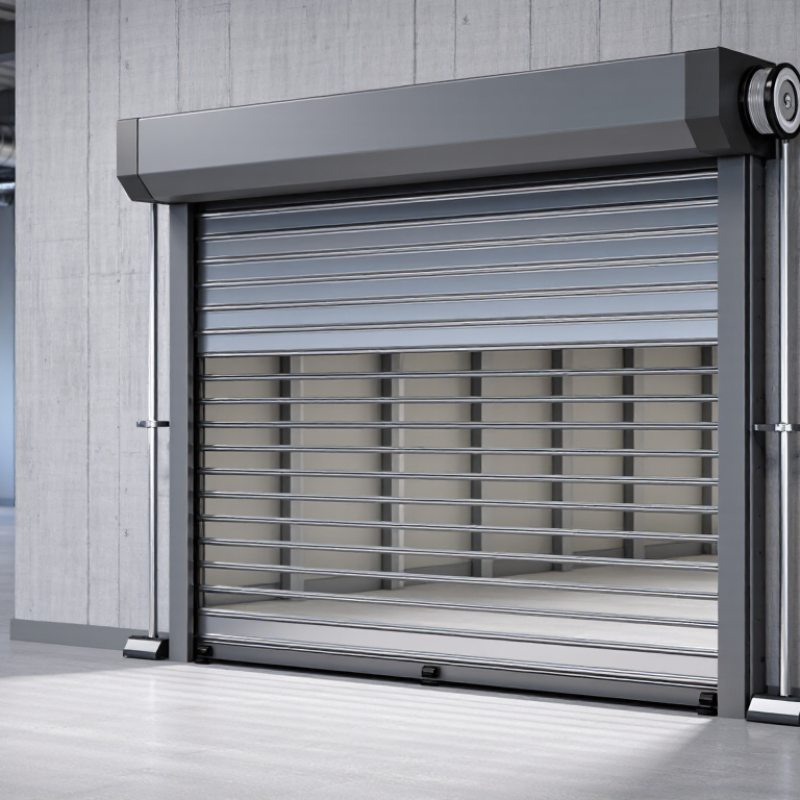
Choosing a steel fire-rated shutter starts with the opening, not the catalogue image. Solid-lath shutters provide a dense barrier, while perforated or vision-panel designs improve visibility but may reduce insulation. Insulated steel curtains usually control heat better. High-cycle rolling shutters suit busy warehouses, though their guides, springs, and closing systems need regular inspection.
Compare the test standard carefully. In the United States, NFPA 80 governs installation and maintenance, while UL 10B and UL 10C evaluate fire-door assemblies under different exposure conditions. In Europe, EN 1634-1 measures fire resistance using integrity, E, and insulation, I. A shutter marked EI60 is not automatically equivalent to a 60-minute rating elsewhere. Test scope matters. Wall construction, mounting method, clearances, and automatic release devices can change performance.
The NFPA report Fire Loss in the United States During 2023 recorded about 1.39 million fires and approximately 21.9 billion dollars in property damage. That figure makes compartmentation more than a paperwork exercise. A correctly rated shutter should close fully when the alarm activates, without striking stored goods or leaving a visible gap at the sill. On site, dust around the guides is easy to miss. It can delay closing. A rating alone can mislead; maintenance records, field conditions, and compatible hardware deserve equal attention. Even experienced buyers sometimes compare minutes before comparing test methods.
How to Choose Steel Fire Rated Shutters?
Start with accurate opening measurements. Record the clear width, height, headroom, side space, and sill level. A few millimeters can affect guide alignment and curtain travel. Measure after nearby finishes are installed, not from early drawings alone. In site reviews, I have seen ducts and lighting obstruct the shutter box. These details are easy to miss.
Mounting conditions deserve equal attention. Masonry, structural steel, and framed walls require different fixing methods. Confirm the wall can support the shutter assembly, guides, and operating loads. Check anchor positions, fire-rated surrounding materials, and access for future inspections. The shutter should close without rubbing against uneven floors. It sounds obvious. It is not.
Choose the operating mechanism according to opening size, frequency, and emergency requirements. Manual chains may suit smaller openings, while larger shutters often need a properly rated motor and controlled closing system. Ask how the shutter behaves during power loss. A tested fail-safe arrangement is essential. Confirm that the complete assembly, including curtain, guides, hood, controls, and release devices, carries the required fire rating. Do not judge protection by the steel gauge alone. That shortcut can mislead. Installation quality also matters, so use trained technicians and retain inspection records. A practical trial after installation may reveal problems that drawings never show.
Steel fire rated shutters should be selected as complete, tested assemblies. Material thickness matters, but it is not the only concern. Galvanized steel can resist corrosion in many indoor environments. Stainless steel may suit damp or chemically exposed areas. Check the curtain, guides, barrel, bottom rail, and fixing brackets together. A strong curtain can still fail if the guides deform.
Safety features deserve close attention. Look for controlled closing, emergency release, obstruction detection, and reliable limit settings. The shutter should close at a predictable speed during a fire alarm. It should also avoid trapping people or blocking essential escape routes. On site, I have seen poorly adjusted shutters strike uneven floors. Small installation errors can create serious gaps. Check smoke seals, guide alignment, and the condition of the surrounding wall.
Certification documents provide the clearest evidence. Request the full fire test report, classification certificate, product scope, and installation instructions. Confirm the tested fire period, mounting method, wall construction, shutter size, and operating arrangement. These details must match the proposed installation. A certificate for one configuration may not cover another. Ask for traceable serial numbers and inspection records. Maintenance logs should show testing of alarms, releases, guides, and closing performance. I once relied too heavily on a certificate title. The detailed limitations changed the decision. Read every page. Then have a qualified fire professional review unclear points against applicable local requirements.
Choosing steel fire-rated shutters starts with the supplier, not the catalog photograph. Ask for tested assembly reports, certification scope, installation instructions, and traceable material records. Confirm the rating matches the wall type, opening size, exposure, and local code requirements. A credible supplier explains limitations clearly. Request references from warehouses, kitchens, or service corridors. Ask who will inspect the completed shutter. This question matters.
Before delivery, survey the opening in person. Record width, height, sill condition, headroom, nearby sprinklers, electrical points, and traffic patterns. A small site error can force expensive alterations. Coordinate structural supports, power isolation, signage, and access for future servicing. Installation should follow approved details, with guides plumb and the curtain free from rubbing. Test drop speed, sensing devices, alarms, and manual release under controlled conditions. Do not rely on one demonstration.
Write maintenance responsibilities into the contract. Define inspection frequency, spare parts, response times, and reporting requirements. Inspect curtains, guides, bottom bars, fasteners, fusible links, detectors, and release mechanisms. Remove dust and grease before they hide damage. Keep the surrounding area clear. Monthly visual checks help, but qualified technicians should perform functional tests. Record unusual noise, uneven travel, or failed resets. We once treated a sticky guide as minor; it later caused incomplete closure. That mistake changed our checklist. Site conditions rarely remain unchanged.
| Selection or Planning Dimension | Recommended Data or Requirement | Why It Matters | Supplier and Project Check |
|---|---|---|---|
| Application Area | Use steel fire-rated shutters for openings such as service counters, commercial kitchens, storage areas, loading zones, industrial compartments, and other locations where a fire-resisting closure is required. | The opening type, traffic level, heat exposure, and security needs determine the appropriate shutter construction and operating system. | Provide the supplier with the room use, opening location, wall type, nearby equipment, and expected daily operating cycles. |
| Required Fire Rating | Specify the rating required by the project’s fire strategy and applicable building code. Common tested durations include 60, 90, 120, and 180 minutes, but available ratings depend on the complete tested assembly. | A shutter rating cannot be selected independently from the surrounding wall, headbox, guides, sill, and installation method. | Request a valid test or classification report for the exact shutter configuration, size, wall condition, and hardware arrangement. |
| Fire Test Standard | Confirm compliance with the standard required in the project jurisdiction, such as UL 10B, UL 10C, NFPA 80, EN 1634-1, or another locally accepted standard. | Fire-test methods, classifications, labeling rules, and installation requirements differ between regions. | Do not accept a general “fire resistant” statement without traceable test documentation and an installation manual. |
| Opening Dimensions | Record the clear width, clear height, wall thickness, available headroom, side-room, sill condition, and required finished opening dimensions. Measure after confirming the final wall construction. | Incorrect measurements can prevent the curtain from closing fully or leave insufficient space for guides, brackets, barrel, or headbox. | Require a dimensioned shop drawing showing the shutter, guides, brackets, barrel, headbox, controls, and service clearances. |
| Curtain and Slat Construction | Choose steel slats or a steel curtain system with a thickness, profile, coating, and interlock that are included in the fire-tested design. Use corrosion-resistant finishes where the environment requires them. | Slat geometry and curtain weight affect fire performance, durability, winding space, and operating force. | Ask for material specifications, nominal steel thickness, coating system, curtain weight, and evidence that substitutions are permitted by the tested design. |
| Guides and Bottom Bar | Use rigid steel guides and a reinforced bottom bar sized for the tested shutter assembly. The bottom bar should close evenly against the sill or floor condition. | Guides maintain curtain alignment, while the bottom bar supports reliable closure and helps limit gaps. | Check guide depth, fixing method, clearances, floor level, obstructions, and the permitted gap at the closed position. |
| Smoke and Gap Control | Where smoke control is required, specify only seals, brushes, or other components that are approved for the selected assembly and operating temperature. | Fire resistance and smoke-control performance are related but are not automatically the same claim. | Confirm whether the product has a separate smoke-leakage classification and identify the required perimeter sealing details. |
| Operating Method | Typical options include manual chain or crank operation, motor operation, fusible-link release, heat-sensitive release, alarm-linked release, or a combined system. | The operating method must provide dependable closure during normal use and during a fire event. | Verify release temperature, fail-safe behavior, emergency controls, reset procedure, power requirements, and compatibility with the fire alarm system. |
| Automatic Closure | Fire shutters commonly require automatic closure when a specified heat or fire signal is detected, subject to the approved design and local code. | A shutter that remains open during a fire event cannot perform its intended compartmentation function. | Test the automatic release during commissioning and confirm that closure is not blocked by stock, equipment, cables, or building movement. |
| Thermal and Environmental Conditions | Review ambient temperature, humidity, dust, wash-down exposure, salt air, chemicals, freezing conditions, and the possibility of direct radiant heat. | Environmental exposure can cause corrosion, electrical faults, seal deterioration, or increased operating resistance. | Specify suitable steel protection, stainless or corrosion-resistant components where justified, enclosure protection, and operating temperature limits. |
| Supplier Qualification | Select a supplier that can provide product documentation, fire-test evidence, engineered drawings, installation instructions, commissioning support, spare parts, and maintenance guidance. | Fire performance depends on the complete assembly and correct installation, not only on the curtain material. | Compare documentation quality, qualified installers, warranty terms, response time, training, replacement-part availability, and technical support. |
| Installation Preparation | Complete the opening, wall finishes, electrical containment, fire alarm interfaces, floor level, access equipment, and required support steel before installation. | Late building work can damage guides, block the headbox, alter clearances, or interfere with release devices. | Use an approved installation drawing and coordinate responsibilities among the shutter installer, electrical contractor, fire-alarm contractor, and builder. |
| Installation Verification | Check plumb guides, secure fixings, correct curtain travel, unobstructed closure, aligned bottom bar, correct wiring, and proper operation of release devices. | Small alignment or fixing defects can cause noise, binding, incomplete closure, or premature component wear. | Record installation checks, photographs, test results, product labels, serial references, and any approved deviations. |
| Commissioning Tests | Perform normal open-close cycles, manual operation, automatic release, alarm interface testing where applicable, emergency stop testing, and reset testing. | Commissioning confirms that the installed shutter operates as designed under both normal and fire-related control conditions. | Provide the building operator with a signed commissioning record and clear instructions for returning the shutter to service. |
| Routine Inspection | Inspect the curtain, guides, bottom bar, brackets, headbox, labels, release devices, controls, wiring, seals, and surrounding opening. Follow the local code and the manufacturer’s instructions; many projects use at least an annual formal inspection. | Regular inspection identifies corrosion, impact damage, obstruction, loose fixings, failed releases, and changes to the opening condition. | Set an inspection schedule based on use frequency, environment, risk level, and legal requirements. Keep dated records of findings and corrective actions. |
| Cleaning and Lubrication | Remove dust, grease, packaging, and deposited materials from guides and the sill. Lubricate only components and locations permitted by the maintenance instructions. | Contamination can increase friction and prevent complete closure, while unsuitable lubricants can damage seals or attract dust. | Use approved cleaning products and lubricants, and never modify, disable, or obstruct a fusible link, release device, or fire-control component. |
| Repair and Replacement | Replace damaged slats, guides, bottom bars, release devices, seals, controls, or motors with parts approved for the specific assembly. | Unapproved alterations may invalidate the tested fire performance and create unsafe operating conditions. | Use competent service personnel and obtain written approval for any change affecting the curtain, guides, headbox, controls, or fire-release system. |
| Records and Handover | Maintain fire-test documents, product data, shop drawings, installation records, commissioning results, inspection reports, repair history, and operator training records. | Complete records support compliance, troubleshooting, future maintenance, and building-control inspections. | Store records in the building’s fire-safety documentation system and identify the person responsible for arranging inspections and repairs. |

Important: Fire-rated shutter performance depends on the complete tested assembly, the surrounding construction, and correct installation. Always confirm the required rating, test standard, automatic-release arrangement, and inspection frequency with the project’s fire engineer, authority having jurisdiction, and applicable local regulations.
We use cookies on our website to give you an improved browser experience. View our Privacy Policy for more information. Please make your selection to opt in or out of ALL cookies here: Accept or Decline
Do you consent to the use of ALL cookies?
901 2nd Court West
Birmingham, AL 35204
Sales: 866.481.4036
Logistics/Ops: 866.481.4036
2101 Dralle Road
University Park, IL 60466
Sales: 708.813.9070
Logistics/Ops: 708.235.4200
400 E. 13th Street
Little Rock, AR 72114
Sales: 866.760.5344
Logistics/Ops: 866.760.5344
225 Collins Road
Elkhart, IN 46515
Sales: 574.295.0214
Logistics/Ops: 574.607.4611
601 Berryman Pike
Tipton, IN 46072
Sales: 800.897.7591
Logistics/Ops: 800.897.7591
3900 Uvalda Street
Denver, CO 80239
Sales: 303.706.8000
Ops/Logistics: 303.576.8398
510 3rd Street E
Milan, IL 61264
Sales: 800.322.1052
Logistics/Ops: 800.322.1052
1660 E. Aurora
Des Moines, IA 50313
Sales: 800.671.1660
Logistics: 800.671.1660
86554 Gene Lasserre Blvd.
Yulee, FL 32097
Sales: 904.253.3060
Logistics/Ops: 904.225.3000
694 S.E. County Road 245
Lake City, FL 32025
Sales: 800.727.6706
Logistics/Ops: 386.752.7412
210 Neptune Road
Auburndale, FL 33823
Sales: 863.967.1131
Logistics/Ops: 863.777.9814
4601 McCoy Drive
Pensacola, FL 32503
Sales: 850.308.7030
Logistics/Ops: 850.434.5502
815 South 56th Street
Tampa, FL 33619
Sales: 813.302.1940
Logistics/Ops: 813.621.1352
200 Hosea Road
Lawrenceville, GA 30046
Sales: 770.953.7575
Logistics/Ops: 770.513.6000
Branch Product Guide
Branch Line Card
Moulding Offering
Cedar Offering
Column Offering
8173 Hwy. 165 North
Monroe, LA 71211
Sales: 800.256.4165
Logistics/Ops: 800.256.4165
508 Warren Avenue
Portland, ME 04103
Sales: 207.888.2331
Logistics/Ops: 207.797.6565
4300 Georgia Pacific Blvd.
Frederick, MD 21704
Sales: 301.798.7474
Logistics/Ops: 301.874.8000
419 Maple Street
Bellingham, MA 02019
Sales: 508.449.0535
Logistics/Ops: 508.966.5500
825 Buchanan Ave SW
Grand Rapids, MI 49507
Sales: 877.800.1180
Logistics/Ops: 616.278.0909
995 Pacific St. NW
Aitkin, MN 56431
Sales: 800.432.3727
Logistics/Ops: 218.212.7770
1102 Port Terminal Drive
Duluth, MN 55802
Sales: 800.951.9899
Logistics/Ops: 800.851.9899
9110 83rd Ave. North
Brooklyn Park, MN 55445
Sales: 763.425.0204
Logistics/Ops: 763.425.0204
910 E. Railroad Street
Long Beach, MS 39560
Sales: 866.535.4135
Logistics/Ops: 228.205.2400
1727 Warren Street
North Kansas City, MO 64116
Sales: 800.621.2611
Logistics/Ops: 800.621.2611
2123 North Golden
Springfield, MO 65803
Sales: 800.375.7891
Logistics/Ops: 800.375.7891
13860 Corp. Woods Trail
Bridgeton, MO 63044
Sales: 314.209.0800
Logistics/Ops: 314.209.0800
1109 South 19th Street
Omaha, NE 68108
Sales: 800.489.6637
Logistics/Ops: 800.489.6637
1 Luger Road
Denville, NJ 07834
Sales: 973-339-3539
Logistics/Ops: 973.625.1461
3720 Jeffrey Blvd.
Blasdell, NY 14219
Sales: 716.235.5989
Logistics/Ops: 716.825.6557
319 Yaphank Ave.
Yaphank, NY 11980
Sales: 631.358.5714
Logistics/Ops: 631.924.7401
3300 Parkside Drive
Charlotte, NC 28208
Sales: 800.839.2588
Logistics/Ops: 704.394.3172
1712 East D Street
Butner, NC 27509
Sales: 984.389.8200
Logistics/Ops: 919.575.3700
128 Foothills Drive
Statesville, NC 28687
Sales: 800.222.1414
Logistics/Ops: 704.394.3172
550 Munroe Falls Rd.
Tallmadge, OH 44278
Sales: 330.357.4506
Logistics/Ops: 330.794.1141
10347 Toebben Dr.
Independence, KY 41051
Sales: 859.298.3926
Logistics/Ops: 859.746.2250
450 N. MacArthur
Oklahoma City, OK 73127
Sales: 800.375.6025
Logistics/Ops: 800.375.6025
1680 North Aspen
Broken Arrow, OK 74012
Sales: 918.272.2212
Logistics/Ops: 918.272.2212
522 Bridge Street
Hunker, PA 15639
Sales: 878.217.2001
Logistics/Ops: 724.925.7285
4290 Atlanta Street
Charleston, SC 29418
Sales: 843.371.1420
Logistics/Ops: 843.554.8192
1040 S. Industrial Dr.
Erwin, TN 37650
Sales: 423.641.1005
Logistics/Ops: 423.742.5911
4287 Pilot Drive
Memphis, TN 38118
Sales: 901.365.2101
Logistics/Ops: 901.365.2101
700 Myatt Drive
Madison, TN 37115
Sales: 615.327.9547
Logistics/Ops: 629.777.4949
4747 Mark IV Parkway
Fort Worth, TX 76106
Sales: 866.323.5117
Logistics/Ops: 817.625.9091
6990 Market Avenue
El Paso, TX 79915
Sales: 915.778.6356
Logistics/Ops: 915.265.7200
2502 Wilson Road
Harlingen, TX 78552
Sales: 800.580.6711
Logistics/Ops: 800.580.6711
10,000 North Loop East
Houston, TX 77029
Sales: 713.921.1977
Logistics/Ops: 713.675.3544
702 East 44th St.
Lubbock, TX 79404
Sales: 866.454.6010
Logistics/Ops: 866.454.6010
535 N. WW White Road
San Antonio, TX 78219
Sales: 800.284.0488
Logistics/Ops: 210.333.8112
142 Pine Haven Shores Rd.
Shelburne, VT 05482
Sales: 802.800.2540
Logistics/Ops: 802.985.2512
4700 Bethlehem Road,
Richmond, VA 23230
Sales: 804.201.2400
Logistics/Ops: 804.342.1161
4516 N Barker Road
Spokane Valley, WA 99027
Phone: 509.892.9420
Toll free: 800.728.6157
8365 N. 76th Street
Milwaukee, WI 53223
Sales: 800.356.9245
Logistics/Ops: 800.356.9245
312 S. Chester Street
Sparta, WI 54656
Sales: 800.362.5864
Logistics/Ops: 800.362.5864
899 Grossman Drive
Schofield, WI 54476
Sales: 800.472.0017
Logistics/Ops: 800.472.0017