
We use cookies on our website to give you an improved browser experience. View our Privacy Policy for more information. Please make your selection to opt in or out of ALL cookies here: Accept or Decline
For retail buyers, a nicotine pouch display is more than a countertop fixture. It is a controlled way to organize product formats, communicate essential information, and support responsible, age-restricted retail practices. A clear layout can help staff locate stock quickly. Small details matter: readable labels, stable shelves, and space for required notices. The fixture should fit the store, not overwhelm it.
Market reports offer useful context, but forecasts are not guarantees. Grand View Research estimated the global nicotine pouches market at about USD 5.2 billion in 2023 and projected strong growth through 2030. Such estimates depend on market definitions and assumptions. Buyers should check the original report and compare its scope with their own region before using its figures. A growing category does not automatically justify more shelf space.
A Nicotine pouches promotional display should therefore be assessed as both a merchandising tool and an operational choice. Consider its footprint, capacity, refill access, durability, and compatibility with local rules and store policies. Keep messaging factual and appropriate for adult-only retail environments. No fixture replaces staff training or careful stock control. And displays can underperform. A polished unit may still create clutter if its labels are hard to read or its placement disrupts service. The best buying decision begins with practical testing, not appearance alone.
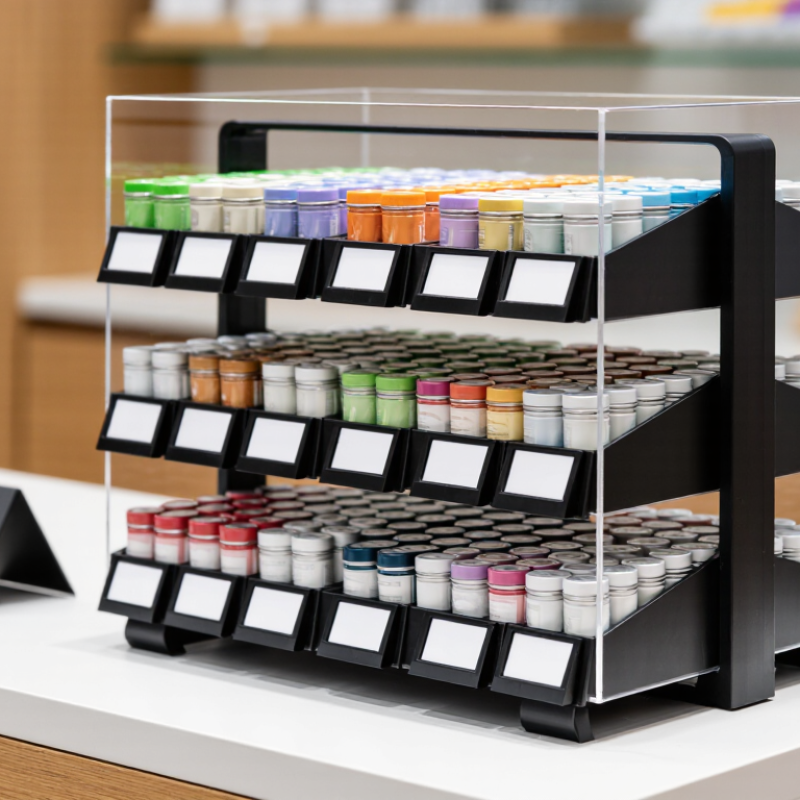
A nicotine pouch display is a retail fixture designed to present nicotine pouches clearly, securely, and within applicable age-control rules. Its purpose is practical: help adult shoppers identify pouch strength, format, flavor, price, and usage information before purchase. For retail buyers, it also supports stock control, product rotation, and consistent shelf presentation.
The display may sit behind the counter or inside a lockable cabinet. Small compartments can separate slim cans by strength and pouch count. Clear labels reduce repeated questions for staff. An age-verification notice should remain visible, not hidden behind promotional panels. This detail matters. A neat fixture cannot replace responsible selling procedures.
Market data explains why retailers examine this category. Grand View Research estimated the global nicotine pouch market at about USD 3.9 billion in 2023, with strong projected growth through 2030. Fortune Business Insights also reported rapid expansion, although its market estimate differs. Such variation deserves attention. Definitions, regions, and legal classifications are not always consistent across reports.
A display should therefore be assessed beyond appearance. Buyers can measure sales per facing, replenishment time, misplaced units, and customer questions. A practical trial might use one shelf section for four weeks. Results may be uneven. That is useful evidence. It can reveal whether the fixture improves navigation or simply occupies valuable counter space. For compliant retail environments, materials should be durable, easy to clean, and suitable for restricted-access placement.
A nicotine pouch display is a compact retail fixture designed to keep products organized, visible, and easy for staff to manage. Its components often include a stable base, divided product compartments, clear price labels, and a lockable or staff-controlled access area where appropriate. A front-facing layout helps shoppers compare package sizes without obscuring required product information. Materials should withstand frequent cleaning and daily handling; smooth edges and replaceable label holders also reduce upkeep.
Good design balances visibility with responsible presentation. The Point of Purchase Advertising International’s 2012 Shopper Engagement Study reported that 76% of purchase decisions are made in-store. This broad retail finding is not specific to nicotine products, but it shows why clear shelf organization matters. Displays should use legible type, consistent spacing, and neutral colors, while avoiding youth-oriented imagery or promotional claims. Local requirements vary, so buyers should verify placement, labeling, and access rules before ordering. A detail can be missed.
Tips: Measure the counter before selecting a unit. Check that labels remain readable from standing height, and test how quickly staff can restock each compartment. Keep the fixture stable when fully loaded. Small layout tests can reveal awkward reaches or blocked price information, though a neat display alone does not guarantee better sales.
| Component / Feature | Typical Specification | Retail Purpose | Buyer Evaluation Criteria | Recommended Design Practice |
|---|---|---|---|---|
| Display Format | Countertop, wall-mounted, shelf-ready, or lockable cabinet format | Matches different store layouts and merchandising policies | Available space, fixture compatibility, installation requirements, and visibility | Offer modular formats with a consistent visual system and replaceable panels |
| Product Capacity | Commonly 12–36 cans or equivalent product facings, depending on fixture size | Provides enough assortment while controlling the display footprint | Expected sales velocity, SKU count, replenishment frequency, and stock rotation | Use adjustable dividers and clearly separated product lanes |
| Shelf Configuration | Typically 2–4 horizontal shelves or stepped product tiers | Improves product visibility and makes stock levels easier to check | Shelf adjustability, load stability, label placement, and cleaning access | Use slightly angled shelves or front lips to prevent cans from sliding forward |
| Material Selection | Powder-coated metal, acrylic, PETG, ABS plastic, laminated board, or mixed construction | Balances durability, weight, appearance, and production cost | Resistance to scratching, moisture, impact, and repeated handling | Select smooth, non-porous surfaces that can be wiped and disinfected easily |
| Footprint and Dimensions | Compact countertop units are often approximately 200–400 mm wide and 150–300 mm deep | Supports placement near checkout areas or behind service counters | Counter depth, sight lines, available clearance, and local fixture standards | Confirm dimensions with a store-space survey before production |
| Product Identification | SKU cards, flavor or strength labels, category markers, and price-ticket holders | Helps staff and eligible adult consumers identify products quickly | Readability, replaceability, label size, and compatibility with changing assortments | Use high-contrast, legible labels and avoid overcrowding the display |
| Age-Restriction Messaging | Clear adult-only and nicotine health-warning communication where required | Supports responsible merchandising and regulatory compliance | Local legal requirements, minimum text size, placement, language, and visibility | Reserve a dedicated compliance area and obtain local legal review before rollout |
| Security and Access | Open access, staff-assisted access, sliding cover, hinged door, or lockable cabinet | Reduces unauthorized access, shrinkage, and product handling | Store policy, theft risk, ease of staff operation, and emergency access | Choose the least restrictive format that meets local law and store-security needs |
| Stock Rotation | Front-loading lanes or first-in, first-out shelf access | Promotes orderly replenishment and helps prevent outdated inventory | Ease of loading, date-code visibility, lane capacity, and staff workflow | Keep older stock accessible at the front and avoid deep, difficult-to-reach lanes |
| Branding and Graphics | Header panel, side panels, shelf strips, and interchangeable graphic inserts | Creates a recognizable category presentation at the point of sale | Print quality, color consistency, replacement cost, and compliance with advertising rules | Use restrained graphics, strong hierarchy, and only legally permitted product information |
| Lighting | Optional low-voltage LED edge, shelf, or header lighting | Improves visibility in dim retail environments | Power availability, heat generation, maintenance, and store lighting policy | Use diffuse, low-glare lighting and conceal wiring for a clean appearance |
| Stability and Safety | Weighted base, non-slip feet, rounded edges, and stable shelf connections | Limits tipping, movement, and accidental product falls | Center of gravity, fixture anchoring, edge treatment, and applicable safety standards | Test the fully loaded display, not only the empty unit |
| Installation and Assembly | Tool-free assembly, pre-assembled unit, or flat-pack construction | Reduces setup time and deployment labor across multiple locations | Assembly time, instruction quality, packaging protection, and replacement parts | Provide clear instructions and minimize loose hardware and assembly steps |
| Maintenance | Wipe-clean surfaces, removable dividers, and replaceable labels or panels | Keeps the fixture presentable and reduces long-term service effort | Cleaning time, spare-part availability, stain resistance, and repairability | Avoid textured recesses and hard-to-reach corners that collect dust |
| Packaging and Logistics | Protective carton, molded inserts, flat-pack or nested shipping configuration | Reduces transit damage and controls shipping volume | Carton efficiency, damage rate, storage space, and unpacking time | Use recyclable protective materials and label cartons clearly for store deployment |
| Performance Tracking | Sales per facing, stock-out frequency, replenishment time, and display compliance | Measures whether the display supports availability and efficient retail execution | Data collection method, store reporting capability, and review frequency | Review results after installation and adjust capacity, layout, or replenishment rules |
Note: Specifications should be adapted to the store format, applicable tobacco and nicotine regulations, age-restriction requirements, and retailer merchandising standards in the target market.
What Is a Nicotine Pouch Display for Retail Buyers
How Retail Buyers Evaluate Display Options
A nicotine pouch display is a fixture that organizes sealed, age-restricted products near a staffed retail counter. It may use shelves, trays, drawers, or a compact countertop unit. For retail buyers, the display is not merely decoration. It supports controlled access, clear product organization, and faster staff service.
Buyers usually assess visibility from the service area first. Can employees identify each product quickly? Are labels readable under bright store lighting? A good unit uses stable dividers and enough spacing for easy restocking. It should also fit the counter without blocking payment equipment or customer movement. Small details matter. A loose tray can look careless.
Security deserves close attention. The design should discourage casual handling while allowing trained staff to retrieve products efficiently. Buyers should check durable materials, smooth edges, and simple cleaning requirements. Displays that collect dust around corners create extra work. That matters during busy shifts.
Cost is only one factor. Retailers should compare capacity, delivery size, installation needs, and expected replacement costs. A lower-priced unit may require frequent repairs. That is not always a saving. Buyers also need to confirm compliance with local age-verification, labeling, advertising, and placement rules. Requirements differ by market and may change over time. Practical testing helps: place the display in the intended store, simulate a busy transaction, and ask staff what feels awkward. Their feedback may challenge the original buying decision.
This normalized buyer scorecard shows the retail factors that typically carry the greatest weight when comparing nicotine pouch display options. Visibility, regulatory communication, shelf efficiency, replenishment speed, and display durability help buyers judge whether a fixture can support sales while remaining practical for store operations.
Evaluation scale: 0–100 relative importance score. Higher scores indicate a stronger influence on the purchase decision.
A nicotine pouch display is a controlled retail fixture for products sold only where local rules permit. Its position should support visibility, staff supervision, and responsible sales. In my retail experience, a counter-adjacent location works better than an unattended corner. It keeps the product within staff view and reduces handling by unauthorized customers. Avoid placing it beside children’s products, food, or bright promotional displays. The surrounding context matters.
Organization should be simple and consistent. Group products by strength, pouch format, or approved product information. Use clear price labels and readable descriptions. Keep one facing per option when shelf space is limited. Reserve back-stock in a locked, dry cabinet, away from direct sunlight and heat. Rotate inventory by delivery date. Check packaging condition during every restock. Damaged or unclear packs should not reach the sales area.
A tidy display is not automatically effective. I have seen dense layouts confuse staff during busy periods. Fewer visible options may improve accuracy. That can reduce impulse decisions, too. Retail buyers should confirm age-verification procedures, display restrictions, warning requirements, and sales rules before installation. These details vary by location and can change. A practical review every month helps identify empty sections, slow-moving stock, and unclear labels. The display should support trained staff, not replace them.
A nicotine pouch display is a controlled retail fixture for presenting regulated, age-restricted products. It should support clear product information without encouraging irresponsible use. Retail buyers should confirm local rules on placement, labeling, health warnings, advertising, and customer age verification. Requirements can differ between regions, so legal review remains essential. Do not rely on a supplier’s checklist alone.
Security begins with controlled access. A lockable cabinet, tamper-resistant panels, and limited staff access can reduce theft and unauthorized handling. Keep the display behind the counter where employees can monitor it easily. Clear age-restriction notices should remain visible but not promotional. Train staff to request valid identification according to local requirements. Keep it simple. Record unusual incidents promptly.
Maintenance affects both compliance and customer trust. Staff should check the display each day for broken locks, loose shelves, faded notices, dust, and damaged packaging. Product counts should match sales records, with discrepancies investigated quickly. Use a written inspection log with dates and employee initials. A practical weakness is assuming the display remains secure after installation. It may not. Lighting can fail, hinges can loosen, and signs can become unreadable. Retail buyers should schedule monthly reviews and replace worn components before they create confusion or risk.
We use cookies on our website to give you an improved browser experience. View our Privacy Policy for more information. Please make your selection to opt in or out of ALL cookies here: Accept or Decline
Do you consent to the use of ALL cookies?
901 2nd Court West
Birmingham, AL 35204
Sales: 866.481.4036
Logistics/Ops: 866.481.4036
2101 Dralle Road
University Park, IL 60466
Sales: 708.813.9070
Logistics/Ops: 708.235.4200
400 E. 13th Street
Little Rock, AR 72114
Sales: 866.760.5344
Logistics/Ops: 866.760.5344
225 Collins Road
Elkhart, IN 46515
Sales: 574.295.0214
Logistics/Ops: 574.607.4611
601 Berryman Pike
Tipton, IN 46072
Sales: 800.897.7591
Logistics/Ops: 800.897.7591
3900 Uvalda Street
Denver, CO 80239
Sales: 303.706.8000
Ops/Logistics: 303.576.8398
510 3rd Street E
Milan, IL 61264
Sales: 800.322.1052
Logistics/Ops: 800.322.1052
1660 E. Aurora
Des Moines, IA 50313
Sales: 800.671.1660
Logistics: 800.671.1660
86554 Gene Lasserre Blvd.
Yulee, FL 32097
Sales: 904.253.3060
Logistics/Ops: 904.225.3000
694 S.E. County Road 245
Lake City, FL 32025
Sales: 800.727.6706
Logistics/Ops: 386.752.7412
210 Neptune Road
Auburndale, FL 33823
Sales: 863.967.1131
Logistics/Ops: 863.777.9814
4601 McCoy Drive
Pensacola, FL 32503
Sales: 850.308.7030
Logistics/Ops: 850.434.5502
815 South 56th Street
Tampa, FL 33619
Sales: 813.302.1940
Logistics/Ops: 813.621.1352
200 Hosea Road
Lawrenceville, GA 30046
Sales: 770.953.7575
Logistics/Ops: 770.513.6000
Branch Product Guide
Branch Line Card
Moulding Offering
Cedar Offering
Column Offering
8173 Hwy. 165 North
Monroe, LA 71211
Sales: 800.256.4165
Logistics/Ops: 800.256.4165
508 Warren Avenue
Portland, ME 04103
Sales: 207.888.2331
Logistics/Ops: 207.797.6565
4300 Georgia Pacific Blvd.
Frederick, MD 21704
Sales: 301.798.7474
Logistics/Ops: 301.874.8000
419 Maple Street
Bellingham, MA 02019
Sales: 508.449.0535
Logistics/Ops: 508.966.5500
825 Buchanan Ave SW
Grand Rapids, MI 49507
Sales: 877.800.1180
Logistics/Ops: 616.278.0909
995 Pacific St. NW
Aitkin, MN 56431
Sales: 800.432.3727
Logistics/Ops: 218.212.7770
1102 Port Terminal Drive
Duluth, MN 55802
Sales: 800.951.9899
Logistics/Ops: 800.851.9899
9110 83rd Ave. North
Brooklyn Park, MN 55445
Sales: 763.425.0204
Logistics/Ops: 763.425.0204
910 E. Railroad Street
Long Beach, MS 39560
Sales: 866.535.4135
Logistics/Ops: 228.205.2400
1727 Warren Street
North Kansas City, MO 64116
Sales: 800.621.2611
Logistics/Ops: 800.621.2611
2123 North Golden
Springfield, MO 65803
Sales: 800.375.7891
Logistics/Ops: 800.375.7891
13860 Corp. Woods Trail
Bridgeton, MO 63044
Sales: 314.209.0800
Logistics/Ops: 314.209.0800
1109 South 19th Street
Omaha, NE 68108
Sales: 800.489.6637
Logistics/Ops: 800.489.6637
1 Luger Road
Denville, NJ 07834
Sales: 973-339-3539
Logistics/Ops: 973.625.1461
3720 Jeffrey Blvd.
Blasdell, NY 14219
Sales: 716.235.5989
Logistics/Ops: 716.825.6557
319 Yaphank Ave.
Yaphank, NY 11980
Sales: 631.358.5714
Logistics/Ops: 631.924.7401
3300 Parkside Drive
Charlotte, NC 28208
Sales: 800.839.2588
Logistics/Ops: 704.394.3172
1712 East D Street
Butner, NC 27509
Sales: 984.389.8200
Logistics/Ops: 919.575.3700
128 Foothills Drive
Statesville, NC 28687
Sales: 800.222.1414
Logistics/Ops: 704.394.3172
550 Munroe Falls Rd.
Tallmadge, OH 44278
Sales: 330.357.4506
Logistics/Ops: 330.794.1141
10347 Toebben Dr.
Independence, KY 41051
Sales: 859.298.3926
Logistics/Ops: 859.746.2250
450 N. MacArthur
Oklahoma City, OK 73127
Sales: 800.375.6025
Logistics/Ops: 800.375.6025
1680 North Aspen
Broken Arrow, OK 74012
Sales: 918.272.2212
Logistics/Ops: 918.272.2212
522 Bridge Street
Hunker, PA 15639
Sales: 878.217.2001
Logistics/Ops: 724.925.7285
4290 Atlanta Street
Charleston, SC 29418
Sales: 843.371.1420
Logistics/Ops: 843.554.8192
1040 S. Industrial Dr.
Erwin, TN 37650
Sales: 423.641.1005
Logistics/Ops: 423.742.5911
4287 Pilot Drive
Memphis, TN 38118
Sales: 901.365.2101
Logistics/Ops: 901.365.2101
700 Myatt Drive
Madison, TN 37115
Sales: 615.327.9547
Logistics/Ops: 629.777.4949
4747 Mark IV Parkway
Fort Worth, TX 76106
Sales: 866.323.5117
Logistics/Ops: 817.625.9091
6990 Market Avenue
El Paso, TX 79915
Sales: 915.778.6356
Logistics/Ops: 915.265.7200
2502 Wilson Road
Harlingen, TX 78552
Sales: 800.580.6711
Logistics/Ops: 800.580.6711
10,000 North Loop East
Houston, TX 77029
Sales: 713.921.1977
Logistics/Ops: 713.675.3544
702 East 44th St.
Lubbock, TX 79404
Sales: 866.454.6010
Logistics/Ops: 866.454.6010
535 N. WW White Road
San Antonio, TX 78219
Sales: 800.284.0488
Logistics/Ops: 210.333.8112
142 Pine Haven Shores Rd.
Shelburne, VT 05482
Sales: 802.800.2540
Logistics/Ops: 802.985.2512
4700 Bethlehem Road,
Richmond, VA 23230
Sales: 804.201.2400
Logistics/Ops: 804.342.1161
4516 N Barker Road
Spokane Valley, WA 99027
Phone: 509.892.9420
Toll free: 800.728.6157
8365 N. 76th Street
Milwaukee, WI 53223
Sales: 800.356.9245
Logistics/Ops: 800.356.9245
312 S. Chester Street
Sparta, WI 54656
Sales: 800.362.5864
Logistics/Ops: 800.362.5864
899 Grossman Drive
Schofield, WI 54476
Sales: 800.472.0017
Logistics/Ops: 800.472.0017
