
We use cookies on our website to give you an improved browser experience. View our Privacy Policy for more information. Please make your selection to opt in or out of ALL cookies here: Accept or Decline
Binder For Screen Printing is the material that helps pigment stay attached to fabric after printing. In water-based textile inks, the binder forms a film around pigment particles and helps them hold to the fibers as the ink dries and cures. Without a suitable binder, a bright print may fade, crack, or rub off sooner than expected. It is not just glue. Its chemistry and amount can affect softness, stretch, opacity, and wash durability.
The result depends on more than the binder alone. Fabric type, ink thickness, mesh, drying conditions, and curing temperature all matter. A cotton shirt and a polyester blend may respond differently, so follow the ink maker’s technical guidance and test the complete process on a sample. Feel the printed area after curing; check for tackiness, stiffness, and color loss after washing. Small details count. Too much binder can leave a heavy hand, while too little may weaken adhesion. That trade-off is easy to overlook. This guide explains what screen-printing binders do, how they work with pigments, and which practical factors affect print performance. Some outcomes still vary from shop to shop, so careful testing remains more reliable than assumptions.
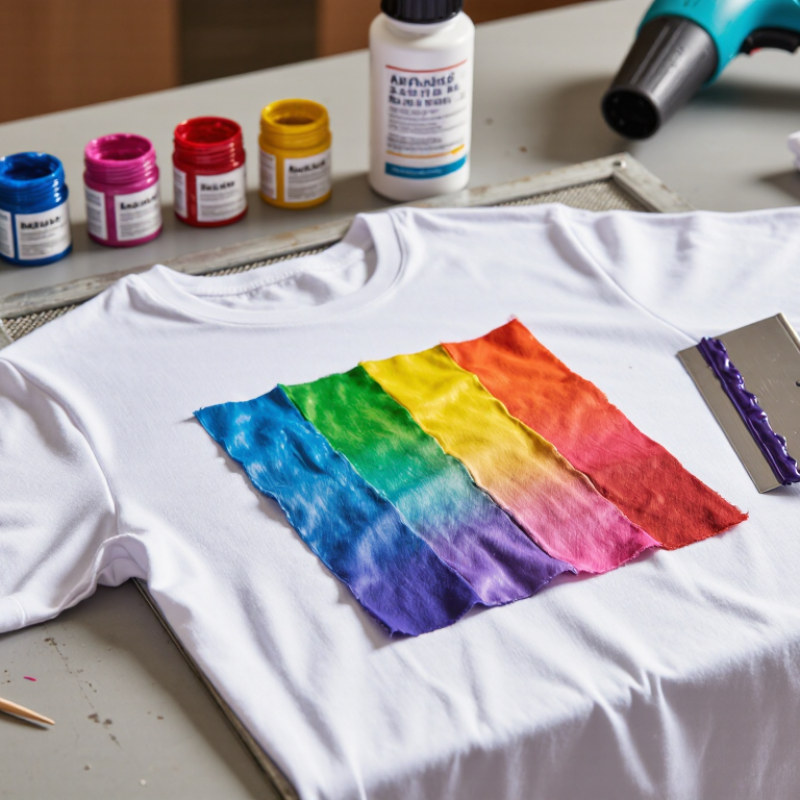
In screen printing, a binder is a polymer that holds pigment on a textile surface. Pigment particles do not dissolve into the fibers like many dyes do. Not dye. As water or another carrier evaporates, polymer particles join into a thin film around the pigment. The film grips fibers through surface contact and, depending on the formulation, chemical attraction. Under a microscope, the printed area resembles tiny colored particles caught in a clear net.
Heat helps the polymer form a durable layer, but the correct curing conditions depend on the binder and fabric. Too little heat can leave a print weak; too much may stiffen the cloth or dull its feel. A useful industry context comes from Textile Exchange’s Materials Market Report 2024: global fiber production reached 124 million tonnes in 2023, with polyester accounting for 57 percent. This matters because binder performance can vary across fiber surfaces, and synthetic fabrics may need formulations designed for their low-absorbency finish. In practice, check adhesion after curing by rubbing a small print and washing a test swatch. Even then, results can be imperfect: fabric finishes, ink thickness, and uneven heating all affect the bond.
Approximate size ranges help illustrate how fine pigment and polymer particles form a colored film on much larger textile fibers.
A screen-printing binder is a polymer dispersion. As water evaporates during drying and curing, the polymer particles coalesce into a film that holds pigment and helps anchor it to the textile surface. The size ranges shown are approximate and vary by pigment, binder formulation, and fiber.
In screen printing, a binder surrounds pigment particles and helps them form a durable layer on fabric. Acrylic dispersions are common because they can provide good color holdout, wash resistance, and a relatively crisp print. After water evaporates, the acrylic particles join into a continuous film. Heat and drying conditions matter; a print that feels dry may not be fully cured.
Acrylic films can feel firm, which suits detailed graphics but may feel less comfortable on stretchy knits. Polyurethane dispersions are often chosen when softness, flexibility, or abrasion resistance is important. Their film can move with the fabric instead of cracking as readily under repeated bending. That is not automatic. Formulation and cure still count.
Some binders blend acrylic and polyurethane properties, but there is always a trade-off. A softer film may feel better yet show poorer edge definition, while a harder film can improve detail but feel stiff. Test on the actual fabric. Print a small swatch, cure it under measured conditions, then check adhesion, stretch, and wash performance. Small differences in fabric finish can change the result. I would not trust feel alone.
| Aspect | Acrylic Dispersions | Polyurethane (PU) Dispersions | Practical Screen-Printing Note |
|---|---|---|---|
| What a binder does | Provides a film-forming polymer that holds pigment particles together and helps anchor the printed layer to the substrate. | Performs the same basic film-forming and pigment-binding role; PU chemistry can be selected to provide different combinations of flexibility, toughness, and adhesion. | The binder is the polymer component of the ink, not the pigment. Pigments provide color; the binder helps form the durable printed film. |
| How a waterborne dispersion works | Polymer particles are dispersed in water. As water leaves the print, the particles come closer together and form a continuous film under suitable drying conditions. | PU particles are likewise carried in water and form a film as the water evaporates; film formation depends on the specific dispersion and drying conditions. | Drying removes water, while heat may be needed to support film formation or any specified curing reaction. Follow the ink supplier’s technical instructions. |
| Common film characteristics | Can range from relatively soft and flexible to harder films. Acrylic systems are often chosen when color clarity, hardness, or weathering performance is important. | Often used where flexibility, abrasion resistance, or adhesion is desired, although actual performance varies with PU structure and formulation. | These are broad tendencies, not guarantees. Pigment loading, additives, substrate, film thickness, and cure all affect the finished print. |
| Potential applications | Water-based printing inks for suitable textiles, paper, and other compatible surfaces. | Water-based inks and coatings for applications that may require a flexible or tough film on a compatible surface. | Always check substrate compatibility. A binder suitable for fabric may not be suitable for paper, plastic, or another surface. |
| Flexibility and hand feel | Flexibility depends on the polymer grade and formulation; a harder acrylic film may feel less flexible than a softer one. | Many PU dispersions can provide flexible films, but softness and stretch performance depend on the particular chemistry and formulation. | For textiles, assess the printed fabric after the specified cure, including stretch, cracking, and hand feel. |
| Durability considerations | Can provide useful film strength and resistance properties when formulated and cured for the intended application. | Can be selected for demanding flexibility or wear requirements, subject to the formulation and correct processing. | Wash, rub, abrasion, and adhesion performance must be verified with tests appropriate to the end use. |
| Curing and crosslinking | Some formulations rely mainly on drying and film formation; others may use additional crosslinking chemistry to improve performance. | Some formulations also use crosslinkers or other curing aids; whether these are needed depends on the product and performance target. | Do not assume that all water-based binders cure identically. Use the stated time, temperature, and handling guidance for the specific ink. |
| Choosing between them | Consider when the required balance of film hardness, clarity, weathering, adhesion, and cost fits an acrylic-based system. | Consider when the required balance of flexibility, toughness, abrasion resistance, and adhesion fits a PU-based system. | Compare technical data and test prints on the actual substrate. Formulation and processing often matter as much as the polymer family. |
In screen printing, binder is the material that holds pigment particles together and anchors them to the fabric. In water-based inks, it is usually dispersed in water as tiny polymer particles. After printing, the wet layer may look dull or slightly uneven. The film forms as moisture leaves and the particles draw closer.
Water evaporation is only part of the change. Air movement, humidity, fabric absorbency, and ink thickness all affect drying. That takes time. As water escapes, polymer particles pack together and deform, joining into a more continuous film. This stage is called coalescence. If the print dries too quickly, the surface can feel dry while moisture remains underneath; a thick deposit may also form an uneven film.
Some binder systems then crosslink: polymer chains develop additional chemical links, strengthening the film and improving resistance to washing or rubbing. Not every binder crosslinks in the same way, and some rely mainly on particle coalescence. Follow the ink maker’s stated curing conditions, since temperature and dwell time matter. A properly formed film should flex with the cloth, but it may still feel heavier than the untreated fabric. A quick touch test can mislead; a wash test gives more useful evidence.
A screen-printing binder is the film-forming polymer that anchors pigment to fabric. Its dosage should be judged against binder solids, pigment load, and the print’s intended hand—not by wet mix weight alone. Too little can leave a dusty surface and weak rubbing resistance; too much may create a stiff, shiny patch. Small shifts matter. Add binder in measured increments, then print and cure a test swatch before adjusting the batch.
pH and viscosity are linked to the binder’s chemistry. An unsuitable pH can destabilize some water-based systems, while excessive viscosity may block fine mesh openings or produce uneven edges. Check pH with a calibrated meter and record viscosity using the same method each time; a single cup reading can mislead. Fabric changes the target, too: cotton absorbs water differently from polyester, and blends can behave inconsistently. Textile Exchange’s Materials Market Report 2024 estimates global fiber production at 124 million tonnes in 2023, with polyester accounting for 57 percent. That scale reflects how varied print substrates can be. Test on the actual fabric, checking stretch, wash durability, and surface feel. A tidy lab swatch is not always a reliable production forecast.
For screen printing on fabric, binder helps pigment form a flexible layer that grips the fibers. Heat curing helps that layer dry and develop its intended properties. A common textile starting range is 150–160°C for 2–3 minutes, but this is not a universal recipe. Follow the binder or ink supplier’s technical instructions, since formulations and fabric types differ. Small details matter.
The dryer’s displayed temperature may not match the ink film’s actual temperature. A thick garment, fast belt speed, or uneven airflow can leave parts under-cured. Check the fabric or print temperature with a suitable probe, and allow the print to cool before testing it. Some binders rely mainly on film formation; others also need a chemical curing reaction. Do not assume extra heat always improves the result. It can damage or discolor fabric.
A practical test uses a printed sample from the same fabric and curing run. Check for cracking after gentle stretching, then assess wash performance according to the product’s guidance. If the print feels tacky or loses color, review both time and temperature, along with ink deposit and airflow. That range is only a starting point. Small production changes can matter, and the first test may not tell the whole story.
We use cookies on our website to give you an improved browser experience. View our Privacy Policy for more information. Please make your selection to opt in or out of ALL cookies here: Accept or Decline
Do you consent to the use of ALL cookies?
901 2nd Court West
Birmingham, AL 35204
Sales: 866.481.4036
Logistics/Ops: 866.481.4036
2101 Dralle Road
University Park, IL 60466
Sales: 708.813.9070
Logistics/Ops: 708.235.4200
400 E. 13th Street
Little Rock, AR 72114
Sales: 866.760.5344
Logistics/Ops: 866.760.5344
225 Collins Road
Elkhart, IN 46515
Sales: 574.295.0214
Logistics/Ops: 574.607.4611
601 Berryman Pike
Tipton, IN 46072
Sales: 800.897.7591
Logistics/Ops: 800.897.7591
3900 Uvalda Street
Denver, CO 80239
Sales: 303.706.8000
Ops/Logistics: 303.576.8398
510 3rd Street E
Milan, IL 61264
Sales: 800.322.1052
Logistics/Ops: 800.322.1052
1660 E. Aurora
Des Moines, IA 50313
Sales: 800.671.1660
Logistics: 800.671.1660
86554 Gene Lasserre Blvd.
Yulee, FL 32097
Sales: 904.253.3060
Logistics/Ops: 904.225.3000
694 S.E. County Road 245
Lake City, FL 32025
Sales: 800.727.6706
Logistics/Ops: 386.752.7412
210 Neptune Road
Auburndale, FL 33823
Sales: 863.967.1131
Logistics/Ops: 863.777.9814
4601 McCoy Drive
Pensacola, FL 32503
Sales: 850.308.7030
Logistics/Ops: 850.434.5502
815 South 56th Street
Tampa, FL 33619
Sales: 813.302.1940
Logistics/Ops: 813.621.1352
200 Hosea Road
Lawrenceville, GA 30046
Sales: 770.953.7575
Logistics/Ops: 770.513.6000
Branch Product Guide
Branch Line Card
Moulding Offering
Cedar Offering
Column Offering
8173 Hwy. 165 North
Monroe, LA 71211
Sales: 800.256.4165
Logistics/Ops: 800.256.4165
508 Warren Avenue
Portland, ME 04103
Sales: 207.888.2331
Logistics/Ops: 207.797.6565
4300 Georgia Pacific Blvd.
Frederick, MD 21704
Sales: 301.798.7474
Logistics/Ops: 301.874.8000
419 Maple Street
Bellingham, MA 02019
Sales: 508.449.0535
Logistics/Ops: 508.966.5500
825 Buchanan Ave SW
Grand Rapids, MI 49507
Sales: 877.800.1180
Logistics/Ops: 616.278.0909
995 Pacific St. NW
Aitkin, MN 56431
Sales: 800.432.3727
Logistics/Ops: 218.212.7770
1102 Port Terminal Drive
Duluth, MN 55802
Sales: 800.951.9899
Logistics/Ops: 800.851.9899
9110 83rd Ave. North
Brooklyn Park, MN 55445
Sales: 763.425.0204
Logistics/Ops: 763.425.0204
910 E. Railroad Street
Long Beach, MS 39560
Sales: 866.535.4135
Logistics/Ops: 228.205.2400
1727 Warren Street
North Kansas City, MO 64116
Sales: 800.621.2611
Logistics/Ops: 800.621.2611
2123 North Golden
Springfield, MO 65803
Sales: 800.375.7891
Logistics/Ops: 800.375.7891
13860 Corp. Woods Trail
Bridgeton, MO 63044
Sales: 314.209.0800
Logistics/Ops: 314.209.0800
1109 South 19th Street
Omaha, NE 68108
Sales: 800.489.6637
Logistics/Ops: 800.489.6637
1 Luger Road
Denville, NJ 07834
Sales: 973-339-3539
Logistics/Ops: 973.625.1461
3720 Jeffrey Blvd.
Blasdell, NY 14219
Sales: 716.235.5989
Logistics/Ops: 716.825.6557
319 Yaphank Ave.
Yaphank, NY 11980
Sales: 631.358.5714
Logistics/Ops: 631.924.7401
3300 Parkside Drive
Charlotte, NC 28208
Sales: 800.839.2588
Logistics/Ops: 704.394.3172
1712 East D Street
Butner, NC 27509
Sales: 984.389.8200
Logistics/Ops: 919.575.3700
128 Foothills Drive
Statesville, NC 28687
Sales: 800.222.1414
Logistics/Ops: 704.394.3172
550 Munroe Falls Rd.
Tallmadge, OH 44278
Sales: 330.357.4506
Logistics/Ops: 330.794.1141
10347 Toebben Dr.
Independence, KY 41051
Sales: 859.298.3926
Logistics/Ops: 859.746.2250
450 N. MacArthur
Oklahoma City, OK 73127
Sales: 800.375.6025
Logistics/Ops: 800.375.6025
1680 North Aspen
Broken Arrow, OK 74012
Sales: 918.272.2212
Logistics/Ops: 918.272.2212
522 Bridge Street
Hunker, PA 15639
Sales: 878.217.2001
Logistics/Ops: 724.925.7285
4290 Atlanta Street
Charleston, SC 29418
Sales: 843.371.1420
Logistics/Ops: 843.554.8192
1040 S. Industrial Dr.
Erwin, TN 37650
Sales: 423.641.1005
Logistics/Ops: 423.742.5911
4287 Pilot Drive
Memphis, TN 38118
Sales: 901.365.2101
Logistics/Ops: 901.365.2101
700 Myatt Drive
Madison, TN 37115
Sales: 615.327.9547
Logistics/Ops: 629.777.4949
4747 Mark IV Parkway
Fort Worth, TX 76106
Sales: 866.323.5117
Logistics/Ops: 817.625.9091
6990 Market Avenue
El Paso, TX 79915
Sales: 915.778.6356
Logistics/Ops: 915.265.7200
2502 Wilson Road
Harlingen, TX 78552
Sales: 800.580.6711
Logistics/Ops: 800.580.6711
10,000 North Loop East
Houston, TX 77029
Sales: 713.921.1977
Logistics/Ops: 713.675.3544
702 East 44th St.
Lubbock, TX 79404
Sales: 866.454.6010
Logistics/Ops: 866.454.6010
535 N. WW White Road
San Antonio, TX 78219
Sales: 800.284.0488
Logistics/Ops: 210.333.8112
142 Pine Haven Shores Rd.
Shelburne, VT 05482
Sales: 802.800.2540
Logistics/Ops: 802.985.2512
4700 Bethlehem Road,
Richmond, VA 23230
Sales: 804.201.2400
Logistics/Ops: 804.342.1161
4516 N Barker Road
Spokane Valley, WA 99027
Phone: 509.892.9420
Toll free: 800.728.6157
8365 N. 76th Street
Milwaukee, WI 53223
Sales: 800.356.9245
Logistics/Ops: 800.356.9245
312 S. Chester Street
Sparta, WI 54656
Sales: 800.362.5864
Logistics/Ops: 800.362.5864
899 Grossman Drive
Schofield, WI 54476
Sales: 800.472.0017
Logistics/Ops: 800.472.0017
