
We use cookies on our website to give you an improved browser experience. View our Privacy Policy for more information. Please make your selection to opt in or out of ALL cookies here: Accept or Decline
Choosing mineral wool is not just a matter of comparing prices per square foot. The right product must fit the wall, roof, or floor assembly, resist moisture where needed, and meet the project’s fire and sound-control goals. Mineral Wools are commonly sold as batts, boards, and loose-fill products, and each form suits different spaces. A dense board may feel rigid in your hand; a batt should fit snugly without being crushed. Small details matter.
The U.S. Environmental Protection Agency’s ENERGY STAR program estimates that air sealing and adding insulation in key areas can save homeowners an average of 15% on heating and cooling costs. That figure is a useful benchmark, not a promise: results depend on the building, climate, installation, and existing insulation. The U.S. Department of Energy also advises selecting insulation by its R-value and intended application. Check product data sheets, not just packaging claims.
Building-science expert Joseph Lstiburek emphasizes that enclosure performance depends on controlling water, air, vapor, and heat. That principle is especially useful when comparing mineral wool products, though no insulation choice fixes a poorly detailed wall. It is easy to focus on advertised performance and overlook fit, facings, or installation conditions. That deserves a second look. These seven tips will help you assess specifications, compare costs, and choose a product that suits the actual assembly—not merely the shelf label.
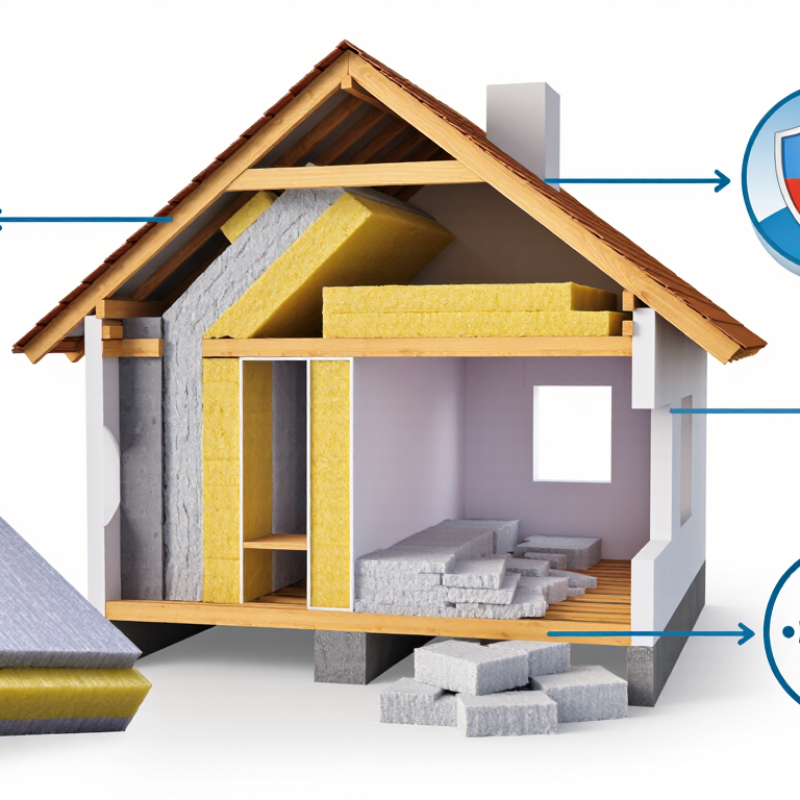
Mineral wool insulation is a broad category, not one uniform product. Its two main forms are rock wool and glass wool. Rock wool is made from volcanic rock or similar minerals. Glass wool uses sand and recycled glass. Slag wool is another mineral-fiber type, although it is less common in many residential markets.
These materials differ in texture, density, handling, and thermal performance. The U.S. Department of Energy lists typical mineral wool R-values near R-3.0 to R-3.3 per inch. Glass fiber guidance shows a wider range, around R-2.9 to R-3.8 per inch. Do not compare R-value alone. A higher-density batt may resist fire and sound better, but it can require more careful cutting. Details matter.
Before buying, check the product’s declared R-value, thickness, facing, moisture exposure, and installation method. EPA ENERGY STAR guidance repeatedly pairs insulation upgrades with air sealing, because gaps can reduce real-world performance. That advice is practical, not glamorous. Measure twice. Cut once. Wear protective clothing, gloves, and eye protection during installation. Rock wool usually feels firmer and heavier, while glass wool is often easier to compress between irregular framing. Neither choice is automatically best. A perfectly rated product performs poorly when it is squeezed, left with gaps, or installed over damp materials. I still find that the label explains less than the wall assembly.
7 Tips for Buying Mineral Wool Insulation
Assessing Your Project’s Thermal and Soundproofing Needs
Before comparing batts or boards, identify where heat escapes and noise travels. Check the attic, exterior walls, and floors above unheated spaces. The U.S. Department of Energy says heating and cooling use about 50–70% of energy in a typical home. That makes insulation levels worth checking, but the right target depends on climate and location. Compare your project with the DOE’s climate-zone R-value recommendations, rather than choosing the thickest product by default.
Sound needs a different assessment. Is the problem traffic outside, voices through a partition, or footsteps from above? Mineral wool can absorb sound within a cavity, but the full wall or floor assembly matters. Look for test results using ASTM C423, which measures sound absorption, and check the reported Noise Reduction Coefficient (NRC). NRC describes absorption, not how much sound passes through a wall. A high NRC alone can mislead.
Match the material’s tested thickness and density to your design. A loosely fitted batt around pipes or electrical boxes may leave gaps; compression can also reduce thermal performance. Ask for documentation that matches the installed configuration. I would measure one troublesome room before ordering for the whole building. It takes extra time. Still, sound paths are easy to misjudge, and I have not found a simple rating that captures every real-world condition.
Estimated thermal resistance by insulation thickness, using an illustrative value of R-4.0 per inch. Actual ratings vary by product; check the manufacturer’s declared R-value and compare acoustic performance for the complete wall or ceiling assembly.
R-value is useful, but it is not a complete buying guide. The U.S. Department of Energy’s Insulation Fact Sheet explains that R-value measures resistance to heat flow, and that installed performance depends on factors such as thickness and fit. Mineral wool commonly provides about R-3 to R-4 per inch, though exact ratings vary by product. Check the package label, not just a general range. A 3½-inch batt rated R-15, for example, is not equivalent to a thicker wall assembly with a higher total R-value. Small gaps matter.
Match the product format to the space. Batts and rolls suit standard stud bays; rigid boards can cover continuous surfaces, while loose-fill works in some irregular cavities. Product dimensions and density affect handling and fit, so measure the cavity depth and spacing before ordering. DOE guidance also warns that compressing insulation can reduce its effective R-value. A batt squeezed behind a pipe may look neatly installed, but it will not deliver its labeled thickness. Awkward corners are easy to miss. For a practical comparison, record each option’s labeled R-value, thickness, coverage area, and intended use. Then check whether its format fits around wiring, framing, and obstructions without forcing it into place.
When comparing mineral wool insulation, check the fire rating for the exact product and thickness you plan to buy. “Noncombustible” does not mean every wall or ceiling assembly is fire-rated. Ask for test reports that match the intended use, and confirm whether facings, binders, or other components affect performance.
Details matter. A sales sheet is useful, but it is not a substitute for a current technical data sheet or independent test documentation.
Moisture resistance also needs careful reading. Mineral wool fibers can resist water, yet gaps, compression, or poor drainage may still leave a wall assembly damp. Look for published water-absorption data and installation guidance. If possible, inspect sample boards: feel their density and check that edges remain intact when handled.
I once assumed a moisture-resistant label meant a product could tolerate any wet cavity; that was too broad an assumption. It cannot fix a leak.
Check certifications for scope, date, and testing body, not just a logo on packaging. Verify that the listed standard applies to the product form you are purchasing, such as batts or rigid boards. Then compare the documentation with local building requirements and the full assembly design.
If a supplier cannot provide clear records, pause before ordering. Ask for specifics.
Estimating mineral wool insulation costs takes more than comparing the price per bag. Check the coverage area, thickness, and stated thermal performance, since cheaper packs may cover less wall space. Include delivery, cutting waste, protective equipment, and any extra materials in your estimate. A tape measure and a simple room sketch can prevent an expensive second order. Prices vary by region and season. Ask suppliers for a written quote that lists pack size, coverage, delivery fees, and quote validity. I once underestimated offcuts around pipes; they added up faster than expected.
A suitable supplier should provide clear product data, including density, dimensions, and installation guidance. Ask whether the insulation is intended for your specific application, such as a loft, partition, or external wall. Do not assume that one product suits every location. Reliable staff will explain limitations and answer technical questions without pressuring you to buy immediately. Check stock levels and delivery timing, especially if tradespeople are scheduled. A delayed pallet can leave a room exposed or disrupt other work.
Inspect the packaging on arrival for moisture, tears, or crushed edges, and compare the delivery with your order. Keep the paperwork. It helps if quantities or specifications need checking later. Supplier reviews can offer useful clues, but look for repeated comments about accurate orders and helpful after-sales support, not just star ratings. I would compare at least two detailed quotes, though that can feel tedious. The lowest figure is not always the lowest finished cost.
| Tip | What to Compare or Verify | Planning Data | Why It Matters |
|---|---|---|---|
| 1. Match the insulation to the project | Confirm whether you need batts, boards, or loose-fill, and whether the product is intended for walls, floors, ceilings, or another application. | Product form, thickness, dimensions, and stated application should match the space and installation method. | Products designed for different applications may not fit the cavity or provide the required performance. |
| 2. Compare thermal resistance | Compare the labeled R-value for the product's actual thickness; check local building requirements for the assembly. | Mineral wool commonly provides roughly R-3 to R-4 per inch. Example nominal batt ratings include R-15 at about 3½ inches and R-23 at about 5½ inches; verify the product label. | R-value depends on product and thickness, and the installed assembly can perform differently if insulation is compressed or gaps are left. |
| 3. Estimate the material budget | Request itemized quotes with product type, R-value, thickness, coverage per package, and quantity. | As a rough U.S. planning range, mineral wool batts may cost about $0.80–$2.50 per square foot for materials. Prices vary by region, product, and order size. | Package prices are difficult to compare unless coverage and performance are included. |
| 4. Include installation and extras | Ask whether the quote includes labor, removal of existing insulation, access work, waste disposal, and required air sealing. | A broad U.S. installed budgeting range for batt insulation is about $1.50–$4.50 per square foot; site conditions and labor can move the total outside this range. | A materials-only quote is not directly comparable to a complete installation quote. |
| 5. Check quantity and packaging | Measure the net insulated area and compare it with package coverage. Confirm the number of pieces and whether coverage assumes a particular cavity size. | Estimate net area after subtracting openings, then allow a small cutting allowance based on the layout; avoid excessive over-ordering. | Accurate takeoffs reduce shortages, leftover material, and delays. |
| 6. Evaluate supplier service and availability | Verify current stock, lead time, delivery area, minimum order, return policy, and whether technical product documents are available. | Request a written quote with a validity period, delivery charges, and itemized quantities. | Availability and delivery costs can materially affect both the schedule and total project budget. |
| 7. Review specifications and safe handling | Ask for the technical data sheet and safety data sheet. Confirm applicable fire, acoustic, or other project requirements from the product documentation. | Use the manufacturer’s handling guidance; during cutting and installation, suitable gloves, eye protection, and a dust mask may be recommended. | Documented specifications help confirm suitability, while proper handling reduces exposure to dust and fibers. |
| Cost note: Price figures are broad indicative U.S. budgeting ranges, not supplier quotations. Actual costs depend on location, product specifications, order quantity, delivery, labor, and project conditions. Confirm current local prices and code requirements before purchasing. | |||
We use cookies on our website to give you an improved browser experience. View our Privacy Policy for more information. Please make your selection to opt in or out of ALL cookies here: Accept or Decline
Do you consent to the use of ALL cookies?
901 2nd Court West
Birmingham, AL 35204
Sales: 866.481.4036
Logistics/Ops: 866.481.4036
2101 Dralle Road
University Park, IL 60466
Sales: 708.813.9070
Logistics/Ops: 708.235.4200
400 E. 13th Street
Little Rock, AR 72114
Sales: 866.760.5344
Logistics/Ops: 866.760.5344
225 Collins Road
Elkhart, IN 46515
Sales: 574.295.0214
Logistics/Ops: 574.607.4611
601 Berryman Pike
Tipton, IN 46072
Sales: 800.897.7591
Logistics/Ops: 800.897.7591
3900 Uvalda Street
Denver, CO 80239
Sales: 303.706.8000
Ops/Logistics: 303.576.8398
510 3rd Street E
Milan, IL 61264
Sales: 800.322.1052
Logistics/Ops: 800.322.1052
1660 E. Aurora
Des Moines, IA 50313
Sales: 800.671.1660
Logistics: 800.671.1660
86554 Gene Lasserre Blvd.
Yulee, FL 32097
Sales: 904.253.3060
Logistics/Ops: 904.225.3000
694 S.E. County Road 245
Lake City, FL 32025
Sales: 800.727.6706
Logistics/Ops: 386.752.7412
210 Neptune Road
Auburndale, FL 33823
Sales: 863.967.1131
Logistics/Ops: 863.777.9814
4601 McCoy Drive
Pensacola, FL 32503
Sales: 850.308.7030
Logistics/Ops: 850.434.5502
815 South 56th Street
Tampa, FL 33619
Sales: 813.302.1940
Logistics/Ops: 813.621.1352
200 Hosea Road
Lawrenceville, GA 30046
Sales: 770.953.7575
Logistics/Ops: 770.513.6000
Branch Product Guide
Branch Line Card
Moulding Offering
Cedar Offering
Column Offering
8173 Hwy. 165 North
Monroe, LA 71211
Sales: 800.256.4165
Logistics/Ops: 800.256.4165
508 Warren Avenue
Portland, ME 04103
Sales: 207.888.2331
Logistics/Ops: 207.797.6565
4300 Georgia Pacific Blvd.
Frederick, MD 21704
Sales: 301.798.7474
Logistics/Ops: 301.874.8000
419 Maple Street
Bellingham, MA 02019
Sales: 508.449.0535
Logistics/Ops: 508.966.5500
825 Buchanan Ave SW
Grand Rapids, MI 49507
Sales: 877.800.1180
Logistics/Ops: 616.278.0909
995 Pacific St. NW
Aitkin, MN 56431
Sales: 800.432.3727
Logistics/Ops: 218.212.7770
1102 Port Terminal Drive
Duluth, MN 55802
Sales: 800.951.9899
Logistics/Ops: 800.851.9899
9110 83rd Ave. North
Brooklyn Park, MN 55445
Sales: 763.425.0204
Logistics/Ops: 763.425.0204
910 E. Railroad Street
Long Beach, MS 39560
Sales: 866.535.4135
Logistics/Ops: 228.205.2400
1727 Warren Street
North Kansas City, MO 64116
Sales: 800.621.2611
Logistics/Ops: 800.621.2611
2123 North Golden
Springfield, MO 65803
Sales: 800.375.7891
Logistics/Ops: 800.375.7891
13860 Corp. Woods Trail
Bridgeton, MO 63044
Sales: 314.209.0800
Logistics/Ops: 314.209.0800
1109 South 19th Street
Omaha, NE 68108
Sales: 800.489.6637
Logistics/Ops: 800.489.6637
1 Luger Road
Denville, NJ 07834
Sales: 973-339-3539
Logistics/Ops: 973.625.1461
3720 Jeffrey Blvd.
Blasdell, NY 14219
Sales: 716.235.5989
Logistics/Ops: 716.825.6557
319 Yaphank Ave.
Yaphank, NY 11980
Sales: 631.358.5714
Logistics/Ops: 631.924.7401
3300 Parkside Drive
Charlotte, NC 28208
Sales: 800.839.2588
Logistics/Ops: 704.394.3172
1712 East D Street
Butner, NC 27509
Sales: 984.389.8200
Logistics/Ops: 919.575.3700
128 Foothills Drive
Statesville, NC 28687
Sales: 800.222.1414
Logistics/Ops: 704.394.3172
550 Munroe Falls Rd.
Tallmadge, OH 44278
Sales: 330.357.4506
Logistics/Ops: 330.794.1141
10347 Toebben Dr.
Independence, KY 41051
Sales: 859.298.3926
Logistics/Ops: 859.746.2250
450 N. MacArthur
Oklahoma City, OK 73127
Sales: 800.375.6025
Logistics/Ops: 800.375.6025
1680 North Aspen
Broken Arrow, OK 74012
Sales: 918.272.2212
Logistics/Ops: 918.272.2212
522 Bridge Street
Hunker, PA 15639
Sales: 878.217.2001
Logistics/Ops: 724.925.7285
4290 Atlanta Street
Charleston, SC 29418
Sales: 843.371.1420
Logistics/Ops: 843.554.8192
1040 S. Industrial Dr.
Erwin, TN 37650
Sales: 423.641.1005
Logistics/Ops: 423.742.5911
4287 Pilot Drive
Memphis, TN 38118
Sales: 901.365.2101
Logistics/Ops: 901.365.2101
700 Myatt Drive
Madison, TN 37115
Sales: 615.327.9547
Logistics/Ops: 629.777.4949
4747 Mark IV Parkway
Fort Worth, TX 76106
Sales: 866.323.5117
Logistics/Ops: 817.625.9091
6990 Market Avenue
El Paso, TX 79915
Sales: 915.778.6356
Logistics/Ops: 915.265.7200
2502 Wilson Road
Harlingen, TX 78552
Sales: 800.580.6711
Logistics/Ops: 800.580.6711
10,000 North Loop East
Houston, TX 77029
Sales: 713.921.1977
Logistics/Ops: 713.675.3544
702 East 44th St.
Lubbock, TX 79404
Sales: 866.454.6010
Logistics/Ops: 866.454.6010
535 N. WW White Road
San Antonio, TX 78219
Sales: 800.284.0488
Logistics/Ops: 210.333.8112
142 Pine Haven Shores Rd.
Shelburne, VT 05482
Sales: 802.800.2540
Logistics/Ops: 802.985.2512
4700 Bethlehem Road,
Richmond, VA 23230
Sales: 804.201.2400
Logistics/Ops: 804.342.1161
4516 N Barker Road
Spokane Valley, WA 99027
Phone: 509.892.9420
Toll free: 800.728.6157
8365 N. 76th Street
Milwaukee, WI 53223
Sales: 800.356.9245
Logistics/Ops: 800.356.9245
312 S. Chester Street
Sparta, WI 54656
Sales: 800.362.5864
Logistics/Ops: 800.362.5864
899 Grossman Drive
Schofield, WI 54476
Sales: 800.472.0017
Logistics/Ops: 800.472.0017
