
We use cookies on our website to give you an improved browser experience. View our Privacy Policy for more information. Please make your selection to opt in or out of ALL cookies here: Accept or Decline
Choosing Garden Lighting for international projects is rarely about brightness alone. It involves climate, architecture, maintenance, safety, and local expectations. A coastal resort may need corrosion-resistant fixtures, while a compact urban terrace may need low-glare wall lights. These differences make a universal recommendation difficult.
Janet Lennox Moyer, a respected landscape lighting designer and author, calls lighting “the jewelry of the landscape.” Her observation explains why fixture selection matters. The right light can reveal a stone path, highlight textured planting, or make a quiet seating area feel welcoming. The wrong one can create harsh shadows, visible glare, and unnecessary energy use.
This guide examines ten practical Garden Lighting types for global buyers. It considers path lights, spotlights, in-ground fixtures, wall lights, string lights, bollards, step lights, floodlights, smart systems, and solar options. Each type offers useful advantages, but each has limits.
Performance varies.
Buyers should check IP ratings, operating voltage, material quality, beam angles, color temperature, and replacement access. Local electrical requirements also deserve careful review. A beautiful fixture is not automatically a reliable one. Solar products may perform well in sunny regions, yet disappoint during long rainy seasons. Smart controls can improve convenience, but connectivity may become a weak point.
Some recommendations will remain debatable. That is intentional. Garden Lighting decisions depend on property size, budget, weather, planting design, and personal taste. The most expensive system is not always the most suitable. A thoughtful balance usually creates the safer, calmer, and more durable result.
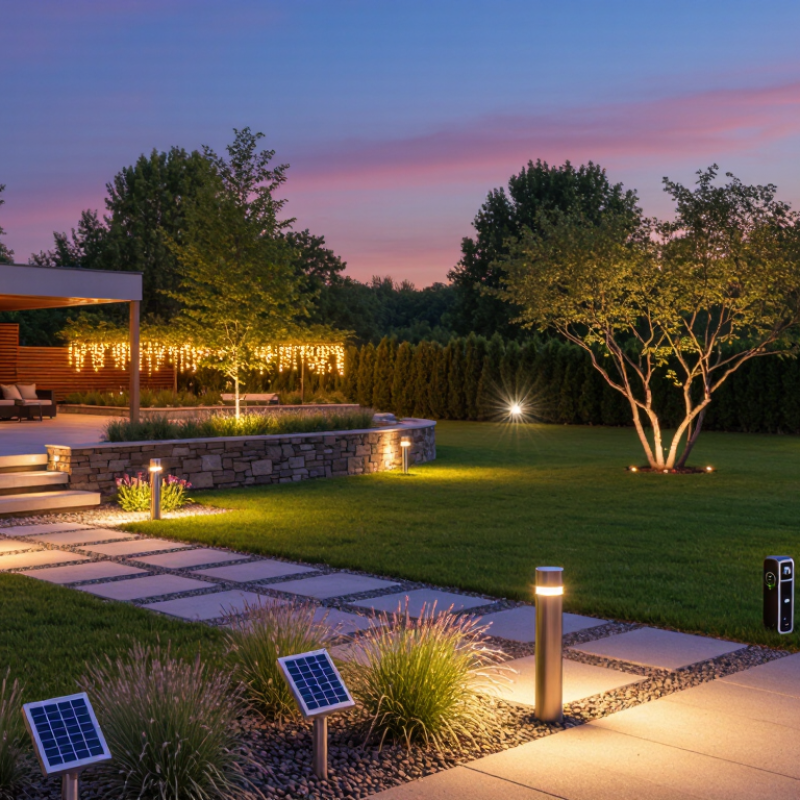
Garden lighting works best when each fixture has a clear job and a suitable position. A practical taxonomy helps global buyers compare performance, installation needs, and climate resistance. Path lights guide feet along walkways, while step lights reduce shadows on stairs and level changes. Bollard lights mark borders with stronger visual structure. Post lights brighten entrances, gates, and larger planting zones. Wall lights add security and useful illumination beside doors, patios, and service areas.
Spotlights create focused beams for trees, sculptures, or architectural details. Floodlights spread wider coverage across lawns, driveways, and open courtyards. Uplights sit at ground level and send light into trunks or foliage, shaping the garden after dark. String lights provide decorative warmth across pergolas, balconies, and seating areas. Deck or recessed lights fit into timber, stone, or paving, making edges easier to read.
Placement should follow the task, not fashion. Check ingress protection ratings, corrosion resistance, cable quality, heat management, and local electrical requirements. Solar models suit sunny borders, but winter performance can disappoint. Low-voltage systems often simplify installation, though transformers still need dry, accessible locations. Use warm light near seating and softer output around plants. I have found that excessive brightness flattens texture and disturbs neighbors. This is easy to overlook. Test beam angles at night, because catalogue images rarely show glare, shadows, or wet-surface reflections.
| No. | Lighting Type | Primary Function | Typical Placement | Typical Light Output | Common CCT | Typical Power | Recommended Ingress Protection | Main Advantages | Key Buyer Consideration |
|---|---|---|---|---|---|---|---|---|---|
| 1 | Pathway Lights | Wayfinding and low-level safety illumination | Walkways, driveways, borders, and steps | 50–200 lm per fixture | 2,700–3,000 K | 1–8 W LED | IP44 minimum; IP65 for exposed locations | Creates visual guidance with comfortable, low-glare light | Check spacing, beam distribution, glare control, and anchoring in the soil |
| 2 | Spotlights | Accent lighting and focal-point highlighting | Trees, sculptures, façades, planters, and architectural details | 200–1,000 lm per fixture | 2,700–4,000 K | 3–20 W LED | IP65–IP67 | Precise beam control and strong visual emphasis | Select beam angle, aiming adjustment, glare shielding, and heat management |
| 3 | In-Ground Well Lights | Concealed uplighting and architectural enhancement | Ground surfaces, paving, lawns, and beneath trees | 300–1,500 lm per fixture | 2,700–3,000 K | 5–25 W LED | IP67–IP68 | Minimal visual clutter and high-impact upward illumination | Confirm load rating, drainage, flush installation, and resistance to standing water |
| 4 | Wall and Fence Lights | Perimeter, entrance, and façade illumination | Garden walls, fences, gates, garages, and exterior walls | 300–1,200 lm per fixture | 2,700–4,000 K | 4–18 W LED | IP44 minimum; IP65 for weather-exposed areas | Combines property visibility, safety, and decorative design | Verify mounting surface, cable entry, corrosion resistance, and light spill |
| 5 | Deck and Step Lights | Task lighting and trip-hazard reduction | Deck boards, stair risers, railings, patios, and terraces | 20–150 lm per fixture | 2,700–3,000 K | 0.5–5 W LED | IP65–IP67 | Compact, discreet, and effective for level changes | Check surface temperature, load resistance, drill dimensions, and cable protection |
| 6 | String and Festoon Lights | Ambient, festive, and social-area lighting | Pergolas, trees, balconies, fences, and outdoor dining areas | 10–40 lm per LED lamp | 2,200–3,000 K | 0.5–2 W per lamp | IP44 minimum; IP65 for permanent outdoor use | Creates a warm atmosphere and is simple to arrange | Review cable length, lamp spacing, suspension support, timer options, and outdoor connectors |
| 7 | Floodlights | Broad-area security and functional illumination | Large lawns, driveways, patios, service areas, and entrances | 1,000–5,000 lm per fixture | 3,000–5,000 K | 15–60 W LED | IP65–IP66 | Covers large areas with relatively few fixtures | Control glare, avoid light trespass, and size output for the mounting height |
| 8 | Solar Garden Lights | Wire-free decorative and pathway illumination | Flower beds, pathways, lawns, patios, and remote garden zones | 10–200 lm per fixture | 2,700–4,000 K | 0.1–2 W LED; solar charging | IP44–IP65 | Easy installation without trenching or mains wiring | Assess solar exposure, battery capacity, seasonal runtime, and cloudy-weather performance |
| 9 | Underwater and Pond Lights | Water-feature enhancement and aquatic accents | Ponds, fountains, waterfalls, pools, and garden streams | 100–1,000 lm per fixture | 2,700–5,000 K or RGB | 2–20 W LED | IP68 for permanent submersion | Adds depth, movement, and visual interest to water features | Confirm submersion depth, low-voltage safety, cable sealing, and local water-feature regulations |
| 10 | Smart and Sensor-Activated Lights | Automated control, security, and energy management | Entrances, pathways, driveways, patios, and perimeter zones | 100–2,000 lm per fixture | 2,700–4,000 K; tunable options available | 2–30 W LED | IP44 minimum; IP65 for exposed fixtures | Supports timers, motion detection, dimming, and remote control | Check network range, sensor detection area, control compatibility, privacy, and software support |
Solar garden lights are among the most practical choices for global buyers. Their typical runtime reaches 6–12 hours after sufficient daylight charging. Most decorative models deliver 100–300 lumens, enough for paths, steps, flower beds, and small seating areas. They create guidance, not stadium brightness.
The U.S. Department of Energy reports that LED lighting uses at least 75% less energy than incandescent lighting. LEDs also last up to 25 times longer. This supports solar lighting’s low-maintenance advantage. However, the 6–12-hour claim needs careful reading. Cloud cover, winter sunlight, panel angle, battery age, and shade can reduce performance. The World Bank’s Global Solar Atlas shows major differences in solar resources across regions. A light tested in southern Europe may behave differently in northern climates. That is easy to overlook.
Tips: Check the lumen rating, battery capacity, panel size, and stated runtime together. Place panels where direct sunlight reaches them for several hours. Wipe dust from the panel monthly. For a narrow walkway, 100–150 lumens may feel comfortable. Larger garden zones may need 200–300 lumens or several fixtures. In my experience, brighter is not always better. Excessive glare can hide steps and disturb the garden’s evening character. Real performance remains imperfect, so buyers should request test conditions before placing large orders.
The ten most useful garden lighting types include pathway, bollard, step, spot, flood, wall, deck, inground, underwater, and string lights.
IP65 protects against dust and water jets, but it does not permit underwater installation. Underwater fixtures require a suitable higher rating and careful installation.
A warm color temperature between 2700K and 3000K usually makes plants, timber, and stone look natural. Cooler light can flatten foliage and feel harsh at night.
I have found that spacing matters more than brightness. Too many fixtures produce glare and hide the garden’s depth. Low-voltage systems can simplify planning, but cable routes still need protection and professional inspection. Product performance may also change after harsh winters or coastal exposure.
What Are the Top 10 Garden Lighting Types for Global Buyers?
Spotlights, Floodlights, and Uplights: 10–40° Beams and 500–1,500 lm
Garden lighting should reveal texture without flattening the landscape. Spotlights suit trees, sculptures, and narrow planting beds. Their 10–20° beams create focused accents. Floodlights spread 25–40° beams across lawns, walls, and entrances. Uplights direct 500–1,500 lumens upward, emphasizing trunks and architectural surfaces. Beam choice matters.
Path lights guide movement along walkways, while bollard lights define wider garden edges. Step lights improve visibility on terraces and stairs. Wall lights add practical illumination near doors and outdoor kitchens. Deck lights sit within boards or railings, producing low glare. String lights create a softer social atmosphere. In-ground lights deliver discreet uplighting around paving and planting zones.
Use lower lumen output near seating areas. Reserve stronger fixtures for tall trees or broad walls. Weather-resistant housings, sealed connectors, and stable mounting points deserve careful attention. Color temperatures around 2700–3000K often make foliage feel warmer and less harsh. Very cool light can reveal details, but it may make a garden feel clinical. Keep it subtle.
I have seen layouts fail when every feature receives equal brightness. Darker areas create depth and protect nighttime comfort. A 10° spotlight may look elegant on a slim trunk, yet disappoint on a large hedge. Testing one fixture after sunset is wiser than trusting daytime measurements. Even professional plans need adjustment when leaves, paving, and neighboring windows reflect unexpected light.
Typical residential garden fixtures commonly use focused beams of 10–40° and outputs of approximately 500–1,500 lumens. The chart compares representative lumen output with beam angle across ten widely used lighting types.
Higher-lumen fixtures are generally suited to trees, façades, driveways, and larger garden areas, while narrower beams create stronger accents on architectural or landscape features. Actual specifications vary by fixture size, optics, installation height, and local lighting standards.
Garden lighting works best when each fixture has a clear task. The ten most useful types include string lights, lanterns, in-ground lights, path lights, bollards, spotlights, wall lights, step lights, floodlights, and pond lights. String lights soften patios, while lanterns add a warmer focal point. In-ground lights guide movement without cluttering planting beds. I prefer LED sources with CRI 80 or higher, because leaves, stone, and skin tones appear more natural.
LED efficiency can reduce energy use and replacement work, but brightness still needs control. A narrow spotlight may highlight a tree, while a shielded path light prevents glare near eye level. Outdoor fixtures should match the site’s moisture exposure rating and use wiring suitable for local electrical requirements. Low-voltage systems can simplify installation, though professional inspection remains sensible. My first layout used too many bright fixtures. It looked safe, but the garden felt flat.
Tips: Layer light instead of filling every dark space. Test fixtures after sunset. Keep cables protected from digging tools and standing water. Choose warm color temperatures for seating areas, and cooler tones only where visibility matters. Check CRI, lumen output, beam angle, and weather resistance together. A beautiful fixture can still fail if its seal weakens after one wet season.
We use cookies on our website to give you an improved browser experience. View our Privacy Policy for more information. Please make your selection to opt in or out of ALL cookies here: Accept or Decline
Do you consent to the use of ALL cookies?
901 2nd Court West
Birmingham, AL 35204
Sales: 866.481.4036
Logistics/Ops: 866.481.4036
2101 Dralle Road
University Park, IL 60466
Sales: 708.813.9070
Logistics/Ops: 708.235.4200
400 E. 13th Street
Little Rock, AR 72114
Sales: 866.760.5344
Logistics/Ops: 866.760.5344
225 Collins Road
Elkhart, IN 46515
Sales: 574.295.0214
Logistics/Ops: 574.607.4611
601 Berryman Pike
Tipton, IN 46072
Sales: 800.897.7591
Logistics/Ops: 800.897.7591
3900 Uvalda Street
Denver, CO 80239
Sales: 303.706.8000
Ops/Logistics: 303.576.8398
510 3rd Street E
Milan, IL 61264
Sales: 800.322.1052
Logistics/Ops: 800.322.1052
1660 E. Aurora
Des Moines, IA 50313
Sales: 800.671.1660
Logistics: 800.671.1660
86554 Gene Lasserre Blvd.
Yulee, FL 32097
Sales: 904.253.3060
Logistics/Ops: 904.225.3000
694 S.E. County Road 245
Lake City, FL 32025
Sales: 800.727.6706
Logistics/Ops: 386.752.7412
210 Neptune Road
Auburndale, FL 33823
Sales: 863.967.1131
Logistics/Ops: 863.777.9814
4601 McCoy Drive
Pensacola, FL 32503
Sales: 850.308.7030
Logistics/Ops: 850.434.5502
815 South 56th Street
Tampa, FL 33619
Sales: 813.302.1940
Logistics/Ops: 813.621.1352
200 Hosea Road
Lawrenceville, GA 30046
Sales: 770.953.7575
Logistics/Ops: 770.513.6000
Branch Product Guide
Branch Line Card
Moulding Offering
Cedar Offering
Column Offering
8173 Hwy. 165 North
Monroe, LA 71211
Sales: 800.256.4165
Logistics/Ops: 800.256.4165
508 Warren Avenue
Portland, ME 04103
Sales: 207.888.2331
Logistics/Ops: 207.797.6565
4300 Georgia Pacific Blvd.
Frederick, MD 21704
Sales: 301.798.7474
Logistics/Ops: 301.874.8000
419 Maple Street
Bellingham, MA 02019
Sales: 508.449.0535
Logistics/Ops: 508.966.5500
825 Buchanan Ave SW
Grand Rapids, MI 49507
Sales: 877.800.1180
Logistics/Ops: 616.278.0909
995 Pacific St. NW
Aitkin, MN 56431
Sales: 800.432.3727
Logistics/Ops: 218.212.7770
1102 Port Terminal Drive
Duluth, MN 55802
Sales: 800.951.9899
Logistics/Ops: 800.851.9899
9110 83rd Ave. North
Brooklyn Park, MN 55445
Sales: 763.425.0204
Logistics/Ops: 763.425.0204
910 E. Railroad Street
Long Beach, MS 39560
Sales: 866.535.4135
Logistics/Ops: 228.205.2400
1727 Warren Street
North Kansas City, MO 64116
Sales: 800.621.2611
Logistics/Ops: 800.621.2611
2123 North Golden
Springfield, MO 65803
Sales: 800.375.7891
Logistics/Ops: 800.375.7891
13860 Corp. Woods Trail
Bridgeton, MO 63044
Sales: 314.209.0800
Logistics/Ops: 314.209.0800
1109 South 19th Street
Omaha, NE 68108
Sales: 800.489.6637
Logistics/Ops: 800.489.6637
1 Luger Road
Denville, NJ 07834
Sales: 973-339-3539
Logistics/Ops: 973.625.1461
3720 Jeffrey Blvd.
Blasdell, NY 14219
Sales: 716.235.5989
Logistics/Ops: 716.825.6557
319 Yaphank Ave.
Yaphank, NY 11980
Sales: 631.358.5714
Logistics/Ops: 631.924.7401
3300 Parkside Drive
Charlotte, NC 28208
Sales: 800.839.2588
Logistics/Ops: 704.394.3172
1712 East D Street
Butner, NC 27509
Sales: 984.389.8200
Logistics/Ops: 919.575.3700
128 Foothills Drive
Statesville, NC 28687
Sales: 800.222.1414
Logistics/Ops: 704.394.3172
550 Munroe Falls Rd.
Tallmadge, OH 44278
Sales: 330.357.4506
Logistics/Ops: 330.794.1141
10347 Toebben Dr.
Independence, KY 41051
Sales: 859.298.3926
Logistics/Ops: 859.746.2250
450 N. MacArthur
Oklahoma City, OK 73127
Sales: 800.375.6025
Logistics/Ops: 800.375.6025
1680 North Aspen
Broken Arrow, OK 74012
Sales: 918.272.2212
Logistics/Ops: 918.272.2212
522 Bridge Street
Hunker, PA 15639
Sales: 878.217.2001
Logistics/Ops: 724.925.7285
4290 Atlanta Street
Charleston, SC 29418
Sales: 843.371.1420
Logistics/Ops: 843.554.8192
1040 S. Industrial Dr.
Erwin, TN 37650
Sales: 423.641.1005
Logistics/Ops: 423.742.5911
4287 Pilot Drive
Memphis, TN 38118
Sales: 901.365.2101
Logistics/Ops: 901.365.2101
700 Myatt Drive
Madison, TN 37115
Sales: 615.327.9547
Logistics/Ops: 629.777.4949
4747 Mark IV Parkway
Fort Worth, TX 76106
Sales: 866.323.5117
Logistics/Ops: 817.625.9091
6990 Market Avenue
El Paso, TX 79915
Sales: 915.778.6356
Logistics/Ops: 915.265.7200
2502 Wilson Road
Harlingen, TX 78552
Sales: 800.580.6711
Logistics/Ops: 800.580.6711
10,000 North Loop East
Houston, TX 77029
Sales: 713.921.1977
Logistics/Ops: 713.675.3544
702 East 44th St.
Lubbock, TX 79404
Sales: 866.454.6010
Logistics/Ops: 866.454.6010
535 N. WW White Road
San Antonio, TX 78219
Sales: 800.284.0488
Logistics/Ops: 210.333.8112
142 Pine Haven Shores Rd.
Shelburne, VT 05482
Sales: 802.800.2540
Logistics/Ops: 802.985.2512
4700 Bethlehem Road,
Richmond, VA 23230
Sales: 804.201.2400
Logistics/Ops: 804.342.1161
4516 N Barker Road
Spokane Valley, WA 99027
Phone: 509.892.9420
Toll free: 800.728.6157
8365 N. 76th Street
Milwaukee, WI 53223
Sales: 800.356.9245
Logistics/Ops: 800.356.9245
312 S. Chester Street
Sparta, WI 54656
Sales: 800.362.5864
Logistics/Ops: 800.362.5864
899 Grossman Drive
Schofield, WI 54476
Sales: 800.472.0017
Logistics/Ops: 800.472.0017
