
We use cookies on our website to give you an improved browser experience. View our Privacy Policy for more information. Please make your selection to opt in or out of ALL cookies here: Accept or Decline
Thermal Break profiles are no longer niche specifications for premium façades. They serve windows, doors, curtain walls, and insulated panels. By separating interior and exterior metal paths, they reduce conductive heat flow. They can also help limit interior condensation.
The International Energy Agency reports that buildings use about 30% of global final energy. They also produce roughly 26% of energy-related emissions. The 2024 Global Status Report for Buildings and Construction was published by UNEP and GlobalABC. It reports that buildings and construction consumed 32% of global energy. The sector also produced 34% of global carbon emissions. These figures make frame design important. However, they do not prove equal performance across profiles. Polymer geometry, alloy selection, glazing, drainage, and installation quality can change the result.
This guide examines ten profile types used by global buyers. It covers polyamide strips, poured-and-debridged systems, insulated box sections, and composite connectors. It considers conductivity, U-value contribution, structural capacity, fire behavior, tolerances, recyclability, and supply consistency. A narrow polyamide strip may suit a residential window. A reinforced connector may serve a high-rise curtain wall. Small details matter. A 0.2-millimeter tolerance can affect sealing and assembly. Buyers should verify test methods instead of trusting brochure claims. EN 14024 and ISO 10077 offer useful references, but local codes still differ. No profile is universally best. That is the uncomfortable part. Performance depends on the complete building envelope, not one attractive component.
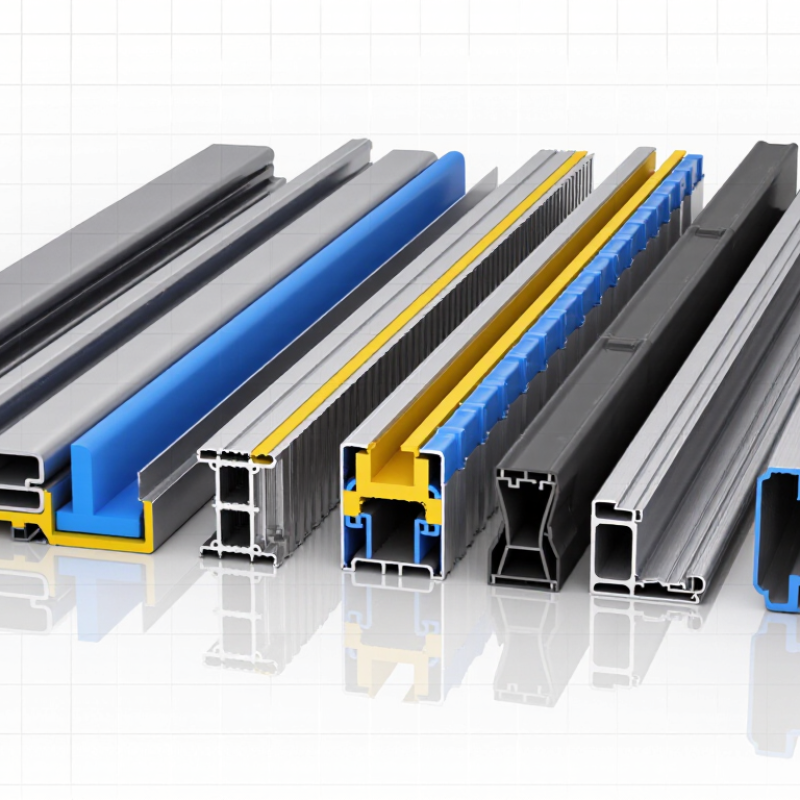
Thermal break profiles are insulating components placed between conductive sections of an aluminum frame. They reduce heat transfer across the assembly. In practical terms, they help keep winter room temperatures stable and summer heat outside. They also lower the risk of interior condensation around windows and doors.
Common designs include straight, serrated, box-shaped, and multi-chamber profiles. Each shape serves a different balance of strength, insulation, and fabrication efficiency.
A reliable design begins with the building’s climate, frame size, and expected loads. Engineers usually evaluate thermal conductivity, profile width, connection strength, and air-sealing performance together. A wider insulating zone often improves thermal resistance. However, it can also affect machining, reinforcement, and installation tolerances.
Material quality matters. Moisture absorption, dimensional stability, and long-term bonding should be tested before production. A perfect profile does not exist. Design decisions involve trade-offs, and small installation gaps can reduce laboratory performance.
Check the complete frame system, not only the profile sample. Confirm test results for heat transfer, condensation, and mechanical strength. Inspect cut edges and joints carefully on site. Use climate-specific calculations instead of copying another project’s specifications. Thermal performance can fail quietly. Condensation often appears months later, near corners or fasteners. A practical review should include drawings, material certificates, factory controls, and installation photographs.
Aluminum thermal break profiles reduce heat transfer through an insulating strip between inner and outer aluminum sections. In practical projects, profile choice depends on opening size, climate, glazing weight, and drainage design. The main window types include casement, sliding, tilt-and-turn, fixed, and lift-and-slide profiles. Each requires different chambers, gaskets, rollers, or reinforcement. Casement systems often prioritize airtightness, while sliding systems need smooth tracks and reliable water drainage.
Door applications commonly use hinged, sliding, folding, and entrance profiles. Hinged doors need strong hinges and stable thermal separators. Lift-and-slide doors require deeper sections for heavy glass panels. Folding doors demand accurate alignment across several moving leaves. Curtain wall systems add pressure plate, stick-built, unitized, and corner profiles to the list of practical options. These sections must coordinate with glass thickness, mullion loads, panel joints, and concealed drainage paths.
Polyamide strips are widely used because they provide stable thermal separation and support precise assembly. Some projects need reinforced strips or deeper cavities for stronger insulation. A profile can look impressive but still perform poorly after incorrect cutting or sealing. I have seen small drainage errors create larger maintenance problems. This detail matters. Buyers should review tested air, water, wind, and thermal data before approval. Local climate and installation quality can change the final result. A perfect profile does not exist; the right profile fits the whole system.
Thermal break profiles reduce heat transfer through aluminum frames, but selection depends on climate, geometry, and installation quality. Global buyers should compare performance data, not catalog claims alone.
Material-based types include glass-fiber-reinforced polyamide strips, PVC profiles, polyurethane cast-and-debridge systems, and resin-composite profiles. Polyamide offers stable insulation and strong mechanical support. PVC can suit lighter interior applications, but its thermal and fire performance requires careful verification. Polyurethane systems can fill complex cavities effectively. Resin composites may provide design flexibility, though long-term data can vary.
Shape-based types include flat strips, multi-cavity strips, T-shaped profiles, and U-shaped profiles. Flat strips simplify production. Multi-cavity designs usually improve resistance to heat flow. T-shaped profiles help connect uneven frame sections. U-shaped profiles can support compact assemblies. Application-based types include window-and-door profiles and curtain-wall profiles. Sliding doors may need reinforced variants because their frames face repeated movement and wider spans.
A practical assessment should check thermal conductivity, tensile strength, water absorption, fire behavior, dimensional tolerance, and compatibility with sealants. I have seen an attractive profile fail because its corner joints were poorly assembled. That detail matters. The classification is useful, but not perfect. Local climate, frame depth, glazing weight, and workshop skill can change the result. Buyers should request test reports, installation drawings, and samples before approving bulk production. A small sample is not enough. But ignoring it is worse.
Top 10 Types of Thermal Break Profiles for Global Buyers
Global buyers should evaluate thermal break profiles through performance standards, not appearance alone. Common options include polyamide, PVC, polyurethane, resin-based, and hybrid profiles. Each suits different curtain walls, windows, doors, and climate zones. A narrow profile may improve sightlines, but it can reduce insulation space. Small details matter.
Request tested U-value data for the complete frame system, not only the profile. Standards such as EN ISO 10077, ASTM C1363, or equivalent regional methods may support thermal calculations. Confirm air leakage, water tightness, structural resistance, dimensional stability, and fire behavior where required. Testing should come from a competent laboratory, preferably accredited to ISO/IEC 17025. Check the report date, specimen size, temperature range, and installation method. Numbers without conditions can mislead.
Tips: Compare the same frame size and glass setup. Ask for long-term aging data. Inspect cut samples for consistent ribs, clean joining surfaces, and stable tolerances. A perfect profile does not exist. Some specifications still overvalue low conductivity while ignoring assembly quality. Review local building requirements before purchase, because test methods and acceptance limits vary between markets. Keep drawings, batch records, and inspection photos for traceability. A careful review now can prevent condensation around a cold corner later.
| Rank | Thermal Break Profile Type | Typical Base Material | Typical Thermal Conductivity | Typical Profile Thickness | Primary Applications | Key Performance Advantages | Relevant Test Methods or Standards | Important Buyer Considerations |
|---|---|---|---|---|---|---|---|---|
| 1 | Glass-Fiber-Reinforced Polyamide Strip | Polyamide 6.6 reinforced with approximately 25% glass fiber | Approximately 0.30–0.35 W/m·K | 14.8–40 mm | Thermally broken aluminum windows, doors, curtain walls, and façades | High dimensional stability, strong mechanical performance, good moisture resistance, and compatibility with industrial aluminum rolling or crimping systems | EN 14024; EN ISO 10077-2; ISO 4892-2 for accelerated weathering where required | Check glass-fiber content, tensile and shear strength, strip geometry, dimensional tolerance, and compatibility with the aluminum alloy and coating process |
| 2 | Polyamide Insulating Box Profile | Extruded reinforced polyamide, often produced as a hollow or multi-chamber section | Approximately 0.30–0.35 W/m·K | 20–50 mm | Large aluminum frame sections, sliding doors, high-performance windows, and façade mullions | Greater insulation depth than a simple strip, improved stiffness-to-weight ratio, and the ability to create multiple insulating chambers | EN 14024; EN ISO 10077-2; EN 12152 and EN 12154 for relevant curtain-wall air and water performance | Evaluate chamber design, drainage, insertion method, corner-joint strength, and the effect of the profile on the complete-frame U-value |
| 3 | Pour-and-Debridge Polyurethane Thermal Break | Rigid polyurethane foam cast between aluminum sections and mechanically debridged after curing | Approximately 0.025–0.035 W/m·K | 20–45 mm | Aluminum windows, doors, façades, and thermally improved framing systems | Very low material conductivity, flexible cavity design, and efficient insulation for complex aluminum cross-sections | EN ISO 10077-2; ISO 8302 or ASTM C177 for steady-state thermal resistance; ASTM C518 for heat-flow measurements | Confirm foam density, adhesion, curing consistency, debridging quality, dimensional stability, and long-term resistance to moisture and temperature cycling |
| 4 | Rigid PVC Thermal Separator | Unplasticized polyvinyl chloride, commonly used as an insulating separator or glazing component | Approximately 0.16–0.20 W/m·K | 2–30 mm | Window glazing pockets, door thresholds, light-duty aluminum frames, and secondary thermal isolation | Low cost, easy extrusion, good electrical insulation, and resistance to many common chemicals | EN ISO 10077-2; ISO 4892-2 for weathering evaluation; applicable regional PVC fire and building regulations | Review impact strength, low-temperature behavior, UV stabilization, fire classification, shrinkage, and whether the material is suitable for structural load transfer |
| 5 | Polyurethane Foam Insulating Insert | Closed-cell or semi-closed-cell polyurethane foam, supplied as a flexible insert or rigid preformed section | Approximately 0.025–0.040 W/m·K | 10–60 mm | Thermal enhancement of aluminum profiles, façade cavities, door panels, and retrofit frame systems | Excellent insulation efficiency per unit thickness, lightweight construction, and easy adaptation to irregular cavities | ISO 8302; ASTM C518; EN ISO 10077-2 for integration into a complete window or façade assembly | Check water absorption, compression recovery, adhesive compatibility, dimensional stability, smoke and fire behavior, and resistance to installation damage |
| 6 | Expanded or Extruded Polystyrene Insert | Expanded polystyrene or extruded polystyrene foam | Approximately 0.029–0.040 W/m·K | 15–80 mm | Insulated façade panels, spandrel zones, door cores, and non-load-bearing thermal infill areas | Low thermal conductivity, low density, easy cutting, and economical use in large insulated cavities | EN 13163 for expanded polystyrene; EN 13164 for extruded polystyrene; ISO 8302 or ASTM C518 for thermal testing | Assess water absorption, compressive strength, fire classification, vapor behavior, dimensional tolerances, and suitability for the intended cavity geometry |
| 7 | Aerogel Thermal Break Strip or Blanket | Silica-aerogel composite reinforced with fibers or flexible carrier materials | Approximately 0.013–0.020 W/m·K | 5–20 mm | High-performance retrofit applications, narrow frame cavities, steel connections, and space-constrained thermal bridges | Very low thermal conductivity, thin construction, and strong performance where installation space is limited | ISO 8302; ASTM C177; ASTM C518; EN ISO 10211 for thermal-bridge assessment in building details | Consider material cost, dust control, compression behavior, edge sealing, handling requirements, moisture exposure, and compatibility with adhesives or sealants |
| 8 | Glass-Fiber-Reinforced Thermoplastic Profile | Glass-fiber-reinforced thermoplastic such as reinforced polycarbonate, polyester, or other engineering polymers | Approximately 0.25–0.40 W/m·K | 10–50 mm | Structural thermal isolators, façade brackets, window reinforcement zones, and custom engineered frame components | Good strength-to-weight ratio, corrosion resistance, electrical insulation, and freedom for complex custom geometries | EN ISO 10077-2; ISO 527 for tensile properties; ISO 178 for flexural properties; ISO 75 for heat-deflection behavior | Verify fiber orientation, creep resistance, coefficient of thermal expansion, water absorption, fire performance, and load capacity over the service temperature range |
| 9 | EPDM Thermal Isolation Gasket | Ethylene-propylene-diene rubber, normally used as a flexible gasket or isolating seal | Approximately 0.20–0.25 W/m·K | 1–15 mm | Glazing systems, pressure plates, aluminum-to-glass interfaces, and flexible air or water seals | Excellent weathering, ozone, and UV resistance; flexible sealing; and reliable accommodation of movement | EN 12365 for building hardware gaskets; EN ISO 10077-2 for thermal calculations; ISO 815 for compression set evaluation | Confirm hardness, compression set, tensile strength, compatibility with sealants and coatings, weather resistance, and the required air and water tightness class |
| 10 | Thermal Break Pad or Structural Shim | High-density polymer, reinforced composite, glass-fiber laminate, or other load-bearing insulating material | Approximately 0.20–0.50 W/m·K | 3–30 mm | Base plates, curtain-wall brackets, balcony connections, steel-to-concrete interfaces, and point thermal bridges | Reduces conductive heat flow through fasteners and supports while maintaining controlled load transfer | EN ISO 10211; ISO 8302; ASTM C177; EN 1993 and EN 1992 where the shim forms part of a structural connection | Prioritize compressive strength, creep, fire behavior, bearing area, fastener interaction, moisture resistance, and verified structural calculations for the connection |
Choosing a thermal break profile requires more than comparing catalog prices. Start with the frame material, glazing weight, climate, and installation method. Experienced buyers request thermal conductivity, tensile strength, shear strength, moisture resistance, and service-temperature data. Ask for test reports from independent laboratories. A neat datasheet is not proof of field performance.
Common options include flat strips, I-shaped profiles, T-shaped profiles, U-shaped profiles, omega profiles, serrated strips, perforated profiles, pressure-fit profiles, roll-in profiles, and pour-and-debridge systems. Polyamide reinforced with glass fiber suits many high-performance aluminum frames. PVC can work in less demanding assemblies. Polyurethane offers useful insulation, but dimensional stability needs close review. Check whether the profile matches the frame groove and production equipment.
Specify width, wall thickness, tolerance, length, color, and allowable shrinkage. Confirm compatibility with sealants, coatings, fasteners, and thermal expansion rates. For cold regions, compare condensation resistance near corners and joints, not only center-frame U-values. For coastal projects, request salt-spray and moisture-aging evidence. Fire requirements also vary by market, so verify the applicable local standard.
Small errors become expensive. A profile may fit physically but fail during crimping. We have seen buyers overlook storage humidity and then blame the material. That judgment is incomplete. Trial assemblies, pull-out checks, and thermal calculations often reveal weaknesses before full production. Use a sample window, not just a sample strip.
We use cookies on our website to give you an improved browser experience. View our Privacy Policy for more information. Please make your selection to opt in or out of ALL cookies here: Accept or Decline
Do you consent to the use of ALL cookies?
901 2nd Court West
Birmingham, AL 35204
Sales: 866.481.4036
Logistics/Ops: 866.481.4036
2101 Dralle Road
University Park, IL 60466
Sales: 708.813.9070
Logistics/Ops: 708.235.4200
400 E. 13th Street
Little Rock, AR 72114
Sales: 866.760.5344
Logistics/Ops: 866.760.5344
225 Collins Road
Elkhart, IN 46515
Sales: 574.295.0214
Logistics/Ops: 574.607.4611
601 Berryman Pike
Tipton, IN 46072
Sales: 800.897.7591
Logistics/Ops: 800.897.7591
3900 Uvalda Street
Denver, CO 80239
Sales: 303.706.8000
Ops/Logistics: 303.576.8398
510 3rd Street E
Milan, IL 61264
Sales: 800.322.1052
Logistics/Ops: 800.322.1052
1660 E. Aurora
Des Moines, IA 50313
Sales: 800.671.1660
Logistics: 800.671.1660
86554 Gene Lasserre Blvd.
Yulee, FL 32097
Sales: 904.253.3060
Logistics/Ops: 904.225.3000
694 S.E. County Road 245
Lake City, FL 32025
Sales: 800.727.6706
Logistics/Ops: 386.752.7412
210 Neptune Road
Auburndale, FL 33823
Sales: 863.967.1131
Logistics/Ops: 863.777.9814
4601 McCoy Drive
Pensacola, FL 32503
Sales: 850.308.7030
Logistics/Ops: 850.434.5502
815 South 56th Street
Tampa, FL 33619
Sales: 813.302.1940
Logistics/Ops: 813.621.1352
200 Hosea Road
Lawrenceville, GA 30046
Sales: 770.953.7575
Logistics/Ops: 770.513.6000
Branch Product Guide
Branch Line Card
Moulding Offering
Cedar Offering
Column Offering
8173 Hwy. 165 North
Monroe, LA 71211
Sales: 800.256.4165
Logistics/Ops: 800.256.4165
508 Warren Avenue
Portland, ME 04103
Sales: 207.888.2331
Logistics/Ops: 207.797.6565
4300 Georgia Pacific Blvd.
Frederick, MD 21704
Sales: 301.798.7474
Logistics/Ops: 301.874.8000
419 Maple Street
Bellingham, MA 02019
Sales: 508.449.0535
Logistics/Ops: 508.966.5500
825 Buchanan Ave SW
Grand Rapids, MI 49507
Sales: 877.800.1180
Logistics/Ops: 616.278.0909
995 Pacific St. NW
Aitkin, MN 56431
Sales: 800.432.3727
Logistics/Ops: 218.212.7770
1102 Port Terminal Drive
Duluth, MN 55802
Sales: 800.951.9899
Logistics/Ops: 800.851.9899
9110 83rd Ave. North
Brooklyn Park, MN 55445
Sales: 763.425.0204
Logistics/Ops: 763.425.0204
910 E. Railroad Street
Long Beach, MS 39560
Sales: 866.535.4135
Logistics/Ops: 228.205.2400
1727 Warren Street
North Kansas City, MO 64116
Sales: 800.621.2611
Logistics/Ops: 800.621.2611
2123 North Golden
Springfield, MO 65803
Sales: 800.375.7891
Logistics/Ops: 800.375.7891
13860 Corp. Woods Trail
Bridgeton, MO 63044
Sales: 314.209.0800
Logistics/Ops: 314.209.0800
1109 South 19th Street
Omaha, NE 68108
Sales: 800.489.6637
Logistics/Ops: 800.489.6637
1 Luger Road
Denville, NJ 07834
Sales: 973-339-3539
Logistics/Ops: 973.625.1461
3720 Jeffrey Blvd.
Blasdell, NY 14219
Sales: 716.235.5989
Logistics/Ops: 716.825.6557
319 Yaphank Ave.
Yaphank, NY 11980
Sales: 631.358.5714
Logistics/Ops: 631.924.7401
3300 Parkside Drive
Charlotte, NC 28208
Sales: 800.839.2588
Logistics/Ops: 704.394.3172
1712 East D Street
Butner, NC 27509
Sales: 984.389.8200
Logistics/Ops: 919.575.3700
128 Foothills Drive
Statesville, NC 28687
Sales: 800.222.1414
Logistics/Ops: 704.394.3172
550 Munroe Falls Rd.
Tallmadge, OH 44278
Sales: 330.357.4506
Logistics/Ops: 330.794.1141
10347 Toebben Dr.
Independence, KY 41051
Sales: 859.298.3926
Logistics/Ops: 859.746.2250
450 N. MacArthur
Oklahoma City, OK 73127
Sales: 800.375.6025
Logistics/Ops: 800.375.6025
1680 North Aspen
Broken Arrow, OK 74012
Sales: 918.272.2212
Logistics/Ops: 918.272.2212
522 Bridge Street
Hunker, PA 15639
Sales: 878.217.2001
Logistics/Ops: 724.925.7285
4290 Atlanta Street
Charleston, SC 29418
Sales: 843.371.1420
Logistics/Ops: 843.554.8192
1040 S. Industrial Dr.
Erwin, TN 37650
Sales: 423.641.1005
Logistics/Ops: 423.742.5911
4287 Pilot Drive
Memphis, TN 38118
Sales: 901.365.2101
Logistics/Ops: 901.365.2101
700 Myatt Drive
Madison, TN 37115
Sales: 615.327.9547
Logistics/Ops: 629.777.4949
4747 Mark IV Parkway
Fort Worth, TX 76106
Sales: 866.323.5117
Logistics/Ops: 817.625.9091
6990 Market Avenue
El Paso, TX 79915
Sales: 915.778.6356
Logistics/Ops: 915.265.7200
2502 Wilson Road
Harlingen, TX 78552
Sales: 800.580.6711
Logistics/Ops: 800.580.6711
10,000 North Loop East
Houston, TX 77029
Sales: 713.921.1977
Logistics/Ops: 713.675.3544
702 East 44th St.
Lubbock, TX 79404
Sales: 866.454.6010
Logistics/Ops: 866.454.6010
535 N. WW White Road
San Antonio, TX 78219
Sales: 800.284.0488
Logistics/Ops: 210.333.8112
142 Pine Haven Shores Rd.
Shelburne, VT 05482
Sales: 802.800.2540
Logistics/Ops: 802.985.2512
4700 Bethlehem Road,
Richmond, VA 23230
Sales: 804.201.2400
Logistics/Ops: 804.342.1161
4516 N Barker Road
Spokane Valley, WA 99027
Phone: 509.892.9420
Toll free: 800.728.6157
8365 N. 76th Street
Milwaukee, WI 53223
Sales: 800.356.9245
Logistics/Ops: 800.356.9245
312 S. Chester Street
Sparta, WI 54656
Sales: 800.362.5864
Logistics/Ops: 800.362.5864
899 Grossman Drive
Schofield, WI 54476
Sales: 800.472.0017
Logistics/Ops: 800.472.0017
