
We use cookies on our website to give you an improved browser experience. View our Privacy Policy for more information. Please make your selection to opt in or out of ALL cookies here: Accept or Decline
Choosing the right belt conveyor roller can affect load stability, belt wear, noise, and maintenance time. In 2026, buyers will still encounter familiar options, including carrying, return, impact, and training rollers. Material choices matter too. Steel rollers suit many demanding applications, while polymer rollers can reduce weight and resist corrosion in suitable environments. Rubber-disc designs may help manage sticky material on return runs. Each type solves a different problem.
The best choice depends on more than a product label. Consider belt width, load weight, speed, moisture, dust, and the size of material falling onto the belt. An impact roller beneath a loading point, for example, needs to handle repeated shocks without creating a new tracking problem. Small details count. Seal design, bearing quality, shaft fit, and access for replacement can influence service life. Ask suppliers for operating limits and maintenance guidance, then compare them with actual site conditions. Specifications are useful, but they do not tell the whole story. A tidy chart may overlook uneven loading or harsh washdown routines. Real installations can be messier. This guide compares the leading belt conveyor roller types and explains where each is commonly used, what trade-offs to check, and which questions to ask before purchase. It is a starting point, not a substitute for engineering review.
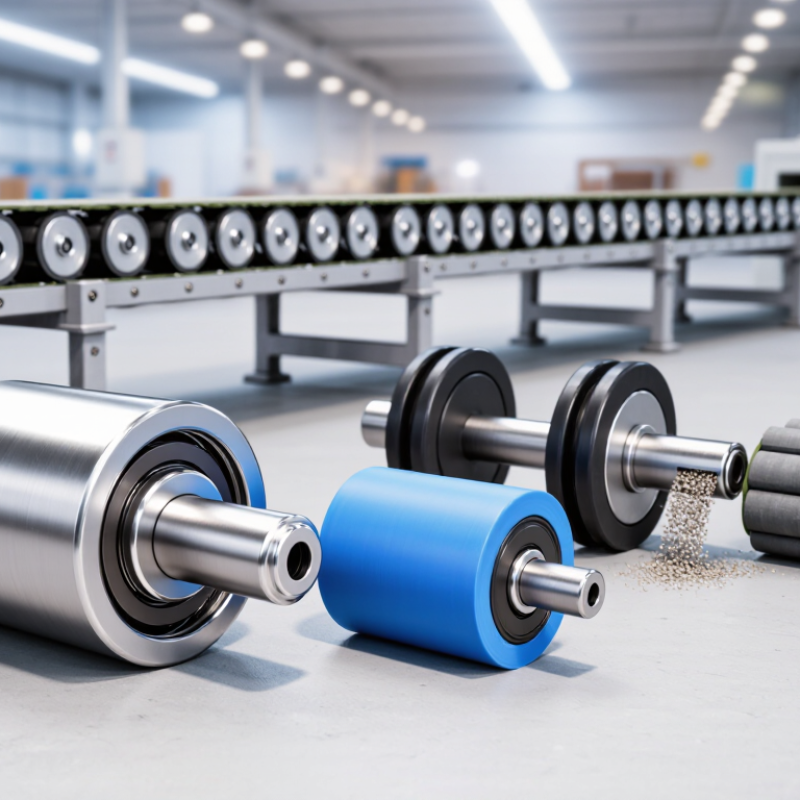
Belt conveyor rollers keep the belt supported while material moves between loading and discharge points. Carrying rollers sit beneath the loaded belt and help limit sag between supports. Return rollers guide the empty belt underneath the conveyor. At loading zones, impact rollers with resilient surfaces can soften blows from falling stone or packed cartons. Small details matter. Roller spacing, bearing condition, and belt tension all affect smooth travel.
Tips: Match roller design to the load, belt speed, and surrounding conditions. Check for buildup, unusual noise, and uneven wear during routine inspections. A roller that turns poorly can increase drag and contribute to belt mistracking. Dust changes things.
In practice, the clean layout on a drawing may behave differently once material starts shifting. Misaligned supports or sticky carryback can make a belt wander, even when individual rollers appear sound. Self-aligning rollers may help correct minor tracking drift, but they cannot fix every underlying problem. Check the frame and belt condition too. For a damp or abrasive site, select suitable seals and surfaces, then inspect them at intervals that reflect actual operating conditions.
Belt conveyor rollers are best classified by function first, then by construction. Carrying idlers support the loaded belt, often in a three-roll trough that contains loose material. Return rollers support the empty belt beneath the frame. Impact rollers use resilient discs near loading points, where falling rock can dent a standard steel shell. Training idlers can pivot to correct minor belt drift, but they cannot compensate for poor alignment. Small differences matter.
Design adds another layer. A flat single-roll roller suits some light-duty or package conveyors, while troughing sets commonly use two or three rolls. Return designs may use flat rolls, spaced discs, or helical surfaces to shed sticky material. CEMA’s Belt Conveyors for Bulk Materials, 7th edition, treats belt width, speed, load, and operating conditions as key idler-selection inputs. Grand View Research’s 2024 conveyor systems market report estimated a global market of $10.31 billion in 2023 and projected 5.6% annual growth through 2030. That market figure is broad, not a roller-sales measure. For a practical choice, inspect belt speed, material size, moisture, and loading height; a roller that looks robust may still fail early under abrasive fines or misalignment. The labels help, but field conditions deserve a second look.
In everyday belt systems in 2026, carrying rollers, return rollers, and impact rollers remain among the most common types. Carrying rollers support the loaded belt along its upper run, often in a trough-shaped arrangement that helps contain bulk material. A familiar setup. Return rollers carry the empty belt underneath, where dust and buildup can still cause trouble.
Impact rollers sit below loading points, where falling material may strike the belt with force. Their resilient surfaces help reduce damage, but they do not replace a properly designed loading chute. For long or heavily loaded conveyors, training rollers can help correct belt drift. Flat return rollers are also common on lighter-duty systems. The neat categories can blur: a site may combine several roller styles along one conveyor.
Choosing rollers starts with the material, belt speed, load, and operating environment. A wet, abrasive transfer point needs different protection from a clean packaging line. Check roller diameter, bearing protection, and spacing against the system’s actual conditions. Small details matter. Even a suitable roller can wear quickly if material accumulates around its ends or the frame is misaligned. There is no single best type for every conveyor, and maintenance access deserves attention too. It is easy to overlook until replacement becomes awkward.
A qualitative comparison of commonly used belt conveyor roller types.
Troughing carrying idlers and flat return idlers are widely used in conventional belt conveyors. Impact, training, and self-cleaning rollers are selected for specific loading, tracking, or material-handling needs. Scores are qualitative estimates—not measured market shares or sales data.
How to Choose Rollers for Different Conveyor Conditions
Choosing rollers starts with the material, load, belt speed, and environment. Troughing rollers support the carrying side and help keep bulk material centered. Flat return rollers support the belt on its way back. For loading zones, impact rollers with resilient surfaces can reduce shock from falling rock or ore. Match roller spacing and load ratings to the conveyor design, not just the material name. Small details matter.
Dust, moisture, and corrosive washdown can shorten bearing life. Sealed bearings and suitable roller materials may help, but confirm their limits with the supplier’s technical data. In abrasive service, check shell wear and inspect rollers regularly for rough rotation or buildup. Plastic or coated rollers may suit some light-duty or corrosive settings, yet they are not automatically the better choice. Temperature, belt tension, and cleaning methods still matter.
Misalignment calls for a different check. Training rollers can help guide a wandering belt, but they do not fix poor structure alignment or uneven loading. Measure the frame, examine the splice, and watch the belt under normal operating conditions before choosing a solution. No chart gets every site right. Record noise, heat, and visible wear during inspections; those clues can reveal whether the roller type, seal, or spacing needs reconsideration.
What Are the Top Belt Conveyor Roller Types in 2026?
What Design Trends Are Shaping Conveyor Rollers in 2026
In 2026, conveyor roller design is moving toward lower resistance, easier maintenance, and better condition monitoring. Improved seals help keep fine dust and moisture away from bearings in demanding environments. Lightweight composite rollers can reduce rotating mass, while carefully selected steel rollers remain practical for heavy loads. No single material suits every line.
Sensor-ready roller assemblies are gaining attention. Temperature and vibration readings can help maintenance teams spot wear before a roller seizes or damages a belt. Quieter designs also matter in enclosed facilities, where repeated roller noise can make inspections harder. Still, sensors need proper placement and routine checks. A data point is not a diagnosis.
Tips: Check rollers during a real operating shift. Look for uneven belt tracking, unusual heat, rough rotation, and material buildup near the ends. Compare readings with a baseline from the same conveyor. Do not replace a roller based on one brief vibration spike. Small issues are easy to miss, especially when production is busy. Keeping a few measurements in a simple log can make maintenance decisions more reliable.
| Roller type | Typical position or purpose | Common design characteristics | Suitable operating conditions | Relevant design trends for 2026 |
|---|---|---|---|---|
| Troughing idler roller | Carrying side; arranged in sets to form a trough that supports bulk material. | Usually installed as a three-roll set; roll angles are selected to suit the belt and conveyor design. | General bulk handling, including mining, aggregates, and material processing. | Lower-resistance bearings and improved sealing help reduce rotational drag and protect against dust and moisture. |
| Flat carrying idler roller | Carrying side of flat-belt conveyors; supports the belt and conveyed items. | Single horizontal roller or a flat idler arrangement; dimensions and spacing depend on load and belt design. | Unit loads, light-duty handling, and applications where a flat belt profile is required. | Quieter operation and easier-to-replace components support maintenance and workplace-noise goals. |
| Return roller | Return side; supports the empty belt on its way back to the loading point. | Commonly a single roller; may use discs or other surface features where carryback is a concern. | Most belt conveyor systems, with configuration chosen for belt width, return-span length, and material carryback. | Improved sealing and corrosion-resistant materials can extend service life in dirty or damp areas. |
| Impact roller or impact idler | Loading and transfer zones; helps cushion the belt where material lands. | Often uses resilient rubber rings or sleeves over a roller shell; installed in an impact-support arrangement. | Chutes and loading points where falling material can impose concentrated impact loads. | More durable, replaceable impact elements and application-specific designs help limit damage and simplify service. |
| Rubber-disc return roller | Return side; the spaced discs provide clearance for material that adheres to the belt. | Rubber discs are fitted along the roller shell; spacing and disc profile vary by application. | Bulk materials prone to carryback, where belt cleaning and conveyor layout are also properly designed. | Replaceable disc elements and wear-focused designs can reduce the need to replace an entire assembly. |
| Self-aligning (training) idler | Carrying or return side; helps guide a belt that tends to drift from its intended path. | Uses a pivoting or steering arrangement; correct positioning and adjustment are important for effective tracking. | Conveyors with persistent tracking issues after alignment, loading, and belt condition have been checked. | Monitoring belt position can help identify misalignment earlier; sensors complement, but do not replace, correct mechanical setup. |
| Garland idler roller | Carrying side, commonly on long or curved conveyor sections; linked rolls form a flexible support set. | Two or more rollers are connected in a suspended assembly that can adapt to belt movement and conveyor profile. | Selected bulk-handling layouts, including certain overland and curved conveyor applications. | Modular assemblies and service-access improvements can help make inspection and component replacement more practical. |
| Polymer or HDPE roller | Carrying or return side, where the roller material is suitable for the load and operating environment. | Uses a polymer shell rather than a conventional steel shell; bearing and shaft design remain critical. | Applications prioritizing corrosion resistance or lower roller mass, subject to load, temperature, and chemical compatibility. | Material selection increasingly considers service life, recyclability, and environmental conditions alongside weight and corrosion resistance. |
| Sensor-enabled roller or idler assembly | Selected conveyor locations; provides condition data rather than a different belt-support geometry. | May incorporate or work with sensors that monitor factors such as temperature, vibration, or rotation, depending on the system. | Sites where monitoring access is difficult or unplanned downtime is costly; sensor coverage is typically selective. | Condition-based maintenance, wireless data collection, and integration with maintenance systems are notable design directions. |
Selection note: Roller suitability depends on belt width and speed, material load, impact, environment, and the conveyor design. Trends describe design directions, not guaranteed performance improvements.
We use cookies on our website to give you an improved browser experience. View our Privacy Policy for more information. Please make your selection to opt in or out of ALL cookies here: Accept or Decline
Do you consent to the use of ALL cookies?
901 2nd Court West
Birmingham, AL 35204
Sales: 866.481.4036
Logistics/Ops: 866.481.4036
2101 Dralle Road
University Park, IL 60466
Sales: 708.813.9070
Logistics/Ops: 708.235.4200
400 E. 13th Street
Little Rock, AR 72114
Sales: 866.760.5344
Logistics/Ops: 866.760.5344
225 Collins Road
Elkhart, IN 46515
Sales: 574.295.0214
Logistics/Ops: 574.607.4611
601 Berryman Pike
Tipton, IN 46072
Sales: 800.897.7591
Logistics/Ops: 800.897.7591
3900 Uvalda Street
Denver, CO 80239
Sales: 303.706.8000
Ops/Logistics: 303.576.8398
510 3rd Street E
Milan, IL 61264
Sales: 800.322.1052
Logistics/Ops: 800.322.1052
1660 E. Aurora
Des Moines, IA 50313
Sales: 800.671.1660
Logistics: 800.671.1660
86554 Gene Lasserre Blvd.
Yulee, FL 32097
Sales: 904.253.3060
Logistics/Ops: 904.225.3000
694 S.E. County Road 245
Lake City, FL 32025
Sales: 800.727.6706
Logistics/Ops: 386.752.7412
210 Neptune Road
Auburndale, FL 33823
Sales: 863.967.1131
Logistics/Ops: 863.777.9814
4601 McCoy Drive
Pensacola, FL 32503
Sales: 850.308.7030
Logistics/Ops: 850.434.5502
815 South 56th Street
Tampa, FL 33619
Sales: 813.302.1940
Logistics/Ops: 813.621.1352
200 Hosea Road
Lawrenceville, GA 30046
Sales: 770.953.7575
Logistics/Ops: 770.513.6000
Branch Product Guide
Branch Line Card
Moulding Offering
Cedar Offering
Column Offering
8173 Hwy. 165 North
Monroe, LA 71211
Sales: 800.256.4165
Logistics/Ops: 800.256.4165
508 Warren Avenue
Portland, ME 04103
Sales: 207.888.2331
Logistics/Ops: 207.797.6565
4300 Georgia Pacific Blvd.
Frederick, MD 21704
Sales: 301.798.7474
Logistics/Ops: 301.874.8000
419 Maple Street
Bellingham, MA 02019
Sales: 508.449.0535
Logistics/Ops: 508.966.5500
825 Buchanan Ave SW
Grand Rapids, MI 49507
Sales: 877.800.1180
Logistics/Ops: 616.278.0909
995 Pacific St. NW
Aitkin, MN 56431
Sales: 800.432.3727
Logistics/Ops: 218.212.7770
1102 Port Terminal Drive
Duluth, MN 55802
Sales: 800.951.9899
Logistics/Ops: 800.851.9899
9110 83rd Ave. North
Brooklyn Park, MN 55445
Sales: 763.425.0204
Logistics/Ops: 763.425.0204
910 E. Railroad Street
Long Beach, MS 39560
Sales: 866.535.4135
Logistics/Ops: 228.205.2400
1727 Warren Street
North Kansas City, MO 64116
Sales: 800.621.2611
Logistics/Ops: 800.621.2611
2123 North Golden
Springfield, MO 65803
Sales: 800.375.7891
Logistics/Ops: 800.375.7891
13860 Corp. Woods Trail
Bridgeton, MO 63044
Sales: 314.209.0800
Logistics/Ops: 314.209.0800
1109 South 19th Street
Omaha, NE 68108
Sales: 800.489.6637
Logistics/Ops: 800.489.6637
1 Luger Road
Denville, NJ 07834
Sales: 973-339-3539
Logistics/Ops: 973.625.1461
3720 Jeffrey Blvd.
Blasdell, NY 14219
Sales: 716.235.5989
Logistics/Ops: 716.825.6557
319 Yaphank Ave.
Yaphank, NY 11980
Sales: 631.358.5714
Logistics/Ops: 631.924.7401
3300 Parkside Drive
Charlotte, NC 28208
Sales: 800.839.2588
Logistics/Ops: 704.394.3172
1712 East D Street
Butner, NC 27509
Sales: 984.389.8200
Logistics/Ops: 919.575.3700
128 Foothills Drive
Statesville, NC 28687
Sales: 800.222.1414
Logistics/Ops: 704.394.3172
550 Munroe Falls Rd.
Tallmadge, OH 44278
Sales: 330.357.4506
Logistics/Ops: 330.794.1141
10347 Toebben Dr.
Independence, KY 41051
Sales: 859.298.3926
Logistics/Ops: 859.746.2250
450 N. MacArthur
Oklahoma City, OK 73127
Sales: 800.375.6025
Logistics/Ops: 800.375.6025
1680 North Aspen
Broken Arrow, OK 74012
Sales: 918.272.2212
Logistics/Ops: 918.272.2212
522 Bridge Street
Hunker, PA 15639
Sales: 878.217.2001
Logistics/Ops: 724.925.7285
4290 Atlanta Street
Charleston, SC 29418
Sales: 843.371.1420
Logistics/Ops: 843.554.8192
1040 S. Industrial Dr.
Erwin, TN 37650
Sales: 423.641.1005
Logistics/Ops: 423.742.5911
4287 Pilot Drive
Memphis, TN 38118
Sales: 901.365.2101
Logistics/Ops: 901.365.2101
700 Myatt Drive
Madison, TN 37115
Sales: 615.327.9547
Logistics/Ops: 629.777.4949
4747 Mark IV Parkway
Fort Worth, TX 76106
Sales: 866.323.5117
Logistics/Ops: 817.625.9091
6990 Market Avenue
El Paso, TX 79915
Sales: 915.778.6356
Logistics/Ops: 915.265.7200
2502 Wilson Road
Harlingen, TX 78552
Sales: 800.580.6711
Logistics/Ops: 800.580.6711
10,000 North Loop East
Houston, TX 77029
Sales: 713.921.1977
Logistics/Ops: 713.675.3544
702 East 44th St.
Lubbock, TX 79404
Sales: 866.454.6010
Logistics/Ops: 866.454.6010
535 N. WW White Road
San Antonio, TX 78219
Sales: 800.284.0488
Logistics/Ops: 210.333.8112
142 Pine Haven Shores Rd.
Shelburne, VT 05482
Sales: 802.800.2540
Logistics/Ops: 802.985.2512
4700 Bethlehem Road,
Richmond, VA 23230
Sales: 804.201.2400
Logistics/Ops: 804.342.1161
4516 N Barker Road
Spokane Valley, WA 99027
Phone: 509.892.9420
Toll free: 800.728.6157
8365 N. 76th Street
Milwaukee, WI 53223
Sales: 800.356.9245
Logistics/Ops: 800.356.9245
312 S. Chester Street
Sparta, WI 54656
Sales: 800.362.5864
Logistics/Ops: 800.362.5864
899 Grossman Drive
Schofield, WI 54476
Sales: 800.472.0017
Logistics/Ops: 800.472.0017
