
We use cookies on our website to give you an improved browser experience. View our Privacy Policy for more information. Please make your selection to opt in or out of ALL cookies here: Accept or Decline
Stainless Wire Grates serve many practical roles, from supporting food trays to protecting drains and allowing airflow through equipment. Their appearance may seem simple, but construction, wire spacing, and stainless steel grade affect how each grate performs. A tightly spaced surface can support smaller items, while a more open pattern may improve drainage and ventilation. Small details matter.
This guide introduces common types, including welded wire grates, woven wire grates, and heavier-duty grating designs. Welded versions have fixed intersections that create a firm, regular grid. Woven styles use interlaced wires and can suit applications where a finer mesh is useful. Some products combine thicker support bars with cross wires, offering greater load capacity for suitable installations. Yet labels alone do not tell the whole story. Dimensions, expected loads, cleaning needs, and exposure to moisture or chemicals should all be checked before choosing. Grade 304 is widely used in many general environments, while grade 316 may be considered where corrosion exposure is more demanding; actual suitability depends on conditions. A grate that looks sturdy may still flex if its supports are too far apart. Not every choice is obvious. The sections ahead compare these designs, explain where each may fit, and point out practical questions buyers should ask. Even with careful guidance, real site conditions can complicate a neat comparison.
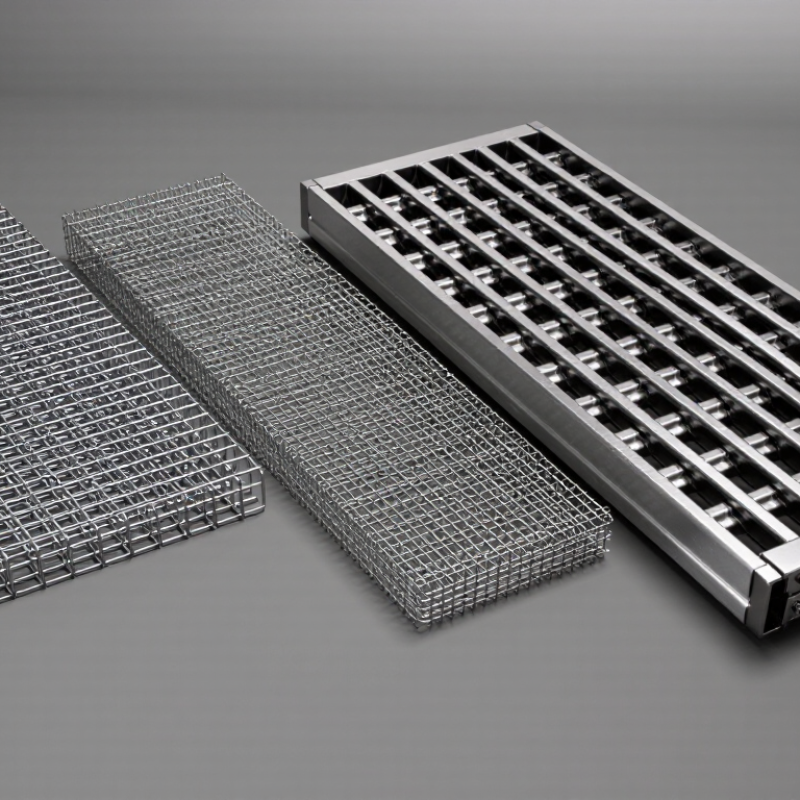
Stainless steel wire grates are open, load-bearing panels made from intersecting metal wires. Their gaps allow air, water, and light to pass while supporting parts, people, or stored goods. In practice, “grate” may mean a rigid welded panel or a lighter woven screen. The product name alone rarely tells the whole story. Details matter.
A useful classification starts with construction. Welded grates have crossing wires fused at joints. Woven versions pass wires over and under one another, and may flex more. An alloy designation, such as 304 or 316, indicates a grade with particular corrosion resistance.
Exposure still matters. Salt spray, cleaning chemicals, and standing moisture can affect service life. Openings and wire diameter affect drainage, visibility, and load capacity. Compare measured dimensions, not labels like fine or heavy-duty.
Surface finish is another practical category, from mill finish to smoother polished surfaces that are easier to wipe. There is no single naming system across every supplier. That can be confusing.
Record the alloy, joint style, opening size, wire diameter, panel dimensions, and expected load. Verify these against the intended installation.
I would not assume two grates are equivalent just because both are called stainless.
Welded stainless steel wire grates are made from intersecting wires joined at each crossing. This creates a rigid grid that can support loads while allowing air, water, and light to pass through. The openings and wire thickness affect strength, drainage, and visibility. Smaller openings may catch more debris, but can also slow water flow.
These grates appear in walkways, equipment platforms, drainage covers, and storage racks. Stainless steel helps resist rust, though performance depends on the grade, finish, and surrounding conditions. Salt, cleaning chemicals, and trapped moisture can still cause problems. A grate that looks sturdy may flex if its wire size or support spacing is poorly matched to the load. That detail is easy to overlook.
Tips: Check the stated load capacity, opening size, and stainless grade before choosing a grate. Inspect welded intersections and edges for damage, especially where people walk. Measure the support frame, too. Small gaps matter. A quick fit check can prevent rocking, rattling, or uneven support.
What Are the Top Types of Stainless Wire Grates?
Woven Stainless Steel Wire Grates: Structure and Uses
Woven stainless steel wire grates are made by crossing wires over and under one another, much like a compact metal fabric. The pattern creates regular openings for airflow, drainage, or screening. Wire diameter, weave style, and opening size determine stiffness and function. A fine weave catches small particles; a wider one allows faster flow. Simple, but not interchangeable.
Common uses include food drying racks, equipment guards, filtration supports, and removable inserts in industrial trays. The weave can flex more than a welded grid, so a rigid frame may be needed when loads are concentrated. World Stainless reports that global stainless steel production reached 58.4 million tonnes in 2023 (Stainless Steel in Figures 2024). This offers useful industry context, not a guarantee that every grate resists every chemical or operating condition. Check material grade and working environment.
Tips: Match the opening size to the material being retained, then confirm load limits with the supplier. Clean the intersections regularly; residue can collect there. One detail is easy to overlook: a grate that drains well may still sag under a heavy point load.
Crimped stainless steel wire grates use wires shaped with small bends where they cross. These bends help hold the wires in position and create a stable grid. The exact pattern depends on wire diameter, opening size, and intended load. They feel rigid. A grate with tighter spacing can support smaller items, while wider openings allow better drainage and airflow. For example, a workshop shelf may need closely spaced wires to keep small parts from slipping through. A washdown area may benefit from larger openings that let water pass freely.
Crimped grates are used in platforms, shelving, guards, and equipment screens. Stainless steel can resist rust in many environments, but performance depends on the alloy, surface finish, and exposure conditions. Salt, chemicals, and trapped moisture may still cause problems if the material is poorly matched to the setting. Check the load rating, support span, edge finish, and cleaning needs before choosing a grate. A detail that is easy to overlook is the cut edge; it may need finishing to reduce sharpness and simplify maintenance. Crimped construction is not automatically the best choice for every application. A longer unsupported span, for instance, may require a different wire size or added support.
| Type | Structure | Key Characteristics | Typical Uses | Selection Considerations |
|---|---|---|---|---|
| Crimped Woven Wire Grate | Wires are mechanically crimped before weaving. The bends help hold the wires in position at their crossing points. Common forms include plain, intermediate, and lock crimp. | Rigid, open construction with a regular pattern. Wire diameter and opening size can be selected to balance strength, screening, and material flow. | Screening and sorting, guards, baskets, ventilation panels, and general-purpose industrial grates. | Specify wire diameter, opening size, weave pattern, panel dimensions, and stainless steel grade according to load, exposure, and the material being screened. |
| Plain-Weave Wire Mesh | Each warp wire passes alternately over and under each weft wire in a simple, balanced pattern. | Uniform openings and a straightforward construction; commonly used for fine-to-medium screening where a regular mesh is needed. | Filters, sieves, screens, insect screens, and protective mesh panels. | For larger openings or heavier wire, compare rigidity and panel stability with crimped or welded constructions. |
| Twill-Weave Wire Mesh | Each wire passes over and under two or more wires in a repeating pattern, producing diagonal lines across the mesh. | Can accommodate relatively fine openings with heavier wires than a comparable plain weave, depending on the specification. | Fine filtration, screening, and applications requiring a denser woven surface. | Its openings and weave should be matched to the required filtration or screening performance; it is not automatically a load-bearing floor grate. |
| Dutch-Weave Wire Mesh | Uses different wire diameters and mesh counts in the warp and weft; some versions use closely packed wires to create small filtration passages. | Designed primarily for fine filtration rather than large, open grate surfaces. | Process filtration, separation, and filter elements for liquids or gases. | Choose by filtration requirements, flow conditions, and pressure limits; confirm the specific weave and opening specification with the fabricator. |
| Welded Wire Mesh Panel | Longitudinal and transverse wires are joined at their intersections by welding. | Fixed rectangular openings and a stable panel form; panel strength depends on wire size, spacing, weld quality, and support conditions. | Machine guards, partitions, cages, racks, and protective panels. | Check panel span, support arrangement, load requirements, and the suitability of the stainless grade for the operating environment. |
| Expanded Stainless Steel Grating | A sheet is slit and stretched to create a connected pattern of openings, rather than being woven from separate wires. | One-piece construction with open areas; the pattern and sheet thickness affect stiffness, weight, and slip resistance. | Walkway panels, platforms, screens, and protective covers where an open sheet construction is suitable. | Confirm load capacity, opening shape, edge treatment, support spacing, and surface requirements for the intended installation. |
Welded, woven, and crimped stainless wire grates balance rigidity, open area, and cleanability differently. Welded mesh holds its shape under repeated loading, while woven mesh can flex and suit finer screening. Crimped mesh offers firm wire positioning, but its crossings may collect residue. ASTM E2016-22 provides dimensional guidance for industrial woven wire cloth; actual load capacity still depends on wire diameter, alloy, and support spacing.
Open area can be estimated from mesh geometry. For square openings with a 12 mm pitch and 2 mm wire, the clear opening is 10 mm, giving about 69% open area: (10 ÷ 12)². This is a calculated example, not a load rating or a test result. More open area improves drainage and airflow, but smaller openings usually mean more wire and more places for food or dust to lodge. Smooth welded intersections are often easier to wipe than dense woven crossings. Still, surface finish and grate orientation can change cleaning time.
Tips: Match the opening to the material being screened, then check the supplier’s load data for your actual span. Rinse while warm. Don’t assume identical open-area figures mean identical strength; I’d want the support layout confirmed before specifying a grate.
We use cookies on our website to give you an improved browser experience. View our Privacy Policy for more information. Please make your selection to opt in or out of ALL cookies here: Accept or Decline
Do you consent to the use of ALL cookies?
901 2nd Court West
Birmingham, AL 35204
Sales: 866.481.4036
Logistics/Ops: 866.481.4036
2101 Dralle Road
University Park, IL 60466
Sales: 708.813.9070
Logistics/Ops: 708.235.4200
400 E. 13th Street
Little Rock, AR 72114
Sales: 866.760.5344
Logistics/Ops: 866.760.5344
225 Collins Road
Elkhart, IN 46515
Sales: 574.295.0214
Logistics/Ops: 574.607.4611
601 Berryman Pike
Tipton, IN 46072
Sales: 800.897.7591
Logistics/Ops: 800.897.7591
3900 Uvalda Street
Denver, CO 80239
Sales: 303.706.8000
Ops/Logistics: 303.576.8398
510 3rd Street E
Milan, IL 61264
Sales: 800.322.1052
Logistics/Ops: 800.322.1052
1660 E. Aurora
Des Moines, IA 50313
Sales: 800.671.1660
Logistics: 800.671.1660
86554 Gene Lasserre Blvd.
Yulee, FL 32097
Sales: 904.253.3060
Logistics/Ops: 904.225.3000
694 S.E. County Road 245
Lake City, FL 32025
Sales: 800.727.6706
Logistics/Ops: 386.752.7412
210 Neptune Road
Auburndale, FL 33823
Sales: 863.967.1131
Logistics/Ops: 863.777.9814
4601 McCoy Drive
Pensacola, FL 32503
Sales: 850.308.7030
Logistics/Ops: 850.434.5502
815 South 56th Street
Tampa, FL 33619
Sales: 813.302.1940
Logistics/Ops: 813.621.1352
200 Hosea Road
Lawrenceville, GA 30046
Sales: 770.953.7575
Logistics/Ops: 770.513.6000
Branch Product Guide
Branch Line Card
Moulding Offering
Cedar Offering
Column Offering
8173 Hwy. 165 North
Monroe, LA 71211
Sales: 800.256.4165
Logistics/Ops: 800.256.4165
508 Warren Avenue
Portland, ME 04103
Sales: 207.888.2331
Logistics/Ops: 207.797.6565
4300 Georgia Pacific Blvd.
Frederick, MD 21704
Sales: 301.798.7474
Logistics/Ops: 301.874.8000
419 Maple Street
Bellingham, MA 02019
Sales: 508.449.0535
Logistics/Ops: 508.966.5500
825 Buchanan Ave SW
Grand Rapids, MI 49507
Sales: 877.800.1180
Logistics/Ops: 616.278.0909
995 Pacific St. NW
Aitkin, MN 56431
Sales: 800.432.3727
Logistics/Ops: 218.212.7770
1102 Port Terminal Drive
Duluth, MN 55802
Sales: 800.951.9899
Logistics/Ops: 800.851.9899
9110 83rd Ave. North
Brooklyn Park, MN 55445
Sales: 763.425.0204
Logistics/Ops: 763.425.0204
910 E. Railroad Street
Long Beach, MS 39560
Sales: 866.535.4135
Logistics/Ops: 228.205.2400
1727 Warren Street
North Kansas City, MO 64116
Sales: 800.621.2611
Logistics/Ops: 800.621.2611
2123 North Golden
Springfield, MO 65803
Sales: 800.375.7891
Logistics/Ops: 800.375.7891
13860 Corp. Woods Trail
Bridgeton, MO 63044
Sales: 314.209.0800
Logistics/Ops: 314.209.0800
1109 South 19th Street
Omaha, NE 68108
Sales: 800.489.6637
Logistics/Ops: 800.489.6637
1 Luger Road
Denville, NJ 07834
Sales: 973-339-3539
Logistics/Ops: 973.625.1461
3720 Jeffrey Blvd.
Blasdell, NY 14219
Sales: 716.235.5989
Logistics/Ops: 716.825.6557
319 Yaphank Ave.
Yaphank, NY 11980
Sales: 631.358.5714
Logistics/Ops: 631.924.7401
3300 Parkside Drive
Charlotte, NC 28208
Sales: 800.839.2588
Logistics/Ops: 704.394.3172
1712 East D Street
Butner, NC 27509
Sales: 984.389.8200
Logistics/Ops: 919.575.3700
128 Foothills Drive
Statesville, NC 28687
Sales: 800.222.1414
Logistics/Ops: 704.394.3172
550 Munroe Falls Rd.
Tallmadge, OH 44278
Sales: 330.357.4506
Logistics/Ops: 330.794.1141
10347 Toebben Dr.
Independence, KY 41051
Sales: 859.298.3926
Logistics/Ops: 859.746.2250
450 N. MacArthur
Oklahoma City, OK 73127
Sales: 800.375.6025
Logistics/Ops: 800.375.6025
1680 North Aspen
Broken Arrow, OK 74012
Sales: 918.272.2212
Logistics/Ops: 918.272.2212
522 Bridge Street
Hunker, PA 15639
Sales: 878.217.2001
Logistics/Ops: 724.925.7285
4290 Atlanta Street
Charleston, SC 29418
Sales: 843.371.1420
Logistics/Ops: 843.554.8192
1040 S. Industrial Dr.
Erwin, TN 37650
Sales: 423.641.1005
Logistics/Ops: 423.742.5911
4287 Pilot Drive
Memphis, TN 38118
Sales: 901.365.2101
Logistics/Ops: 901.365.2101
700 Myatt Drive
Madison, TN 37115
Sales: 615.327.9547
Logistics/Ops: 629.777.4949
4747 Mark IV Parkway
Fort Worth, TX 76106
Sales: 866.323.5117
Logistics/Ops: 817.625.9091
6990 Market Avenue
El Paso, TX 79915
Sales: 915.778.6356
Logistics/Ops: 915.265.7200
2502 Wilson Road
Harlingen, TX 78552
Sales: 800.580.6711
Logistics/Ops: 800.580.6711
10,000 North Loop East
Houston, TX 77029
Sales: 713.921.1977
Logistics/Ops: 713.675.3544
702 East 44th St.
Lubbock, TX 79404
Sales: 866.454.6010
Logistics/Ops: 866.454.6010
535 N. WW White Road
San Antonio, TX 78219
Sales: 800.284.0488
Logistics/Ops: 210.333.8112
142 Pine Haven Shores Rd.
Shelburne, VT 05482
Sales: 802.800.2540
Logistics/Ops: 802.985.2512
4700 Bethlehem Road,
Richmond, VA 23230
Sales: 804.201.2400
Logistics/Ops: 804.342.1161
4516 N Barker Road
Spokane Valley, WA 99027
Phone: 509.892.9420
Toll free: 800.728.6157
8365 N. 76th Street
Milwaukee, WI 53223
Sales: 800.356.9245
Logistics/Ops: 800.356.9245
312 S. Chester Street
Sparta, WI 54656
Sales: 800.362.5864
Logistics/Ops: 800.362.5864
899 Grossman Drive
Schofield, WI 54476
Sales: 800.472.0017
Logistics/Ops: 800.472.0017
