
We use cookies on our website to give you an improved browser experience. View our Privacy Policy for more information. Please make your selection to opt in or out of ALL cookies here: Accept or Decline
A prefabricated metal carport is a factory-designed shelter assembled from prepared steel or aluminum components. It protects vehicles from sun, rain, snow, and falling branches. Unlike a fully built garage, it usually has open sides, a roof, and a shorter installation process. The parts arrive measured and cut, reducing much of the on-site construction work.
Prefabricated Metal Carports come in several forms, including freestanding, attached, single-vehicle, and larger commercial models. A typical structure includes galvanized steel posts, roof panels, braces, anchors, and connection hardware. The roof may be rounded, boxed, or sloped to help move water away. Standing beneath one during heavy rain makes its purpose clear: the vehicle stays drier, while airflow remains unrestricted.
Still, “prefabricated” does not mean effortless. Site preparation matters. Uneven ground, weak anchoring, poor drainage, or incorrect measurements can reduce stability and service life. That detail is easy to overlook. A reliable supplier should provide material specifications, wind and snow-load information, installation guidance, and clear warranty terms. Local building requirements may also affect setbacks, permits, and foundation choices.
From practical experience, the best carport is not always the largest or cheapest model. It should match the vehicle dimensions, climate, available space, and expected use. A professional installer can check alignment, fastener placement, and anchoring conditions. Even then, owners should inspect the roof, bolts, and drainage areas periodically. Prefabricated Metal Carports offer efficient protection, but thoughtful planning makes their performance more dependable.
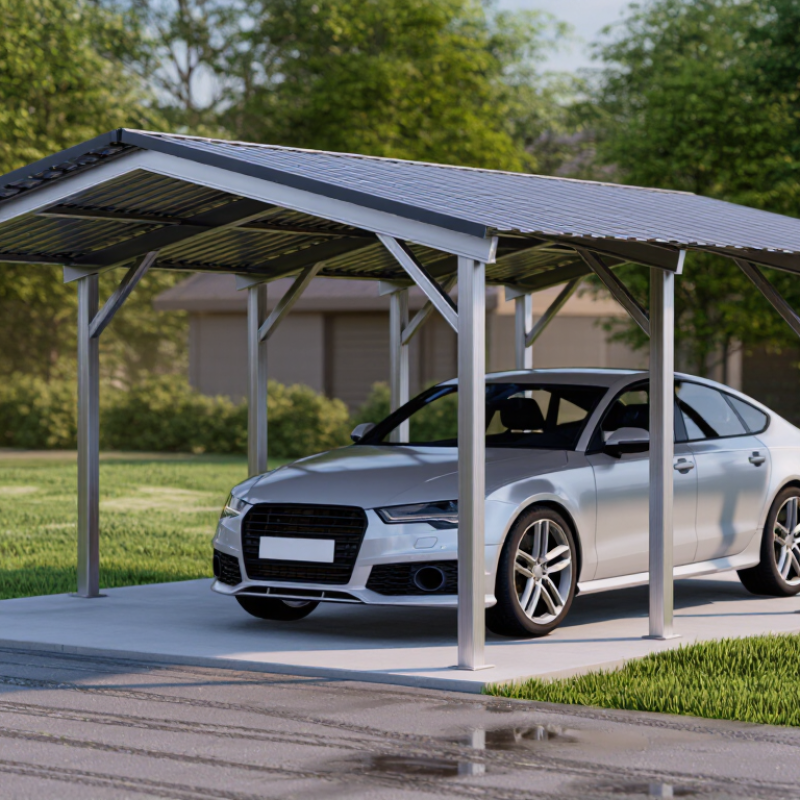
A prefabricated metal carport is a shelter made from factory-cut steel or aluminum components. These parts arrive ready for assembly on a prepared site. Unlike a garage, it usually has open sides and no lockable walls. Its main purpose is to protect vehicles from sun, rain, snow, and falling debris. Typical designs include a metal roof, support posts, base plates, braces, and anchor hardware. Galvanized steel is common because its protective coating helps resist rust. Still, coating quality and installation accuracy matter greatly.
Core features include modular sizing, bolted connections, and a sloped roof that directs water away. Some models use stronger frames for heavy snow or high wind conditions. The structure must match local ground conditions and expected weather loads. A small error in anchoring can create serious movement during storms. That detail is easy to underestimate. The surface should also drain properly, because standing water can weaken nearby soil and encourage corrosion. A carport is simple, but not careless.
Tips: Check the frame thickness, roof pitch, anchor method, and corrosion protection before buying. Measure the vehicle with doors open, not only its body length. Leave enough clearance for turning and maintenance. Installation instructions deserve careful attention; rushing bolt alignment often causes avoidable problems. Local approval requirements may also apply, so verify them before delivery.
A prefabricated metal carport begins with accurate site information. Designers measure available space, ground slope, vehicle height, and local weather exposure. Snow, wind, and rain loads influence the roof shape, frame size, and anchor layout. A practical design also leaves enough clearance for doors, mirrors, and drainage.
Computer-aided drawings guide production, but field experience remains important. Engineers select galvanized steel or coated metal for strength and corrosion resistance. They calculate beam spacing, connection points, and water runoff before fabrication. A small measurement error can create installation problems later. That risk deserves attention.
The factory cuts, punches, bends, and drills each component to specified dimensions. Some joints are welded, while others use bolted connections for easier transport and assembly. Workers inspect hole positions, surface coatings, weld quality, and overall dimensions. Protective packaging helps prevent scratches during delivery. It is not perfect, though. Coatings can suffer damage, and uneven ground may require careful adjustment on site. Installers should verify the foundation, anchor depth, frame alignment, and roof slope before tightening every connection. A level check matters. Regular inspections can reveal loose fasteners, rust spots, or blocked drainage before minor issues become expensive repairs.
What Is a Prefabricated Metal Carport?
A prefabricated metal carport is a factory-made shelter assembled on site. Its main frame usually uses galvanized steel for strength and corrosion resistance. Aluminum is lighter, but it may suit smaller shelters better. Roof panels often use coated steel or aluminum sheets. These materials handle sun, rain, and moderate weather with limited maintenance. Still, no material is maintenance-free. Inspect fasteners, joints, and coating damage each year.
Common structural types include regular-roof, A-frame, and vertical-roof designs. A regular roof is economical and simple. An A-frame roof resembles a small house roof and sheds water effectively. Vertical panels guide rain and debris downward, which can help in wet regions. Freestanding models work beside a home, while attached models use an existing wall. The supporting surface must be checked carefully. Weak anchoring can undermine an otherwise strong frame.
Tips: Measure the vehicle, doors, mirrors, and walking space before ordering. A single-car unit may fit a compact sedan, but larger vehicles need extra width. Double-car shelters commonly allow two vehicles, while RV sizes require greater height and length. Add clearance for opening doors and future vehicle changes. Check local wind, snow, drainage, and installation requirements with a qualified professional. One overlooked measurement can become an expensive correction.
| Category | Common Option | Typical Specifications | Main Benefits | Important Considerations | Typical Application |
|---|---|---|---|---|---|
| Definition | Prefabricated metal carport | A factory-engineered shelter made from pre-cut or pre-formed metal components that are transported and assembled on site. | Faster installation, repeatable component quality, and reduced on-site fabrication. | The foundation, anchoring method, local building codes, and site conditions still affect the final design. | Vehicle parking, equipment storage, and weather protection. |
| Common Materials | Galvanized steel frame | Steel tubing, square sections, or formed structural members protected with a zinc coating. | High strength, good durability, and resistance to ordinary outdoor corrosion. | Cut edges, scratches, and drilled areas may require appropriate corrosion protection. | General-purpose residential and commercial carports. |
| Powder-coated steel | Steel components finished with a bonded dry-powder coating that is cured using heat. | Consistent appearance, added surface protection, and a broad range of colors. | Coating damage should be repaired to limit exposure of the underlying steel. | Projects where appearance and finish consistency are important. | |
| Aluminum | Extruded or formed aluminum posts, beams, and roof components. | Lightweight, naturally corrosion-resistant, and relatively easy to handle during assembly. | Generally has lower structural strength than steel of the same size and may require larger sections for equivalent spans. | Coastal areas and installations where low weight is valuable. | |
| Metal roof panels | Corrugated or ribbed steel panels, commonly supplied with protective metallic or painted finishes. | Lightweight roof covering with effective rain shedding when correctly overlapped and fastened. | Panel thickness, roof pitch, fastener spacing, insulation, and local snow or wind loads must be evaluated. | Open-sided shelters and enclosed metal storage structures. | |
| Structural Types | Regular roof | A peaked roof with two sloping planes and a central ridge, often using gable-end framing. | Traditional appearance and effective drainage on both sides. | The ridge height and end framing must account for snow, wind, and clearance requirements. | Homes, farms, and storage areas requiring a familiar roof profile. |
| A-frame roof | A steeply sloped, symmetrical roof formed by rafters or trusses meeting at a ridge. | Good rain and snow shedding, with increased clearance near the centerline. | The steeper profile can increase overall height and may be restricted by local setback or height rules. | Areas with frequent precipitation or users seeking a residential-style appearance. | |
| Single-slope roof | One continuous sloping roof plane supported by posts, beams, or a wall connection. | Simple geometry, straightforward drainage, and suitability for attachment beside a building. | Drainage must be directed away from structures, and the high and low edges provide different clearances. | Side-yard parking, lean-to shelters, and locations with limited width. | |
| Vertical-roof design | Roof panels run from the ridge toward the eaves, with raised ribs that commonly improve water drainage. | Efficient water and snow runoff, particularly when the roof has adequate pitch and properly sealed overlaps. | Ridge caps, closures, fasteners, and panel alignment are important for weather resistance. | Regions with heavier rain or snow and larger storage-oriented structures. | |
| Size Options | Single vehicle | Common widths are approximately 12–14 ft; typical lengths are about 20–24 ft. | Efficient coverage for one passenger vehicle with a relatively small site footprint. | Allow extra clearance for doors, mirrors, walking paths, and vehicle overhang. | Cars, compact sport utility vehicles, and small pickups. |
| Two vehicles | Common widths are approximately 20–24 ft; typical lengths are about 20–24 ft. | Provides side-by-side parking for two standard vehicles. | Column placement and turning space should be checked before selecting the final width. | Households with two vehicles or mixed vehicle storage. | |
| Extended vehicle | Typical lengths range from approximately 26–36 ft, depending on the vehicle and storage needs. | Accommodates long-bed pickups, recreational vehicles, trailers, or a vehicle plus equipment. | Greater length may require additional bracing, posts, or more substantial foundations. | RVs, boats, trailers, work vehicles, and equipment storage. | |
| Height options | Common eave heights are approximately 6–9 ft, while taller configurations may be selected for recreational or commercial vehicles. | Allows the structure to match vehicle height and provides usable overhead clearance. | Higher structures experience greater wind exposure and may need stronger framing and anchoring. | Passenger vehicles, vans, trucks, RVs, and agricultural equipment. | |
| Custom or modular expansion | Multiple bays or modular sections joined to create wider or longer coverage. | Flexible layout for changing storage requirements and multi-vehicle use. | Every added bay affects structural loads, drainage, foundation layout, and permitting requirements. | Commercial parking, farms, workshops, and large equipment shelters. |
Note: Dimensions and structural requirements vary by local building codes, wind and snow loads, foundation conditions, vehicle dimensions, and the selected engineering design.
A prefabricated metal carport is a factory-cut structure assembled on your property. Its frame, roof panels, and fittings arrive ready for installation. The process is faster than building a shelter from raw materials, but preparation still matters. Measure the vehicle, access route, and planned roof clearance before ordering. A delivery truck needs firm, unobstructed access. Check local permit rules, setback distances, drainage requirements, and property boundaries. Requirements vary by location.
Begin with a level, stable surface such as reinforced concrete or properly compacted ground. Remove loose soil, roots, and standing water. Confirm the slab dimensions against the installation drawings. Even a small measurement error can shift the posts. Mark every anchor point carefully, then assemble the frame according to the manufacturer’s instructions. Install roof panels with overlapping seams facing away from prevailing rain. Tighten fasteners evenly. Over-tightening may damage the panels. Anchors must suit the foundation material and expected wind conditions. A qualified installer or structural professional should review uncertain conditions.
Tips:
Keep a tape measure, level, socket set, and anchor documentation nearby. Inspect the site after rainfall; hidden drainage problems become obvious then. Leave enough clearance for doors, mirrors, and future vehicle changes. Do not place the structure beneath weak branches or near underground services. One detail is easy to miss: confirm the finished height after assembly, not only before it. My own planning would include more time for ground preparation, because rushing this stage often creates alignment problems later.
A prefabricated metal carport is a factory-produced shelter assembled from pre-cut steel or aluminum components. The following chart shows typical two-person crew-hours for a standard residential installation on a prepared, level site.
Site requirements: The site should be level, compact, free of underground utilities, accessible for material delivery, and large enough to maintain the clearances required by local building codes. A suitable foundation may include a concrete slab, footings, or approved ground anchors, depending on soil conditions, wind exposure, and permit requirements.
A prefabricated metal carport is a factory-made shelter assembled from steel or aluminum components. It usually includes a roof, support posts, anchors, and connection hardware. The sections arrive ready for installation, which often reduces construction time and site waste. Compared with a permanent garage, it costs less and allows better airflow around vehicles. It can protect paint, dashboards, and tires from sunlight, rain, tree sap, and light snowfall. A properly anchored structure also offers useful stability during ordinary seasonal weather.
However, a carport is not a fully enclosed garage. Wind-driven rain, dust, and cold air can still reach the vehicle. Its performance depends heavily on soil conditions, roof pitch, drainage, and installation quality. Poor anchoring is a serious weakness. Local planning requirements may also affect placement, height, and foundation choices. Measure the available area carefully. I have seen owners underestimate door clearance, then struggle to open a vehicle comfortably. That mistake is easy to prevent, but surprisingly common.
Maintenance is simple, not absent. Inspect bolts, brackets, anchors, and roof edges twice a year. Tighten loose connections without forcing damaged threads. Remove leaves before they hold moisture against the roof or frame. Check for rust around scratches, cut edges, and ground-level posts. Clean affected areas, dry them thoroughly, and apply a suitable protective coating. Keep water away from the base when possible. After severe wind, inspect the frame before parking underneath. A small distortion may signal stress elsewhere. Metal lasts well, but neglect still wins.
We use cookies on our website to give you an improved browser experience. View our Privacy Policy for more information. Please make your selection to opt in or out of ALL cookies here: Accept or Decline
Do you consent to the use of ALL cookies?
901 2nd Court West
Birmingham, AL 35204
Sales: 866.481.4036
Logistics/Ops: 866.481.4036
2101 Dralle Road
University Park, IL 60466
Sales: 708.813.9070
Logistics/Ops: 708.235.4200
400 E. 13th Street
Little Rock, AR 72114
Sales: 866.760.5344
Logistics/Ops: 866.760.5344
225 Collins Road
Elkhart, IN 46515
Sales: 574.295.0214
Logistics/Ops: 574.607.4611
601 Berryman Pike
Tipton, IN 46072
Sales: 800.897.7591
Logistics/Ops: 800.897.7591
3900 Uvalda Street
Denver, CO 80239
Sales: 303.706.8000
Ops/Logistics: 303.576.8398
510 3rd Street E
Milan, IL 61264
Sales: 800.322.1052
Logistics/Ops: 800.322.1052
1660 E. Aurora
Des Moines, IA 50313
Sales: 800.671.1660
Logistics: 800.671.1660
86554 Gene Lasserre Blvd.
Yulee, FL 32097
Sales: 904.253.3060
Logistics/Ops: 904.225.3000
694 S.E. County Road 245
Lake City, FL 32025
Sales: 800.727.6706
Logistics/Ops: 386.752.7412
210 Neptune Road
Auburndale, FL 33823
Sales: 863.967.1131
Logistics/Ops: 863.777.9814
4601 McCoy Drive
Pensacola, FL 32503
Sales: 850.308.7030
Logistics/Ops: 850.434.5502
815 South 56th Street
Tampa, FL 33619
Sales: 813.302.1940
Logistics/Ops: 813.621.1352
200 Hosea Road
Lawrenceville, GA 30046
Sales: 770.953.7575
Logistics/Ops: 770.513.6000
Branch Product Guide
Branch Line Card
Moulding Offering
Cedar Offering
Column Offering
8173 Hwy. 165 North
Monroe, LA 71211
Sales: 800.256.4165
Logistics/Ops: 800.256.4165
508 Warren Avenue
Portland, ME 04103
Sales: 207.888.2331
Logistics/Ops: 207.797.6565
4300 Georgia Pacific Blvd.
Frederick, MD 21704
Sales: 301.798.7474
Logistics/Ops: 301.874.8000
419 Maple Street
Bellingham, MA 02019
Sales: 508.449.0535
Logistics/Ops: 508.966.5500
825 Buchanan Ave SW
Grand Rapids, MI 49507
Sales: 877.800.1180
Logistics/Ops: 616.278.0909
995 Pacific St. NW
Aitkin, MN 56431
Sales: 800.432.3727
Logistics/Ops: 218.212.7770
1102 Port Terminal Drive
Duluth, MN 55802
Sales: 800.951.9899
Logistics/Ops: 800.851.9899
9110 83rd Ave. North
Brooklyn Park, MN 55445
Sales: 763.425.0204
Logistics/Ops: 763.425.0204
910 E. Railroad Street
Long Beach, MS 39560
Sales: 866.535.4135
Logistics/Ops: 228.205.2400
1727 Warren Street
North Kansas City, MO 64116
Sales: 800.621.2611
Logistics/Ops: 800.621.2611
2123 North Golden
Springfield, MO 65803
Sales: 800.375.7891
Logistics/Ops: 800.375.7891
13860 Corp. Woods Trail
Bridgeton, MO 63044
Sales: 314.209.0800
Logistics/Ops: 314.209.0800
1109 South 19th Street
Omaha, NE 68108
Sales: 800.489.6637
Logistics/Ops: 800.489.6637
1 Luger Road
Denville, NJ 07834
Sales: 973-339-3539
Logistics/Ops: 973.625.1461
3720 Jeffrey Blvd.
Blasdell, NY 14219
Sales: 716.235.5989
Logistics/Ops: 716.825.6557
319 Yaphank Ave.
Yaphank, NY 11980
Sales: 631.358.5714
Logistics/Ops: 631.924.7401
3300 Parkside Drive
Charlotte, NC 28208
Sales: 800.839.2588
Logistics/Ops: 704.394.3172
1712 East D Street
Butner, NC 27509
Sales: 984.389.8200
Logistics/Ops: 919.575.3700
128 Foothills Drive
Statesville, NC 28687
Sales: 800.222.1414
Logistics/Ops: 704.394.3172
550 Munroe Falls Rd.
Tallmadge, OH 44278
Sales: 330.357.4506
Logistics/Ops: 330.794.1141
10347 Toebben Dr.
Independence, KY 41051
Sales: 859.298.3926
Logistics/Ops: 859.746.2250
450 N. MacArthur
Oklahoma City, OK 73127
Sales: 800.375.6025
Logistics/Ops: 800.375.6025
1680 North Aspen
Broken Arrow, OK 74012
Sales: 918.272.2212
Logistics/Ops: 918.272.2212
522 Bridge Street
Hunker, PA 15639
Sales: 878.217.2001
Logistics/Ops: 724.925.7285
4290 Atlanta Street
Charleston, SC 29418
Sales: 843.371.1420
Logistics/Ops: 843.554.8192
1040 S. Industrial Dr.
Erwin, TN 37650
Sales: 423.641.1005
Logistics/Ops: 423.742.5911
4287 Pilot Drive
Memphis, TN 38118
Sales: 901.365.2101
Logistics/Ops: 901.365.2101
700 Myatt Drive
Madison, TN 37115
Sales: 615.327.9547
Logistics/Ops: 629.777.4949
4747 Mark IV Parkway
Fort Worth, TX 76106
Sales: 866.323.5117
Logistics/Ops: 817.625.9091
6990 Market Avenue
El Paso, TX 79915
Sales: 915.778.6356
Logistics/Ops: 915.265.7200
2502 Wilson Road
Harlingen, TX 78552
Sales: 800.580.6711
Logistics/Ops: 800.580.6711
10,000 North Loop East
Houston, TX 77029
Sales: 713.921.1977
Logistics/Ops: 713.675.3544
702 East 44th St.
Lubbock, TX 79404
Sales: 866.454.6010
Logistics/Ops: 866.454.6010
535 N. WW White Road
San Antonio, TX 78219
Sales: 800.284.0488
Logistics/Ops: 210.333.8112
142 Pine Haven Shores Rd.
Shelburne, VT 05482
Sales: 802.800.2540
Logistics/Ops: 802.985.2512
4700 Bethlehem Road,
Richmond, VA 23230
Sales: 804.201.2400
Logistics/Ops: 804.342.1161
4516 N Barker Road
Spokane Valley, WA 99027
Phone: 509.892.9420
Toll free: 800.728.6157
8365 N. 76th Street
Milwaukee, WI 53223
Sales: 800.356.9245
Logistics/Ops: 800.356.9245
312 S. Chester Street
Sparta, WI 54656
Sales: 800.362.5864
Logistics/Ops: 800.362.5864
899 Grossman Drive
Schofield, WI 54476
Sales: 800.472.0017
Logistics/Ops: 800.472.0017
