
We use cookies on our website to give you an improved browser experience. View our Privacy Policy for more information. Please make your selection to opt in or out of ALL cookies here: Accept or Decline
A Shipping Tarp is more than a sheet pulled over a load. It is a practical barrier between cargo and the changing conditions of a journey. On a flatbed, it can help shield lumber from rain, keep dust off equipment, or reduce direct sun exposure on boxed goods. The exact protection depends on the tarp’s material, condition, and fit. No cover can make every load safe in every kind of weather.
Picture a tarp stretched over a pallet of building supplies. Its edges are secured, the fabric lies close to the load, and there are no loose corners snapping in the wind. Those details matter. A poorly fitted tarp may flap, shift, or collect water, while worn seams and damaged grommets can weaken its performance. Before a trip, check the tarp and tie-down points, and follow the product maker’s instructions. Small checks help.
Shipping tarps come in different weights, sizes, and materials, so the right choice depends on the cargo and route. A breathable cover may suit some items, while other loads need stronger resistance to moisture or abrasion. It is tempting to think one heavy tarp solves everything. It does not. Understanding what a shipping tarp is used for—and what it cannot do—helps people protect cargo more thoughtfully, reduce avoidable damage, and choose a cover that fits the job.
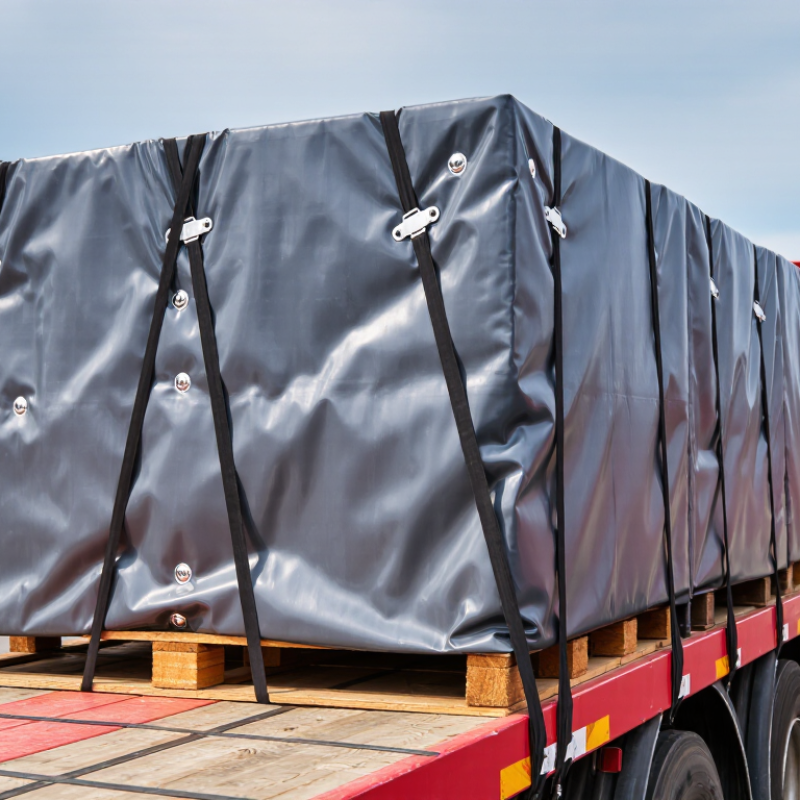
Shipping tarps commonly cover lumber, plywood, pipes, and other building materials moving by truck. They help shield loads from rain, road spray, dust, and sunlight. Steel beams and bundled metal stock may also be tarped to reduce exposure during transit. For machinery, a tarp can protect exposed surfaces from grime and light moisture. It should not press against delicate parts or trap condensation. Palletized goods and bagged materials may need coverage too, especially when packaging could tear or absorb water. Hay bales and some agricultural loads are covered in suitable conditions, though airflow matters. One detail is easy to miss: a tarp does not secure cargo. Proper blocking and tie-downs still matter.
Tips: Choose a tarp large enough to cover the load without dragging on the road. Check its condition before use; small tears can spread under wind pressure. Keep sharp corners from rubbing through the fabric with padding. Tighten straps evenly, then recheck them after the load settles. For damp cargo, consider whether trapped moisture could cause damage. Tarps help, but they are not a perfect seal.
A shipping tarp shields cargo from rain, road spray, dust, and wind during transit. It also helps reduce scuffs from loose straps or light contact with nearby freight. The right coverage depends on the load: a flatbed carrying lumber needs a different fit from a palletized machine part. The tarp should cover exposed surfaces without dragging near the road or blocking required visibility.
A close fit matters. Creases can collect water, while loose edges may flap and wear against the load. Small gaps matter. Secure the tarp with suitable tie-downs, distributing tension across the load rather than pulling hard at one point. Check corners and edges, especially where sharp or rough surfaces could cause tears. Padding vulnerable contact points can help, but a tarp is not a substitute for proper cargo securement.
Before departure, inspect the cover for holes, worn seams, and loose fasteners. Recheck it after a long stop or in strong winds, when shifting cargo can change the tension. Even experienced crews can miss a small opening beneath a folded edge. A tarp reduces exposure; it cannot guarantee dry cargo in every storm or compensate for poor loading. That distinction is easy to overlook.
| Tarp Type | Typical Loads | How It Protects the Load | Common Material Features | Important Use Considerations |
|---|---|---|---|---|
| Lumber tarp | Lumber and other long, stacked building materials on flatbed trailers | Covers the top and sides of the stack to help shield it from rain, road spray, and dirt during transit. | Often made from coated, water-resistant fabric; some designs include drops or flaps to cover exposed ends. | Choose a size that covers the load without dragging. Secure all tie-down points and avoid trapping moisture against cargo that needs ventilation. |
| Steel tarp | Steel coils, plate, pipe, and other compact metal loads | Provides a cover against precipitation, road grime, and some surface contamination. | Typically shorter than a lumber tarp, with reinforced edges and attachment points for tie-downs. | Use edge protection where straps or tarp fabric contact sharp metal. A tarp does not replace proper cargo securement or moisture-control measures required for the shipment. |
| Machinery tarp | Equipment, machinery, and irregularly shaped freight | Helps keep rain, dust, and road spray away from exposed surfaces, controls, and components. | May use heavier fabric and reinforced corners to accommodate bulky shapes and repeated handling. | Allow clearance around delicate parts, exhausts, and moving components. Secure the cover so it cannot flap, abrade surfaces, or obstruct required lights and markings. |
| General-purpose flatbed tarp | Palletized goods, packaged materials, and mixed freight suitable for open-deck transport | Creates a protective barrier against weather and airborne debris when properly fitted and secured. | Available in different fabric weights, sizes, and edge configurations; water resistance varies by construction and condition. | Check the tarp for holes, worn seams, and damaged grommets before use. Match the cover to the cargo, route, and expected weather. |
| Mesh tarp | Loads that need airflow or debris containment, such as certain bulk materials | Allows air to pass through while helping contain material and reduce exposure to larger debris. | Open-weave fabric; it is generally not a waterproof cover. | Do not use it when the cargo needs protection from rain or fine dust. Confirm that the material and coverage meet applicable load and transport requirements. |
A shipping tarp is a protective cover, not a substitute for rated tie-downs, edge protection, or other required cargo-securement equipment. Inspect the tarp and its attachment points before each trip.
What Is a Shipping Tarp Used For?
Transport Settings Where Shipping Tarps Are Used
Shipping tarps protect freight from rain, road spray, dust, and sun during transport. On flatbed trucks, they commonly cover lumber, machinery, bundled pipes, or palletized goods. A well-fitted tarp helps shield exposed loads as vehicles cross open highways, where wind can lift loose edges. It does not secure cargo by itself. Straps and other approved restraints must hold the load in place.
Tarps also serve freight moving through rail yards, ports, and temporary transfer areas. A covered load can face blowing dust, brief showers, or grime while waiting between vehicles. In construction transport, tarps help keep loose materials contained and reduce exposure to weather. Conditions vary, though. A tarp that works for a short local trip may not suit a long journey in strong wind or heavy rain. Check its material, size, and condition before use.
Tips: Pull the tarp evenly over the load, then secure every edge. Check for worn seams or small tears. Leave no loose flaps. After a wet trip, let the tarp dry before storing it; I would not assume a quick shake removes trapped moisture.
Common transport settings where tarps protect exposed loads
Bars count three common protection functions: shielding loads from precipitation, airborne dust or debris, and direct sun. A tarp can serve these roles on flatbed trucks, open rail wagons, open-top containers, deck cargo, and heavy-equipment hauls. Counts are an illustrative comparison of typical uses, not measured usage statistics; the specific protection needed depends on the load and route.
A shipping tarp protects cargo from rain, road spray, dust, and sun during storage or transit. Material choice depends on the load and handling conditions. Woven polyethylene is light and easy to manage, making it useful for general weather protection. Heavier vinyl-coated polyester resists abrasion and repeated handling, but it takes more effort to lift and secure. Canvas allows more airflow, though untreated canvas may absorb water. No material suits every load.
Look beyond the fabric. Reinforced hems, sturdy grommets, and reinforced corners help a tarp hold tension without tearing as easily. UV resistance can matter for cargo left outdoors, while a suitable size helps prevent flapping edges. Check the seams and tarp condition before use; small holes can let water reach cartons or metal parts. Add padding over sharp corners. A tightly covered load can still trap moisture, so ventilation may be important for some cargo.
Tips: Match the tarp to the cargo’s weight, shape, and exposure time. Secure it evenly, but avoid overtightening around fragile edges. Check it after the first stretch of travel, since straps can loosen and the cover may shift. Fit matters. A costly, heavy tarp is not automatically the better choice.
A shipping tarp shields cargo from rain, road spray, dust, and sun during transport. Its protection depends on the tarp, the load, and how securely everything is arranged. A loose corner can flap hard in the wind, while a sharp crate edge may wear through fabric. Smooth exposed edges with suitable padding before covering the load.
Check the tarp for tears, weakened seams, and worn attachment points before each trip. Center it so the cargo is covered, then secure it to approved tie-down points with suitable straps. Keep straps snug, but avoid pulling them across fragile goods. Small details matter. After a short distance, stop somewhere safe and check for shifting, slack, or rubbing.
A tarp is not a substitute for proper cargo restraints, and it cannot guarantee a completely dry load. Seams and pooled water may let moisture through; tightly covered goods can also trap condensation. Strong crosswinds can strain both tarp and fastenings, especially when the cover billows. Keep required lights, reflectors, and driver visibility unobstructed, and follow the vehicle’s operating guidance. Even careful tarping has limits, so weather-sensitive cargo may need a more suitable enclosed transport option.
We use cookies on our website to give you an improved browser experience. View our Privacy Policy for more information. Please make your selection to opt in or out of ALL cookies here: Accept or Decline
Do you consent to the use of ALL cookies?
901 2nd Court West
Birmingham, AL 35204
Sales: 866.481.4036
Logistics/Ops: 866.481.4036
2101 Dralle Road
University Park, IL 60466
Sales: 708.813.9070
Logistics/Ops: 708.235.4200
400 E. 13th Street
Little Rock, AR 72114
Sales: 866.760.5344
Logistics/Ops: 866.760.5344
225 Collins Road
Elkhart, IN 46515
Sales: 574.295.0214
Logistics/Ops: 574.607.4611
601 Berryman Pike
Tipton, IN 46072
Sales: 800.897.7591
Logistics/Ops: 800.897.7591
3900 Uvalda Street
Denver, CO 80239
Sales: 303.706.8000
Ops/Logistics: 303.576.8398
510 3rd Street E
Milan, IL 61264
Sales: 800.322.1052
Logistics/Ops: 800.322.1052
1660 E. Aurora
Des Moines, IA 50313
Sales: 800.671.1660
Logistics: 800.671.1660
86554 Gene Lasserre Blvd.
Yulee, FL 32097
Sales: 904.253.3060
Logistics/Ops: 904.225.3000
694 S.E. County Road 245
Lake City, FL 32025
Sales: 800.727.6706
Logistics/Ops: 386.752.7412
210 Neptune Road
Auburndale, FL 33823
Sales: 863.967.1131
Logistics/Ops: 863.777.9814
4601 McCoy Drive
Pensacola, FL 32503
Sales: 850.308.7030
Logistics/Ops: 850.434.5502
815 South 56th Street
Tampa, FL 33619
Sales: 813.302.1940
Logistics/Ops: 813.621.1352
200 Hosea Road
Lawrenceville, GA 30046
Sales: 770.953.7575
Logistics/Ops: 770.513.6000
Branch Product Guide
Branch Line Card
Moulding Offering
Cedar Offering
Column Offering
8173 Hwy. 165 North
Monroe, LA 71211
Sales: 800.256.4165
Logistics/Ops: 800.256.4165
508 Warren Avenue
Portland, ME 04103
Sales: 207.888.2331
Logistics/Ops: 207.797.6565
4300 Georgia Pacific Blvd.
Frederick, MD 21704
Sales: 301.798.7474
Logistics/Ops: 301.874.8000
419 Maple Street
Bellingham, MA 02019
Sales: 508.449.0535
Logistics/Ops: 508.966.5500
825 Buchanan Ave SW
Grand Rapids, MI 49507
Sales: 877.800.1180
Logistics/Ops: 616.278.0909
995 Pacific St. NW
Aitkin, MN 56431
Sales: 800.432.3727
Logistics/Ops: 218.212.7770
1102 Port Terminal Drive
Duluth, MN 55802
Sales: 800.951.9899
Logistics/Ops: 800.851.9899
9110 83rd Ave. North
Brooklyn Park, MN 55445
Sales: 763.425.0204
Logistics/Ops: 763.425.0204
910 E. Railroad Street
Long Beach, MS 39560
Sales: 866.535.4135
Logistics/Ops: 228.205.2400
1727 Warren Street
North Kansas City, MO 64116
Sales: 800.621.2611
Logistics/Ops: 800.621.2611
2123 North Golden
Springfield, MO 65803
Sales: 800.375.7891
Logistics/Ops: 800.375.7891
13860 Corp. Woods Trail
Bridgeton, MO 63044
Sales: 314.209.0800
Logistics/Ops: 314.209.0800
1109 South 19th Street
Omaha, NE 68108
Sales: 800.489.6637
Logistics/Ops: 800.489.6637
1 Luger Road
Denville, NJ 07834
Sales: 973-339-3539
Logistics/Ops: 973.625.1461
3720 Jeffrey Blvd.
Blasdell, NY 14219
Sales: 716.235.5989
Logistics/Ops: 716.825.6557
319 Yaphank Ave.
Yaphank, NY 11980
Sales: 631.358.5714
Logistics/Ops: 631.924.7401
3300 Parkside Drive
Charlotte, NC 28208
Sales: 800.839.2588
Logistics/Ops: 704.394.3172
1712 East D Street
Butner, NC 27509
Sales: 984.389.8200
Logistics/Ops: 919.575.3700
128 Foothills Drive
Statesville, NC 28687
Sales: 800.222.1414
Logistics/Ops: 704.394.3172
550 Munroe Falls Rd.
Tallmadge, OH 44278
Sales: 330.357.4506
Logistics/Ops: 330.794.1141
10347 Toebben Dr.
Independence, KY 41051
Sales: 859.298.3926
Logistics/Ops: 859.746.2250
450 N. MacArthur
Oklahoma City, OK 73127
Sales: 800.375.6025
Logistics/Ops: 800.375.6025
1680 North Aspen
Broken Arrow, OK 74012
Sales: 918.272.2212
Logistics/Ops: 918.272.2212
522 Bridge Street
Hunker, PA 15639
Sales: 878.217.2001
Logistics/Ops: 724.925.7285
4290 Atlanta Street
Charleston, SC 29418
Sales: 843.371.1420
Logistics/Ops: 843.554.8192
1040 S. Industrial Dr.
Erwin, TN 37650
Sales: 423.641.1005
Logistics/Ops: 423.742.5911
4287 Pilot Drive
Memphis, TN 38118
Sales: 901.365.2101
Logistics/Ops: 901.365.2101
700 Myatt Drive
Madison, TN 37115
Sales: 615.327.9547
Logistics/Ops: 629.777.4949
4747 Mark IV Parkway
Fort Worth, TX 76106
Sales: 866.323.5117
Logistics/Ops: 817.625.9091
6990 Market Avenue
El Paso, TX 79915
Sales: 915.778.6356
Logistics/Ops: 915.265.7200
2502 Wilson Road
Harlingen, TX 78552
Sales: 800.580.6711
Logistics/Ops: 800.580.6711
10,000 North Loop East
Houston, TX 77029
Sales: 713.921.1977
Logistics/Ops: 713.675.3544
702 East 44th St.
Lubbock, TX 79404
Sales: 866.454.6010
Logistics/Ops: 866.454.6010
535 N. WW White Road
San Antonio, TX 78219
Sales: 800.284.0488
Logistics/Ops: 210.333.8112
142 Pine Haven Shores Rd.
Shelburne, VT 05482
Sales: 802.800.2540
Logistics/Ops: 802.985.2512
4700 Bethlehem Road,
Richmond, VA 23230
Sales: 804.201.2400
Logistics/Ops: 804.342.1161
4516 N Barker Road
Spokane Valley, WA 99027
Phone: 509.892.9420
Toll free: 800.728.6157
8365 N. 76th Street
Milwaukee, WI 53223
Sales: 800.356.9245
Logistics/Ops: 800.356.9245
312 S. Chester Street
Sparta, WI 54656
Sales: 800.362.5864
Logistics/Ops: 800.362.5864
899 Grossman Drive
Schofield, WI 54476
Sales: 800.472.0017
Logistics/Ops: 800.472.0017
