
We use cookies on our website to give you an improved browser experience. View our Privacy Policy for more information. Please make your selection to opt in or out of ALL cookies here: Accept or Decline
Welded Pipe is manufactured by forming flat steel strip into a round shape and joining its edges through heat, pressure, or both. The process may use electric resistance welding, high-frequency welding, or submerged arc welding. Each method creates a different seam profile, production speed, and inspection requirement. The result can serve water systems, structural projects, energy facilities, and industrial machinery.
“ A weld is a metallurgical region, not merely a line joining two metals,” notes Dr. John C. Lippold, a respected welding engineer and author of Welding Metallurgy and Weldability. That warning explains why Welded Pipe requires more than a clean-looking surface. Operators must control strip alignment, welding current, travel speed, temperature, and cooling behavior. A small edge mismatch can leave an internal defect. It may appear harmless under bright factory lighting. It may not remain harmless under pressure.
Reliable production also depends on ultrasonic testing, radiographic inspection, dimensional checks, and careful review of the pipe grade. Standards help, but they do not replace judgment. This is where the subject becomes less tidy. A pipe that passes one inspection may still perform poorly in corrosive soil or repeated thermal cycling. Wall thickness, seam orientation, coating quality, and installation conditions all matter. In my view, the best definition is practical: Welded Pipe is not simply steel with a seam. It is a controlled manufacturing decision, with strengths, limitations, and details that deserve closer examination.
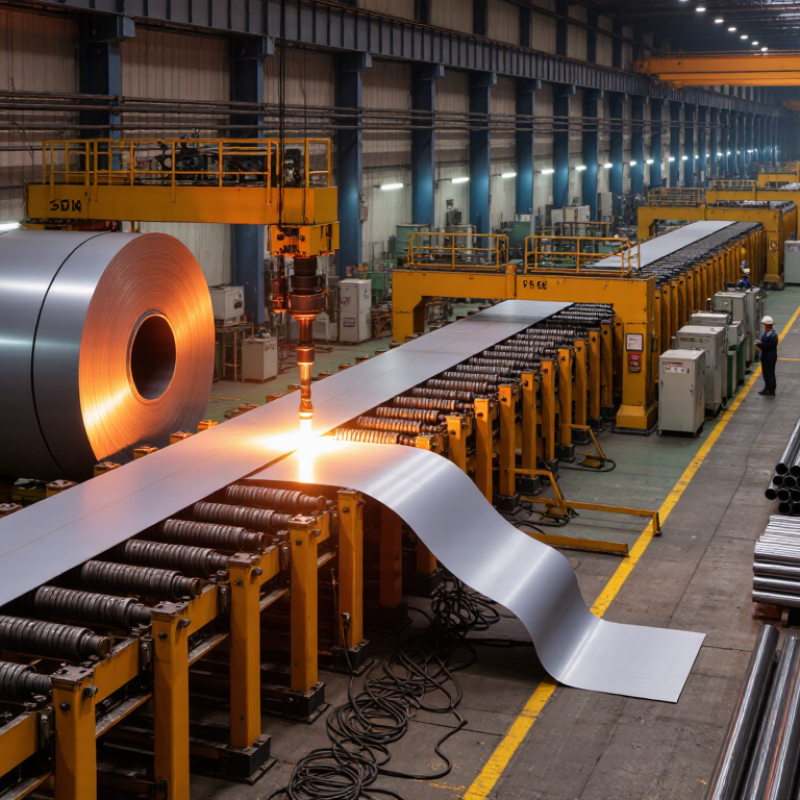
Welded pipe is made by forming flat steel strip or plate into a round shape. The meeting edges are then joined by heat, pressure, or both. Unlike seamless pipe, it contains a longitudinal or spiral weld seam. A simple definition can mislead. The seam is not automatically a weakness; its quality depends on process control, inspection, and service conditions.
The basic structure includes the pipe body, weld zone, heat-affected zone, and finished ends. The body carries pressure and external loads. The weld zone joins the formed edges. Near it, heat can change the steel’s grain structure and hardness. Experienced inspectors check alignment, wall thickness, surface defects, and weld continuity. Ultrasonic or radiographic testing may reveal flaws hidden beneath the surface. Dimensional tolerances should also follow the selected specification, such as ISO 3183 or ASME B36.10M. The World Steel Association reported 1.89 billion tonnes of global crude steel production in 2023, showing the scale of the material supply behind modern pipe manufacturing.
Tips: Match the pipe grade, wall thickness, and weld process to the fluid, pressure, temperature, and installation environment. Measure the outside diameter at several points. One reading is not enough. In practice, the textbook circle is rarely perfect, and that deserves checking before installation. Be careful with assumptions.
What Is Welded Pipe?
Welded pipe begins as a flat steel strip or plate, not a finished tube. The material is uncoiled, leveled, and cut to a controlled width. Rollers then curve it into a round, square, or rectangular shape. The edges meet along one seam.
The mill joins that seam through electric resistance welding, high-frequency welding, or submerged arc welding. Each method suits different wall thicknesses and pipe sizes. During forming, sensors monitor temperature, pressure, alignment, and weld current. A small edge mismatch can create an incomplete joint. It may look harmless, but later testing can expose it.
After welding, the pipe may pass through sizing rolls and straightening equipment. Technicians often inspect the seam with ultrasonic or radiographic testing. Hydrostatic testing can also reveal leaks by filling the pipe with pressurized water. Requirements vary by service, so standards such as ASTM A53 and ISO 3183 help define dimensions and performance.
Material efficiency matters during production. The World Steel Association reported 1.89 billion metric tonnes of crude steel production in 2023. The scale is enormous. The International Energy Agency estimates that steelmaking creates about 7% to 9% of global energy-related carbon dioxide emissions. Better yield, lower scrap, and precise welding therefore affect both cost and environmental impact. The process is highly controlled, but not perfectly predictable. Real manufacturing still depends on careful operators, repeatable equipment, and honest inspection records.
| Manufacturing Stage | What Happens | Common Method or Equipment | Typical Quality Checks |
|---|---|---|---|
| 1. Material selection | Flat steel strip, coil, or plate is selected according to the required pipe grade, dimensions, and service conditions. | Carbon steel, stainless steel, and other specified steel grades may be used. | Material identification, chemical composition, mechanical properties, and surface condition are checked against the purchase specification. |
| 2. Slitting or plate preparation | Coil is slit to the required width, or plate edges are prepared for forming and welding. | Slitting lines, levellers, edge milling, or edge bevelling, depending on the product and process. | Width, thickness, edge condition, flatness, and material traceability are verified. |
| 3. Forming | The flat material is shaped into a cylindrical or near-cylindrical form so its edges meet along a longitudinal seam or a spiral seam. | Roll-forming stands are commonly used for strip and coil. Large-diameter pipe may be formed from plate using press or roll-forming methods. | Formed diameter, roundness, edge alignment, and fit-up are monitored. |
| 4. Seam welding | The adjoining edges are joined to create the pipe wall. The weld seam runs along the pipe or follows a spiral path, depending on the manufacturing route. | Electric resistance welding (ERW) uses electrical heat and pressure to join edges. Submerged arc welding (SAW) uses an arc beneath a layer of granular flux and may be applied to the inside, outside, or both sides of a seam. | Welding parameters and seam condition are controlled. Inspection may include visual examination and specified non-destructive testing. |
| 5. Sizing and straightening | The welded pipe is brought closer to its required outside diameter, shape, and straightness. | Sizing rolls, straightening equipment, and, where specified, expansion processes. | Outside diameter, ovality, wall thickness, and straightness are measured against the applicable specification. |
| 6. Seam treatment and heat treatment | Weld reinforcement may be trimmed or conditioned. Heat treatment may be used when required by the product specification or manufacturing process. | Mechanical trimming or grinding; controlled heat-treatment equipment where specified. | Seam profile, surface condition, and required heat-treatment records or properties are checked. |
| 7. Cutting and end finishing | Pipe is cut to ordered lengths, and the ends are prepared for handling or connection. | Saw or thermal cutting; end facing or beveling when required. | Length, end squareness, bevel dimensions, and end condition are inspected. |
| 8. Final inspection and protection | Finished pipe is inspected, identified, and protected for storage and transport. | Inspection and testing are selected according to the applicable product standard, order, and service requirements. | Checks may include visual inspection, dimensional measurement, weld examination, hydrostatic testing, marking, and coating inspection when specified. |
Welded pipe is made by forming flat steel into a pipe shape and joining the meeting edges with a weld. Available diameters, wall thicknesses, weld processes, tolerances, and inspection requirements vary by material, manufacturing route, product standard, and order specification.
Welded pipe begins as steel strip or plate shaped into a cylinder. Its edges meet, then heat or pressure creates a continuous seam. Compared with seamless pipe, welded pipe offers flexible sizing and efficient production. The seam remains important, though. Its quality can influence strength, corrosion resistance, and service life.
Electric resistance welded pipe, or ERW pipe, is common for water lines, structural supports, and moderate-pressure service. High-frequency welded pipe uses concentrated electrical energy to heat the edges quickly. Longitudinal submerged arc welded pipe, often called LSAW, starts from a wide plate. It suits larger diameters and thicker walls. Spiral Welded Pipe forms from a coil along a helical seam. This method can produce long, large-diameter sections for water, piles, and low-pressure transport. Double submerged arc welding can weld the seam from both sides.Better, but not perfect.
Material creates another useful distinction. Carbon steel welded pipe is practical and economical for many general systems. Stainless steel welded pipe resists moisture and chemical attack more effectively. Galvanized welded pipe adds a zinc coating for improved atmospheric protection. Selection depends on pressure, temperature, fluid chemistry, diameter, and installation conditions. In real inspections, technicians check wall thickness, ovality, weld appearance, and nondestructive test records. Hydrostatic testing can reveal weaknesses that visual inspection misses. Standards help, but careless handling can still damage a sound pipe. The right choice requires evidence, not only a familiar label.
What Is Welded Pipe?
Materials and Welding Methods Used
Welded pipe is formed from steel plate or strip, shaped into a tube, and joined along a seam. The material choice depends on pressure, temperature, corrosion, and installation conditions. Carbon steel is common for structural and fluid service. Stainless steel performs better where moisture or chemicals may cause corrosion. Alloy steel can retain strength under higher temperatures.
The welding method changes the pipe’s performance. Electric resistance welding uses heat from electrical resistance and pressure. It suits many smaller and medium-diameter pipes made from consistent strip. Submerged arc welding uses a granular flux to protect the arc and weld pool. It is useful for larger pipe sizes and deeper weld penetration. Spiral welding forms the pipe continuously from a coiled strip, while longitudinal welding follows a straight seam.
The seam matters.
In practical fabrication, clean edge preparation is critical. Uneven edges can create incomplete fusion, while excessive heat may enlarge the heat-affected zone. A polished weld is not automatically a strong weld. Operators may use visual checks, ultrasonic testing, radiography, or hydrostatic testing, depending on the service requirements. Wall thickness, ovality, and weld alignment also require measurement after forming.
No method wins every time. A welding process that works well for dry indoor service may be unsuitable for corrosive fluid lines. Even material certificates need careful review, because traceability can be weakened during cutting and storage. Good pipe selection connects the material, welding process, inspection plan, and actual working environment.
Welded pipe is formed from steel plate or strip, then joined along a longitudinal or spiral seam. It serves water systems, structural supports, process lines, and many oil and gas applications. Its broad use reflects practical economics. The World Steel Association reported about 1.89 billion tonnes of crude steel production in 2023. This massive supply supports efficient pipe manufacturing and stable material availability.
Welded pipe offers consistent dimensions, flexible diameters, and lower production costs than many seamless alternatives. Large spiral-welded sections can move substantial water volumes through treatment plants and municipal networks.
However, the weld remains a critical inspection zone. Heat can create residual stress, slight distortion, or local changes in toughness. Modern ultrasonic and radiographic testing reduce these risks, but they do not remove them. A clean surface can still hide a poor internal condition. That is an uncomfortable but important field lesson.
Tips: Match the pipe to pressure, temperature, fluid chemistry, and installation loads. Check the specified standard, wall thickness, weld-test records, and corrosion allowance. For sour, highly corrosive, or severe high-pressure service, request engineering verification before selection. A cheaper pipe may become expensive after premature repairs. Welded pipe is not automatically inferior, but assuming it fits every duty is careless.
We use cookies on our website to give you an improved browser experience. View our Privacy Policy for more information. Please make your selection to opt in or out of ALL cookies here: Accept or Decline
Do you consent to the use of ALL cookies?
901 2nd Court West
Birmingham, AL 35204
Sales: 866.481.4036
Logistics/Ops: 866.481.4036
2101 Dralle Road
University Park, IL 60466
Sales: 708.813.9070
Logistics/Ops: 708.235.4200
400 E. 13th Street
Little Rock, AR 72114
Sales: 866.760.5344
Logistics/Ops: 866.760.5344
225 Collins Road
Elkhart, IN 46515
Sales: 574.295.0214
Logistics/Ops: 574.607.4611
601 Berryman Pike
Tipton, IN 46072
Sales: 800.897.7591
Logistics/Ops: 800.897.7591
3900 Uvalda Street
Denver, CO 80239
Sales: 303.706.8000
Ops/Logistics: 303.576.8398
510 3rd Street E
Milan, IL 61264
Sales: 800.322.1052
Logistics/Ops: 800.322.1052
1660 E. Aurora
Des Moines, IA 50313
Sales: 800.671.1660
Logistics: 800.671.1660
86554 Gene Lasserre Blvd.
Yulee, FL 32097
Sales: 904.253.3060
Logistics/Ops: 904.225.3000
694 S.E. County Road 245
Lake City, FL 32025
Sales: 800.727.6706
Logistics/Ops: 386.752.7412
210 Neptune Road
Auburndale, FL 33823
Sales: 863.967.1131
Logistics/Ops: 863.777.9814
4601 McCoy Drive
Pensacola, FL 32503
Sales: 850.308.7030
Logistics/Ops: 850.434.5502
815 South 56th Street
Tampa, FL 33619
Sales: 813.302.1940
Logistics/Ops: 813.621.1352
200 Hosea Road
Lawrenceville, GA 30046
Sales: 770.953.7575
Logistics/Ops: 770.513.6000
Branch Product Guide
Branch Line Card
Moulding Offering
Cedar Offering
Column Offering
8173 Hwy. 165 North
Monroe, LA 71211
Sales: 800.256.4165
Logistics/Ops: 800.256.4165
508 Warren Avenue
Portland, ME 04103
Sales: 207.888.2331
Logistics/Ops: 207.797.6565
4300 Georgia Pacific Blvd.
Frederick, MD 21704
Sales: 301.798.7474
Logistics/Ops: 301.874.8000
419 Maple Street
Bellingham, MA 02019
Sales: 508.449.0535
Logistics/Ops: 508.966.5500
825 Buchanan Ave SW
Grand Rapids, MI 49507
Sales: 877.800.1180
Logistics/Ops: 616.278.0909
995 Pacific St. NW
Aitkin, MN 56431
Sales: 800.432.3727
Logistics/Ops: 218.212.7770
1102 Port Terminal Drive
Duluth, MN 55802
Sales: 800.951.9899
Logistics/Ops: 800.851.9899
9110 83rd Ave. North
Brooklyn Park, MN 55445
Sales: 763.425.0204
Logistics/Ops: 763.425.0204
910 E. Railroad Street
Long Beach, MS 39560
Sales: 866.535.4135
Logistics/Ops: 228.205.2400
1727 Warren Street
North Kansas City, MO 64116
Sales: 800.621.2611
Logistics/Ops: 800.621.2611
2123 North Golden
Springfield, MO 65803
Sales: 800.375.7891
Logistics/Ops: 800.375.7891
13860 Corp. Woods Trail
Bridgeton, MO 63044
Sales: 314.209.0800
Logistics/Ops: 314.209.0800
1109 South 19th Street
Omaha, NE 68108
Sales: 800.489.6637
Logistics/Ops: 800.489.6637
1 Luger Road
Denville, NJ 07834
Sales: 973-339-3539
Logistics/Ops: 973.625.1461
3720 Jeffrey Blvd.
Blasdell, NY 14219
Sales: 716.235.5989
Logistics/Ops: 716.825.6557
319 Yaphank Ave.
Yaphank, NY 11980
Sales: 631.358.5714
Logistics/Ops: 631.924.7401
3300 Parkside Drive
Charlotte, NC 28208
Sales: 800.839.2588
Logistics/Ops: 704.394.3172
1712 East D Street
Butner, NC 27509
Sales: 984.389.8200
Logistics/Ops: 919.575.3700
128 Foothills Drive
Statesville, NC 28687
Sales: 800.222.1414
Logistics/Ops: 704.394.3172
550 Munroe Falls Rd.
Tallmadge, OH 44278
Sales: 330.357.4506
Logistics/Ops: 330.794.1141
10347 Toebben Dr.
Independence, KY 41051
Sales: 859.298.3926
Logistics/Ops: 859.746.2250
450 N. MacArthur
Oklahoma City, OK 73127
Sales: 800.375.6025
Logistics/Ops: 800.375.6025
1680 North Aspen
Broken Arrow, OK 74012
Sales: 918.272.2212
Logistics/Ops: 918.272.2212
522 Bridge Street
Hunker, PA 15639
Sales: 878.217.2001
Logistics/Ops: 724.925.7285
4290 Atlanta Street
Charleston, SC 29418
Sales: 843.371.1420
Logistics/Ops: 843.554.8192
1040 S. Industrial Dr.
Erwin, TN 37650
Sales: 423.641.1005
Logistics/Ops: 423.742.5911
4287 Pilot Drive
Memphis, TN 38118
Sales: 901.365.2101
Logistics/Ops: 901.365.2101
700 Myatt Drive
Madison, TN 37115
Sales: 615.327.9547
Logistics/Ops: 629.777.4949
4747 Mark IV Parkway
Fort Worth, TX 76106
Sales: 866.323.5117
Logistics/Ops: 817.625.9091
6990 Market Avenue
El Paso, TX 79915
Sales: 915.778.6356
Logistics/Ops: 915.265.7200
2502 Wilson Road
Harlingen, TX 78552
Sales: 800.580.6711
Logistics/Ops: 800.580.6711
10,000 North Loop East
Houston, TX 77029
Sales: 713.921.1977
Logistics/Ops: 713.675.3544
702 East 44th St.
Lubbock, TX 79404
Sales: 866.454.6010
Logistics/Ops: 866.454.6010
535 N. WW White Road
San Antonio, TX 78219
Sales: 800.284.0488
Logistics/Ops: 210.333.8112
142 Pine Haven Shores Rd.
Shelburne, VT 05482
Sales: 802.800.2540
Logistics/Ops: 802.985.2512
4700 Bethlehem Road,
Richmond, VA 23230
Sales: 804.201.2400
Logistics/Ops: 804.342.1161
4516 N Barker Road
Spokane Valley, WA 99027
Phone: 509.892.9420
Toll free: 800.728.6157
8365 N. 76th Street
Milwaukee, WI 53223
Sales: 800.356.9245
Logistics/Ops: 800.356.9245
312 S. Chester Street
Sparta, WI 54656
Sales: 800.362.5864
Logistics/Ops: 800.362.5864
899 Grossman Drive
Schofield, WI 54476
Sales: 800.472.0017
Logistics/Ops: 800.472.0017
