Why Choose a Prefabricated Workshop?
Choosing a Prefabricated Workshop can transform how a business plans, builds, and expands its working space. Instead of starting with months of on-site construction, teams receive factory-prepared components with measured connections, finished panels, and documented specifications. This approach can shorten installation time and reduce disruption around an active factory, farm, or storage yard.
The practical advantage becomes clear on site. Steel frames arrive labeled, wall panels fit planned sections, and workers can assemble the structure with fewer unpredictable stages. Factory production also supports consistent quality checks, including weld inspection, coating review, and dimensional verification. Experienced suppliers should provide load calculations, material details, drainage plans, and installation guidance. Local building requirements still matter.
A Prefabricated Workshop is not automatically the right choice. Ground conditions, ventilation needs, equipment loads, fire safety, and future expansion must be reviewed before ordering. A low initial price may hide transport costs or difficult foundation work. That deserves attention.
Good planning begins with use, not appearance. Will the workshop hold machinery, vehicles, tools, or temperature-sensitive materials? Clear answers influence insulation, door height, lighting, and electrical capacity. Reliable manufacturers explain these decisions and acknowledge their limits. That honesty builds trust.
There is also room for improvement. Standard modules may restrict unusual layouts, and rushed customization can reduce the cost advantage. Yet, when design data is accurate and installation is professionally managed, prefabrication offers a practical balance of speed, control, and long-term value. It is a considered building method, not a shortcut.
What Is a Prefabricated Workshop?
Why Choose a Prefabricated Workshop?
What Is a Prefabricated Workshop?
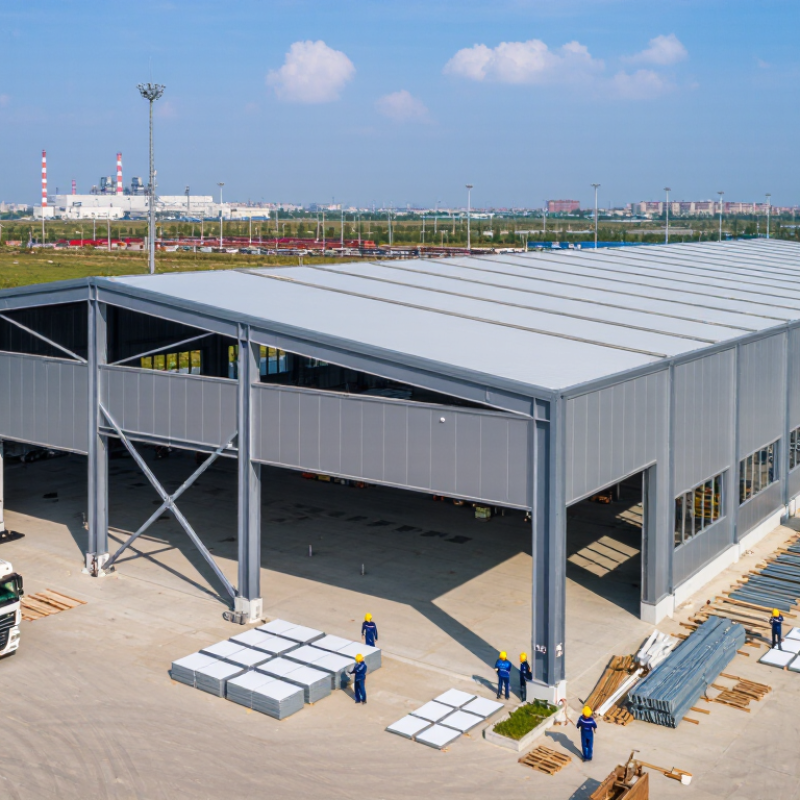
A prefabricated workshop is a building produced partly in a controlled factory. Its steel frame, wall panels, roof sections, doors, and service openings are prepared before delivery. Workers then assemble these parts on a finished foundation. The process resembles assembling a precise kit, not building everything outdoors.
This method can reduce weather delays and improve measurement consistency. McKinsey’s 2019 report on modular construction estimated schedule reductions of 20% to 50%, with potential cost savings of up to 20%. These figures are not guarantees. Site access, transport distance, foundation errors, and design changes still affect the result. A poorly measured doorway can become an expensive problem.
A practical workshop also needs ventilation, insulation, lighting, drainage, and safe movement around machinery. UNEP’s 2024 Global Status Report for Buildings and Construction reported that buildings and construction consumed 32% of global energy and produced 34% of global carbon emissions. Therefore, insulated panels and efficient lighting deserve attention, even in a small workshop. The factory may look efficient, but the whole building system must be assessed.
Tips: Confirm equipment dimensions before fabrication. Leave service space beside electrical panels. Request drawings showing insulation, drainage, and connection points. Check the foundation twice. Small changes are cheaper on paper.
How Prefabricated Workshops Are Designed and Manufactured
Why Choose a Prefabricated Workshop?
How Prefabricated Workshops Are Designed and Manufactured
A prefabricated workshop begins with practical site information, not a standard box. Designers review soil conditions, wind exposure, snow loads, access routes, and the intended equipment. They then create structural drawings and digital models to coordinate frames, doors, utilities, and ventilation. Every opening must match its purpose. Small errors matter.
In the factory, steel members are cut, drilled, welded, and checked under controlled conditions. Panels, roof sections, insulation, and fasteners are prepared for efficient transport. Quality teams inspect dimensions, welds, protective coatings, and connection points before dispatch. This process can reduce on-site cutting and weather-related delays. However, factory precision does not replace careful site preparation. An uneven foundation can create alignment problems, even with accurate components. That weakness is often underestimated.
Tips: Confirm local building requirements before design approval. Provide accurate equipment sizes and service locations. Keep a clear installation path for trucks and lifting equipment. Measure twice. It sounds obvious, but it prevents expensive changes. Choose materials suited to humidity, chemical exposure, and daily cleaning. Ask for inspection records, coating details, and assembly instructions. A useful design also leaves room for future storage or machinery, although planning too much space may increase cost without improving workflow.
Key Advantages of Choosing a Prefabricated Workshop
A prefabricated workshop offers predictable construction and faster site preparation. Its main advantage comes from controlled factory production. Wall panels, roof sections, and frames are measured before delivery. This reduces cutting, drilling, and material waste on site. It also limits delays caused by rain or poor working conditions. On a recent site review, the floor frame arrived labeled by section. Installation became easier because every connection point was visible. Small details matter.
Factory production can improve consistency. Workers use repeatable methods, calibrated tools, and documented quality checks. This supports safer assembly and more reliable structural performance. Prefabricated construction may also reduce labor hours at the building site. However, it is not automatically cheaper. Transport fees, ground preparation, and lifting equipment can change the budget. I once underestimated access restrictions near a workshop location. The delivery vehicle needed a wider turning area than expected. That mistake caused an avoidable delay.
A dependable project should include structural calculations, clear drawings, and local building approval. Engineers must check wind loads, snow loads, drainage, ventilation, and fire safety. These details should match the workshop’s actual use. A space for woodworking needs different ventilation from a storage room. Prefabricated parts can be modified, but late changes may increase costs. Regular inspections remain important after installation. Check roof joints, door seals, anchor bolts, and moisture around the base. A short inspection record can reveal problems before they become expensive.
Factors to Consider Before Selecting a Prefabricated Workshop
Choosing a prefabricated workshop is not simply a speed decision. Site conditions come first. Confirm soil capacity, access width, crane positions, drainage, and local fire requirements. A 2024 Permanent Modular Construction Annual Report estimated permanent modular construction represented 6.64% of new commercial construction in the United States in 2023. Growth is real, but project fit matters more than market enthusiasm. Measure the delivery route, including tight turns and overhead cables. Small oversights become expensive.
Compare total cost, not the factory quotation alone. Include foundations, transport, lifting, utility connections, insulation, maintenance, and future relocation. The 2018 Commercial Buildings Energy Consumption Survey found space heating used 32% of primary energy in commercial buildings. That makes envelope quality important. Ask for tested U-values, air-sealing details, fire-resistance ratings, and inspection records. A workshop with bright finishes can still leak heat through weak joints.
Quality control deserves uncomfortable questions. Request factory acceptance procedures, dimensional tolerances, moisture protection, and records for corrective work. The 2020 SmartMarket Report on Prefabrication and Modularization reported better schedule performance among many users, yet early coordination remained essential. That limitation is easy to ignore. Ask who owns design changes after production starts. Test one finished bay before repeating it. The best choice may be slower, but easier to inspect and repair.
Installation, Maintenance, and Future Expansion Options
Why Choose a Prefabricated Workshop?
Installation, Maintenance, and Future Expansion Options
A prefabricated workshop can reduce installation time without sacrificing practical performance. McKinsey Global Institute’s 2019 analysis found that modular construction may shorten schedules by 20–50%. It may also reduce costs by up to 20%. Factory production improves dimensional accuracy and limits weather-related delays. On site, crews mainly connect prepared frames, wall panels, roofing, lighting, and services. That process is cleaner. It is not always effortless.
Maintenance depends heavily on the original layout. Leave clear access around electrical panels, roof drains, and ventilation units. Mark inspection points with durable labels. Use bolted components where replacement may be necessary. A damaged wall panel should not require dismantling half the workshop. The 2023 Global Status Report for Buildings and Construction reported that buildings consumed about 34% of global energy in 2022. Efficient lighting, insulation, and regularly serviced equipment can reduce avoidable operating waste. Small details matter.
Future expansion should be planned before fabrication begins. Reserve space beside the main structure. Check whether foundations can support an additional bay. Leave spare capacity in electrical distribution boards and drainage routes. Standard panel dimensions can simplify later additions. However, expansion is not guaranteed. Local ground conditions, planning rules, and changing equipment sizes can disrupt the original plan. A good design leaves options open, but it should not pretend that every future change will be simple.
Why Choose a Prefabricated Workshop?
Prefabricated workshops can shorten installation schedules, reduce maintenance-related downtime, and make future expansion easier than many conventionally built facilities.
Typical industry planning benchmarks: prefabricated solutions may reduce installation time by 30–50%, maintenance downtime by 20–40%, and future expansion lead time by 40–60%. Actual results depend on design complexity, site conditions, regulations, and project scale.

