Why Choose Aluminum Profiles for Sliding Doors?
Choosing Aluminum Profiles For Sliding Doors involves more than selecting a sleek frame. It affects daylight, ventilation, security, maintenance, and long-term operating costs. The U.S. Department of Energy reports that windows can account for 25–30% of residential heating and cooling energy use. Therefore, the frame, glass, seals, and installation must work together.
Dr. Helen Sanders, a building-envelope specialist, explains, “A window is a system, not just a product.” That principle applies directly to sliding doors. A thermally broken aluminum profile can reduce heat transfer through the frame. Multi-chamber designs may also improve insulation and condensation control. Proper rollers and reinforced tracks help a large glass panel move smoothly, even after years of daily use. Small details matter.
Aluminum also offers strong sustainability credentials. The International Aluminium Institute reports that roughly 75% of all aluminum ever produced remains in use today. This reflects aluminum’s durability and established recycling infrastructure. It does not make every product automatically sustainable. Manufacturing energy, coating quality, transport, and end-of-life recovery still deserve careful review.
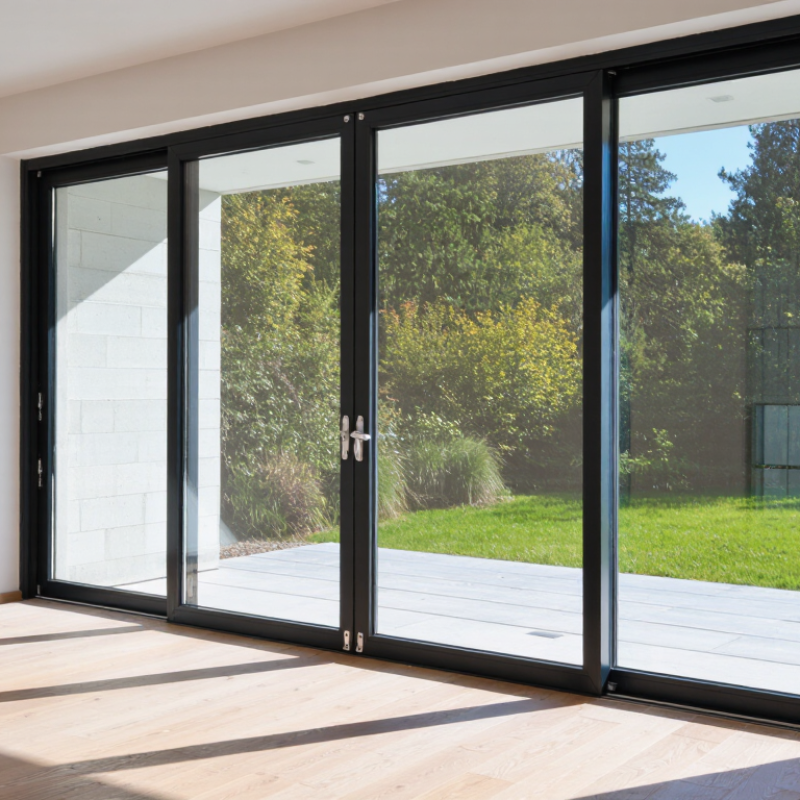
Architects and homeowners often choose aluminum because it combines narrow sightlines with structural strength. A slim black frame can surround a wide glass opening without feeling visually heavy. However, poor installation can cause air leakage, water entry, or difficult operation. The material alone cannot solve those problems. This is where product testing, experienced fabricators, and certified installers become important. The best choice is not simply the thinnest frame. It is a balanced system designed for the building’s climate, opening size, and everyday demands.
Aluminum Profile Basics: 2.7 g/cm³ Density and 150–220 W/m·K Conductivity
Why Choose Aluminum Profiles for Sliding Doors?
Aluminum profiles suit sliding doors because they combine low weight with useful structural strength. At about 2.7 g/cm³, aluminum is much lighter than steel. This reduces the load on rollers, tracks, and supporting walls during installation. In practice, a lighter frame can make large door panels easier to move and adjust. The difference is noticeable when a panel spans a wide opening.
Thermal behavior needs closer attention. Aluminum typically conducts heat at 150–220 W/m·K, depending on its alloy and temper. This high conductivity helps spread heat quickly through the frame, but it can also create a thermal bridge between indoors and outdoors. Thermal breaks, insulated chambers, accurate seals, and suitable glazing can reduce that weakness. A profile alone cannot deliver good insulation. That is easy to overlook. On a cold morning, a poorly designed frame may feel cool even when the glass performs well. Installation quality matters just as much. Misaligned rollers increase friction, while small gaps invite drafts and moisture. Experienced fabricators check tolerances, drainage paths, and gasket compression before final adjustment. Still, performance varies between projects. Local climate, panel size, alloy selection, and maintenance habits all influence results. Aluminum is practical, but it is not automatically perfect.
How Slim Aluminum Frames Maximize Glass Area and Sliding Door Daylight
Why Choose Aluminum Profiles for Sliding Doors?
A sliding door feels more open when its frame occupies less visual space. Slim aluminum profiles create wider glass panels, improving sightlines and bringing deeper daylight into living areas. Research summarized by Lawrence Berkeley National Laboratory indicates that effective daylighting can reduce lighting electricity use by about 20% to 60%, depending on climate, controls, and occupancy. The result is practical: a bright floor, softer shadows, and fewer hours under artificial lights.
Aluminum also provides the stiffness needed for large sliding panels without bulky sightlines. In real installations, this helps preserve a clean glass-to-frame ratio while supporting smooth movement and stable alignment. However, slim does not automatically mean efficient. The U.S. Department of Energy reports that windows can represent around 25% to 30% of residential heating and cooling energy use. Thermal breaks, low-emissivity glazing, insulated spacers, and suitable solar-control glass therefore matter as much as profile width.
There is a trade-off.
A narrow frame may expose poor engineering. Large panels can increase weight, air leakage, and hardware stress if the system is not correctly specified. NFRC performance ratings offer useful checks for U-factor, solar heat gain, and visible transmittance. On site, careful drainage, seals, and track installation are equally important. A beautiful glass opening can still disappoint when condensation appears beside the handle or daylight arrives with unwanted summer heat.
Why Choose Aluminum Profiles for Sliding Doors? - How Slim Aluminum Frames Maximize Glass Area and Sliding Door Daylight
| Performance Dimension | Conventional Sliding Door Example | Slim Aluminum Frame Example | Effect on Glass Area and Daylight |
| Reference opening size | 2,400 mm × 2,100 mm | 2,400 mm × 2,100 mm | The same structural opening is used for a direct comparison. |
| Approximate visible frame width | 100 mm outer sightline and approximately 100 mm central meeting stile | 45 mm outer sightline and approximately 35 mm central meeting stile | Narrower profiles leave more of the opening visually unobstructed. |
| Estimated visible glass area | Approximately 4.18 m² | Approximately 4.58 m² | The slim-frame example provides about 0.40 m² more glazing in the same opening. |
| Estimated glass-to-opening ratio | Approximately 83.0% | Approximately 90.8% | The slim design increases the glass proportion by approximately 7.8 percentage points. |
| Potential daylight improvement | Baseline: 100% | Approximately 9.7% more glazing area than the conventional example | With the same glass type and visible transmittance, the larger glazed area can transmit proportionally more daylight. |
| Material density | Aluminum: approximately 2.70 g/cm³ | Aluminum: approximately 2.70 g/cm³ | Aluminum provides a relatively low-density metal option for strong, narrow frame sections. |
| Profile stiffness benefit | Wider profiles may be used to control deflection around large glass panels. | Aluminum profiles can use hollow sections, ribs, and reinforced chambers to improve stiffness without making the visible face excessively wide. | The structural section can remain strong while the sightline stays visually slim. |
| Thermal design consideration | Uninsulated metal can conduct heat rapidly. | Thermally broken aluminum profiles use a low-conductivity polyamide isolator between the interior and exterior aluminum sections. | Thermal breaks help reduce heat transfer while preserving the slim visual appearance. |
| Design outcome | More visible framing and a stronger visual division between interior and exterior spaces. | Slimmer sightlines, broader views, and a higher proportion of transparent glazing. | A larger uninterrupted glass surface can make rooms feel brighter, more open, and more visually connected to the outdoors. |
Calculation note: The glass-area figures are simplified estimates based on the stated opening dimensions and visible frame widths. Actual results depend on the sliding-door system, panel overlap, track design, glazing thickness, drainage requirements, hardware, and structural calculations.
Thermal Performance: Insulated Profiles Can Reduce Heat Transfer by 30–50%
Why Choose Aluminum Profiles for Sliding Doors?
Thermal performance is a practical reason to choose aluminum sliding door profiles. Standard aluminum conducts heat quickly, creating a colder interior frame during winter. Insulated profiles interrupt this path with a thermal break, often made from low-conductivity polymer sections. In suitable systems, this design can reduce frame-related heat transfer by 30–50% compared with non-insulated profiles. The exact result depends on profile geometry, glazing, seals, and installation quality.
The U.S. Department of Energy reports that windows can account for 25–30% of household heating and cooling energy use. A thermally improved sliding door can therefore support lower indoor temperature swings. Near the frame, occupants may feel less cold radiation. Condensation risk can also decrease when interior surface temperatures remain higher. Small details matter here. A poorly fitted gasket can undermine an expensive profile.
The International Energy Agency states that buildings consume about 30% of global final energy. Better envelope components have a measurable role in reducing this demand. However, the 30–50% figure is not universal. It usually reflects tested comparisons, not every project in the field. This qualification matters. Specifiers should request U-value data from recognized testing procedures and review the complete door assembly. Aluminum still needs thoughtful design. Thermal breaks alone cannot fix weak glazing, air leakage, or an installation gap around the frame.
Durability Standards: EN 12207 Air Permeability and EN 12208 Watertightness
Why Choose Aluminum Profiles for Sliding Doors?
Aluminum profiles provide slim, rigid frames for large sliding door panels. Their strength helps maintain smooth movement during daily use. The material also resists corrosion when properly finished and maintained. However, profile quality alone cannot guarantee a weatherproof door.
EN 12207 evaluates air permeability under controlled pressure differences. It classifies how much air passes through the complete door assembly. EN 12208 measures watertightness during simulated wind-driven rain. Sliding doors need careful testing because tracks, rollers, gaskets, and corner joints can create leakage paths. These standards assess the finished product, not only the aluminum profile. On site, poor installation can reduce laboratory performance. Small gaps matter.
Tips: Ask for test reports covering the complete door system. Check the declared EN 12207 and EN 12208 classes. Inspect drainage channels and track seals before installation. Keep the lower track free from dust and leaves. In real projects, assumptions can fail. A strong frame may still leak if the sill is uneven or the seals are compressed incorrectly. Choose designs with thermal breaks where indoor comfort matters. Review local exposure, building height, and rainfall before selecting performance levels. A practical inspection should include opening cycles, seal contact, and visible water drainage.
Sustainability Data: Recycling Aluminum Uses About 95% Less Energy Than Primary Metal
Why Choose Aluminum Profiles for Sliding Doors?
Aluminum profiles suit sliding doors because they are light, strong, and resistant to moisture. Their slim frames can create wider glass openings without feeling heavy. In daily use, this means smoother movement and fewer bulky visual barriers. The environmental case is also important. Recycling aluminum uses about 95% less energy than producing primary aluminum, according to widely cited industry estimates. Recycled metal can return to production repeatedly without losing its essential properties.
That saving depends on real sourcing. A profile made with recycled aluminum may still involve transport, melting, coatings, and fabrication impacts. The 95% figure is not a magic guarantee. It varies by electricity supply, recycling systems, and production methods. This is where professional checks matter. Ask for recycled-content data, lifecycle information, or an environmental product declaration when available. Good documentation is more dependable than a green label alone.
Tips: Choose durable profiles with replaceable hardware and suitable thermal breaks. Confirm that the sliding track drains water properly. Measure twice. A poorly aligned door can waste materials and energy through air leakage. I have seen attractive systems fail because installation received less attention than the frame design. That is a useful reminder: sustainability includes long service life, repairability, and careful workmanship, not only recycled content.

